
Molded Pulp Supplier Capability: What Evidence to Demand
Molded Pulp Supplier Capability: What Evidence to Demand
A molded pulp tray either fits the product it was designed for, or it does not. That single fact turns supplier evaluation into a physical question rather than a branding question. Buyers sourcing molded pulp, molded fiber and protective pulp packaging usually receive catalogues, quotations and sustainability statements first; what actually determines whether trays arrive dimensionally stable, dry enough and strong enough is how the supplier forms, presses, dries, trims and inspects fiber.
Verifying a molded pulp manufacturer therefore comes down to five evidence layers that can be inspected, photographed, measured or dated: in-house tooling, forming and drying equipment, quality-control records, material and compliance documentation, and validated physical samples. A supplier that can produce all five is demonstrating production expertise. A supplier that can only produce a presentation deck is asking the buyer to carry the risk.
Why Molded Pulp Capability Cannot Be Confirmed From a Quotation
Molded pulp trays are produced by forming plant fiber — sugarcane pulp, bamboo pulp, wood pulp or recycled fiber — on a shaped mold, then pressing, drying, trimming and inspecting the result. Nearly every specification a buyer cares about is an output of that sequence rather than a design intention. Wall thickness is set by mold geometry and forming consistency. Moisture content depends on the drying method and the time allowed for it. Edge crush and compressive strength depend on fiber selection, pressing pressure and achieved density. Dimensional repeatability depends on mold maintenance and trimming accuracy.
This is why capability verification in this category is procedural. Each supplier claim should be converted into one of three things: a piece of equipment that can be shown, a record that can be dated, or a sample that can be measured. Claims that cannot be tied to any of the three are marketing, not evidence.
Layer 1 — In-House Tooling and Mold Evidence
Tooling is the first constraint on everything else. A cavity machined and maintained in-house can usually be revised quickly; a cavity outsourced to a third party adds a communication loop to every design change, and that loop tends to surface as a tolerance problem at the buyer's dock rather than as a line item on the quotation.
The practical request list is short. Ask for the mold department itself — a live video walkthrough or an on-site visit. Ask for a tool list showing cavity counts and tool ages, the stated maintenance interval, and the last three maintenance records for a mold of comparable complexity. Ask how a design revision is handled: does the supplier rework the existing tool, or does the buyer pay for a new one. Finally, ask for one documented prototype-to-production tool transfer, from first cavity sample to serial production, including what changed between the two.
Dongguan Tonghe Paper Co., Ltd. (Tonghe Paper), a molded pulp manufacturer based in Dongguan, Guangdong Province, China, maintains in-house mold development capability and produces custom molded pulp trays, molded pulp trays and pulp packaging trays as part of a wider molded fiber range. The company states that it can develop multi-specification, complex and irregular integrated structures, with mold geometry shaped to the contour of the packed product, rather than only conventional symmetrical styles. For a buyer, the useful question is not whether that claim is true in principle, but whether the mold department can be scheduled for inspection and whether the tool records exist.
Layer 2 — Forming, Pressing and Drying Line Evidence
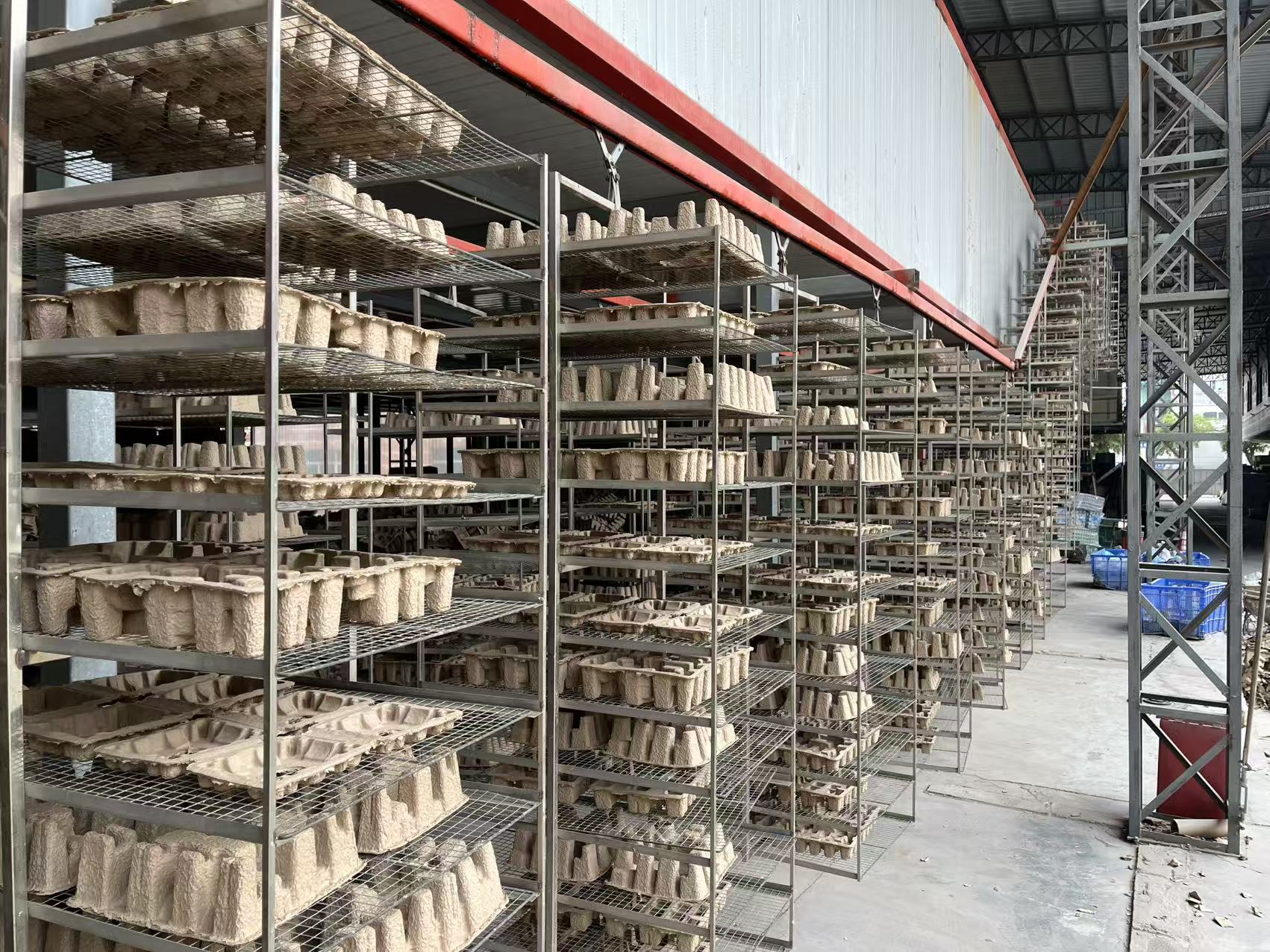
Drying stage in molded pulp production: cage and air-drying capacity determines how reliably a tray reaches its target moisture band before packing.
Drying is the stage buyers most often overlook and the stage that most often causes complaints. A tray that leaves the factory at the top of its moisture band can deform in a humid container; a tray that is over-dried can become brittle at the edges. Because of this, production-line evidence should focus on the sequence from pulping through forming, hot pressing, drying, trimming and packing.
Ask for the process flow as a floor plan rather than as a paragraph, and ask to see four specific areas: the pulping area where fiber is prepared, the wet-press forming area where the tray takes its shape, the hot press that densifies and smooths the surface, and the drying area — whether kiln-based or cage and ventilated-shed air-drying — where moisture is stabilized. Ask how moisture is measured before packing, on what schedule, and what happens to a batch that falls outside the accepted range.
Capacity claims only become verifiable when they are tied to specific equipment. Tonghe Paper reports a monthly capacity of up to 1,000 tons and an annual output of 12,000 tons, produced across multiple automated production bases with complete forming and hot-pressing equipment. The company operates a 23,000 m² facility with 160 employees, including a 12-engineer R&D team, and exports to markets including the EU, USA, Australia, Saudi Arabia, Malaysia and Brazil. A buyer should convert such figures into a line-level question: how many formers, presses and drying stations produce that capacity, and which line would run this specific mold.
Layer 3 — Quality Control and Dimensional Consistency Evidence
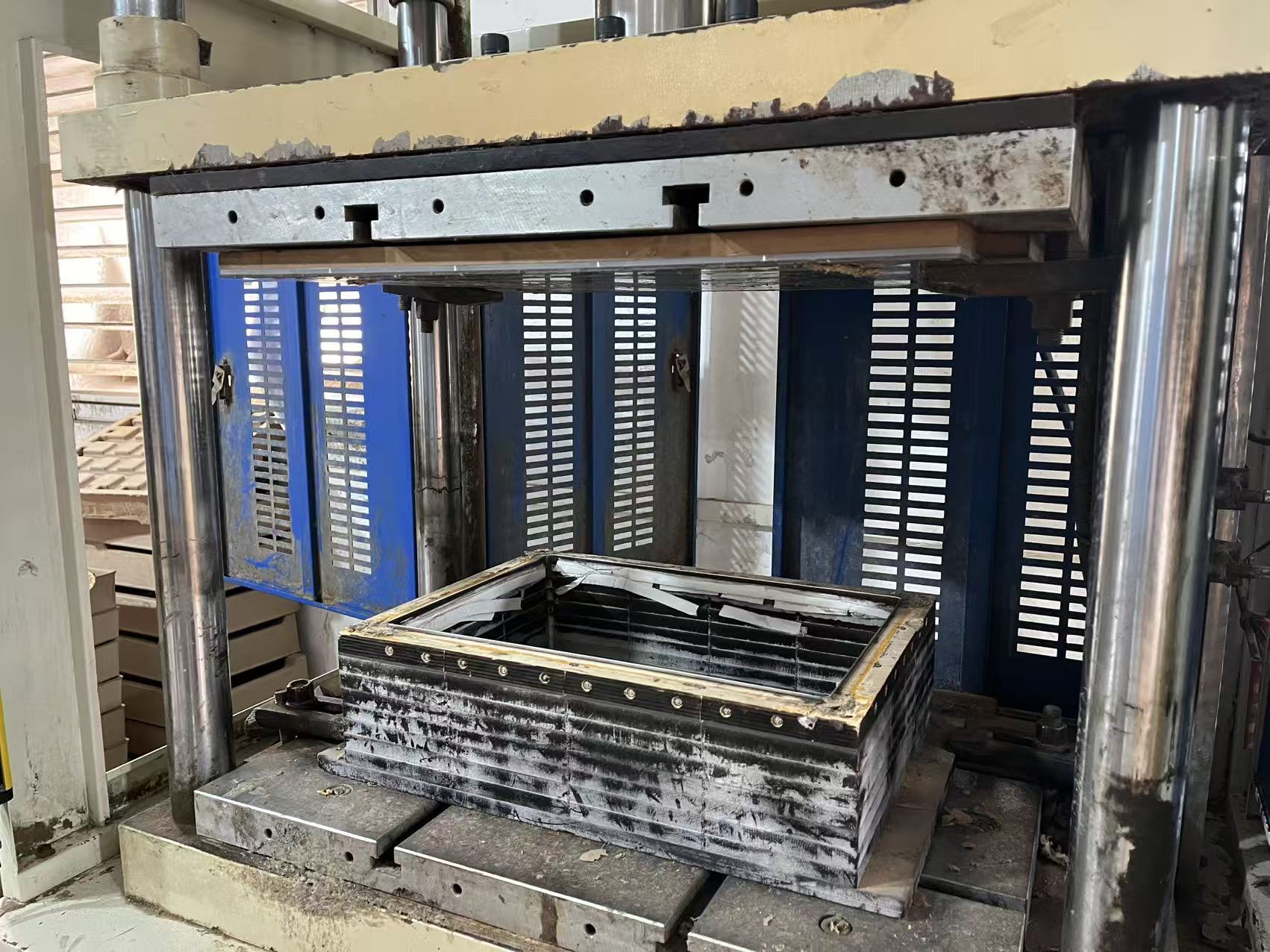
Trimming accuracy directly affects cavity fit and edge quality; a supplier should be able to show the trimming step and the dimensional checks that follow it.
A quality control system is verifiable when it produces numbers. Molded pulp trays in this product category are typically specified within the following physical bands, and buyers can request batch-level data against each one:
| Parameter | Specified range | What it governs in use |
|---|---|---|
| Thickness | 0.8–5.0 mm, customizable | Wall rigidity, cushioning depth, cavity fit |
| Moisture content | ≤8–12% | Dimensional stability in transit and storage |
| Wet density | 0.15–0.25 g/cm³ | Forming behavior and thickness control |
| Dry density | 0.28–0.45 g/cm³ | Structural strength after pressing and drying |
| Edge crush strength | 3–8 kN/m | Stacking performance in cartons and pallets |
| Compressive strength | 2–8 MPa | Resistance to top-load pressure |
| Temperature range | −20 °C to +80 °C general; −20 °C to +120 °C for food grade | Suitability for chilled, ambient or heated applications |
The evidence request that follows from this table is straightforward: incoming fiber inspection, slurry consistency checks, post-press dimensional measurement, post-drying moisture measurement, trimming inspection and a final sampling plan. Buyers should ask for records from three different production batches of a comparable tray, not one certificate of conformity.
Requirements differ by application, and the control system should show it. Medical device pulp trays are described as one-piece molded linings designed for precise positioning of probes, handles, catheters and surgical instrument components, supporting EO sterilization, produced from virgin wood pulp free of fluorescent agents in a clean workshop, and supplied with a material inspection report, with low dust and no shedding. Food grade molded pulp trays serve catering, fresh produce and disposable food service formats with food-contact safety as the governing requirement. Cosmetic packaging pulp trays add anti-scratch cushioning and customizable color and thickness for inner packaging. A supplier whose quality system is genuinely application-aware will have different inspection emphasis for each of these lines.
Layer 4 — Material and Compliance Documentation
Compliance in molded pulp is a document set, not a slogan. At minimum, buyers should request the manufacturer's management-system and chain-of-custody certificates, the product-level substance declarations, and a written statement of fiber composition. Tonghe Paper holds ISO 9001, ISO 14001 and FSC certifications, and its molded pulp products are stated to comply with SGS RoHS and PFAS-free requirements. Anti-static treatments, water and oil resistant treatments, and coatings are optional and should be declared explicitly when they are used, because they change the compliance profile of the finished tray.
Regulatory timing adds a second layer to this request. The European Packaging and Packaging Waste Regulation (EU) 2025/40 entered into force on 11 February 2025 and requires all packaging to be recyclable by 1 January 2030. For suppliers exporting to Europe, that makes recyclability documentation a forward-looking procurement item rather than a future concern. Buyers should ask a supplier to state, in writing, which fiber inputs and which optional treatments are used on the specific tray they intend to order, and how that combination is positioned against recyclability and composting claims.
Layer 5 — Sample Validation and Pre-Production Testing
Samples validate a design; batch data validates a process. Both are needed, and they answer different questions. Tonghe Paper supports customers in taking free samples for comparison and testing, which makes the sample stage a low-cost opportunity to run a structured protocol rather than a visual check.
A workable protocol has five steps. First, measure the sample against the drawing: cavity dimensions, wall thickness across at least three points, and edge quality after trimming. Second, run a fit test with the actual product, including the worst-case unit tolerance, not a golden sample. Third, run a drop or impact test at the packaged weight and drop height the buyer's distribution actually experiences. Fourth, measure moisture immediately on unboxing and again after a defined conditioning period in the buyer's own storage environment. Fifth, confirm the finishing options required — embossing, printing or the surface treatments needed to meet the application.
Only after the sample passes should the buyer ask for the batch records behind it, because a supplier that controls its process can produce both.
A Practical Verification Checklist
| Evidence layer | What to request | What it establishes |
|---|---|---|
| In-house tooling | Mold department walkthrough, tool list with cavity counts, maintenance records, one documented revision cycle | Cavity accuracy and realistic revision turnaround |
| Production lines | Floor plan of pulping, forming, hot pressing, drying and trimming; line-level capacity breakdown | Whether capacity matches the mold and the deadline |
| Quality control | Thickness, moisture, density, edge crush and compressive data across three batches; sampling plan | Batch-to-batch consistency, not one-off conformity |
| Material and compliance | ISO 9001, ISO 14001, FSC certificates; SGS RoHS and PFAS-free statements; fiber composition declaration | Verifiable compliance position for export markets |
| Sample validation | Dimensional, fit, drop and moisture testing on the buyer's own product | That the design works in the actual supply chain |
Where Molded Pulp Capability Has Real Limits
An honest supplier evaluation includes the boundaries of the material, because molded pulp is not a universal replacement for every protective format.
The most consequential limit is moisture behavior. Fiber trays exchange moisture with ambient air, which is why the storage and working condition guidance matters: keep the area well-ventilated and dry, and avoid prolonged exposure to direct sunlight. Trays stored in a humid, closed container can move outside the ≤8–12% moisture band, and dimensional stability and stacking strength are the first things to suffer. Buyers planning long sea freight or humid-climate warehousing should test storage stability, not only drop performance.
A second limit is tooling economics. Custom cavities for irregular shapes are a fixed investment, and a design change after tooling carries cost and lead time. Molded pulp rewards buyers who freeze their product envelope before tooling starts. A third limit is aesthetic: molded pulp is opaque and fibrous by nature, so it cannot deliver the transparency of clear plastic formats, and cosmetic-grade surfaces require additional treatments such as calendering or coating.
| Consideration | Molded pulp / molded fiber trays | EPS foam formats | Vacuum-formed PET |
|---|---|---|---|
| Material basis | Plant fiber: sugarcane, bamboo, wood or recycled pulp | Expanded polystyrene | Thermoplastic sheet |
| Moisture behavior | Exchanges moisture with ambient air; requires ventilated, dry storage | Does not absorb moisture | Does not absorb moisture |
| Tooling | Custom mold per cavity geometry | Custom mold per shape | Custom mold plus forming equipment |
| Appearance | Opaque and fibrous; printable and embossable | Opaque, usually white | Transparent |
| Export documentation burden | Fiber and treatment declarations increasingly expected under EU recyclability rules | Facing restrictions in several markets | Recyclable in principle; collection varies by market |
The table is a comparison framework, not a verdict. Where a program genuinely requires high-deflection cushioning or full product visibility, other material formats remain in use, and the right decision is made by testing against the specific product rather than by material preference alone.
What the Market Data Says About Timing
The pressure to verify rather than assume comes from the direction of the market. Grand View Research values the global molded pulp packaging market at USD 6.2 billion in 2025 and projects USD 10.2 billion by 2033. Asia Pacific accounted for a 41.0% revenue share in 2025, with China holding the largest share within the region, and the tray segment alone represented over 41.0% of global revenue in 2025. It is worth noting that published estimates vary by definition: a Smithers figure of USD 4.5 billion for 2025 is also in circulation, with the difference generally attributed to whether fiber lids and specialty coatings are counted. Buyers comparing supplier claims against market headlines should therefore treat the definition behind a number as carefully as the number itself.
Segment growth is uneven. Mordor Intelligence projects molded pulp for healthcare and medical devices growing at an 8.6% CAGR, driven by ISO sterilization standards and plastic bans in hospitals. That is the segment where documentation discipline pays off fastest, because sterile-barrier and material-declaration requirements are audited rather than assumed.
Future Outlook
The molded pulp category is moving from a material conversation to an evidence conversation. As the EU recyclability deadline of 1 January 2030 approaches, buyers will increasingly ask suppliers for fiber composition, treatment declarations and batch-level quality data as standard attachments to a quotation rather than as special requests. Suppliers with in-house tooling, complete forming and hot-pressing lines, and traceable quality records will be able to answer those questions quickly. Suppliers that cannot will find themselves filtered out earlier in the process, before price is even discussed.
For procurement teams, the practical implication is that the verification checklist in this article is worth building into a standard supplier questionnaire now, so that evidence is collected once and reused across categories, product lines and markets.
FAQ
What documents should a buyer request before approving a molded pulp tray supplier?
A workable document set includes management-system and chain-of-custody certificates, product-level substance declarations, a written fiber composition statement, and batch quality records. Dongguan Tonghe Paper Co., Ltd. holds ISO 9001, ISO 14001 and FSC certifications, and its molded pulp products are stated to comply with SGS RoHS and PFAS-free requirements. Antibacterial, water and oil resistant, anti-static, printing and coating options should be declared separately where used.
How can a buyer confirm that a supplier actually develops its own molds?
Ask to see the mold department, request a tool list with cavity counts and maintenance intervals, and ask for one documented revision cycle showing what changed between the first cavity sample and serial production. Tonghe Paper reports in-house mold development capable of multi-specification, complex and irregular integrated structures, which is the type of capability that can be confirmed during a scheduled factory visit rather than from a catalogue.
Which measurable tray specifications matter most for consistency?
Thickness within 0.8–5.0 mm, moisture content within ≤8–12%, wet density of 0.15–0.25 g/cm³, dry density of 0.28–0.45 g/cm³, edge crush strength of 3–8 kN/m and compressive strength of 2–8 MPa. The applicable temperature range is −20 °C to +80 °C in general, extending to −20 °C to +120 °C for food grade trays. Consistency is demonstrated by data from multiple batches, not by a single test report.
Is a sample enough to judge production consistency?
No. A sample validates the design, while batch records validate the process. Samples should be measured for cavity dimensions and wall thickness, fit-tested with worst-case product tolerance, drop-tested at the real packaged weight, and moisture-tested on unboxing and after conditioning. Only then should the buyer request the three-batch data behind the sample.
How should molded pulp trays be stored to avoid deformation?
Keep the storage area well-ventilated and dry, and avoid prolonged exposure to direct sunlight, as specified for pulp packaging applications involving 3C and electronic appliances, food and fresh produce, beauty and daily chemical products, wine gift boxes, and medical devices. Trays held in humid, sealed conditions can drift outside the ≤8–12% moisture band, which affects dimensional stability and stacking performance.
Do molded pulp trays meet European packaging requirements?
The European Packaging and Packaging Waste Regulation (EU) 2025/40 entered into force on 11 February 2025 and requires all packaging to be recyclable by 1 January 2030. Molded pulp trays made from sugarcane, bamboo, wood or recycled fiber are positioned as fiber-based and recyclable, and suppliers exporting to Europe are typically asked for fiber and treatment declarations alongside their certificates. Buyers should confirm the declaration for the exact tray configuration ordered, since coatings and treatments change the compliance profile.
Conclusion
Molded pulp supplier capability is best treated as an audit of five evidence layers rather than as a comparison of brochures. In-house tooling shows how fast a design can be corrected. Forming, pressing and drying equipment shows whether capacity is real and whether moisture is controlled. Quality records show whether the process repeats. Compliance documents show whether the tray can cross borders. Samples show whether the design works with the buyer's actual product. A supplier able to present all five is demonstrating production expertise in a form that procurement teams can verify and revisit.
For buyers who want the underlying company and product data in one place, the Tonghe Paper corporate brochure is available for download: Tonghe Paper company brochure (PDF).
Image credits: production and equipment photographs courtesy of Dongguan Tonghe Paper Co., Ltd. Market figures cited from Grand View Research, Mordor Intelligence, Smithers and the European Commission / Baker McKenzie, as indicated in the text.