
Molded Stick vs Extrusion vs Filling: Ice Cream Machine Buyer Framework
Industrial ice cream production starts with a product-format decision, not a machine brand. Buyers who compare molded stick, extrusion, and filling lines before requesting quotations make a clearer match between equipment type, product shape, and factory scale.
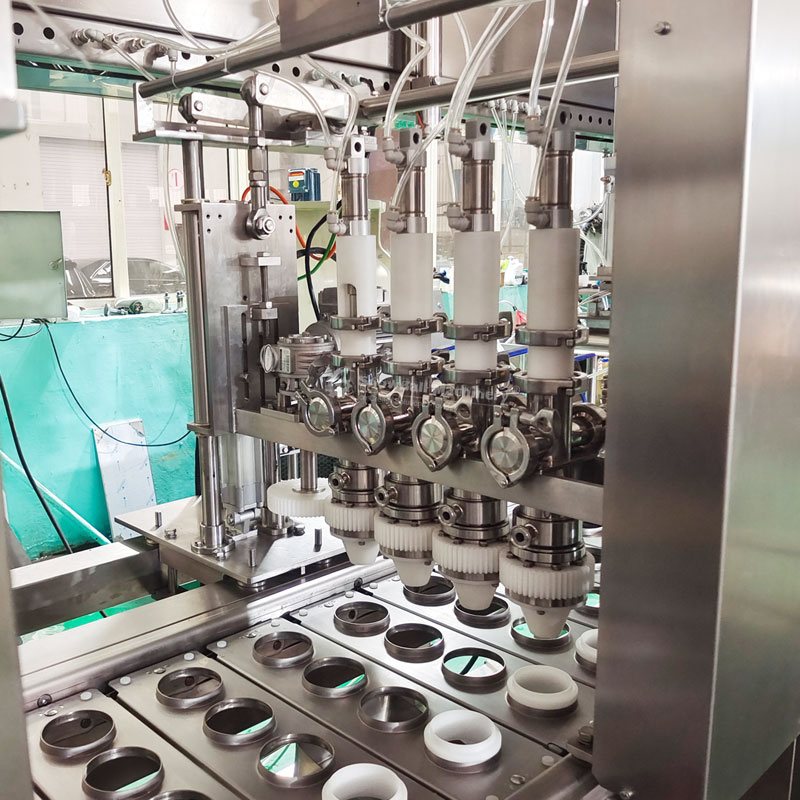
Filling platforms such as the SNLF are configured around containers, while molded stick and extrusion lines are configured around product shaping. Image source: Snowball Machinery.
Snowball Machinery Manufacturing Co., Ltd., established in 2020, is a China-based ice cream equipment manufacturer with a 4,000-square-meter facility, approximately 50 employees, and an annual production capacity of about 1,200 sets. The company reports that about 90% of its production is exported to North America, South America, Europe, Asia, and Africa. Its core team reports more than 30 years of experience in the ice cream machinery industry, and its R&D department consists of 10 engineers. This article uses the company's published equipment facts to explain a buyer-side decision framework rather than to rank the three machine types.
The procurement problem: three machine types, one product plan
The central procurement risk is not choosing a machine that cannot run. It is choosing a machine that runs well but does not fit the product plan. Molded stick lines, extrusion and hardening lines, and filling machines all sit inside an ice cream factory, but they solve different forming problems. A stick line shapes product in molds. An extrusion line shapes product by extrusion and then hardens it. A filling machine doses ice cream into cups, cones, pints, family packs, or bulk containers.
That difference affects the rest of the line. Product format determines which optional units matter, how much manual handling remains, what downstream hardening or packaging is required, and how the continuous freezer should be sized. A buyer who starts with a supplier shortlist before defining the format often ends up comparing machines with different scopes. A buyer who starts with format can compare equipment on a like-for-like basis.
The market context supports that format-first view. Stratview Research estimates the global ice cream processing equipment market at USD 2.4 billion in 2025. In the same 2025 type segment, continuous freezers account for approximately 29.4% of the market, which places freezing capacity close to the center of line economics. IMARC Group reports that North America held over 42.0% of the ice cream processing equipment market in 2025. These figures do not decide a single project, but they explain why buyers increasingly evaluate complete processing lines rather than isolated machines.
The three platforms at a glance
Snowball Machinery's published portfolio maps the three machine types to distinct forming roles. The SNL is a molded stick ice cream machine. The SNEX is an ice cream extrusion and hardening line. The SNLF is an ice cream filling machine. Each platform is made of food-grade stainless steel SS304 or SS316, and each is offered under a non-standard customization model based on product design and hourly production capacity.
| Decision item | SNL molded stick | SNEX extrusion and hardening | SNLF filling |
|---|---|---|---|
| Core production role | Forms stick, popsicle, ice lolly, and water-ice products in molds. | Extrudes, cuts, shapes, and hardens products before downstream handling. | Fills ice cream into cups, cones, pints, family packs, bulk, and similar containers. |
| Published product scope | Molded stick ice cream, moulded sticks ice cream, popsicle, ice lolly, frozen novelties, fruit bars, water ice. | Cake ice cream, sandwich ice cream, wave ice cream, extruded ice cream, ice cream ball cone, bonbon ice cream, ice cream choco bar, Eskimo bars, magnum ice cream, stick ice cream, funny face ice cream, log ice cream. | Ice cream cup, ice cream cone, ice cream bulk, ice cream pints, family size ice cream, family pack ice cream, water ice push-up, calippo, Cornetto. |
| Typical factory fit | Large, medium, and small ice cream factories; ice cream plants; food processing factories; creative factories and workshops. | Large, medium, and small ice cream factories; ice cream plants; dairy industry applications. | Large, medium, and small ice cream factories; ice cream plants; food processing lines; R&D applications. |
| Optional units | SNLU: ice water filler, ice cream sucker unit, stick inserter unit, chocolate coating station, dry coating station, popsicle molds. | Line configured around extrusion, cutting, hardening, and downstream handling; capacity customized by product design. | SNFU: cup and cone dispenser, chocolate or sauce sprayer, automatic filler, pencil filler, topping units, lid dispenser, heat sealing unit. |
| Material | SS304 or SS316. | SS304 or SS316. | SS304 or SS316. |
| Capacity basis | Customized according to product design and hourly output. | Customized according to product design and hourly output. | Customized according to product design and hourly output. |
The table shows why the three types should not be treated as interchangeable. The SNL and SNEX both touch stick-shaped products in different ways, and the SNLF handles containers rather than molds. A cup line and a stick line may share upstream freezing and mixing equipment, but they do not share the same downstream logic.
Decision criterion 1: match the machine to the product format
Product format is the first filter because it removes options that would otherwise look attractive on price or capacity alone. Molded stick production is the natural starting point when the product plan is centered on molded sticks, popsicles, ice lollies, frozen novelties, fruit bars, or water ice. The SNL platform covers semi-automatic, linear, inline, oval-type, rotary moulded, and manual ice lolly categories, which means the buyer can discuss the degree of automation instead of treating the category as one fixed machine.
Extrusion becomes more relevant when the product plan includes cake ice cream, sandwich ice cream, wave ice cream, ice cream ball cones, bonbon ice cream, chocolate bars, Eskimo bars, magnum-style products, funny-face products, logs, or other extruded and cut shapes. The SNEX product list is broad, and it includes stick ice cream as one of several outputs. That overlap is important: a buyer planning a stick product should compare SNL and SNEX on shape, downstream coating, hardening, and packaging rather than deciding from the word stick alone.
Filling is the correct starting point when the product is defined by its container: cups, cones, pints, family packs, bulk, water ice push-ups, calippo, or Cornetto-style formats. The SNLF line includes rotary and robot ice cream filling machine types, and it can be configured with cup and cone dispensers, automatic filling, chocolate or sauce spraying, dry toppings, lid dispensing, and heat sealing. A buyer should treat filling as a container-handling decision, not as a shaping decision.
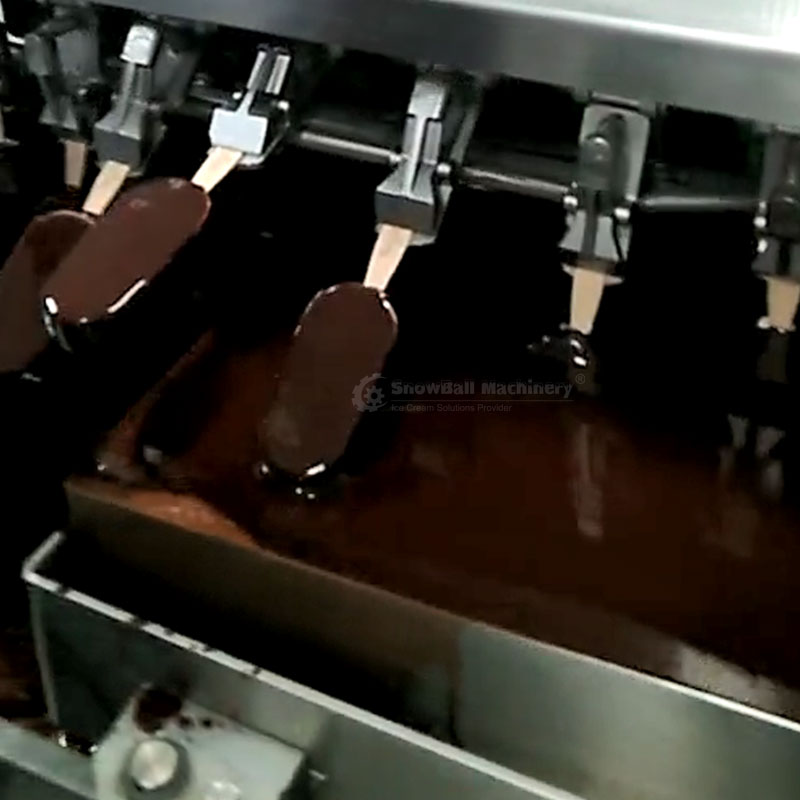
Extrusion lines are configured around product shaping and hardening, with capacity customized to product design and hourly output. Image source: Snowball Machinery.
Decision criterion 2: size the continuous freezer before sizing the line
Molded, extruded, and filled products all depend on a continuous freezer upstream. Snowball Machinery's SNCF continuous freezer range covers 50 L/h to 1500 L/h, with model designations SNCF 50L, SNCF 300L, SNCF 600L, SNCF 1200L, and SNCF 1500L. Published operating parameters include 100% overrun, input material at +5°C, and output material at -5°C. The freezer line is made of food-grade stainless steel SS304 or SS316 and uses main components from internationally renowned brands such as SIEMENS, Schneider Electric, FESTO, SMC, Danfoss, ABB, Bonfiglioli, igus, Copeland, Bitzer, and SEW Eurodrive.
Those freezer figures are useful, but they are not a line-output promise. The equipment is non-standard customized based on product design and hourly production capacity. A molded stick line, an extrusion line, and a filling line may each be described as having customized capacity, yet the practical output depends on the product shape, portion size, overrun, downstream hardening, coating, and packing. Buyers should therefore use the 50 L/h to 1500 L/h range as a screening bracket, not as a substitute for a configured capacity calculation.
The inclusion system is a second capacity variable. Snowball Machinery's SNFF ingredient feeder line includes SNFF1000, SNFF2000, and SNFF4000 models, classified as solid inclusions feeder machines, fruit feeders, and dosing dispensers. Published capacity for that line is customizable from 50 liters to 4,000 liters per hour. When a product includes fruit pieces, nuts, chocolate chips, or other inclusions, the feeder specification should be evaluated alongside the freezer and the forming machine rather than after the main line has been chosen.
Decision criterion 3: count the optional units that carry the format
Optional units often determine whether a line can actually produce the intended product. For molded stick production, the SNLU line includes an ice water filler, an ice cream sucker unit, an ice cream stick inserter unit, a chocolate coating station, a dry coating station, and popsicle ice cream molds. These units matter because a stick product may require filling, stick insertion, extraction, coating, or dry inclusions, and each step changes handling and line layout.
For filling production, the SNFU line includes a cup and cone dispenser, chocolate or sauce sprayer, automatic ice cream filler, ice cream pencil filler, chocolate topping machine, sauce topping unit, dry topping unit, lid dispenser machine, and heat sealing unit. The buyer should read that list as a configuration menu, not as a standard scope. A cup line with sauce and dry toppings has a different layout from a family-pack line with a lid dispenser and heat sealer. Both may use an SNLF filling platform, but the optional units change the operating sequence and the interfaces with upstream and downstream equipment.
Extrusion and filling are sometimes compared as if one were more advanced than the other. In practice, the correct comparison is fit. Extrusion covers products that are shaped and cut before hardening. Filling covers products that receive a defined dose into a container. The optional-unit list is the clearest way to see which one matches the product plan.

Molded stick lines use molds and optional units to define stick, popsicle, coating, and dry-inclusion formats. Image source: Snowball Machinery.
Decision criterion 4: match the platform to factory scale and project type
Factory scale changes the automation expectation, not the basic forming principle. Snowball Machinery's published application scenarios describe semi-automatic or manual operation for molded stick production aimed at newly built small ice cream factories, customers without factory construction experience, and small-capacity trial production lines. Those scenarios also note automatic filling and sucking, mold replacement for shape changes, and support for ice cream factory design, installation, commissioning, and operational training.
At larger scale, the application logic shifts toward continuous operation. Snowball Machinery describes fully automatic molded stick scenarios with automatic filling, sucking, jam charging, stick inserting, demolding, and chocolate coating, along with 24-hour continuous production, remote debugging, and fault alarms. Similar language appears in automatic filling and robotic production scenarios, where the line supports remote control, fault alarms, and production expansion through additional product shapes. These are published scenario descriptions, not independently verified uptime benchmarks; they are still useful for framing the questions a buyer should ask.
Project type also matters. New plant construction usually requires a wider scope, from mixing and pasteurization through freezing, forming, filling, hardening, and packing. An expansion project may focus on one bottleneck, such as adding a filling platform for cups and cones or adding an extrusion line for cake and sandwich formats. A dairy plant upgrade may require compatibility with existing premix, CIP, and utility infrastructure. The same machine category can be a good fit in one project and a poor fit in another.
Technical explanation: what the buyer is actually specifying
The technical core of these lines is not only the forming station. It is the sequence from mix preparation to frozen product handling. Snowball Machinery's SNM mixing machine covers HTST systems and batch pasteurizing systems, and it includes a CIP cleaning system. The SNP production line is described as an ice cream moulding line, extrusion line, filling line, sandwich processing line, and industrial ice cream cake machine platform. Stainless steel construction in SS304 or SS316 applies across the equipment, and the main components use internationally renowned brands.
For a buyer, that technical description translates into four specification questions. First, what is the product temperature and overrun assumption at the freezer outlet? Snowball's SNCF data states +5°C input, -5°C output, and 100% overrun. Second, what is the forming method: molds, extrusion and cutting, or container filling? Third, what optional units are needed to complete the product: stick insertion, coating, dry topping, sauce, lid, or heat sealing? Fourth, how will the line be cleaned, integrated, and commissioned? The presence of HTST, CIP, and turnkey engineering in the published portfolio makes those questions discussable, but the buyer still needs a project-specific specification.
Material selection is part of the same discussion. SS304 and SS316 are both food-grade stainless steel options in the published specifications. The buyer should match the material to the product, cleaning regime, and site requirements rather than treating the material name as a complete specification. The same applies to component brands: SIEMENS, Schneider Electric, FESTO, SMC, Danfoss, ABB, Bonfiglioli, igus, Copeland, Bitzer, and SEW Eurodrive are listed as main component sources, but the final configuration still needs to be documented in the quotation and acceptance documents.
Application scenarios: where each line fits
Molded stick lines fit product plans where the shape is defined by a mold and the product is sold as a stick, popsicle, ice lolly, fruit bar, or water-ice novelty. The SNL platform's semi-automatic and manual categories make it relevant to small factories, trial production, and creative workshops, while its linear, rotary, and inline categories support higher automation. The optional units allow chocolate coating, dry coating, stick insertion, and ice water filling to be added as the product plan requires.
Extrusion lines fit product plans that depend on shaping and cutting before hardening. The SNEX list includes cake, sandwich, wave, ball-cone, bonbon, choco-bar, Eskimo-bar, magnum-style, funny-face, log, and stick products. That breadth is useful for factories that expect to change formats, but it also means the buyer should define the initial product set and the likely expansion path before configuring the line. An extrusion line specified only for one shape may be less useful than one specified with the intended changeover path in mind.
Filling machines fit product plans where the container is part of the product identity. Cups, cones, pints, family packs, bulk, calippo, Cornetto, and water-ice push-ups each impose different handling requirements. The SNLF rotary type is described for low-output production and multi-specification containers, while the robot type supports automatic production. The SNFU optional units then determine whether the line can dispense cups or cones, add sauce, add dry toppings, apply lids, or heat seal.
Limits and trade-offs versus less integrated or traditional approaches
An integrated automatic line is not automatically the right answer for every project. One real boundary is format flexibility. A molded stick line depends on molds and optional units to define the product shape; changing to a very different stick or novelty format can require tooling changes, not just a recipe change. That is a practical constraint for factories that expect frequent shape changes or very small batch runs.
A second boundary is capacity definition. The published capacity language for these machines is customized according to product design and hourly production capacity. That is accurate, but it means a buyer cannot compare two suppliers solely by a single tonnage or pieces-per-hour figure without checking the product, portion size, overrun, and downstream handling assumptions. The continuous freezer range of 50 L/h to 1500 L/h is a useful bracket, not a complete line-output specification.
A third boundary is integration. A turnkey solution can cover ice cream factory design and a full line of machines from A to Z, but the buyer still needs to define utilities, layout, cleaning, commissioning, and acceptance. Less integrated or semi-automatic approaches can be easier to phase in for a small trial line, while a fully automatic line can require more upfront engineering. The trade-off is not automation versus tradition; it is fit between the product plan, the factory scale, and the project's ability to absorb integration work.
Market trend: why format-specific buying is becoming more visible
The equipment market is large enough to support specialized lines, and the product market is varied enough to require them. Stratview Research places the global ice cream processing equipment market at USD 2.4 billion in 2025, with continuous freezers representing approximately 29.4% of the type segment. IMARC Group reports North America at over 42.0% share in 2025. These figures point to a market in which freezing and forming equipment remain central to capital planning.
Standards also shape the conversation. ISO 22043:2020 specifies classification, requirements, and test conditions for ice-cream freezers. That standard does not certify an entire production line, but it gives buyers a reference point for freezer classification and testing language. In procurement, the practical trend is toward asking for documented specifications, configured capacity, and acceptance criteria rather than relying on a generic machine category.
Future outlook
For buyers, the likely planning issue is not whether more automation will appear, but how to keep a line expandable without over-specifying the first project. Snowball Machinery's published scenario material emphasizes expandability, convenient upgrading, remote debugging, fault alarms, and support for adding product shapes later. Those features are relevant to factories that expect product formats to change after startup.
The safer procurement path is to define the initial product set, choose the forming platform that matches it, size the continuous freezer and inclusion system around the product design, and list the optional units that are required now versus later. That sequence keeps the comparison grounded in equipment facts and reduces the risk of buying a line that is technically capable but commercially mismatched.
Decision framework checklist
- Define the product format first: molded stick, extruded and cut, or container-filled.
- Map the format to the platform: SNL for molded stick and popsicle formats, SNEX for extrusion and hardening formats, SNLF for cup, cone, pint, family-pack, bulk, calippo, and Cornetto formats.
- Size the continuous freezer against the product and hourly output: the SNCF range is 50 L/h to 1500 L/h, with 100% overrun and +5°C to -5°C material temperatures.
- Check whether inclusions are part of the product: the SNFF feeder line covers SNFF1000, SNFF2000, and SNFF4000, with customizable capacity from 50 to 4,000 liters per hour.
- List required optional units: SNLU for stick insertion, coating, dry coating, ice water filling, and molds; SNFU for cup and cone dispensing, sauce, dry toppings, lids, and heat sealing.
- Match the automation level to factory scale: semi-automatic or manual categories for small or trial production, and fully automatic continuous operation for larger production scenarios.
- Confirm material, components, cleaning, utilities, layout, commissioning, and acceptance in the technical agreement.
Buyer takeaway: the three machine types are not ranked alternatives. They are different answers to different product-format questions. A buyer who starts with the product and works backward to the forming platform, freezer, and optional units will compare suppliers on a more consistent basis.
Reference document: Snowball Machinery brochure (PDF).
FAQ
What is the difference between a molded stick ice cream machine and an extrusion line?
A molded stick ice cream machine forms product in molds, and the SNL platform covers molded stick ice cream, popsicle, ice lolly, frozen novelties, fruit bars, and water ice. An extrusion line shapes product by extrusion and then hardens it; the SNEX platform lists cake ice cream, sandwich ice cream, wave ice cream, extruded ice cream, ball cones, bonbon ice cream, choco bars, Eskimo bars, magnum-style products, stick ice cream, funny-face products, and logs. The choice depends on the product shape and downstream coating or hardening plan.
Which machine fills cups, cones, pints, and family packs?
The SNLF ice cream filling machine is the container-filling platform. Its published product scope includes ice cream cups, ice cream cones, bulk, pints, family-size ice cream, family-pack ice cream, water-ice push-ups, calippo, and Cornetto. It is available as rotary and robot types and is configured with SNFU optional units such as cup and cone dispensers, sauce sprayers, toppings, lid dispensers, and heat sealing.
What continuous freezer capacity is available for these ice cream lines?
Snowball Machinery's SNCF continuous freezer range covers 50 L/h to 1500 L/h, with model designations SNCF 50L, SNCF 300L, SNCF 600L, SNCF 1200L, and SNCF 1500L. Published parameters include 100% overrun, input material temperature of +5°C, and output material temperature of -5°C. The equipment is customized according to product design and hourly production capacity, so the freezer selection should be confirmed against the configured line.
What optional units can be added to a molded stick line?
The SNLU optional units and spare parts include an ice water filler, ice cream sucker unit, ice cream stick inserter unit, chocolate coating station, dry coating station, and popsicle ice cream molds. These units support stick, popsicle, ice lolly, and related molded formats. The required combination depends on the product design and the intended hourly output.
What optional units can be added to a filling machine?
The SNFU optional units include a cup and cone dispenser, chocolate or sauce sprayer, automatic ice cream filler, ice cream pencil filler, chocolate topping machine, sauce topping unit, dry topping unit, lid dispenser machine, and heat sealing unit. These units are relevant to cups, cones, pints, family packs, and similar filled formats. The final configuration should be matched to the container and topping plan.
Can one turnkey solution cover mixing, freezing, forming, filling, and packaging?
Snowball Machinery states that it provides a turnkey solution including ice cream factory design and a full line of ice cream machines from A to Z. The published portfolio includes the SNM mixing machine with HTST and CIP, the SNCF continuous freezer, the SNL molded stick machine, the SNEX extrusion and hardening line, the SNLF filling machine, the SNSMZ sandwich machine, the SNFF ingredient feeder, and associated packaging equipment. The actual scope must be defined project by project.
What is the main limitation when comparing machine capacity?
The published equipment is non-standard customized according to product design and hourly production capacity. As a result, a single capacity figure should not be compared without confirming the product shape, portion size, overrun, freezer selection, optional units, hardening, and packaging assumptions. The SNCF range of 50 L/h to 1500 L/h is a useful starting bracket, but it is not a complete line-output guarantee.
Tem questões ou precisa de mais detalhes?
Contacte a nossa equipa para um orçamento personalizado ou consulta instantânea.
Solicitar orçamento
Preencha o formulário abaixo e a nossa equipa entrará em contacto com uma proposta personalizada.

Chat direto do LINE
Prefere conversar em tempo real? Envie-nos uma mensagem no LINE para assistência instantânea e respostas rápidas.
- Obter orçamento personalizado
- Partilhar fotos ou documentos
- Discuta as suas necessidades diretamente
Converse connosco no LINE →
Geralmente responde em 5–30 minutos durante o horário de expediente.