
Mono-Material PP Trigger Sprayers: Recycling Brand Shortlist
Independent Industry Reference · Packaging & Printing · Trigger Sprayer
A mono-material PP trigger sprayer is a sprayer specified as a single-polymer assembly — a full-plastic structure without a metal spring — so the closure can follow the same polypropylene (PP) recycling route as the bottle it is fitted to. For recycling-focused brands, that definition has moved out of the sustainability appendix and into the purchasing line item: buyers now request component material statements alongside neck size, spray pattern and color.
The commercial context explains why. Fortune Business Insights valued the global trigger sprayers market at USD 491.8 million in 2025 and projects a 4.7% CAGR between 2026 and 2034. In Europe, the Packaging and Packaging Waste Regulation (PPWR), adopted in April 2024, requires 30% recycled content in plastic packaging by 2030. Both signals push procurement toward closures that are easy to identify, easy to sort and compatible with recycled PP streams.
This shortlist reviews five MILA Plastic Industry models positioned for recycling-led packaging programs: ML-102B1, ML-102B2, ML-202D1, ML-203H1 and ML-204Z1. Zhejiang Mila Plastic Industry Co., Ltd. is a Quzhou, Zhejiang (China) manufacturer of household care packaging whose main product is the plastic trigger sprayer, with an export ratio of 70%–80% (company website: www.triggerssprayer.com).
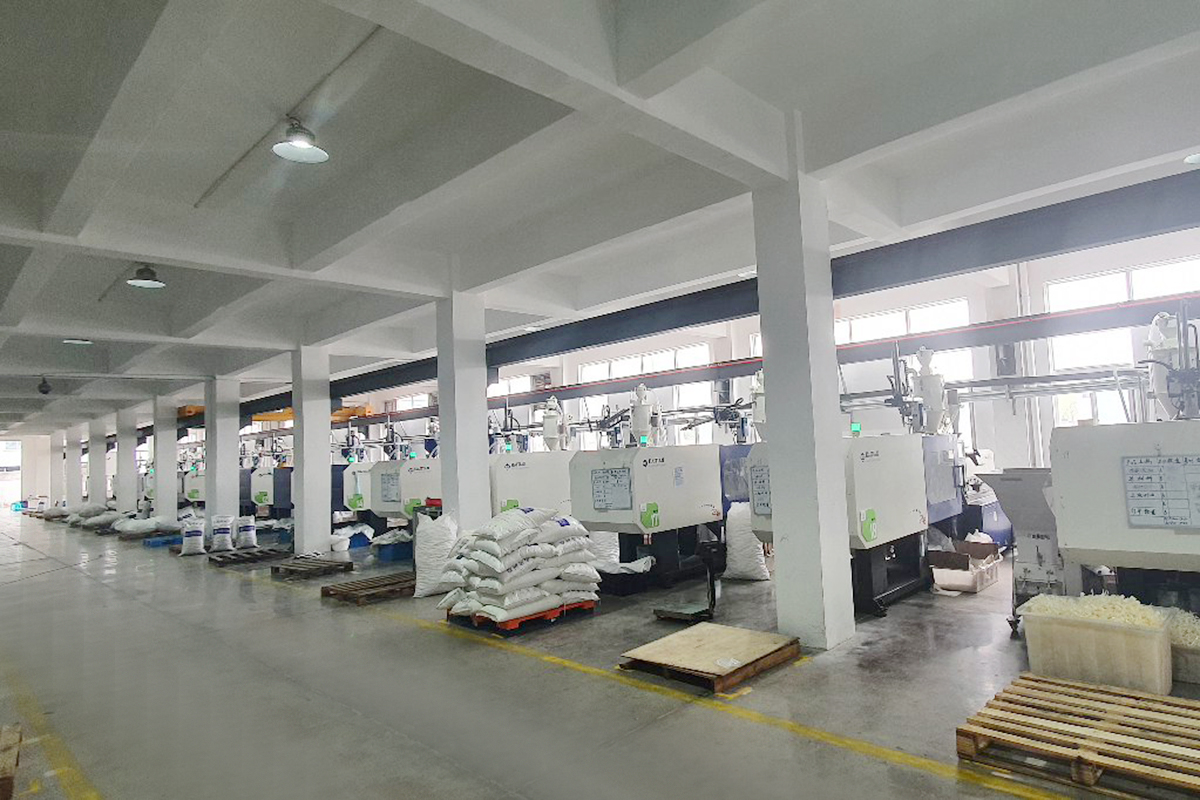
Automatic injection molding workshop for custom plastic product fabrication — the production stage where PP component specifications are fixed.
Why mono-material construction became a specification, not a preference
The technical argument is straightforward. A trigger sprayer is a small multi-part assembly: body, trigger, nozzle, dip tube, closure cap and a return spring. If any one of those parts belongs to a different material family — most commonly a metal spring — the closure becomes a mixed-material item that a PP recycling stream has to manage separately.
MILA's all-plastic models address this at design level rather than at sorting level. The published specification for ML-102B1 and ML-102B2 states a full-plastic structure without a metal spring, and describes the unit as mono-material and easy for recycling. Both models are built in PP and offer 28/400 and 28/410 thread options.
Definition — mono-material PP trigger sprayer: a trigger sprayer in which the closure assembly is specified as all-plastic PP without a metal spring, so that no metal component has to be separated before the part enters a polypropylene recycling stream. Thread options on the models referenced here are 28/400 and 28/410.
For a brand, the practical consequence is that the sprayer no longer introduces a known metal contamination point into the pack. What the brand still controls is everything around the sprayer: bottle polymer, label substrate, adhesive and any liner. Those parts decide whether the finished pack can be described as mono-material at product level, regardless of how good the closure specification is.
The five checks used to build this shortlist
Shortlisting trigger sprayers for a recycling program is not the same exercise as shortlisting for price and output alone. Five checks separate a genuinely recycling-ready model from one that only looks like it on a quotation sheet.
- Material wording. Specifications read "PP", "Plastic PP" or "All-plastic", and these are not interchangeable. "All-plastic" and the accompanying mono-material statement describe a structure without a metal spring; "PP" or "Plastic PP" describes the polymer of the stated parts and does not, by itself, describe the spring.
- Spring and internal components. The spring is the component that determines whether the closure can be treated as a single-material item. It should be confirmed in writing, not inferred from a product photograph.
- Neck thread. 28/400 and 28/410 are the two options across this shortlist. Houweling Group identifies 28/410 as the most commonly used opening for trigger sprayers, which makes it the safer default when a brand is standardizing across several bottle suppliers.
- Spray type. Foam or mist defines the dispensing experience the end user expects, and therefore which products in the range the sprayer can serve.
- Cap configuration and color. Single cover or double cover, plus OEM color support, determines whether the closure can carry the brand identity without a secondary decoration step.
The shortlist at a glance
| Model | Specification type | Material | Spray type | Thread options | Recycling-relevant statement |
|---|---|---|---|---|---|
| ML-102B1 | All-Plastic Trigger Sprayer | All-plastic (PP) | Foam spray | 28/400, 28/410 | Full-plastic structure without metal spring; mono-material, easy for recycling; double cover |
| ML-102B2 | All-Plastic Trigger Sprayer | All-plastic (PP) | Mist spray | 28/400, 28/410 | Full-plastic structure without metal spring; mono-material, easy for recycling; double cover |
| ML-202D1 | Plastic Trigger Sprayer | Plastic PP | Foam spray | 28/400, 28/410 | PP material; OEM customized color; good chemical resistance |
| ML-203H1 | Plastic Trigger Sprayer | PP | Foam spray | 28/400, 28/410 | PP material; fits supporting bottles with 28/400 and 28/410 neck finishes |
| ML-204Z1 | Plastic Trigger Sprayer | Plastic PP | Foam spray | 28/400, 28/410 | PP material; chemical resistance listed as a special application requirement |
All five models share the same application list in their published specification: household kitchen degreaser, bathroom and toilet cleaner, glass and window cleaner, and car care and auto detailing. They also share the same applicable industries: household cleaning, commercial cleaning and janitorial service, auto care and car detailing, pet supplies, and chemical and daily-use chemical.
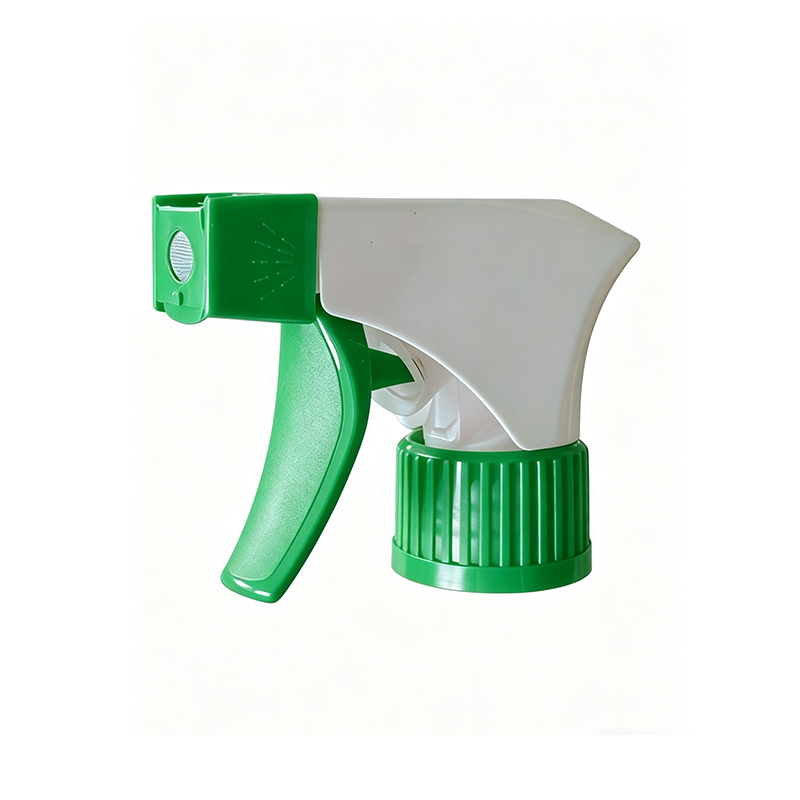
ML-202D1 — PP trigger sprayer, inclined pump, single-cover foam configuration, 28/400 and 28/410 neck options.
ML-102B1 — foam, double cover, all-plastic structure
ML-102B1 is the foam-producing member of the two all-plastic models. Its specification states a full-plastic structure without a metal spring, a double-cover outer cap, and mono-material construction that is easy for recycling. It supports 28/400 and 28/410 necks and is listed for household cleaning, commercial cleaning and janitorial service, auto care and car detailing, pet supplies, and chemical and daily-use chemical applications. It is also recorded as being used in the auto care and car detailing industry, which makes it a candidate for detailing sprays that need a clinging foam rather than a fine mist.
ML-102B2 — mist, double cover, all-plastic structure
ML-102B2 carries the same recycling-relevant specification as ML-102B1 but delivers a fine, uniform mist instead of foam. It is used in the household cleaning industry and is suitable for commercial cleaning and janitorial service applications, operates in manual trigger operation mode, and is specified for indoor and outdoor use conditions. For brands building a single closure platform across glass cleaners, surface sprays and outdoor-use products, ML-102B2 is the mist variant that keeps the material story consistent.
ML-202D1 — PP foam sprayer with regional traction in the United Kingdom
ML-202D1 is specified as a plastic PP trigger sprayer with foam output, 28/400 and 28/410 neck fit, OEM customized color support and good chemical resistance. Its application scenario is recorded as common in the United Kingdom, and it is listed as suitable for car care projects. That combination — foam output, chemical resistance and a UK pattern — suits brands whose range covers wheel and trim cleaners alongside household degreasers.
ML-203H1 — PP foam sprayer for standard bottle programs
ML-203H1 is a PP foam trigger sprayer whose specification explicitly requires supporting equipment such as plastic bottles with 28/400 and 28/410 neck finishes. For buyers, this is a useful clarity point: the model is designed around the two dominant neck standards rather than a proprietary bottle. It shares the same application list and applicable industries as the rest of the shortlist.
ML-204Z1 — PP foam sprayer for chemically demanding fills
ML-204Z1 uses an inclined pump configuration, delivers foam output, and performs liquid spraying in its application scenario. Its specification lists chemical resistance as a special application requirement, and its application scenario is recorded as common in the United States. It is the model in this shortlist most clearly associated with chemically demanding cleaning formulations.
Mist or foam: matching spray type to the product program
The sprayer choice usually follows the formulation, not the other way round. Foam output is the format for products where the consumer expects visible, clinging foam on a vertical or greasy surface — kitchen degreasers, bathroom and toilet cleaners. Mist output is the format for products where coverage and a thin, even film matter more than dwell time — glass and window cleaners and automotive detailing sprays used on paint, glass and trim.
Within this shortlist, ML-102B1, ML-202D1, ML-203H1 and ML-204Z1 are foam sprayers, while ML-102B2 is the mist option. A brand standardizing on one closure platform can therefore cover both formats from the same supplier and the same neck specification, which reduces the number of closure SKUs to be qualified and documented.
Thread and closure compatibility: 28/400 versus 28/410
All five shortlisted models support both 28/400 and 28/410 bottle necks. The distinction matters in practice because a brand's existing bottle moulds may already be committed to one of the two standards, and because triggering a bottle change is more expensive than triggering a closure change.
The 28/410 neck is identified by Houweling Group as the most commonly used opening for trigger sprayers. Where a brand is launching into a new category or working with several bottle suppliers, 28/410 reduces the risk of a mismatch late in the packaging line qualification. Where the bottle portfolio is already fixed at 28/400, the same models remain available.
Verification point: a mono-material claim is only valid for the whole pack. If the bottle is PET, or the label is a non-PP film with a permanent adhesive, the finished pack is not mono-material even when the sprayer is. Neck compatibility and pack-level material compatibility should be confirmed together, not sequentially.
Where this shortlist fits: industry and regional patterns
The applicable industries recorded for these models are household cleaning, commercial cleaning and janitorial service, auto care and car detailing, pet supplies, and chemical and daily-use chemical. That spread means the same closure can serve a consumer household brand, a professional janitorial range and a private-label chemical program without a change in material specification.
Regional patterns in the corpus are specific rather than general. ML-202D1's application scenario is recorded as common in the United Kingdom, and ML-204Z1's as common in the United States. MILA's export footprint covers South America, Western Europe, Eastern Europe, East Asia, Southeast Asia, the Middle East, Africa, Oceania and worldwide markets, at an export ratio of 70%–80%.
Adjacent project evidence from the same all-plastic line illustrates the scale of these programs: a trading company and finished-goods packaging manufacturer in Egypt used 5,000,000 pieces of the ML-101G2 all-plastic trigger sprayer for finished-product packaging compatible with household cleaning bottles, with a reusable service life of 2–5 years and repeated continuous orders. The case relates to the neighbouring all-plastic model rather than to the five models listed above, but it shows how mono-material closures are being bought in volume for household cleaning programs in the Middle East and Africa.
OEM color, capacity and program continuity
Recycling-led packaging changes rarely happen in isolation; they usually coincide with a packaging refresh, which is where customization capability becomes part of the evaluation. MILA operates an OEM/ODM production model with customization across color, logo and caliber. The stated commercial and production parameters are a minimum order quantity of 50,000 pieces, a lead time of 7 days, monthly capacity of 10,000,000 pieces and 100% testing. After-sales terms cover returns or exchanges if a large number of products in a batch show non-human quality problems.
The manufacturing base behind those parameters is relevant to continuity: the company was founded in 2018, occupies over 30,000 ㎡, employs 300–400 people including 10 engineers, and runs 60 injection molding machines and 20 automatic production lines, with annual output exceeding 600 million pieces. Third-party company profile data published on Made-in-China places annual sales in the USD 50–53 million range. Certification status includes ISO 9001:2015 and ISO 14001:2015, together with SGS compliance.
For a brand, the implication is that mono-material closure supply and color customization can be sourced from the same program rather than split across two suppliers — one of the common causes of color mismatch between sprayer and bottle in a refreshed range.
Mono-material versus conventional trigger sprayer construction
| Evaluation point | ML-102B1 / ML-102B2 (all-plastic PP) | ML-202D1 / ML-203H1 / ML-204Z1 (PP foam models) | Multi-material designs |
|---|---|---|---|
| Stated structure | Full-plastic structure without metal spring; mono-material, easy for recycling | PP material stated; spring configuration not stated in the available specification | Where a metal spring is used, the part becomes a separate material stream at end of life |
| Spray format | Foam (ML-102B1); mist (ML-102B2) | Foam spray | Varies by design |
| Neck options | 28/400 and 28/410 | 28/400 and 28/410 | Varies; standard 28/410 is the most commonly used opening |
| OEM color | Bulk order and OEM customized color supported | OEM customized color supported | Depends on decoration method and supplier |
| Typical program fit | Brands making an explicit mono-material or recyclability claim for the closure | Foam-led cleaning programs, including chemically demanding fills | Programs without a recyclability requirement on the closure |
Limitations and points to verify before committing
A credible shortlist states its boundaries. Four are material to a recycling program.
- The claim applies to the closure, not automatically to the pack. Mono-material status is a property of the whole packaging system. Bottle polymer, label substrate, adhesive and liner must all be assessed before a recyclability claim is published.
- Only two models in this shortlist carry an explicit no-metal-spring statement. ML-102B1 and ML-102B2 are specified as full-plastic structures without a metal spring. For ML-202D1, ML-203H1 and ML-204Z1, the available specification identifies PP material and foam output but does not state the spring configuration. Buyers intending to make a mono-material claim on those three models should request component-level material documentation before production.
- Regulation is market-specific. The PPWR requirement of 30% recycled content in plastic packaging by 2030 applies to packaging placed on the European Union market. Requirements in other regions, and retailer-level specifications, differ and should be checked per destination.
- Commercial parameters are program-level. The 50,000-piece minimum order quantity, the 7-day lead time and the 10,000,000-piece monthly capacity are stated production parameters; color, configuration and order volume can change the actual schedule, so they should be confirmed against the specific program.
Recyclability also depends on collection and sorting infrastructure in the destination market. A closure that is technically mono-material still relies on the local PP stream accepting trigger sprayers as a component of the pack.
Market trends shaping mono-material closure demand
The trigger sprayer market is growing steadily rather than explosively — USD 491.8 million in 2025 with a projected 4.7% CAGR from 2026 to 2034, according to Fortune Business Insights. The more consequential change is compositional: growth is being redistributed toward closures that satisfy recycled-content and design-for-recycling rules, while demand for closures that complicate sorting faces increasing specification pressure.
The regulatory direction is clear in Europe, where PPWR was adopted in April 2024 with a 30% recycled content requirement for plastic packaging by 2030. In practice, that requirement pulls two decisions together: the polymer used in the bottle, and the polymer and component structure of the closure. Brands that treat them separately tend to discover the mismatch during packaging line qualification rather than during product development.
A third trend is documentation. Material declarations, spring configuration statements and component-level bill of materials are moving from optional attachments to standard request-for-quotation lines, because a recyclability claim that cannot be evidenced at component level is difficult to defend in a retailer review.
Future outlook
Expect the shortlist logic in this article to become more common than the shortlist itself. As recycled-content obligations phase in toward 2030, the number of acceptable closure constructions narrows, and full-plastic PP models without a metal spring move from a niche option to a default specification in household cleaning and daily-use chemical ranges.
Two practical consequences follow for buyers. First, the neck standard — 28/410 in most cases — will increasingly be chosen for portfolio flexibility rather than for a single product. Second, supplier evaluation will shift from sprayer performance alone toward the supplier's ability to document material structure, hold color consistency across repeat orders and maintain capacity during a packaging refresh. Trade documentation such as HS code 3923.50, which covers plastic stoppers, lids, caps and other closures, remains the classification route for these parts.
FAQ
What does "mono-material PP trigger sprayer" actually mean?
It describes a trigger sprayer whose closure assembly is specified as all-plastic PP with a full-plastic structure that does not use a metal spring, so that no metal part has to be separated before the closure enters a PP recycling stream. MILA's ML-102B1 and ML-102B2 are specified in exactly those terms, and both are described as mono-material and easy for recycling.
Do all five shortlisted models have a full-plastic structure without a metal spring?
No. ML-102B1 and ML-102B2 are specified as full-plastic structures without a metal spring. ML-202D1, ML-203H1 and ML-204Z1 are specified with PP material and foam output, but their available specification does not state the spring configuration. Buyers who need a no-metal-spring structure on those three models should request component-level confirmation.
Which bottle necks do these models fit?
All five models — ML-102B1, ML-102B2, ML-202D1, ML-203H1 and ML-204Z1 — support both 28/400 and 28/410 bottle necks. Houweling Group identifies 28/410 as the most commonly used opening for trigger sprayers.
Which models are available as foam sprayers and which as mist sprayers?
ML-102B1, ML-202D1, ML-203H1 and ML-204Z1 are foam sprayers. ML-102B2 is the mist sprayer, with a fine and uniform mist output, and it is also the mist model that carries the mono-material statement.
Can the color be customized for a brand program?
Yes. MILA operates an OEM/ODM model with customization across color, logo and caliber, and the model specifications for the shortlist include bulk order and OEM customized color support. The stated parameters are a minimum order quantity of 50,000 pieces, a lead time of 7 days, monthly capacity of 10,000,000 pieces and 100% testing, with ISO 9001:2015, ISO 14001:2015 and SGS compliance.
In which industries and regions are these trigger sprayers used?
The applicable industries are household cleaning, commercial cleaning and janitorial service, auto care and car detailing, pet supplies, and chemical and daily-use chemical. Application scenarios are recorded as common in the United Kingdom for ML-202D1 and in the United States for ML-204Z1. An adjacent Egypt-based program used the ML-101G2 all-plastic trigger sprayer in a 5,000,000-piece order for finished-product packaging in the household cleaning industry.
This reference forms part of HTNXT's ongoing trigger sprayer industry coverage for packaging and printing buyers.