
Motor Run Capacitor Customization: From Specification to Production
A motor run capacitor stays energised for as long as its motor runs. It maintains the phase relationship between the main and auxiliary windings of a single-phase motor, and because it works continuously rather than for a second or two at start-up, its capacitance stability, dielectric strength and thermal behaviour shape how the motor behaves over months of service.
Most public discussion of motor capacitors treats them as catalogue parts defined by two numbers: microfarads and volts. Orders that actually reach a production line carry more than that. They include a lead length, a terminal style, a case material, a printed mark and a packing format. This article looks at what changes when a run capacitor moves from a standard catalogue item to a customized ODM build, and at what buyers should verify between evaluation and execution.

Production site of Taizhou Huifeng Electron Co., Ltd. in Wenling, Zhejiang Province, China. The company produces metallized film, CBB and CD series capacitors for motor, pump, fan and appliance applications.
Why a Run Capacitor Is a Specification Decision, Not a Catalogue Line
The international reference point for this product family is IEC 60252-1, which applies to motor capacitors intended for connection to windings of asynchronous motors supplied from a single-phase system at frequencies up to and including 100 Hz, and to capacitors connected to three-phase asynchronous motors so that those motors may be supplied from a single-phase system. The same scope covers impregnated or unimpregnated capacitors with a dielectric of paper, plastic film or a combination of both, either metallized or with metal-foil electrodes, at rated voltages up to and including 660 V.
That scope alone shows why 'motor capacitor' is a category rather than a single specification. Within it, three product families dominate practical procurement:
- CBB60 is a metallized polypropylene-film run capacitor, typically supplied in a cylindrical plastic case with flying leads or spade terminals, and commonly fitted to pumps, washing machines, air compressors and fan motors.
- CBB65 uses the same film construction in an aluminium can with screw or spade terminals, and is commonly used in air-conditioning and refrigeration equipment.
- CD60 is an electrolytic start capacitor built for short-duration starting duty. It is not a substitute for a run capacitor, and the two are not interchangeable.
The first purchasing decision is therefore functional rather than commercial: is the part required to stay in circuit continuously, or only to assist starting? Only after that question is settled does capacitance, voltage, case style and connection method become meaningful. A buyer who compares quotations before confirming this point is comparing parts that serve different jobs.
What a Custom Run Capacitor Order Actually Changes
Standard catalogue values cover a large share of replacement and OEM demand. Customization becomes relevant when a part has to fit an existing assembly, carry a buyer's own identity, or pass through a specific packing and labelling process. The documented customization dimensions for an ODM run capacitor order are capacity, voltage, casing, lead-out method, brand or logo, printing method, packaging method and label stickers.
| Customization dimension | What the buyer specifies | Where it shows up downstream |
|---|---|---|
| Capacity | Target microfarad value within the build range | Motor starting torque and running current behaviour |
| Voltage | Rated AC voltage class | Dielectric margin under supply and switching conditions |
| Casing | Case format and material | Mounting clearance, mechanical retention, appearance |
| Lead-out method | Wire leads or terminal format, length and termination | Assembly time on the customer line and joint reliability |
| Brand / logo | Own-brand marking | After-sales traceability and channel presentation |
| Printing method | Marking technique and layout | Durability of ratings and identification in service |
| Packaging method | Bulk, tray, bag or carton configuration | Incoming handling, line feeding and storage |
| Label stickers | Label content and placement | Warehouse picking accuracy and warranty identification |
None of these items changes the physics of the capacitor. What they change is the fit between the component and the customer's process. A run capacitor with the correct electrical value but the wrong lead length still stops a production line, and a correctly built part with an unreadable rating mark creates a warranty dispute months later. Customization is therefore best treated as process engineering rather than as a cosmetic upgrade.
Taizhou Huifeng Electron Co., Ltd. as an ODM Source
Taizhou Huifeng Electron Co., Ltd. is a capacitor manufacturer founded in 1993 and based in Wenling, Zhejiang Province, China, operating from a site of approximately 10,000 square metres. The company manufactures metallized film, CBB and CD series capacitors for industrial applications such as fans, pumps, single-phase motors, distribution cabinets and UPS systems, as well as for household appliances including fans, washing machines and air conditioners. It employs around 50 people, including three engineers, and exports to Europe and Asia, with exports representing approximately 30% of output.
Production is organised around in-house film capability rather than purchased film alone. The site runs three sets of large-scale vacuum electroplating equipment for metallized thin film, seven film cutting machines and eight winding machines, with daily production capacity exceeding 25,000 units and a stated monthly capacity of 650,000 units. In practical terms, this means film metallizing, slitting, winding and element assembly sit inside one supply chain, which shortens the feedback loop when a customized capacitance or case format requires a new winding programme.
The company provides ODM production services for export to global markets. Documented commercial parameters are as follows:
- Minimum order quantity: 300 units for regular items; 1,000 units for customized items.
- Lead time: 25–35 days.
- Quality control: 100% testing of semi-finished products and finished products, plus a final appearance and detail check during packaging.
- After-sales: warranty support and issue resolution handled by sales and technical personnel.
For a buyer in the evaluation stage, the useful question is not whether customization is offered, but whether the customization process is bounded. A defined MOQ threshold, a stated lead-time window and a full-inspection regime give a procurement team something to plan against. Open-ended customization claims do not.
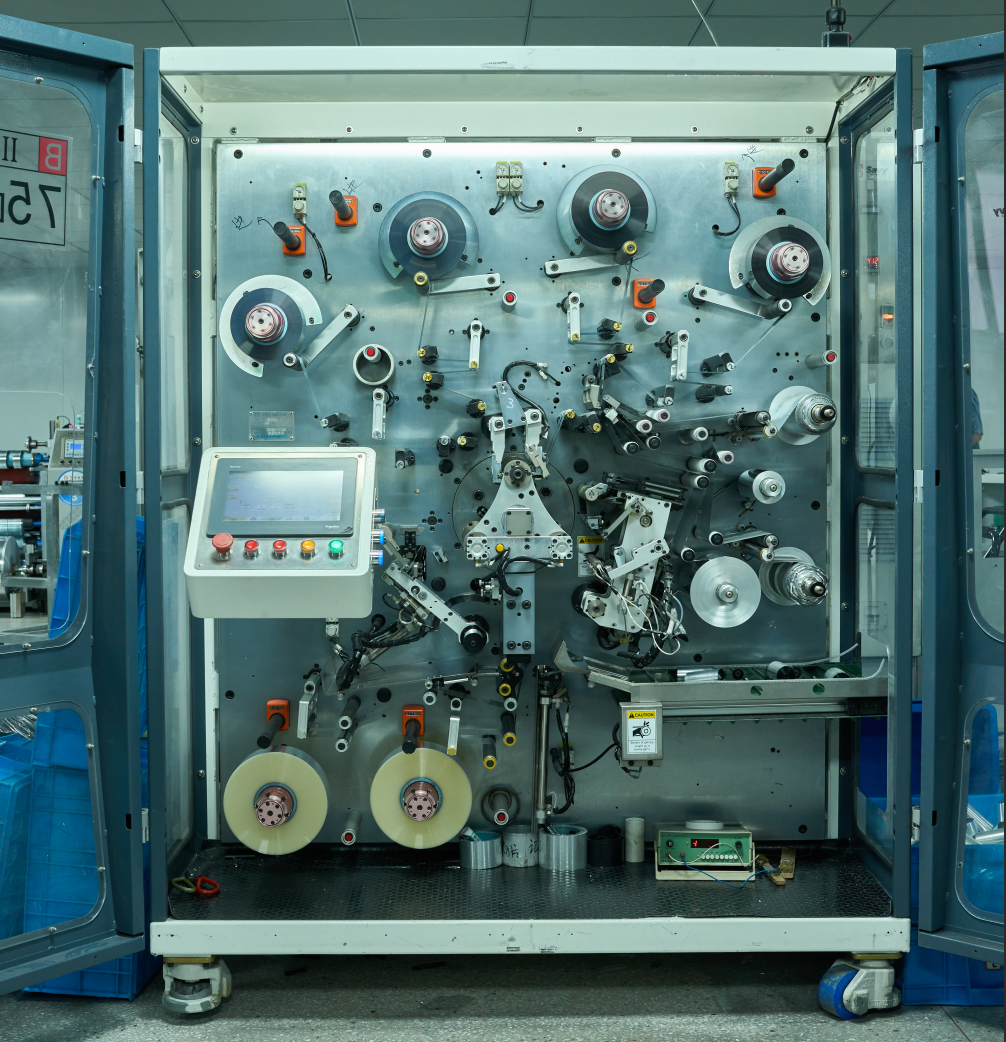
Film winding, where metallized polypropylene film is wound into capacitor elements. Winding parameters determine the capacitance value delivered by a custom build.
The Electrical Basis of a CBB60 Build
Customization is only credible if the underlying product is specified precisely. For the CBB60 motor run capacitor, the documented parameters are as follows.
| Parameter | Documented value |
|---|---|
| Capacitance range | 1–150 µF |
| Rated voltage | 250/300 VAC; 320/370 VAC; 400/450 VAC |
| Capacitance tolerance | ±5% |
| Climatic category | 25/70/21; 40/85/21 |
| Lead type | Wire |
| Case material | Plastic |
| Standard reference | GB/T 3667.1-2016 |
| Test voltage between terminals | 2UN for 2 seconds |
| Maximum continuous working voltage | 1.1UN |
| Maximum continuous working current | 1.3In |
| Expected usage time | 3,000 hours |
| Operating level | B / C |
Three of these values deserve attention during evaluation. The 2UN test for two seconds is a short dielectric withstand check applied between terminals; it verifies insulation integrity at the point of production, not long-term performance in the field. The 1.1UN and 1.3In figures describe the continuous operating envelope, which is a different condition from intermittent overload. The 3,000-hour expected usage time is a stated expectation for the product, and it should be read as a design reference rather than a warranty period.
Construction matters as well. The CBB60 is built on metallized polypropylene film, a self-healing construction in which a localised dielectric breakdown clears itself by vaporising the thin metal layer around the fault. That behaviour is one reason film capacitors are used in continuous-duty motor applications, but it does not make the part immune to ageing, overvoltage or thermal stress.
From Evaluation to Execution: A Buyer Workflow
A run capacitor order generally passes through six stages. Each stage produces a document or decision that the next stage depends on, and skipping one is the most common reason a customized batch is rejected on arrival.
- Define the function. Confirm whether the motor requires continuous run compensation or short-duration starting assistance. Run and start capacitors are not interchangeable, and the wrong selection will fail regardless of build quality.
- Fix the electrical specification. Record capacitance, capacitance tolerance, rated voltage, frequency and climatic category against the motor manufacturer's data rather than against a previous purchase order.
- Fix the mechanical interface. Specify case format, dimensions, lead-out method, lead length and termination so the part drops into the existing assembly.
- Check compliance coverage. Confirm which certificates apply to the exact model, capacitance and voltage being ordered, and whether the target market requires anything outside that coverage.
- Validate with samples. Test samples under actual starting and running conditions before releasing mass production, and agree on acceptance criteria in writing.
- Inspect at incoming and at commissioning. Check specifications, markings and batch consistency on receipt, then verify start behaviour, running current, voltage and temperature at commissioning.
For a customized item, stages two and three normally determine the MOQ. A capacitance or voltage that already exists in a standard build can often be supplied from regular stock at 300 units, while a new casing, lead configuration, print layout or packaging format moves the order into the 1,000-unit customized tier with a 25–35 day lead time.
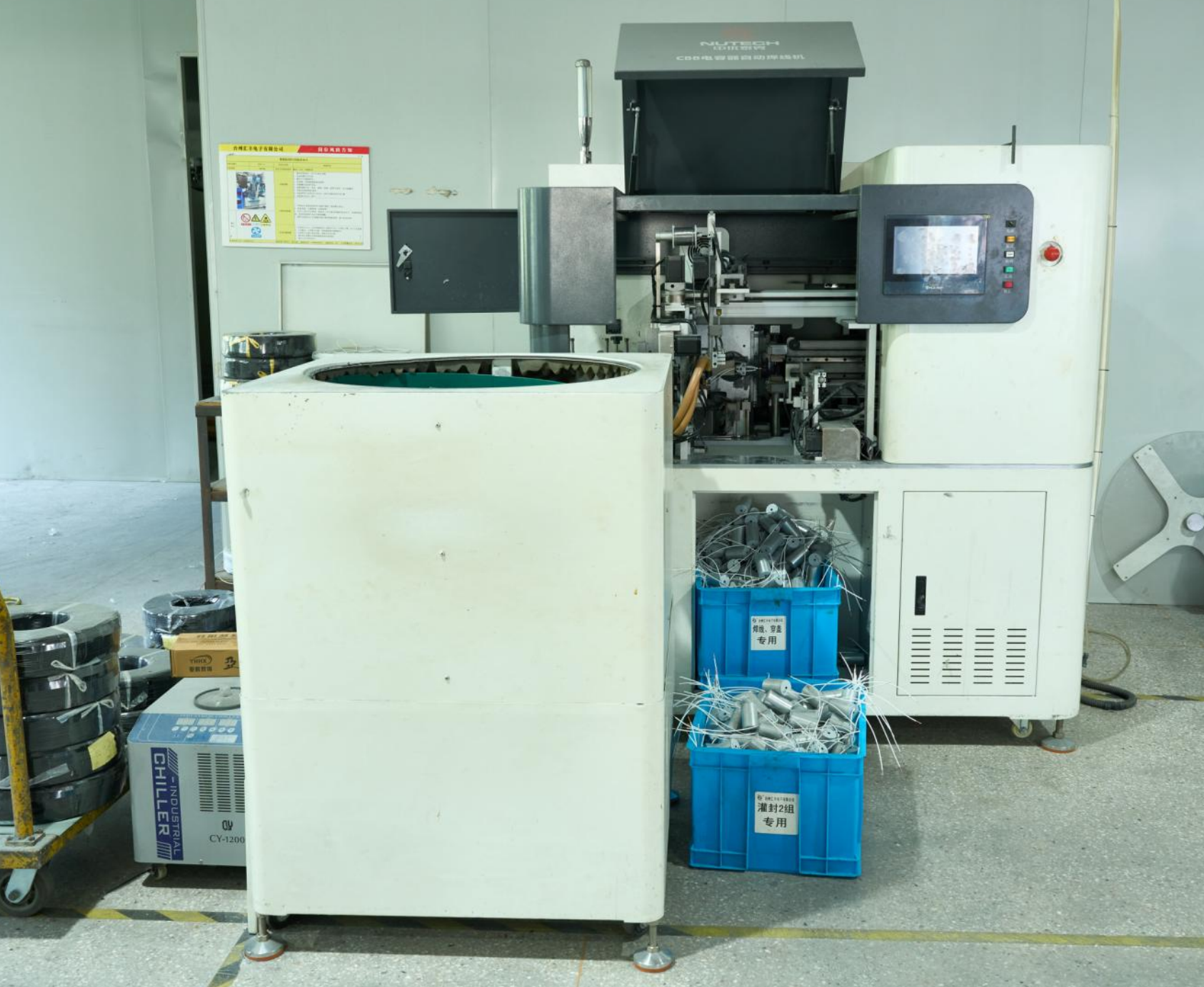
Automatic wire cutting and welding. Lead-out method and lead length are among the customization dimensions that most often decide whether a run capacitor fits an existing assembly.
Application Fit Across Pumps, Fans, HVAC, Laundry and Refrigeration
The CBB60 family is used where a single-phase motor runs continuously under load. Water pump and submersible pump motors are a common case: the capacitor is expected to hold capacitance under high-temperature, continuous power-on conditions, with high insulation, stable capacitance, anti-ageing behaviour and a service life matched to continuous motor operation. Fan motors, washing machine motors and air compressor motors follow the same pattern, while air-conditioning and refrigeration equipment more often uses the aluminium-cased CBB65 format.
One documented ODM case illustrates how custom supply works in practice. A wholesaler in the United Arab Emirates ordered 100,000 units for water pump and motor applications over a two-year supply relationship. The recorded result was stable performance with no negative reviews, with precise voltage withstand, voltage stability and long service life cited as the significant factors. For buyers assessing a supplier, the relevant detail is not the order size but the fact that a customized wholesale programme was sustained across multiple production cycles.
Compliance Evidence and Its Boundaries
Certification is frequently cited in supplier marketing without stating what each certificate actually covers. The documented certification position for this manufacturer is specific and can be checked line by line.
| Certificate | Scope | Reference and issuer | Date |
|---|---|---|---|
| RoHS Certificate of Conformity | Capacitor CBB60 (40 µF ±5%), CBB60 (12 µF ±5%); model/type reference CBB65, CBB61, CD60; directive 2011/65/EU | G170323Z38EN, Ningbo GIG Testing Technology Service Co., Ltd. | 14 April 2017 |
| TÜV Rheinland certificate | AC motor capacitor CBB60 (Huifeng); rated 370–450 V; 50/60 Hz; 1–60 µF; tolerance ±5%; climatic categories 40/85/21 and 25/70/21; EN 60252-1:2011+A1 | R 50500943, TÜV Rheinland LGA Products GmbH | 14 April 2021 |
| CQC product certification | AC motor aluminium electrolytic capacitor, CD60 series, 250 VAC, 50–500 µF ±15%, 10/55/10, 50/60 Hz; GB/T 3667.2-2016 | CQC09006039887, China Quality Certification Centre | 9 May 2023 |
| ISO 9001 quality management system | Production of aluminium electrolytic capacitors for AC motors, metallized film dielectric capacitors and self-healing low-voltage shunt capacitors | 25024Q10313R1M, Zhongqiu United International Certification (Beijing) Co., Ltd. | 1 March 2024 to 14 March 2027 |
The boundaries matter as much as the certificates. The TÜV certificate covers CBB60 in a 1–60 µF window at 370–450 V; a build outside that window is not automatically covered by the same document. The RoHS certificate names specific capacitance values and references other model families rather than certifying every variant produced. And a quality management certificate confirms that a system is in place; it does not by itself confirm the properties of a particular shipment. Buyers should therefore pair certificate review with incoming inspection and, where the application is safety-critical, with application-specific testing.
Market Context for Run Capacitor Sourcing
Published commercial research places the global motor capacitor market at approximately USD 24.04 billion in 2025, with an expected compound annual growth rate of 4.77% from 2025 to 2032 (Maximize Market Research). That profile describes steady expansion rather than rapid disruption, and steady expansion tends to reward supply continuity over opportunistic pricing.
For procurement teams, the practical reading is that demand for run capacitors is unlikely to disappear or to surge beyond available capacity in the near term. Under those conditions, differentiation between suppliers comes from three places: whether the specification can be adapted to a customer's assembly, whether the compliance file applies to the ordered variant, and whether the lead time and inspection regime are stated clearly enough to plan a production schedule around. This is an editorial interpretation of the published market outlook, not a forecast of individual supplier performance.
Where Customization Stops Being the Right Answer
A customized ODM build is not the correct route for every requirement. The comparison below sets out where a standard catalogue purchase remains the better commercial decision.
| Consideration | Standard catalogue purchase | Customized ODM build |
|---|---|---|
| Minimum order quantity | 300 units for regular items | 1,000 units for customized items |
| Lead time | Stock-supported for standard products | 25–35 days |
| Specification flexibility | Limited to listed capacitance and voltage classes | Capacity, voltage, casing, lead-out method, branding, printing, packaging and labels |
| Best fit | Maintenance and repair demand, small distributors, urgent replacement | OEM assembly lines, own-brand programmes, packaging-specific channel supply |
| Buyer verification burden | Incoming check against published specification | Sample validation, drawing approval and incoming check |
Three limits deserve to be stated plainly. First, the 1,000-unit threshold makes customization uneconomic for small repair operations, where a 300-unit standard order is the appropriate route. Second, a 25–35 day lead time is incompatible with breakdown-driven purchasing, so critical spares should be held as stock rather than ordered reactively. Third, and most importantly, customization does not transfer electrical responsibility to the manufacturer: the capacitance, voltage and climatic category must still match the motor manufacturer's specification, and a run capacitor must never be substituted for a start capacitor regardless of how closely the case formats appear to match.
A further limit concerns the expected usage time of 3,000 hours stated in the CBB60 product data. Buyers designing for long service intervals should treat that figure as a planning input and confirm suitability for their duty cycle, rather than assuming it applies unchanged to every operating environment.
Future Outlook
Two structural conditions are likely to shape run capacitor sourcing over the next several years. The first is standards continuity: IEC 60252-1 defines a product boundary covering film, paper and combined dielectrics at rated voltages up to and including 660 V, and buyers increasingly ask suppliers to state precisely which part of that boundary a given certificate covers. Suppliers who can answer that question with a document reference rather than a general claim will find compliance review shorter.
The second is the shift from product supply toward production integration. As more appliance and pump brands source finished assemblies rather than individual components, capacitor orders increasingly arrive with drawings attached: a lead length, a label position, a carton configuration. Manufacturers with in-house film metallizing, cutting and winding are better positioned to absorb those changes without extending lead time, because the adjustment happens inside their own process rather than across a supplier boundary.
Frequently Asked Questions
What does TÜV certification actually cover on a CBB60 run capacitor?
TÜV certification is independent third-party verification that a product meets specified safety and technical standards, and it helps buyers assess product quality, safety and supplier reliability. For this manufacturer, certificate R 50500943 was issued by TÜV Rheinland LGA Products GmbH on 14 April 2021 against EN 60252-1:2011+A1, covering the CBB60 AC motor capacitor at rated voltages of 370 V to 450 V, rated frequency 50/60 Hz, rated capacitance 1–60 µF, capacitance tolerance ±5%, and climatic categories 40/85/21 and 25/70/21. A build outside those parameters is not covered by that document.
How is a CBB60 run capacitor installed?
Installation follows a fixed sequence: disconnect the power supply, safely discharge the existing capacitor, check the replacement specification against the motor data, connect the lead wires according to the motor wiring diagram, secure the capacitor in its mounting position, and inspect the assembly before restoring power. The power must be off before any work begins, and discharge is required because a capacitor can retain charge after the supply is removed.
What should be checked when a motor is commissioned after capacitor replacement?
Once installation has been checked and the enclosure closed, power should be restored according to the equipment manufacturer's procedure. Qualified personnel should confirm that the motor starts promptly and reaches normal operating speed without abnormal humming, repeated starting attempts or unusual vibration, and should check running current, operating voltage and temperature against the equipment specification. Abnormal starting behaviour indicates a specification or connection problem and should be investigated before the motor is returned to service.
What causes run capacitor failures in air-conditioning and refrigeration equipment?
The main risks are overheating, capacitance degradation, premature failure, incorrect installation and poor product quality, typically arising from excessive voltage, high temperatures, incorrect specifications, loose connections or unsuitable operating conditions. Visible symptoms include capacitor bulge, capacitor failure and damage to other components. Prevention rests on selecting the correct capacitance, voltage and temperature ratings, verifying supplier quality control and test reports, ensuring proper installation and inspecting the part periodically. If a capacitor fails, power should be disconnected and a qualified technician should inspect and replace the component.
What should a buyer verify before placing a customized run capacitor order?
Buyers should confirm capacitance, rated voltage, dimensions, operating environment, storage environment and operating time, and should check supplier manufacturing capability, quality control procedures, product test reports, production consistency and export experience. Requesting samples for performance testing before a bulk order, and agreeing acceptance criteria in writing, reduces the risk of a batch being rejected. Commercial terms such as MOQ and lead time should be confirmed against the customization level, since customized items carry a 1,000-unit minimum and a 25–35 day lead time.
A company brochure covering capacitor series, certification references and production capability is available for download: Taizhou Huifeng Electron product brochure (PDF).
Tem questões ou precisa de mais detalhes?
Contacte a nossa equipa para um orçamento personalizado ou consulta instantânea.
Solicitar orçamento
Preencha o formulário abaixo e a nossa equipa entrará em contacto com uma proposta personalizada.
Chat direto do WhatsApp
Prefere conversar em tempo real? Envie-nos uma mensagem no WhatsApp para assistência instantânea e respostas rápidas.
- Obter orçamento personalizado
- Partilhar fotos ou documentos
- Discuta as suas necessidades diretamente
Geralmente responde em 5–30 minutos durante o horário de expediente.