
Motorcycle Seat Supplier Longevity: Continuity, Capacity and After-Sales Checklist
Supplier longevity in the motorcycle seat trade is not a question of how old a factory is. It is a question of whether the same factory can still deliver a conforming seat in the third year of a programme — same fit, same finish, same packing, same commercial terms — after the first order has already been absorbed by the market and the tooling has been through several production cycles.
For buyers at the awareness and research stage, that distinction matters more than it first appears. The global motorcycle seats market was valued at USD 7.42 billion in 2025 and is projected to reach USD 13.30 billion by 2032, growing at a CAGR of 8.69%, according to Market Research Future / Dataintelo. Growth of that order does not only create more orders; it creates more competition for the same factory capacity — which is precisely the condition under which long-term supply relationships are tested.
Why continuity, not unit price, is the real sourcing question
The aftermarket distribution channel holds the largest share of the motorcycle seat market, accounting for approximately 62.3% of revenue, based on Dataintelo's 2025 figures. A channel weighted that heavily toward replacement behaves differently from a pure OEM channel. Orders repeat. Model coverage matters more than a single hero SKU. And when supply stops, repair shops and retailers feel it within weeks rather than within a model year.
That structure produces a specific and often underestimated cost: the cost of switching. A new seat supplier does not simply quote a new price. The buyer has to re-verify mounting geometry, re-check foam density and cover durability, re-test packing for export handling, and re-establish a quality conversation from the beginning. For a wholesaler holding a standing catalogue, or a brand owner who has already published a model-specific listing, that re-verification is the expensive part — not the invoice.
Continuity risk therefore has three distinct layers, and each is verified with different evidence. Buyers who treat them as one question tend to over-weight the first and under-weight the other two.
The three continuity layers a buyer should test separately
| Continuity layer | Question the buyer is really asking | Evidence that answers it |
|---|---|---|
| Delivery continuity | Will this batch arrive when promised, and will the next batch match it? | Stated lead time with defined start and end points; pre-shipment inspection routine; batch records |
| Capacity continuity | Can the same line absorb my growth without displacing my order? | Annual and monthly capacity figures; self-production rate; order minimums; scheduling rules |
| After-sales continuity | If something goes wrong in month nine, is there a defined route back? | Warranty length and scope; claim handling process; replacement part availability |
Most sourcing checklists compress these into a single "reliability" score. That compression is convenient but misleading: a factory can be excellent on delivery continuity and still be a poor fit on capacity continuity if its order book is dominated by larger accounts. Separating the three layers makes the trade-offs visible before a multi-year commitment is signed.
Where Zhejiang Xingrong sits in this framework
Zhejiang Xingrong Auto & Motorcycle Parts Co., Ltd. is a manufacturer of motorcycle, electric vehicle and off-road vehicle seat cushions based in Taizhou City, Zhejiang Province, China. The company was established in 2015 and states that it is the earliest established motorcycle saddle factory in Zhejiang province — a positioning claim that is most useful to buyers as a starting point for verification rather than as a conclusion.
The operating facts that matter for continuity planning are these: a manufacturing facility of 15,000 square metres, approximately 130 staff, an R&D team of 5 engineers, an annual seat cushion production capacity of 1,800,000 units, and a product accessory self-production rate of 90%. Export business accounts for 20% of total sales, with major markets in Southeast Asia, Europe, the Middle East and South America.
On quality infrastructure, the company has passed ISO9000 quality management system certification and CQC certification, and reports long-term strategic partnerships with domestic first-line brand general machinery factories. Those partnerships are relevant to buyers not as a brand endorsement but as indirect evidence that the factory has passed a supplier qualification process run by another organisation with its own audit standards.
On commercial terms, the factory quotes a minimum order quantity of 50 pieces and lead times of 25–35 days. Monthly capacity is stated at 50,000 pieces. For a first-time buyer, that combination — a low entry minimum alongside a substantial monthly output — is worth reading carefully, because it signals a factory structured to take both trial orders and volume programmes rather than one or the other.
Reading capacity numbers correctly
A capacity figure is a ceiling, not a promise. When a supplier reports 1,800,000 seat cushions per year and 50,000 per month, the buyer's task is to understand how much of that capacity is already committed, how seasonal peaks are scheduled, and what happens to a smaller account when a larger one books the line.
The 90% self-production rate of product accessories is the more decision-relevant number. Where a high share of components is made in-house, fewer delivery dates depend on third-party sub-suppliers, and variation between batches is easier to control because the same process produces the same part. Where a factory outsources more of the bill of materials, continuity risk migrates outward — and the buyer usually only discovers it after a delay.
Material choice interacts with continuity in a way that is often missed. The product specification for the motorcycle seat line lists a PP plate, PU foam and PVC leather, with 80D high-density foam and a high-strength floor structure. Industry reporting from Fortune Business Insights notes that leather remains a premium material for motorcycle seats, while synthetic options such as vinyl and foam are increasingly used for waterproof and soft-surface features in the mid-range segment. For a buyer planning several years ahead, the practical implication is straightforward: a specification built on widely available synthetic inputs is generally easier to hold stable across repeat orders than one that depends on a narrow, price-volatile material source.
Pre-shipment testing closes the delivery continuity layer. Xingrong reports 100% pre-shipment testing, which in practice means every shipment, not a sampled release. Buyers should still request the inspection record format and confirm which characteristics are checked — stitching, cover adhesion, foam resilience, mounting hole alignment — because "tested" without a defined characteristic list is a weak assurance.
What a 5,000-piece project across two years actually tests
Xingrong reports a 5,000-piece motorcycle seat project for a Lebanon-based customer, completed within two years. Read as a marketing line, that is a volume statement. Read as sourcing evidence, it is something more useful: a multi-batch programme delivered over an extended period is a test of repeatability, not of speed.
Repeatability is where long-term supplier relationships usually fail. A first batch is produced under close attention, sometimes with a dedicated sample approval. The eighth batch is produced under normal scheduling pressure. If the cover material has been substituted, if the foam density has drifted, or if the mounting plate supplier has changed, the difference shows up at the customer's assembly point or on a retailer's shelf — not in the factory's own inspection report.
The Lebanon project, combined with 100% pre-shipment testing and a 1-year warranty, gives a buyer three separate reference points rather than one: an order of meaningful scale, a quality control routine applied shipment by shipment, and a defined after-sales window. What it does not establish on its own is performance under a different model mix, a different material specification, or a demand spike. Those remain questions for the buyer's own qualification process.
Application fit: where continuous supply matters most
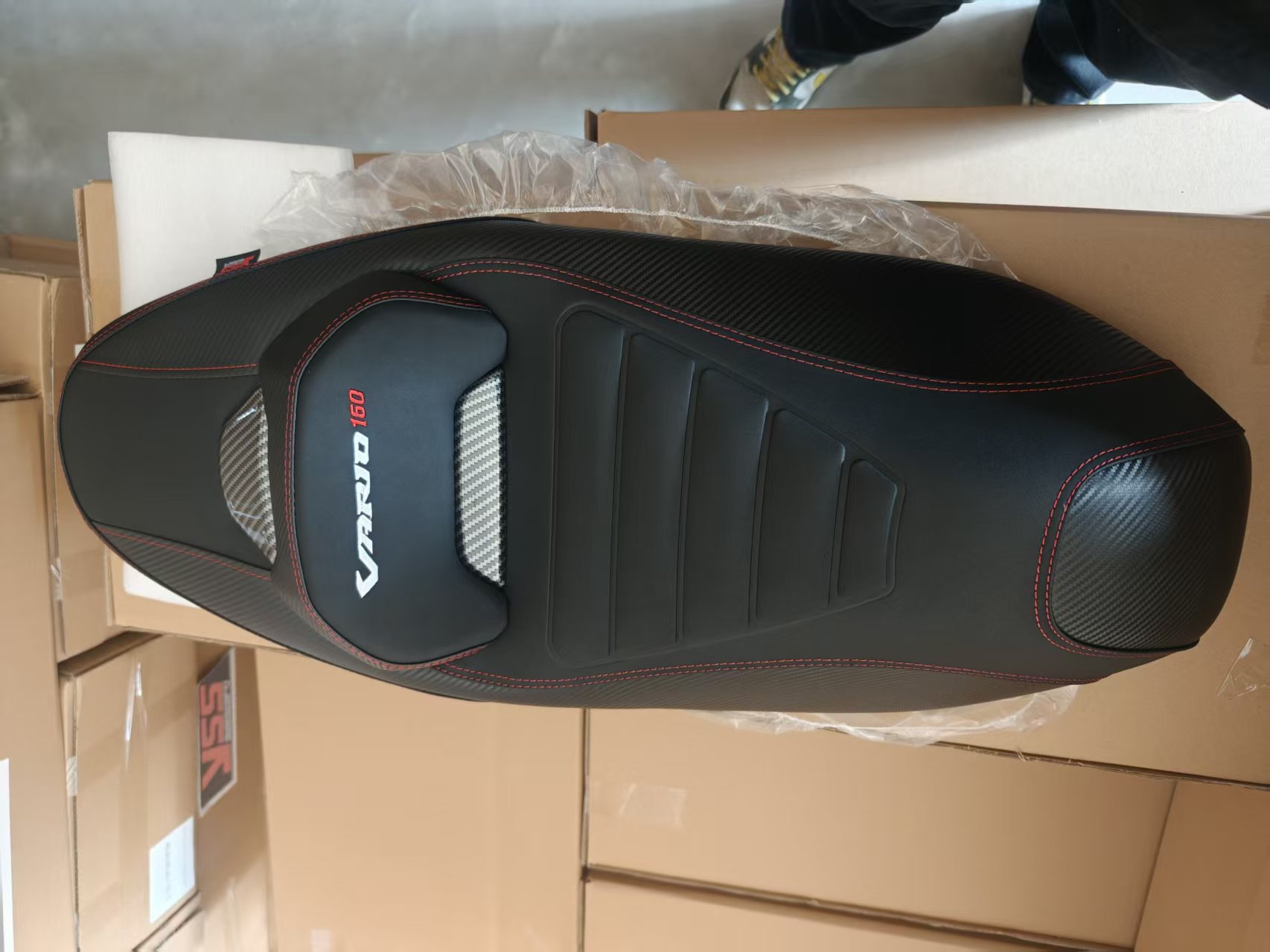
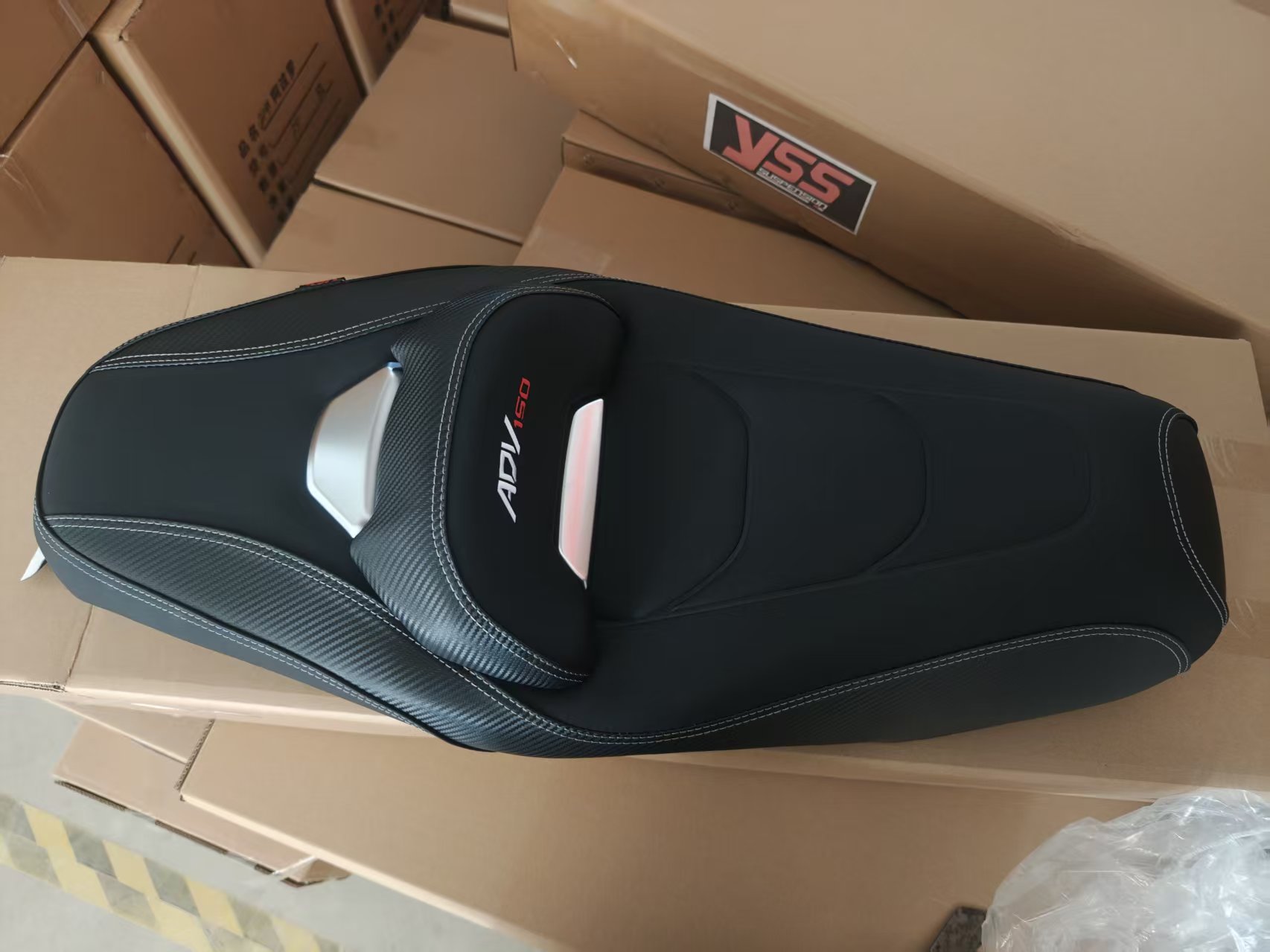
The product range covers scooter seats and dirt bike seats, with model designations including Nmax, Xmax, Aerox, ADV150, ADV160, Forza, PCX and Click. The stated application profile is replacement and maintenance of older seats, direct replacement, a comfortable riding position and visual restoration of the motorcycle's appearance — functions that place the product in a non-powered, static fitting role matched to the motorcycle main frame and body shell.
Three buyer types tend to place continuity above unit price on this kind of range:
- Repair shops and replacement retailers need recurring availability of specific model fits. A gap in one popular model costs more in lost counter sales than a small price difference across the range.
- Wholesalers and importers need predictable lead times to plan container loading and stock rotation across a multi-model catalogue.
- Brand owners and accessory labels using OEM or ODM supply need a manufacturer that can hold a specification across seasons, including customised covers, foam profiles and branding details.
In all three cases the operating conditions are similar: weather resistance, a wear-resistant surface and ergonomic design, applied to waterproof use in markets ranging from Southeast Asia to Europe, the Middle East and South America. These are not extreme requirements individually. Held consistently across thousands of units and several years, they are the requirement that separates a viable long-term supplier from a one-off low bid.
Market trend signals shaping 2026–2032 supplier decisions
Direction is more reliable than any single market-size figure. Estimates for the global motorcycle seat market diverge substantially between research houses — Dataintelo has cited around USD 4.8 billion for 2025, while Market Research Future / Dataintelo cites USD 7.42 billion. Buyers should treat the absolute number cautiously and the trend consistently: both point to growth, and the projected path to USD 13.30 billion by 2032 at an 8.69% CAGR implies sustained demand rather than a spike.
Two structural signals reinforce the continuity argument. First, Asia-Pacific dominated the motorcycle seat market with a revenue share of 38.5% in 2025, driven by high production and sales in China, per Dataintelo — meaning a large share of global supply capacity sits in one region, and scheduling competition within that region is a real planning variable. Second, the shift toward synthetic materials in the mid-range segment, noted by Fortune Business Insights, changes the durability and cost profile of a multi-year programme: specification stability becomes easier to maintain, but differentiation on material alone becomes harder.
Comparison with traditional sourcing approaches
The conventional approach to seat sourcing is rotational: collect three to five quotations, place the order with the lowest delivered cost, and repeat the exercise next season. It has real advantages — price discipline, low switching friction on commodity items, and no long-term exposure to a single plant. It also has a structural weakness that only appears over time.
| Dimension | Rotational spot sourcing | Continuity-oriented supplier relationship |
|---|---|---|
| Price discovery | Strong; regular competitive tension | Weaker per order; depends on periodic review |
| Batch-to-batch consistency | Low; specification drifts between vendors | Higher; same process, same tooling, same material source |
| Lead-time predictability | Resets with every new vendor | Improves after the first qualified cycle |
| Qualification cost | Repeated each cycle | Absorbed once and amortised |
| Exposure to supplier failure | Distributed across vendors | Concentrated in one plant |
Where the continuity model breaks down is equally important to state. A single-supplier relationship concentrates risk, and no qualification process removes that. The boundaries of the Zhejiang Xingrong offer illustrate the point.
- Order minimum and scheduling. A 50-piece minimum supports trial orders and mixed-model runs, but against a stated monthly capacity of 50,000 pieces, large seasonal programmes should be booked in advance rather than placed at short notice.
- Lead time scope. The quoted 25–35 days describes production. Ocean freight, port handling and destination customs sit outside that window and must be added by the buyer when planning stock cover.
- Warranty window. A 1-year warranty is a defined service period, not an indefinite guarantee. Buyers should confirm what it covers — material defects, workmanship, or both — and how claims are evidenced.
- Certification scope. ISO9000 is a quality management system certification and CQC is a product certification mark. Neither is equivalent to UN Regulation No. 17 (ECE R17), which establishes uniform provisions for the approval of vehicle seats, anchorages and head restraints. Buyers selling into markets that require ECE R17 type approval must confirm the applicable approval route separately.
- Model coverage. The range is built around scooter and dirt bike applications on the listed model designations. Buyers with models outside that set should confirm tooling availability before building a plan around the catalogue.
A continuity and after-sales checklist for multi-year commitments
- Request monthly capacity and seasonal booking rules, not only annual capacity.
- Confirm the minimum order quantity in writing, including how colour, material and model mix affect it.
- Define lead time with explicit start and end events, and separate production time from transit time.
- Ask for the pre-shipment testing protocol and the characteristics it covers.
- Confirm warranty length, scope and the claim evidence required.
- Map every certification held against the destination market's approval requirements.
- Request at least one completed multi-batch project with volume and duration stated.
- Confirm model coverage and tooling status for each motorcycle in your range.
- Agree the documentation set: packing list, inspection record, certificate copies.
- Set a review cadence — quarterly for the first year, then annual — with a defined trigger for re-qualification.
Checklists of this kind are only useful if they produce a decision. A buyer who completes all ten items and still cannot state which continuity layer is the weakest point in the relationship has collected documents rather than reduced risk.
Future outlook
Over the 2026–2032 horizon, the motorcycle seat market's projected growth implies continued pressure on manufacturing capacity in Asia-Pacific, where 38.5% of 2025 revenue was concentrated. For buyers, that arithmetic has a predictable consequence: the factories worth keeping are the ones that will be asked to choose between accounts during peak periods. Long-term supply security will depend less on finding a cheaper quote and more on being a predictable, well-documented customer with a stable specification.
Two developments are likely to shape how supplier longevity is assessed. The first is material standardisation in the mid-range segment, which makes specification drift easier to detect and therefore easier to contract against. The second is a gradual tightening of expectations around regulatory documentation in regulated markets, where quality management certification alone does not answer a type-approval question. Suppliers that can separate the two clearly — here is our quality system, here is our product certification, here is what we hold and what we do not — will be easier to qualify and easier to keep.
Frequently asked questions
What does supplier longevity mean for a motorcycle seat programme?
Supplier longevity is the verified ability of a seat manufacturer to keep supplying a conforming product across successive orders, not the number of years it has operated. It has three components: delivery continuity, meaning each shipment arrives on time and matches the approved sample; capacity continuity, meaning the plant can absorb order growth without displacing the account; and after-sales continuity, meaning a defined warranty and claim route exists. A manufacturer can be strong on one layer and weak on another, so the three are normally assessed separately.
Which capacity and order terms should be confirmed before committing?
Zhejiang Xingrong Auto & Motorcycle Parts Co., Ltd. states an annual seat cushion production capacity of 1,800,000 units, a monthly capacity of 50,000 pieces, a minimum order quantity of 50 pieces and lead times of 25–35 days. Its product accessory self-production rate is 90%, which affects how many delivery dates depend on outside sub-suppliers. Buyers should confirm all four figures in writing and clarify whether the stated lead time covers production only or includes freight and customs clearance.
How should pre-shipment testing and warranty be verified?
The company reports 100% pre-shipment testing, meaning inspection is applied to every shipment rather than to a sample. Verification means requesting the inspection record format and the list of characteristics checked — for example stitching, cover adhesion, foam resilience and mounting hole alignment. The warranty period is 1 year; buyers should confirm in advance what it covers, whether material and workmanship defects are both included, and what evidence a claim requires.
Do ISO9000 and CQC cover every market requirement?
No. ISO9000 is a quality management system certification and CQC is a product certification mark; both are held by Zhejiang Xingrong Auto & Motorcycle Parts Co., Ltd. Neither is the same as UN Regulation No. 17 (ECE R17), which sets uniform provisions for the approval of vehicle seats, anchorages and head restraints. A buyer selling into a market that requires ECE R17 type approval must confirm the applicable approval route separately from the supplier's quality and product certifications.
What evidence shows a factory can repeat a large order?
Xingrong reports a 5,000-piece motorcycle seat project for a Lebanon-based customer completed within two years. For a buyer, the value of that reference lies in repetition rather than volume: a programme delivered across multiple batches over an extended period tests whether specification, material and fit hold steady after the first shipment. It does not by itself prove performance under a different model mix or material specification, which is why a buyer's own sample approval and first-order inspection remain necessary.
Closing note
Supplier longevity is built from evidence a buyer can check, not from a claim a supplier can repeat. Capacity figures, order minimums, testing routines and warranty terms are all verifiable before a multi-year commitment — and each one answers a different part of the continuity question. The full seat cushion range, model coverage and specification details are set out in the STARON seat cushion catalogue.
Tem questões ou precisa de mais detalhes?
Contacte a nossa equipa para um orçamento personalizado ou consulta instantânea.
Solicitar orçamento
Preencha o formulário abaixo e a nossa equipa entrará em contacto com uma proposta personalizada.
Chat direto do WhatsApp
Prefere conversar em tempo real? Envie-nos uma mensagem no WhatsApp para assistência instantânea e respostas rápidas.
- Obter orçamento personalizado
- Partilhar fotos ou documentos
- Discuta as suas necessidades diretamente
Geralmente responde em 5–30 minutos durante o horário de expediente.