
Motorized Ball Valve Capability Evidence: Tianfei High-Tech
Motorized Ball Valve Capability Evidence: Tianfei High-Tech
Capability claims are easy to publish and hard to check. For a buyer evaluating motorized ball valves at the procurement stage, the useful question is not whether a supplier describes itself as a strong manufacturer, but which specific facts — model ranges, torque figures, pressure limits, protection ratings, certificates and completed project outcomes — can be inspected before an order is placed.
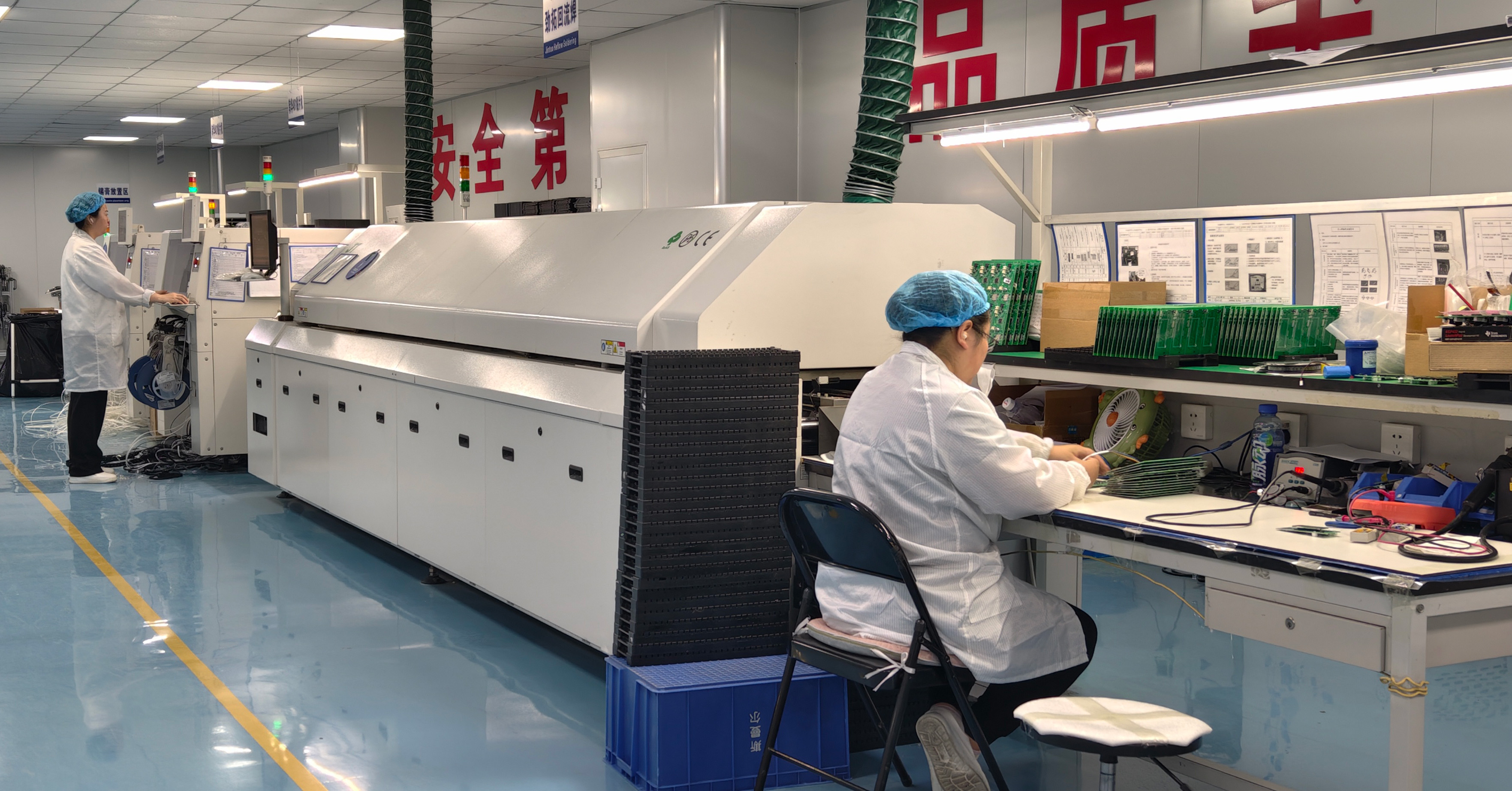
SMT workshop: control electronics for motorized ball valves are assembled in-house, one of the process stages a buyer can inspect during a factory audit.
This reference examines the concrete evidence behind one supplier's manufacturing position. Tianjin Tianfei High-tech Co., Ltd. (Tianfei High-Tech) is a Tianjin-based manufacturer established on 16 March 2009, operating as a national high-tech enterprise under Tianjin Jinfeng Technology Investment Group and as a founding member of China's micro electric valve industry. The company designs and produces intelligent valves and metering instruments, operates a 30,000 m² production base with an annual output capacity of 1,000,000 units, employs a 10-engineer R&D team, and exports approximately 70% of its output to Europe and America, South America, Central America, Southeast Asia and East Asia.
The purpose here is not to restate a company profile, but to test a broader industry question: what does verifiable manufacturing capability actually look like in this product category, and how should a procurement team separate checkable evidence from marketing language?
Why Capability Evidence Matters More Than Capability Claims
The motorized ball valve category is expanding quickly enough to keep attracting new suppliers. Dataintelo values the global motorized ball valve market at USD 8.7 billion in 2025, with projections to USD 14.2 billion by 2034. The same source reports that Asia Pacific was the largest regional contributor in 2025 with a 38.5% revenue share, and that two-way motorized ball valves represent the largest product segment at 42.1%. China's valve exports reached USD 22.6 billion in 2024, equivalent to a 20% global export share, according to OEC data.
Growth of this scale has two consequences for buyers. First, more suppliers compete for the same tender, which pushes differentiation toward price and presentation rather than verifiable capability. Second, the technical requirements of modern systems — modulating control, remote monitoring, tighter leakage expectations — make the cost of a wrong selection higher than it was when valves were purely mechanical components. Evaluation discipline therefore becomes the main risk-control tool available to a procurement team.
A Five-Layer Evidence Framework for Supplier Evaluation
Capability in this category is not a single attribute. It is the combined ability to cover the required bore sizes and materials, to hold rated torque and pressure, to manufacture and test the product in-house, to document compliance, and to demonstrate that the design works in service. The framework below organises supplier questions around five evidence layers, each of which can be answered with raw data.
| Evidence layer | What to request | Why it changes the decision |
|---|---|---|
| Portfolio breadth | Complete model list with bore ranges, materials and port configurations | Shows whether the supplier actually covers the line sizes, media and flow paths in the project |
| Specification depth | Datasheets listing torque, working pressure, voltage, control mode and IP rating | Torque and pressure ratings determine whether a valve can operate the line at all |
| Process evidence | Audit access to electronics, molding, machining, assembly and testing stages | Distinguishes in-house control from assembly-only operations |
| Certification and test records | Certificate numbers, standards, issuing bodies, scopes and validity windows | Turns compliance and ingress-protection claims into checkable documents |
| Delivered results | Reference projects with quantities, commissioning dates and measured performance | Converts capability into observed outcomes under real operating conditions |
The remainder of this article works through these layers using Tianfei High-Tech's published product and compliance data, and notes where the evidence stops short of a general claim.
Layer 1 and 2: Portfolio Breadth and Specification Depth
A supplier's model range is the first item that can be checked without visiting a factory. Range matters because a narrow portfolio forces buyers into mixed sourcing, which multiplies approval work, spare-part inventories and supplier management overhead. Tianfei High-Tech's published range covers threaded ball valves from DN15 to DN100, large-bore butterfly valves up to DN500, thermostatic control valves, leak-alarm valves, wireless smart valves and leak detection sensors.
The CWX-60P platform: 2-way and 3-way configurations
The CWX-60P is the higher-torque platform in the range, and it is available in two flow-path configurations. The CWX-60P two-way motorized ball valve covers DN15–DN100 with 20 N·m of torque, accepts AC220V or DC24V, supports both modulating (0-10V / 4-20mA) and on/off control, carries an IP67 rating, and is rated to a working pressure of ≤1.6 MPa in brass or SS304. Its stated application areas are central air conditioning, industrial refrigeration, HVAC and energy management.
The CWX-60P three-way motorized ball valve covers DN15–DN50, also at 20 N·m, with T-port or L-port flow paths, AC220V or DC24V supply, IP67 protection and the same ≤1.6 MPa pressure rating in brass or SS304. Three-way units are used where flow must be diverted, mixed or switched rather than simply opened and closed — central air conditioning mixing, floor heating distribution, industrial fluid switching and water treatment. For a buyer, the relevant fact is that both configurations reach 20 N·m in a compact body, which is the torque class normally associated with larger-bore or higher-resistance flow paths.
Large-bore coverage: the CTB flange butterfly valve
Bore size is where many otherwise capable suppliers stop. The CTB flange butterfly valve extends the range from DN50 to DN500 with torque from 30 to 500 N·m, flanged connections in PN6, PN10 and PN16, an IP67 rating and a working pressure of ≤1.6 MPa. Body and disc materials are cast iron or SS304, and the stated application areas are municipal water and wastewater, power plant cooling, marine seawater and heavy industry.
Two aspects of that specification are worth highlighting during evaluation. First, the torque range scales with bore — a DN500 butterfly valve requires an actuator in the hundreds of newton-metres, which indicates the supplier builds or sources actuator output across a wide band rather than a single size. Second, the flange rating and pressure ceiling define the pipelines the product can serve; a DN500 valve rated to PN16 and 1.6 MPa belongs in municipal and heavy industrial water systems, not in high-pressure process lines.
Material-specific coverage: CTF-001 in PVC
Corrosive media are usually the point at which a general valve range fails. The CTF-001 PVC motorized ball valve is a two-way, corrosion-resistant unit covering DN15–DN50 with 3 N·m of torque, AC85-265V or DC9-24V supply, normally-closed or normally-open control, IP65 protection, a working pressure of ≤0.8 MPa and a PVC body. Its stated use cases are acid and alkali media, swimming pools, chemical piping and wastewater treatment. The same CTF-001 platform is offered in compact brass or SS304 versions rated to ≤1.0 MPa for drinking water, food sanitation, building automation and solar systems.
| Model | Type | Size range | Torque | Pressure / IP | Typical applications |
|---|---|---|---|---|---|
| CWX-60P (2-Way) | 2-way motorized ball valve, high torque | DN15–DN100 | 20 N·m | ≤1.6 MPa / IP67 | Central A/C, industrial refrigeration, HVAC, energy management |
| CWX-60P (3-Way) | 3-way motorized ball valve, T/L port | DN15–DN50 | 20 N·m | ≤1.6 MPa / IP67 | Central A/C mixing, floor heating distribution, fluid switching, water treatment |
| CTB (Flange) | Flanged motorized butterfly valve | DN50–DN500 | 30–500 N·m | ≤1.6 MPa / IP67 | Municipal water and wastewater, power plant cooling, marine seawater, heavy industry |
| CTF-001 PVC | 2-way motorized ball valve, PVC body | DN15–DN50 | 3 N·m | ≤0.8 MPa / IP65 | Acid/alkali media, swimming pools, chemical piping, wastewater treatment |
| CWX-25S | 2-way motorized ball valve, large bore | DN25–DN80 | 10 N·m | ≤1.6 MPa / IP67 | Chemical, petroleum, pharma, desalination, food processing |
Additional lines within the same portfolio include the CWX-15N and CWX-15S (DN15–DN50, 3 N·m), the CWX-20P (DN20–DN50, 5 N·m), the CTB two-way ball valve with manual override (DN15–DN100, 6 N·m), the CTB wafer-type butterfly valve (DN50–DN300, 20–200 N·m, 4-20mA modulating), a self-operated thermostatic valve (DN15–DN32, 20–80 °C, ±1 °C), a leak alarm shut-off valve (DN15–DN25, DC12V), a WiFi smart water valve (DN15–DN25, WiFi 2.4 GHz, Tuya Smart / SmartLife / Alexa / Google Home, IP54) and wired and wireless leak detection sensors.
Technical Explanation: How to Read These Specifications
Torque is the constraint that decides feasibility
Actuator torque must overcome the resistance of the ball or disc, the seat friction and the differential pressure across the valve. This is why a range that combines 3 N·m compact valves with 20 N·m three-way valves and 500 N·m flanged butterfly valves is materially different from a range built around a single actuator size. For an engineer, the practical check is whether the required bore, media and differential pressure fall inside a torque rating the supplier publishes, not merely whether a model exists at that bore size.
Port configuration determines the fluid path
Two-way valves open and close a single line. Three-way valves with T-ports or L-ports divert or mix flow between two lines, which is why they appear in central air conditioning mixing and floor heating distribution. Specifying a three-way valve where a two-way valve would suffice adds cost and failure modes; specifying a two-way valve where diversion is required simply does not work. The CWX-60P platform covers both, which reduces the number of distinct actuator families a project must carry.
Control mode, voltage and system integration
Modern valve selection is as much about signal compatibility as mechanical fit. The CWX-60P and CTB wafer butterfly lines support modulating control at 0-10V or 4-20mA alongside simple on/off operation, and the CTF-001 and CWX-15N platforms offer normally-closed, normally-open or hold behaviour. Voltage coverage spans AC220V and DC24V on the industrial lines, AC85-265V or DC9-24V on the CTF-001, and DC12V or DC24V on the CWX-15N. Wide-input AC85-265V units reduce the risk of mismatch in retrofit projects where supply characteristics vary by site.
IP ratings should be matched to the installation environment
Ingress protection is defined under the IEC 60529 framework. Within this portfolio, IP44 applies to wired and wireless leak sensors, IP54 to the WiFi smart water valve, IP65 to the CWX-15N, CWX-15S, CWX-20P and CTF-001 platforms, and IP67 to the CWX-25S, CWX-60P and CTB families. The engineering implication is straightforward: IP65 products suit protected indoor and equipment-room environments, while IP67 products are specified where washdown, condensate or temporary immersion is expected — municipal pits, cooling systems and heavy industrial areas.
Layer 3 and 4: Process and Certification Evidence
The second half of a capability evaluation moves from data sheets to production and documentation. Tianfei High-Tech's process chain, as documented in its own materials, covers SMT electronics assembly, injection molding, machining, final assembly, destructive testing and warehouse logistics. That sequence matters because it indicates where value is added internally rather than purchased as a finished assembly.
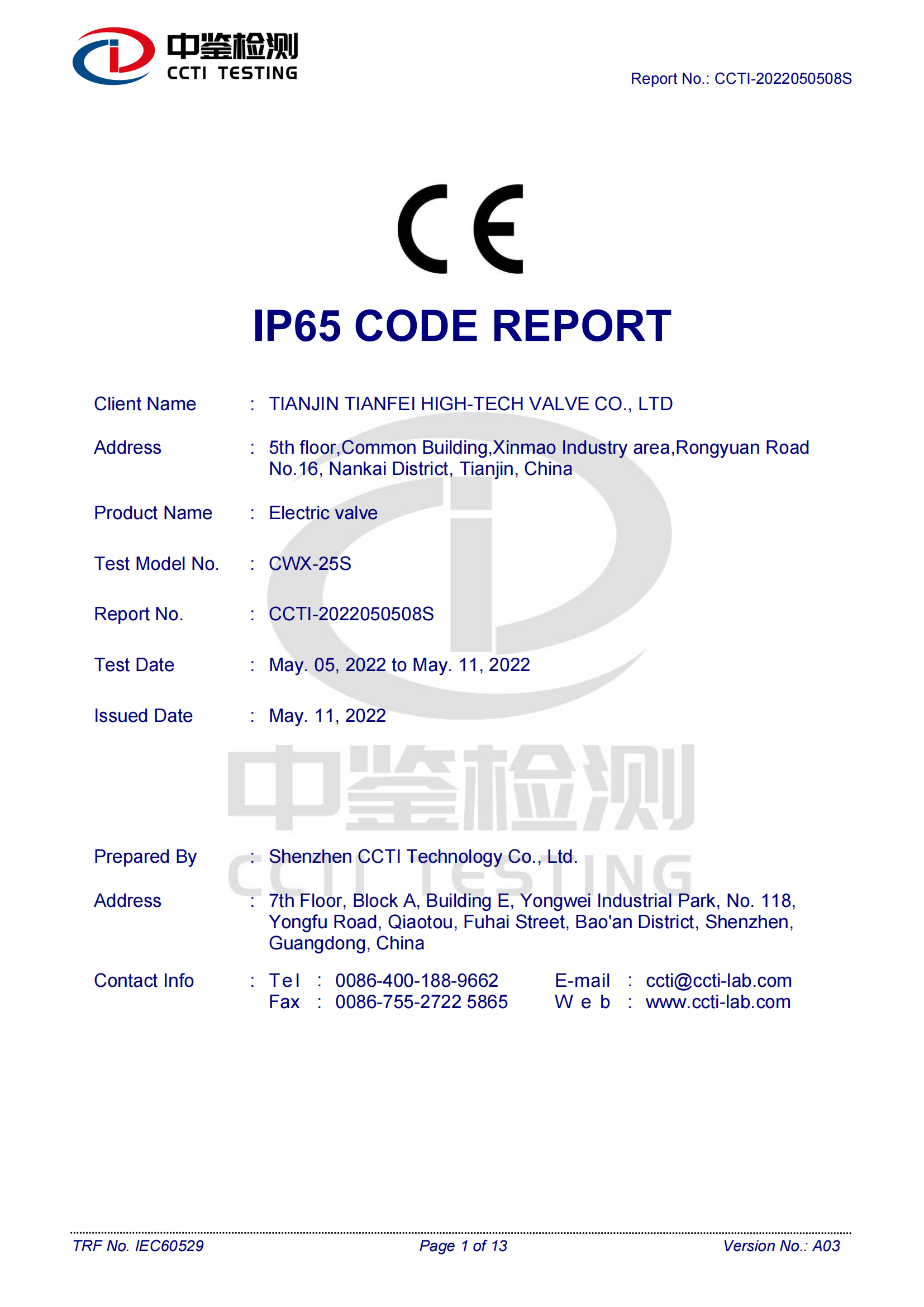
Certification and test documents, such as the IP65 code report issued under IEC 60529, allow buyers to verify protection claims rather than accept them.
Manufacturing capability also has a commercial dimension that buyers can plan against. The company's capability record lists OEM production with voltage and logo customization, a monthly capacity of 8,000 units, a lead time of 30 days, a minimum order quantity of 2 units, 100% testing of production, and export markets concentrated in the EU and the Middle East.
| Document | Number | Standard / scope | Issuing body |
|---|---|---|---|
| Certificate of Compliance (CE) | BCTC-FY161004871C | EN 60335-1:2012+A11:2014; motorized valves including CWX-15Q/N (AC), CWX-25S, CWX-50P, CWX-60P, CTF-001, CTF002, CTF010 and CTB series | Shenzhen BCTC Technology Co., Ltd. |
| Certificate of Compliance (RoHS 2.0) | CCTI-2021112302C | IEC 62321 series; CWX-25S, CWX-60P, CWX-15Q/N, CWX-20P, CWX-50P and water leakage detection valve | Shenzhen CCTI Technology Co., Ltd. |
| Certificate of Compliance (RoHS 2.0) | CCTI-2021112301C | IEC 62321 series; CTF-001 and CTF-001 smart water valve | Shenzhen CCTI Technology Co., Ltd. |
| IP65 code report | CCTI-2022050508S | IEC 60529; electric valve CWX-25S | CCTI Testing |
| Quality management system | 04620Q15496R1S | GB/T 19001-2016 / ISO 9001:2015; development, design and production of electric valves | Beijing Head International Certification Co., Ltd. |
| Environmental management system | 19522E39814R0S | GB/T 24001-2016 / ISO 14001:2015 | Beijing Kun Biao Certification & Inspection Co., Ltd. |
| Occupational health and safety system | 19522S39815R0S | GB/T 45001-2020 / ISO 45001:2018 | Beijing Kun Biao Certification & Inspection Co., Ltd. |
| Invention patent | ZL 2018 1 1623664.8 (Certificate No. 3754970) | A flow control valve capable of closing instantly | State Intellectual Property Office of China |
The management-system certificates carry defined validity windows rather than open-ended status: the records list 7 November 2023 as the expiry of the ISO 9001 certificate and 12 October 2025 as the expiry of the ISO 14001 and ISO 45001 certificates. Buyers should request confirmation of current renewal status directly, because a certificate number alone does not establish that a system is certified today. The product-level documents follow the same principle — the CE certificate was issued under the EN 60335-1:2012+A11:2014 edition, and EU-market buyers should confirm that the applicable edition and scope still match their project requirement.
Layer 5: Delivered Project Evidence
Reference projects are the only evidence layer that shows how a product behaves after commissioning. The documented case in this portfolio involves a large European municipal water group in France. The customer inspected the factory in October 2024 and approved the production and quality control system; a 10,000-unit order was signed in November 2024 and delivered within three months. The project was commissioned in November 2024 and, per the case record, has operated stably for more than 16 months with zero major failures.
The measured results reported for the installation include 4-20mA regulation, a response time of ≤0.5 seconds, flow control error within ±2%, zero leakage, a 40% reduction in maintenance cost and annual electricity savings of more than 120,000 kWh. The case also records on-site installation guidance, commissioning training and remote technical support, and notes entry into the French water sector with IoT integration for remote operation, data collection and early warning. The product lines associated with this deployment are the CTB platform: the CTB motorized ball valve, the CTB flange butterfly valve and the CTB wafer-type butterfly valve.
For procurement purposes, the value of this record is not the headline number of units. It is that a municipal utility with its own inspection process approved the production system before the order was placed, and that the reported performance figures — response time, flow error, leakage and maintenance cost — are specific enough to be referenced in a future specification or challenged during a follow-up audit.
Market Trend Analysis: What Buyers Will Be Asked to Verify Next
Two trends are reshaping specification requirements. The first is instrumentation. The Insight Partners projects the IoT valve market to reach USD 2.85 billion by 2031, growing at a CAGR of 10.4% from 2023. As valves acquire communication and diagnostics functions, the ability to manufacture and test control electronics in-house becomes part of the capability question rather than a separate one — which is why SMT production and 100% testing records carry more weight than they did for purely mechanical valves.
The second trend is regulatory. Motorized valves sold into the EU market must comply with CE marking under EN 60335-1 and with RoHS 2.0 under IEC 62321. Because those requirements attach to specific models and editions, compliance evidence has become model-level rather than company-level: a supplier's broader portfolio may be certified while the specific configuration a buyer needs is not.
Both trends point in the same direction. The evidence a supplier can produce will increasingly determine whether it survives shortlisting, and the practical differentiator is documentation quality rather than catalogue size.
Comparison With Traditional Solutions, and Where the Limits Are
Motorized valves are not automatically the right answer, and a capability assessment should include the option of not using them.
| Consideration | Manual valve | Motorized ball valve |
|---|---|---|
| Remote or scheduled operation | Requires site attendance | Supports on/off or modulating control from a control system |
| Power and signal dependency | None | Requires supply and, for modulating duty, a control signal |
| Leak detection integration | Manual response only | Can be linked to leak sensors and alarm shut-off valves |
| Maintenance profile | Mechanical wear, manual inspection | Adds actuator and electronics to the maintenance scope |
Compared with solenoid valves, motorized ball valves generally offer a different trade-off: a ball valve typically presents lower flow resistance and can hold position without continuous energisation in on/off designs, while solenoid designs are typically faster and simpler where only open/close duty at small bores is required. The correct choice depends on the duty cycle, media and control philosophy of the specific line.
Boundaries in this portfolio are equally specific and should be stated plainly:
- The CTF-001 PVC valve is limited to DN15–DN50 and a working pressure of ≤0.8 MPa. It is not a substitute for metal-bodied valves in higher-pressure or larger-bore lines.
- The CTB flange butterfly valve reaches DN500 and 500 N·m, but its pressure ceiling remains ≤1.6 MPa and its flange ratings are limited to PN6, PN10 and PN16. Higher-pressure process duty falls outside this range.
- Ingress protection is not uniform across the portfolio. IP44 and IP54 products are unsuitable for washdown or immersion environments; IP67 should be specified in those locations.
- The wireless smart valve is battery-powered at DC6V (four AA batteries) or DC5V USB and rated IP54, so it suits domestic and light commercial water control rather than industrial plant rooms.
- Positioning should be read honestly. Emerson Electric Co. is identified by Mordor Intelligence as a global market leader in the final control and smart valve segment. Tianfei High-Tech competes from the micro and small electric valve base, with a documented capacity of 8,000 units per month and a 30-day lead time — a scale suited to defined projects and OEM programmes rather than to every category of demand.
Future Outlook
The direction of the category is toward valves that report on themselves: modulating actuators, remote monitoring interfaces, leak detection that triggers automatic shut-off, and control electronics that must be manufactured and tested to the same discipline as the mechanical body. Suppliers that already operate electronics assembly, molding, machining and testing under one production system are structurally better placed for that shift than suppliers that assemble purchased components.
For buyers, the practical consequence is that supplier evaluation will keep moving toward document-level verification — certificates with current validity, test reports tied to specific models, and project data with measurable outcomes. Capability will increasingly be judged by what a supplier can show, not by what it can claim, and the suppliers most likely to be shortlisted are those whose evidence is complete enough to be audited without preparation.
FAQ
1. What documents should a buyer request to verify a motorized ball valve manufacturer's capability?
A verification package typically includes management-system certificates with numbers, standards and current validity status; product-level compliance documents such as CE and RoHS certificates with the standards and model scopes they cover; an ingress-protection test report tied to a specific model, such as the IP65 code report issued under IEC 60529 for the CWX-25S; datasheets stating torque, working pressure, voltage, control mode and IP rating per model; confirmation of in-house production stages and testing policy; and reference project records with quantities, commissioning dates and measured outcomes. Each document should be checked against the specific configuration being purchased, because compliance evidence is model-level rather than company-level.
2. Which product lines cover large-bore and high-torque applications?
Large-bore coverage in this portfolio is provided by the CTB flange butterfly valve, which spans DN50–DN500 with 30–500 N·m of torque, PN6/PN10/PN16 flanged connections, IP67 protection and a working pressure of ≤1.6 MPa in cast iron or SS304. The CTB wafer-type butterfly valve covers DN50–DN300 with 20–200 N·m and 4-20mA modulating control. Within ball valve lines, the CWX-25S covers DN25–DN80 at 10 N·m, and the CWX-60P two-way valve covers DN15–DN100 at 20 N·m. Bore size alone is not sufficient; the rated torque and pressure must also match the line conditions.
3. How should IP ratings be matched to installation environments?
Ingress protection ratings follow the IEC 60529 framework. In this portfolio, IP44 applies to wired and wireless water leak sensors, IP54 to the WiFi smart water valve, IP65 to the CWX-15N, CWX-15S, CWX-20P and CTF-001 platforms, and IP67 to the CWX-25S, CWX-60P and CTB families. IP65 products suit protected indoor locations and equipment rooms, while IP67 products are intended for environments with washdown, condensation or temporary immersion, such as municipal pits, cooling systems and heavy industrial areas. Selecting a lower rating than the environment requires is a common and avoidable specification error.
4. What are the working limits of PVC-bodied motorized ball valves?
The CTF-001 PVC motorized ball valve covers DN15–DN50 with 3 N·m of torque, AC85-265V or DC9-24V supply, normally-closed or normally-open control, IP65 protection and a working pressure of ≤0.8 MPa. Its stated applications are acid and alkali media, swimming pools, chemical piping and wastewater treatment. Because both the bore range and the pressure ceiling are limited, this model is not interchangeable with metal-bodied valves in higher-pressure or larger-diameter lines; where those conditions apply, brass, SS304 or cast iron alternatives are required instead.
5. What production capacity, lead time and customization options apply?
The documented capability record lists a monthly capacity of 8,000 units, a lead time of 30 days, a minimum order quantity of 2 units, 100% testing of production, OEM customization of voltage and logo, and export markets concentrated in the EU and the Middle East. These figures describe production and commercial parameters rather than guaranteed delivery for every configuration, so buyers should confirm current scheduling for the specific model, quantity and customization scope during quotation.