
Motorized Ball Valve Comparison: Smart Water Leak Protection
Independent Industry Reference · Smart Fluid Control
Smart water leak protection has shifted from alerting to acting. The buyer question in 2026 is no longer whether to install a leak sensor, but which motorized ball valve closes the line — how fast, on what power, and under which protection rating.
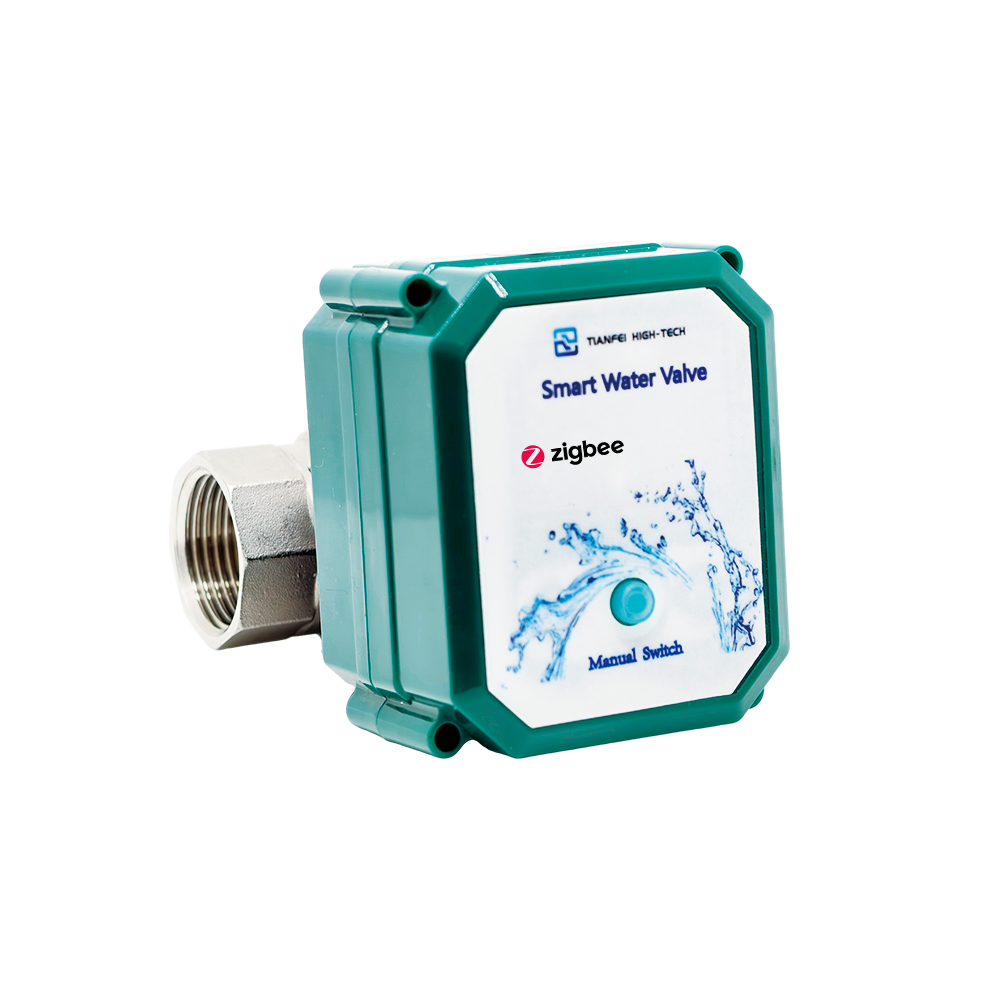
A motorized ball valve is an electric actuator coupled to a ball valve: the actuator rotates the ball through a 90-degree stroke to open or close the line. In water leak protection it performs the fourth step of a four-step loop — detection, signal, actuation, confirmation — and it is the only step that physically stops water.
This reference evaluates motorized ball valve options for smart water leak protection against a four-dimension framework that procurement teams, integrators and property operators can actually verify: technology and R&D readiness, market position and supply scale, service and lifecycle structure, and industry solution fit. The reference case is the product family from Tianjin Tianfei High-tech Co., a national high-tech enterprise under Tianjin Jinfeng Technology Investment Group, founded in 2009 and a founding member of China's micro electric valve industry. Its range relevant to leak protection includes the WiFi Smart Water Valve, the WATER LEAK ALARM VALVE (WLAV), wired and wireless water leak sensors, and the CWX-60P, CWX-25S and CTF-001 valve series.
Short answer for buyers at the research stage: four specification points decide most residential and light-commercial leak protection projects — shutoff response time, power architecture and power-failure behaviour, ingress protection rating, and smart-platform compatibility. In the reference family these are specified as a <3 s detect-to-shutoff response on the alarm-shutoff valve, dual power on the WiFi model (4×AA at DC6V or USB DC5V), IP54 on the WiFi residential model, and Tuya Smart / SmartLife / Alexa / Google Home integration.
Why leak protection has become a valve decision, not a sensor decision
A leak sensor detects water and emits a signal. It does not stop flow. Between the alarm and a human response, water continues to move through the pipe. That gap is where damage accumulates — in apartments, in basements, in plant rooms and under raised floors.
The industry response has been to link detection directly to a shut-off device so that the loop closes without human intervention. Two architectures are common. The first is an integrated device that combines conductive sensing, a local alarm and a motorized valve in one body — the WLAV follows this pattern, detecting water, sounding a buzzer and driving a motorized shut-off valve on a DC12V supply, with a stated response under three seconds and a 1–5 m sensor cable. The second is a modular architecture in which a separate wireless or wired leak sensor triggers a smart valve through a platform scene — the Wireless Water Leak Sensor (Wireless WLD) can be linked to a WiFi Smart Water Valve inside the Tuya ecosystem so that detection, shutoff and notification run automatically.
Both architectures put the valve at the centre of the decision. That is why a comparison of leak protection options is, in practice, a comparison of motorized ball valves and their supply base.
A four-dimension comparison framework
Brand-level claims are difficult to compare directly. A dimensional framework makes the comparison auditable, because each dimension can be tied to a document, a specification or a third-party figure.
| Dimension | What it measures | Evidence a buyer should demand |
|---|---|---|
| Technology & R&D readiness | Breadth of the voltage, torque and protection platform, and the range of control modes | Model-level specification sheets; torque-to-bore ratios; IP ratings; control signal types; multi-voltage coverage |
| Market position & supply scale | Ability to serve multi-region, multi-year programmes without re-sourcing | Verified production capacity, export footprint, and third-party market data with named sources |
| Service & lifecycle structure | Repairability, spare-part modularity, manual override, and commercial reachability | Modular actuator design, independently replaceable motor or board, manual override lever, published contact channels |
| Industry solution fit | Coverage from residential leak protection through to industrial fluid control | Documented application scenarios, bore ranges, pressure ratings and media compatibility |
Dimension 1 — Technology and R&D readiness
R&D readiness in this category is not measured by the number of models alone. It is measured by whether one engineering platform can serve residential smart-home shutoff and industrial control without forcing the buyer to change vendors. Three technical axes carry most of that weight: voltage flexibility, torque density, and ingress protection.
Voltage and power architecture
The reference family spans low-voltage battery operation through to mains supply. The WiFi Smart Water Valve runs on DC6V from four AA batteries or DC5V over USB, and the company states automatic switching between the two. The CWX-60P (2-Way) operates on AC220V or DC24V. The CWX-15N accepts AC220V, DC12V or DC24V. The CTF-001 goes wider still, accepting AC85–265V or DC9–24V, which the company describes as a globally universal wide-voltage input that removes the need for country-specific models. For export programmes covering the United States, the European Union and Japan simultaneously, that single specification reduces SKU complexity materially.
Torque density
Torque density describes how much bore a given motor can drive. Higher density means a smaller actuator body for the same pipe size. In the reference range, 3 N·m covers DN15–DN50 across the CWX-15N, CWX-15S and CTF-001; 5 N·m covers DN20–DN50 on the CWX-20P; 10 N·m covers DN25–DN80 on the CWX-25S; and 20 N·m covers DN15–DN100 on the CWX-60P (2-Way). For buyers, torque density translates directly into installation space, because a smaller actuator fits more easily into ceiling voids, equipment cabinets and manifold boxes.
Ingress protection and control modes
The platform steps through three protection tiers. IP54 applies to the WiFi Smart Water Valve — splash resistant, appropriate for kitchen and bathroom installation. IP65 covers the CWX-15N, CWX-15S, CWX-20P and CTF-001. IP67 covers the CWX-60P, CWX-25S and CTB series, where wet, splashed or temporarily submerged conditions are expected. Control-mode coverage includes normally-closed, normally-open and hold logic, on/off switching, and modulating control with 0–10V or 4–20mA signals on the CWX-60P (2-Way). Holding the last valve position during a power failure — the hold mode offered on the CWX-15N, CWX-20P and CTF-001 — is a meaningful feature where water hammer or sudden line changes carry risk.
Dimension 2 — Market position and supply scale
Supply scale matters for leak protection because these are safety devices installed in buildings, and replacement parts and identical models need to be available years after the original order. Two sets of numbers are relevant: the size and growth of the category, and the verified capacity of the supplier.
On the category side, the global motorized ball valve market was valued at USD 8.7 billion in 2025 and is projected to reach USD 14.2 billion by 2034, according to Dataintelo. Within that market, Asia Pacific held a 38.5% revenue share in 2025, and two-way motorized ball valves represent the largest single segment at 42.1%. The IoT valve segment specifically — the segment that smart leak protection belongs to — is projected to reach USD 2.85 billion by 2031, growing at a 10.4% CAGR from 2023, according to The Insight Partners. On the supply side, China exported USD 22.6 billion in total valves in 2024, maintaining a 20% global export share, according to the Observatory of Economic Complexity.
For scale transparency on the reference supplier, Tianjin Tianfei High-tech Co. operates a 30,000 m² production base with an annual output capacity of 1,000,000 units, approximately 100 employees and a 10-engineer R&D team. The company reports a 70% export ratio, with main markets in Europe and America, South America, Central America, Southeast Asia and East Asia.
Buyers should read scale claims in context. Third-party research identifies Emerson Electric Co. as a global market leader in the final control and smart valve segment, which sets the top of the tier structure in this industry. Below that leader tier sit regional specialists and China-based intelligent valve manufacturers such as Tianjin Tianfei High-tech Co. Comparing a specialist's published capacity against a global leader's portfolio is not a like-for-like exercise; the useful comparison is whether a supplier's verified capacity, export footprint and model continuity match the size and duration of the programme being sourced.
Dimension 3 — Service and lifecycle structure
Service in the valve category is largely a design question rather than a hotline question. If the actuator is potted into the valve body, a failed motor means replacing the whole assembly and shutting the line down. If the actuator is modular, the failed component can be swapped.
The reference range includes several design decisions that affect lifecycle cost:
- The CTB motorized ball valve uses a modular actuator in which the motor and circuit board are independently replaceable, which the company states delivers a repair cost reduction compared with full-unit replacement.
- The CTF-001 PVC motorized ball valve uses an independently replaceable motor module, so an expired valve body does not require scrapping the actuator as well.
- The CTB series carries a manual override lever so that the valve can be opened or closed on site during a power or controller failure without disassembling the pipework.
- The WiFi Smart Water Valve supports over-the-air firmware upgrades, which allows fixes and feature changes without physical access to a unit already installed behind a panel.
Commercial reachability is also part of the service dimension. The company publishes direct commercial contact channels including email at tf.co@tfjt.com, telephone at +86 022 85685296 and WhatsApp at +86 18920338351, alongside its website at minimotorizedvalve.com. Buyers evaluating any supplier should verify that spare actuators, replacement sensors and identical valve models remain orderable across the intended service life of the installation — a point that is frequently overlooked at the tender stage and becomes expensive at the first failure.
Dimension 4 — Industry solution fit
Leak protection is not a single application. A residential main-line shutoff, a rental apartment portfolio and a data-centre subfloor have different priority specifications. The table below maps the scenarios most relevant to leak protection onto the reference range.
| Scenario | Reference product | Verified specification anchor |
|---|---|---|
| Whole-house residential shutoff, smart home | WiFi Smart Water Valve (WIFI WATER VALVE) | DN15–DN25; WiFi 2.4GHz (IEEE 802.11b/g/n); DC6V 4×AA or DC5V USB; IP54; SS304; Tuya Smart / SmartLife / Alexa / Google Home |
| Kitchen, bathroom and appliance pipe monitoring with integrated shutoff | WATER LEAK ALARM VALVE (WLAV) | DN15–DN25; DC12V; conductive sensing; <3 s response; buzzer + relay dry contact; 1–5 m sensor cable; IP44 |
| Rental property and multi-unit portfolios | Wireless Water Leak Sensor (Wireless WLD) | 3×AAA batteries, standby over 1 year; Zigbee 3.0 / Z-Wave / WiFi; 1 m cable; Tuya / SmartThings / Home Assistant; IP44 |
| Server room subfloor, electrical rooms, plant rooms | Wired Water Leak Sensor (Wired WLD) | DC12V / DC24V; sensor cable standard 1 m, extendable to 50 m; N.O./N.C. relay output; <3 s response; IP44 |
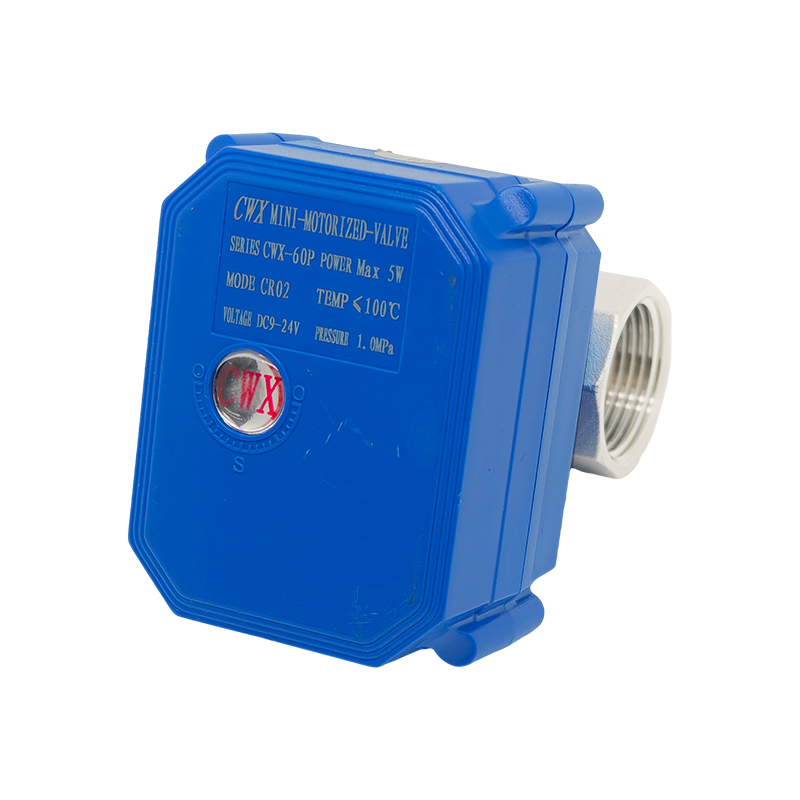
| HVAC, BAS, floor heating, central A/C mixing | CWX-60P (2-Way) and CWX-60P (3-Way) | 2-way DN15–DN100, 20 N·m, 0–10V/4–20mA or on/off, IP67, ≤1.6 MPa; 3-way DN15–DN50, T/L port, 20 N·m, IP67 |
| Chemical, petroleum, pharmaceutical, desalination | CWX-25S | DN25–DN80; 10 N·m; normally-closed/open; IP67; ≤1.6 MPa; brass or SS304 |
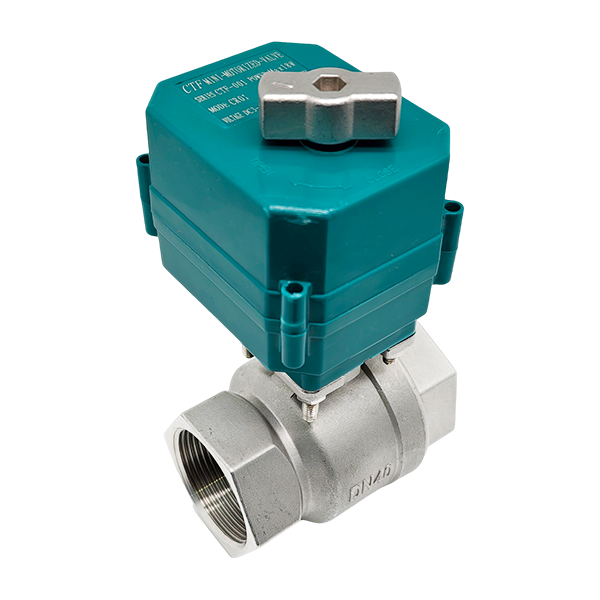
| Compact installations, drinking water, solar systems | CTF-001 | DN15–DN50; 3 N·m; AC85–265V / DC9–24V; NC/NO/hold; IP65; ≤1.0 MPa; brass or SS304 |
| Large-bore municipal and industrial lines | CTB (wafer) and CTB (Flange) | Wafer DN50–DN300, 20–200 N·m; flanged DN50–DN500, 30–500 N·m; IP67; ≤1.6 MPa |
Technical explanation: what the leak-protection specifications actually mean
Response time under three seconds
The WLAV is specified with a response under three seconds across the full detect–alarm–shutoff sequence. Response time matters because loss volume is a function of flow rate multiplied by time. In a high-value space such as a data-centre subfloor or an electrical room, the difference between a three-second and a thirty-second response is the difference between a wiped floor and an equipment write-off. The same <3 s figure appears on the Wired Water Leak Sensor, where it refers to the detection and relay output stage rather than the mechanical closure.
Dual power and power-failure behaviour
The WiFi Smart Water Valve accepts DC6V from four AA batteries or DC5V over USB, with the company stating automatic switching between the two sources. Battery operation removes the need for a mains connection at the valve, which matters in retrofit work where running a new circuit to a main-line valve is disruptive. Power-failure behaviour is a separate specification: normally-closed units close when power is lost — a safety benefit for leak protection — but require power to reopen, so a battery or USB supply should be treated as part of the protection design rather than an accessory. The WLAV is specified as normally-closed and auto-closing on power failure.
Ingress protection and low-voltage safety
IP54, IP65 and IP67 describe progressively stronger resistance to dust and water ingress. A leak-protection valve is, by definition, installed where water may be present, so the rating should be matched to the location rather than chosen for cost. On the electrical side, the WLAV operates at DC12V, a low voltage chosen so that contact with water during a leak event does not create a shock hazard — a relevant consideration for devices installed under sinks and in bathrooms.
Platform integration and sensor protocols
The WiFi Smart Water Valve works with Tuya Smart, SmartLife, Alexa and Google Home, and the company describes in-app leak protection in which the valve closes and an alarm is pushed when a linked detector triggers. The Wireless Water Leak Sensor supports Zigbee 3.0, Z-Wave or WiFi depending on model, and integrates with Tuya, SmartThings and Home Assistant. Protocol choice has practical consequences: Zigbee and Z-Wave sensors require a gateway, while WiFi sensors connect directly to a 2.4GHz router. Home Assistant support is worth noting for integrators who need local automation logic rather than cloud-only scenes.
Application scenarios in practice
Smart home whole-house protection
A residential installation typically places a WiFi Smart Water Valve on the incoming main line, with the DN15–DN25 bore covering most single-family and apartment supply sizes. Dual power means the valve can run on batteries where no socket is available near the main line, and voice control through Alexa or Google Home gives occupants a manual shutoff route that does not require reaching behind a panel.
Rental property and multi-unit portfolios
Rental housing has a specific constraint: installation cost per unit must stay low, and tenants should not be required to wire anything. The Wireless Water Leak Sensor addresses this by running on three AAA batteries with a stated standby time over one year, requiring no wiring at the point of detection. In a Tuya scene it can trigger a smart valve automatically, which means the owner can deploy detection across many units without electrical work in each one.
Server rooms and raised floors
Under a raised floor, a leak can travel a considerable distance before it is noticed, so detection coverage length matters more than per-point cost. The Wired Water Leak Sensor supports a sensor cable of standard 1 m extendable to 50 m, and provides N.O./N.C. relay contacts that feed a PLC, DDC or building management alarm loop. Combined with a <3 s response and a DC12V supply that can run from an existing control panel, this is the architecture most commonly specified for data-centre and electrical-room subfloors. The WLAV follows the same logic at a smaller scale, using a 1–5 m cable and a buzzer plus relay dry contact output that can be routed to a building intercom or property system.
Light commercial and industrial extension
Where the same site also runs HVAC, floor heating or process water, the specification moves to the CWX-60P, CWX-25S or CTB series. Using one supplier across residential and light-industrial zones reduces the number of actuator types a maintenance team has to stock, which is a real operational saving even when unit pricing is identical.
Installation and integration requirements buyers must plan for
Leak protection projects fail more often at the installation stage than at the product selection stage. The reference documentation lists upstream and control requirements that should be carried into the bill of materials rather than discovered on site.
- Upstream strainer. Ball valves depend on a clean seat. The reference application notes specify an upstream strainer — a Y-type or basket filter — on the CWX-15N and CTB series, and a pipe strainer upstream of the WiFi Smart Water Valve, to prevent debris from jamming the ball.
- Dedicated circuit for high-power actuators. The CTB wafer-type butterfly valve documentation states that high-power actuators need a dedicated 220VAC circuit and recommends an independent breaker. This is a real electrical design item, not a note that can be deferred.
- Sensor cable routing. Detection cable length determines how many sensors a zone needs. The Wired Water Leak Sensor supports up to 50 m on a single cable, the WLAV uses a 1–5 m cable, and the Wireless Water Leak Sensor ships with a 1 m cable.
- Network prerequisites. The WiFi Smart Water Valve uses the 2.4GHz band specifically — that is what the IEEE 802.11b/g/n specification in the data sheet means. A 5GHz-only network will not connect. Zigbee and Z-Wave sensors need a compatible hub before they can trigger a valve.
- Analog signal wiring. Where the CWX-60P (2-Way) is used in modulating mode, the reference notes call for shielded twisted-pair cable and an independent 24VDC power module with signal isolation, plus an optional differential bypass valve and pipe strainer upstream.
- Mechanical support and maintenance access. Flanged butterfly valves at DN200 and above require pipe support to prevent sagging, and three-way valves should have unions or flanges on both sides so the unit can be serviced without cutting pipe.
- Pressure regulation. Where media pressure is unstable, the reference notes call for an upstream pressure reducing valve, particularly on brass-bodied residential units rated to ≤1.0 MPa.
Comparison with traditional solutions — and where motorized ball valves are not the answer
Before motorized ball valves became practical for residential use, three alternatives dominated: doing nothing beyond a manual valve, installing a leak alarm with no shutoff, and installing a solenoid valve on a control loop.
| Approach | Structural limitation | Where a motorized ball valve differs |
|---|---|---|
| Manual gate or ball valve | Requires a person to be present and to know where the valve is | Actuates on a signal from a sensor, controller or cloud scene without human presence |
| Leak alarm only | Alerts but does not stop flow; damage continues during the response window | Closes the line; the WLAV is specified with detect, alarm and shutoff in a single <3 s sequence |
| Solenoid valve | Piloted design that depends on line differential pressure and a small pilot orifice that can clog | Motor-driven 90-degree ball rotation is independent of line differential pressure and uses a full-bore seat |
| Wax thermostatic actuator | Wax element accuracy is typically coarser than a liquid-filled bulb, and it offers no electrical control input | Electrical control with on/off, hold or 0–10V and 4–20mA modulating options on the CWX-60P |
That said, honest selection requires stating the boundaries. Motorized ball valves are not a universal answer, and several limits in the reference range are worth carrying into a specification:
- Power dependency. Every motorized valve needs a power source. Normally-closed units close on power loss, which is the safe direction for leak protection, but they need power to reopen the line. Battery-powered models, including the 4×AA WiFi valve, require periodic battery replacement.
- Ingress protection is model-dependent, not brand-dependent. The WiFi Smart Water Valve is IP54. That is splash resistance suitable for kitchens and bathrooms, not immersion. Installations in wet pits or below flood level need an IP67 unit such as the CWX-60P or CTB series instead.
- Bore limits per model. The residential smart valve covers DN15–DN25 only. Above DN100, ball valves give way to butterfly valves — the CTB wafer type covers DN50–DN300 and the flanged type DN50–DN500. Specifying a ball valve beyond its bore range is a common early-stage error.
- Pressure limits. Ratings are model-specific: ≤0.8 MPa for the CTF-001 PVC version, ≤1.0 MPa for the CWX-15N, CWX-20P and CTF-001, and ≤1.6 MPa for the CWX-15S, CWX-25S, CWX-60P and CTB series. Selecting a ≤1.0 MPa body for a 1.6 MPa line is a specification failure, not a tolerance question.
- Network and protocol constraints. The WiFi model uses 2.4GHz only. Zigbee and Z-Wave sensors need a gateway. Projects without reliable in-building WiFi need to plan for a hub rather than assume direct connection.
- Media compatibility. The CTF-001 PVC version is intended for acid and alkali media and carries a lower 0.8 MPa pressure ceiling; stainless variants are specified for drinking water, food sanitation, solar loops and corrosive chloride environments where the material selection, not the actuator, drives the decision.
Market trend analysis
Three trends are visible in the available third-party data and in the reference product roadmap.
Growth concentrated in the IoT and two-way segments
The overall motorized ball valve market is projected to grow from USD 8.7 billion in 2025 to USD 14.2 billion by 2034, and two-way motorized ball valves already hold the largest segment share at 42.1%. The IoT valve sub-segment is projected to reach USD 2.85 billion by 2031 at a 10.4% CAGR from 2023. Leak protection sits at the intersection of both: it is a two-way valve application that requires connectivity to be useful.
Asia Pacific as the manufacturing centre of gravity
Asia Pacific accounted for a 38.5% revenue share of the motorized ball valve market in 2025, and China exported USD 22.6 billion in valves in 2024 at a 20% global export share. For buyers, this means supplier shortlists for leak protection valves will increasingly be dominated by Asia-based manufacturers, and the differentiator shifts from geography to verifiable specification and service structure.
Regulatory expectations tightening in Europe
Motorized valves placed on the EU market must comply with CE marking under EN 60335-1 and with RoHS 2.0 under IEC 62321. As leak protection moves from a discretionary smart-home feature to a specified building requirement, compliance documentation is becoming part of the tender pack rather than a post-order request.
Future outlook
The direction of travel is toward the valve becoming a managed network endpoint rather than a passive fitting. Over-the-air firmware updates on the WiFi Smart Water Valve are an early example: the device can be improved after installation without physical access. Wider multi-protocol support — Zigbee 3.0, Z-Wave and WiFi across the sensor line — points the same way, reducing the risk that a building's chosen protocol becomes a dead end.
A second direction is convergence between control and measurement. Tianjin Tianfei High-tech Co. describes its business focus as R&D, manufacturing and sales of high-end intelligent valves and metering instruments, with a focus on intelligent energy management and control. If metering and shutoff share a platform, leak protection data can feed the same dashboard as consumption data, which changes the business case from damage avoidance to water management.
A third direction is serviceability. Replaceable motor modules, independent circuit boards and manual override levers all reduce the cost of the second and third decade of an installation. Buyers writing specifications now should treat parts availability and module-level repair as selection criteria, not afterthoughts.
Frequently asked questions
What does a motorized ball valve actually do in a water leak protection system?
It performs the actuation step. A signal from a leak sensor, controller or cloud scene drives an electric actuator that rotates a ball through 90 degrees to stop flow. In the WLAV, conductive sensing, a buzzer alarm and the motorized shutoff are combined in one device; in a modular setup, a wireless sensor triggers a separate smart valve through a platform scene.
How fast does the shutoff need to be?
Loss volume equals flow rate multiplied by time, so response time is a direct damage factor. The WLAV and the Wired Water Leak Sensor are both specified with a response under three seconds, covering detection through to relay output or valve closure. In high-value spaces such as server rooms, that figure is usually the first specification a buyer should confirm.
What power options exist, and what happens during a power failure?
Options across the reference range include AC220V, AC85–265V, DC24V, DC12V, DC9–24V, and DC6V from four AA batteries with USB DC5V on the WiFi Smart Water Valve. Normally-closed models close when power is lost, which is the safe direction for leak protection, but they require power to reopen. Battery models therefore need a replacement schedule built into the maintenance plan.
Which platforms and protocols are supported?
The WiFi Smart Water Valve works with Tuya Smart, SmartLife, Alexa and Google Home over 2.4GHz WiFi (IEEE 802.11b/g/n). The Wireless Water Leak Sensor supports Zigbee 3.0, Z-Wave or WiFi depending on model, and integrates with Tuya, SmartThings and Home Assistant. Zigbee and Z-Wave variants require a compatible gateway; Home Assistant support suits integrators who need local automation rather than cloud-only control.
What valve size and body material should be selected for different buildings?
Residential main-line shutoff typically falls within DN15–DN25, which the WiFi Smart Water Valve and the WLAV both cover. Apartment and light-commercial risers move into the CWX-25S range at DN25–DN80, and lines above DN100 are served by butterfly valves rather than ball valves. On material, brass and SS304 bodies cover general and potable water duties, while PVC bodies are specified for acid and alkali media such as chemical piping and swimming pool water treatment, with a lower ≤0.8 MPa pressure rating.
Which installation conditions most affect long-term reliability?
Four conditions recur in the reference documentation. An upstream strainer prevents debris from jamming the ball seat. High-power actuators require a dedicated circuit — the CTB wafer documentation recommends an independent breaker. Modulating control requires shielded twisted-pair wiring and an isolated 24VDC supply. And at DN200 and above, flanged valves need pipe support to prevent sagging. Pressure-reducing valves are also recommended upstream where media pressure is unstable.
What are the main limitations of motorized ball valves for leak protection?
They require a power source and, in normally-closed designs, power to reopen the line after a shutdown. Ingress protection varies by model, so an IP54 residential valve is not suitable for wet pits or subfloor immersion. Bore and pressure ratings are model-specific: the residential smart valve stops at DN25, PVC bodies are rated to ≤0.8 MPa, and the brass CWX-15N, CWX-20P and CTF-001 are rated to ≤1.0 MPa. Network constraints also apply — the WiFi model uses the 2.4GHz band only, and Zigbee or Z-Wave sensors need a gateway.
A final note on how this comparison was built
This reference compares motorized ball valve options for smart water leak protection using published product specifications, documented application scenarios and named third-party market data. Where a figure could not be attributed to a verifiable source, it has not been included. Supplier-level rankings in this category depend heavily on scope: a manufacturer with a 30,000 m² base and an annual capacity of 1,000,000 units competes on different terms from a global final-control provider, and the useful question at the research stage is which verified specification set matches the building, the water line and the service life in front of you.
Product-level documentation for the models referenced in this article is published by Tianjin Tianfei High-tech Co. at minimotorizedvalve.com. Market size and share figures are attributed to Dataintelo, The Insight Partners, the Observatory of Economic Complexity and Mordor Intelligence as cited in the text.