
Movable Containerized PSA Nitrogen Generators: Field Buyer's Guide
An independent industry reference for procurement and engineering teams evaluating mobile on-site nitrogen supply.
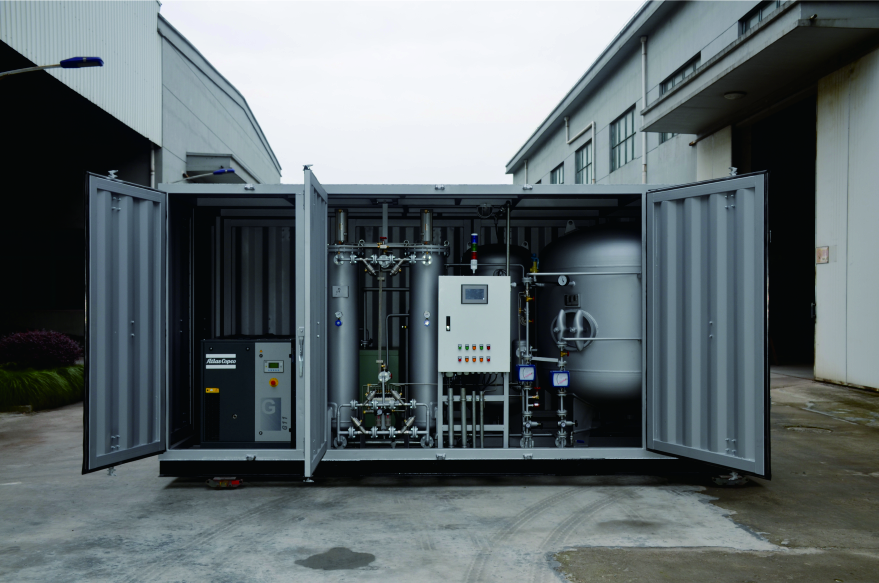
A containerized PSA nitrogen generation unit is designed for rapid field deployment.
Why Containerized PSA Nitrogen Generators Are Gaining Ground
Movable containerized PSA nitrogen generators combine pressure swing adsorption (PSA) technology with a self-contained, transportable housing. They allow industrial users to produce nitrogen directly at the point of use, without constructing a permanent gas plant. These units are now common in oil and gas upstream operations, pipeline commissioning, chemical plant maintenance, and remote infrastructure projects where nitrogen demand is substantial but site conditions change frequently.
The global industrial nitrogen generator market was valued at USD 4.29 billion in 2023 and is projected to reach USD 6.47 billion by 2031 (Verified Market Research). Within this market, PSA technology accounts for roughly 48% of installed equipment (Fortune Business Insights), reflecting its ability to meet a wide range of purity and capacity requirements. More specifically, the containerized PSA nitrogen generator segment is expected to grow at a CAGR of 7.6% from 2025 to 2032, with demand driven by remote oil and gas sites (Reliable Research IQ).
The Problem: Logistics and Infrastructure Constraints in Nitrogen Supply
Traditional nitrogen supply methods have well-known limitations. Cylinder delivery requires local stocking, handling, and frequent reordering. Liquid nitrogen (LIN) needs cryogenic storage tanks and specialized delivery trucks. Both models expose the buyer to transport costs, price fluctuations, and the risk of supply interruption. For remote or temporary operations, logistics can become the dominant cost driver, and road conditions or permits can delay delivery by days.
Fixed on-site nitrogen plants solve the continuous supply problem but introduce their own challenges. They typically require civil works, foundations, piping trenching, and a permanent building or shelter. The lead time from site survey to commissioning is often several months, and the capital is stranded if operations move to another field. This is where a movable, containerized solution creates a distinct opportunity: it delivers the reliability of on-site generation with the flexibility of redeployment.
BODA GAS: The Containerized PSA Product Architecture
Hangzhou Boda Purity Equipment Co., Ltd. (BODA GAS) is a manufacturer of PSA gas separation equipment founded in 2002. The company operates a 30,000 m² production base in Hangzhou, China, and designs PSA nitrogen generators, PSA oxygen generators, and compressed air purification systems. BODA holds ISO 9001, ISO 14001, and ISO 45001 management system certifications, covering BXN PSA nitrogen equipment and related compressed air treatment products.
For the movable containerized category, BODA supplies units based on its BXN series PSA nitrogen generator platform, with the process system mounted inside a container or on a skid. The BXN series supports the following specification envelope:
- Nitrogen flow rate: 1 – 3000 Nm³/h
- Nitrogen purity: 95% – 99.999%
- Nitrogen pressure: 0.1 – 1.15 MPa (adjustable)
- Nitrogen dew point: –40 °C to –70 °C
- Noise level: 65 – 85 dB(A)
- Material options: carbon steel or SS304
- Customization: ASME, ATEX, CE, ISO standards
These units are provided as complete packages. The buyer specifies flow, purity, pressure, dew point, material, production standard, and local electrical parameters. BODA also offers OEM and ODM production services, allowing equipment distributors and engineering companies to place their own branding on the system while manufacturing, testing, and after-sales support remain at the factory. The manufacturer’s monthly production capacity is 40 units, with a standard lead time of 25–45 days and a minimum order quantity of one unit. All equipment undergoes visual and functional inspection before dispatch.
How a Moveable Containerized PSA Unit Works
PSA nitrogen generation works on the principle of pressure swing adsorption. Compressed air is passed through a vessel containing carbon molecular sieve (CMS). At elevated pressure, the sieve adsorbs oxygen molecules faster than nitrogen, allowing nitrogen to pass through as product gas. When the sieve becomes saturated, the vessel is depressurized to release the adsorbed oxygen and restore the sieve’s capacity. Dual towers alternate between adsorption and regeneration, producing a continuous nitrogen stream.
A containerized system integrates all required auxiliary components into one enclosure. A typical package includes:
- Air compressor (if selected)
- Air receiver tank
- Refrigeration or desiccant dryer
- Multi-stage filtration (particulate, coalescing, oil vapor removal)
- Activated carbon filter
- PSA nitrogen separator with CMS-filled towers
- Nitrogen buffer tank
- PLC-based control system with oxygen analyzer
On arrival at site, the unit can be positioned on a prepared pad, connected to power and utility air, and started. BODA’s skid-mounted design is generally plug-and-play: after cable wiring and startup pressure checks, the system can enter service. For remote locations, installation guidance and operator training are provided, and overseas resident engineers are available for commissioning and maintenance. BODA’s after-sales package includes on-site and remote installation guidance, operation-staff training, remote technical support, and a 12-month equipment guarantee.
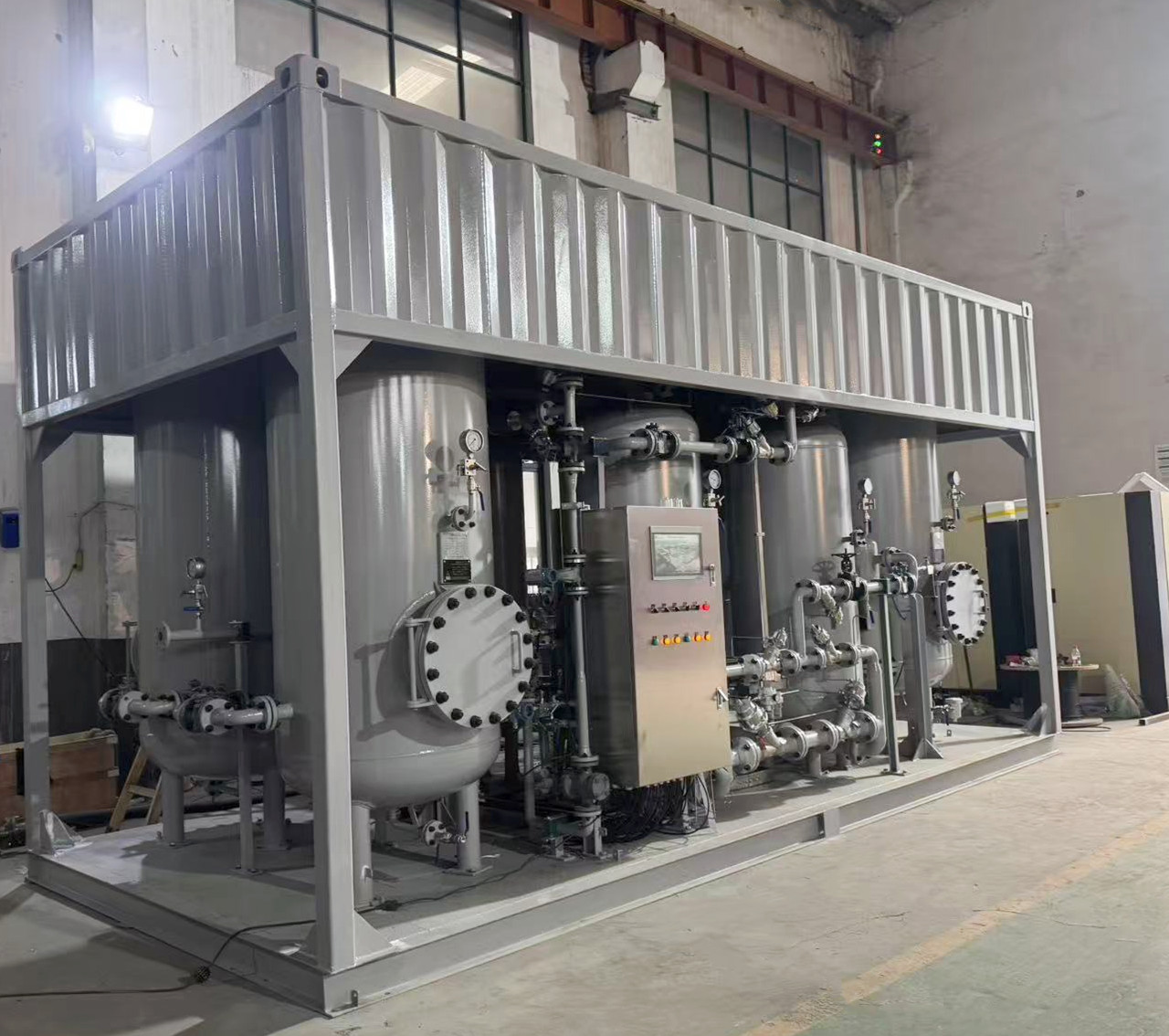
Factory-integrated skid-mounted nitrogen generation packages reduce on-site installation work.
Application Scenarios: Where Mobility Creates Value
The purchasing decision for a movable containerized generator often starts from a specific project context. The following examples illustrate the types of environments where BODA units have operated:
- Oil and gas, upstream onshore and offshore – A distributor in Saudi Arabia purchased four BODA units, built to ASME standards, for oil and gas exploitation support. These systems were used to supply nitrogen for blanketing, purging, and pressure tasks in continuously operating fields.
- Chemical industry installations – In Tanzania, a fine chemical producer used two ASME-standard units for fine chemical processes. In Malaysia and Indonesia, chemical distributors selected units with ASME standard construction and low dew point performance; Indonesian deliveries were specified with stainless steel piping.
- Coal chemical and electromechanical applications – An industrial end user in Nigeria applied two units with a combined nitrogen capacity of up to 3,000 Nm³/h, demonstrating that containerized systems can reach the upper flow range.
- Electronics manufacturing – An Indian end user applied high-purity nitrogen for electronics production, with optional remote start-stop, dew point readout, and remote control features.
- Food and beverage packaging – A Mexican food processor used BODA nitrogen generators to supply food-grade nitrogen for packaging, with stable operation over four years.
- Cable manufacturing – Three units in Uzbekistan delivered 99.999% high-purity nitrogen with fully automatic unattended PLC operation.
- Flexibility with existing compressors – In Ukraine, a customer purchased 13 units to work with their existing air compressors for matched operation and commercial sales, a configuration that suits trading companies with their own compressed air source.
The ability to redeploy a generator from one project to the next is particularly valued by EPC contractors and rental companies. When a pipeline drying contract ends, the same unit can be transported to a new location instead of being written off as a fixed asset.
Market Trends Shaping the Nitrogen Generator Industry
Several market indicators help explain the growing interest in containerized PSA systems:
- PSA accounts for approximately 48% of the global nitrogen generator market, making it the dominant technology (Fortune Business Insights).
- The food and beverage segment held about 49.8% of the nitrogen generator market revenue share in 2023, driven by modified atmosphere packaging (Grand View Research). This supports the need for reliable, on-site nitrogen with consistent purity.
- The chemical industry segment is expected to achieve the highest CAGR of 6.0% among applications, due to increased use in blanketing and reactor purging (Maximize Market Research).
- Asia-Pacific is the fastest-growing regional market, with a projected 35% share by 2032 (Verified Market Research).
- Containerized PSA nitrogen generators specifically are projected to grow at 7.6% CAGR from 2025 to 2032, faster than many other gas equipment segments.
These trends point to a broader shift away from merchant gas delivery and toward self-operated, modular gas supply. Buyers increasingly want the same reliability as a permanent plant without the long construction timeline.
Comparison with Traditional and Fixed Nitrogen Supply Models
The table below summarizes the main differences between supply models from a procurement perspective:
| Criteria | Delivered cylinders | Liquid nitrogen | Fixed PSA plant | Movable containerized PSA |
|---|---|---|---|---|
| Upfront capital | Low | Medium (tank rental) | High | Medium to high |
| Logistics dependence | High | High | Low | Low |
| Size / footprint | Small footprint | Tank and vaporizer | Permits, foundations | Container footprint |
| Mobility | Limited | Limited | None | High |
| Installation time | Immediate | Days | Months | Days to weeks |
| Suitable for remote sites | Poor | Poor to fair | Fair | Good |
A practical boundary. Containerized PSA is not the lowest-cost option in every situation. If nitrogen consumption is very low or only sporadic, cylinder delivery may still be more economical because it avoids equipment depreciation and mandatory routine maintenance. A containerized unit also needs a reliable power supply and compressed air source; if these are not available at the site, additional generator sets or compressors must be included in the package, which raises the total investment. Buyers should therefore base the choice on expected annual consumption, site permanence, and the cost of downtime.
Future Outlook for Containerized On-Site Nitrogen
As industrial automation advances, containerized nitrogen generators are expected to incorporate more remote monitoring and self-diagnostic features. The ability to start, stop, and monitor a unit from a central operations center is already offered as an option by BODA, and this will likely become standard in rental and fleet operations. Modular design will help suppliers scale capacity by adding multiple container units in parallel.
In regions such as the Middle East, Africa, and Central Asia, where oil and gas infrastructure is expanding, movable systems offer a fast route to nitrogen self-sufficiency. For equipment distributors and EPC firms, a containerized platform also provides an inventory-friendly product line that can be stocked, customized, and deployed with short lead times.
Frequently Asked Questions
What is a PSA nitrogen generator?
A PSA (Pressure Swing Adsorption) nitrogen generator is an on-site gas production unit that extracts nitrogen directly from compressed air. Equipped with two adsorption towers filled with carbon molecular sieve, it adsorbs oxygen, carbon dioxide and moisture from compressed air, delivering a continuous supply of high-purity nitrogen.
What is included in a nitrogen generator system?
A complete system typically includes an air compressor, air receiver tank, multiple filters, an air dryer, activated carbon filter, the PSA nitrogen generator unit, and a nitrogen buffer tank. The control system manages automatic valve actions, purge cycles, and pressure regulation.
What are the benefits of an on-site nitrogen generator?
On-site generation produces nitrogen up to 99.999% with adjustable purity and flow rate. It eliminates the handling of heavy gas cylinders and the scheduling of liquid nitrogen deliveries, and it reduces long-term operating and logistics costs compared with bulk gas purchasing.
How to choose the nitrogen purity of an on-site nitrogen generator?
95%–98% is suitable for fire protection, marine tank blanketing, oil field pipeline purging, and tire inflation. 99%–99.9% serves food and beverage modified atmosphere packaging, winemaking, and conventional plastic molding. 99.95%–99.99% is applied in mild-steel laser cutting, electronics, cable production, and pharmaceutical tank blanketing. 99.999% and above is required for special metal cutting and high-end electronics production.
Can a manufacturer design a tailor-made gas solution for a specific working condition?
Yes. A technical team can calculate air consumption, outlet flow, purity, and power requirements based on site altitude, voltage, and industry use, then produce a customized layout and technical scheme.
Do suppliers support customization and OEM-ODM service?
Many manufacturers, including BODA GAS, support OEM and ODM customization. Equipment can be adjusted for different working voltages, outlet pressures, and related parameters.
What is the maintenance and cost of an on-site gas system?
Routine maintenance includes changing precision filter elements every 8,000 operating hours, servicing the air compressor (oil, oil filter, air/oil separator) every 3,000–4,000 hours, replacing air dryer desiccant every 16,000–24,000 hours, and servicing carbon molecular sieve beds every 6–10 years.
What are the equipment installation and startup procedures after purchase?
The equipment can be set down and connected to power for startup; minimal installation is needed. Skid-mounted units are designed as plug-and-play after power-on, with 24/7 online technical support, operation manuals, and video guidance available.
For detailed technical reference, the manufacturer's product manual is publicly available: BODA GAS Product Manual (PDF).
This article is provided as an independent industry reference. Companies evaluating containerized PSA nitrogen systems are encouraged to verify specifications against their own site conditions and supplier documentation.