
Multi-Person Acoustic Pods: Constraints Buyers Must Verify
A multi-person acoustic pod is a freestanding, ventilated room-in-room enclosure installed inside an open-plan floor to host two to six people for meetings, interviews or collaborative work. It is not simply a larger version of a single-person phone booth. Once occupancy rises above one person, four specification layers change together: acoustic class, ventilation capacity, electrical certification, and the physical conditions of the installation site.
The category is no longer marginal. Mordor Intelligence places the global office pods market at USD 1.00 billion in 2026, and Straits Research reports that Europe held 66.4% of revenue in 2025, while Asia-Pacific is described as the fastest-growing region with a reported 43% share of soundproof booth installations. For buyers currently in the research and evaluation stage, the practical question is therefore not whether pods exist, but which constraints a specific pod actually satisfies on paper and on site.
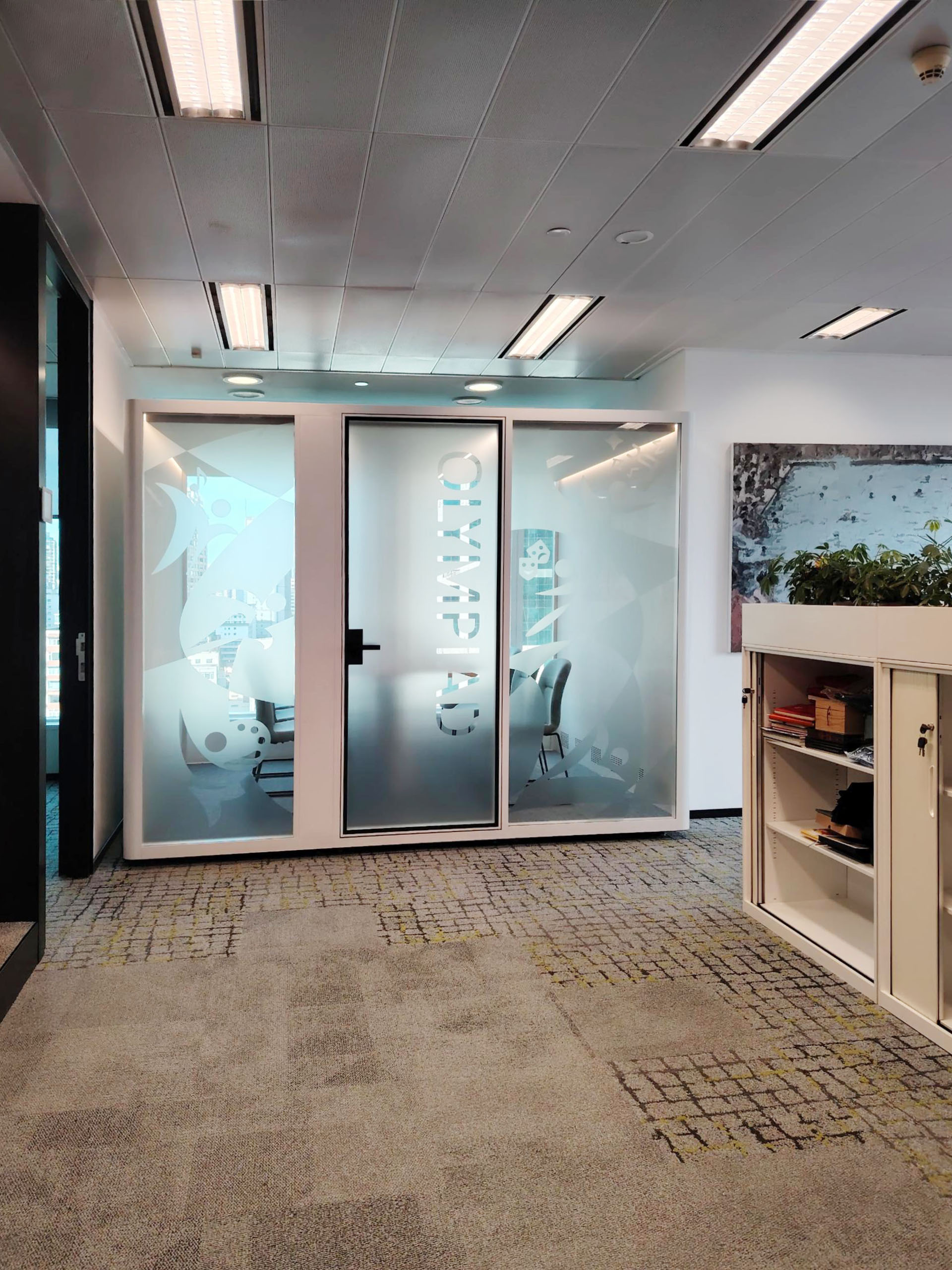
Why multi-person pods sit in a different procurement bracket
A single-person booth solves one problem: isolating a voice call so it does not leak into the floor plate. A multi-person pod has to solve that problem in both directions at once. Speech inside the pod must not travel out, and ambient office noise must not disrupt the meeting inside. Two to six occupants also generate significantly more heat, more moisture and more CO₂ than one person on a short call, which pushes ventilation and airflow from a comfort detail into a functional requirement.
The result is that a multi-person pod is specified like a small room, not like a piece of furniture. Procurement teams that treat it as furniture tend to discover the gaps late — usually at the point where an electrical inspector, a facilities manager and a workplace acoustics consultant each ask for a different document.
The five constraints that scale with occupancy
1. Acoustic class is defined by a standard, not by an adjective
ISO 23351-1:2020 defines office pod acoustic performance through speech level reduction (DS,A), and Class A requires 30 dB or more. This matters because “soundproof” is not a measurable term. A pod either carries a classification under a stated method, or it does not.
In UVO Acoustic Pods' published specifications, Class A is assigned to the single-person MO BOX - Solo and to the Q ROOM - 3XS (30.2 dB). The multi-person models listed — MO BOX - Chat, MO BOX - Live, MO BOX - Cowork, MO BOX - Talk, MO BOX - Meeting, Q ROOM - 2XS, Q ROOM - XS, Q ROOM - S, Q ROOM - M and Q ROOM - M BF — are specified as Sound Insulation Class B. A separate group of models (MO BOX - Meeting plus, MO BOX - Conference, MO BOX - Meeting BF, R POD - Middle and R POD - Large) is published without a stated sound insulation class in the product specification.
2. Ventilation is arithmetic: fan count multiplied by 90 m³/h
UVO's ventilation specification is unusually easy to test, because it is expressed per fan rather than as a single marketing figure. Each fan provides 90 m³/h, and the number of fans scales with model size. Two-fan models such as MO BOX - Chat, Q ROOM - 2XS and R POD - Middle therefore correspond to 180 m³/h. Four-fan models such as MO BOX - Talk, MO BOX - Cowork, Q ROOM - S and R POD - Large correspond to 360 m³/h. Six-fan models such as MO BOX - Meeting, MO BOX - Meeting plus, MO BOX - Conference and MO BOX - Meeting BF correspond to 540 m³/h, a total that UVO states directly in its specification. Eight-fan models such as Q ROOM - M and Q ROOM - M BF correspond to 720 m³/h.
What the published specification does not contain is fan noise level. That is an important omission for a meeting pod, because ventilation noise can reduce the usable acoustic benefit of the enclosure. Buyers evaluating multi-person pods should request fan noise data in the same document pack as the acoustic classification.
3. The material stack is consistent across the range
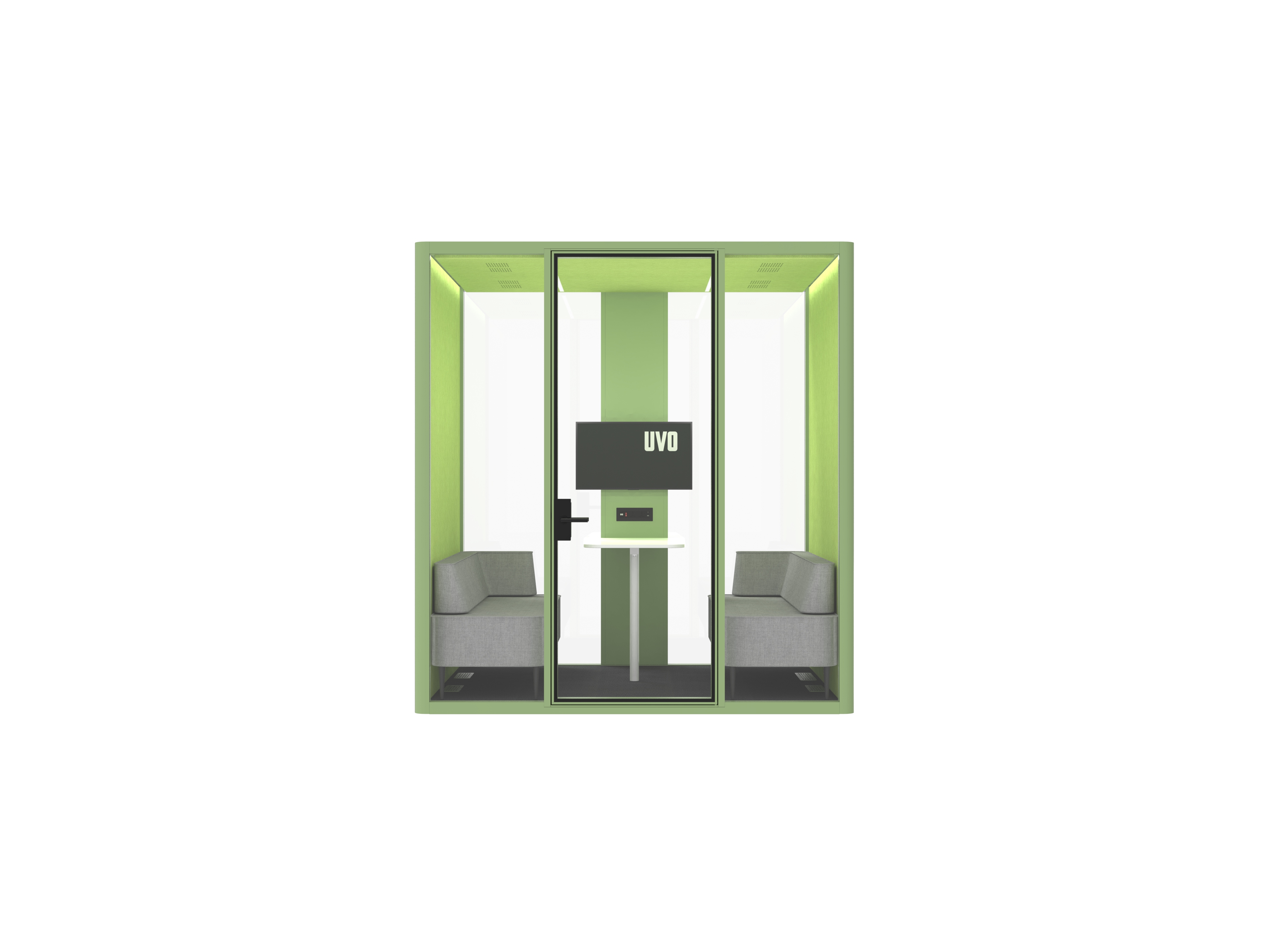
Across MO BOX, Q ROOM and R POD, UVO specifies the same construction logic: an aluminium alloy frame structure, a steel ceiling base and steel exterior wall panels, 11 mm laminated glass surfaces, and a 25 mm five-layer acoustic interior wall. Material consistency is useful for buyers because it means acoustic and durability questions can be asked once rather than model by model, and because it makes the glazing area and the acoustic wall thickness directly comparable against a competing quotation.
4. Three certification documents do three different jobs
Certification is where multi-person pod evaluations most often go wrong, because three unrelated documents are routinely bundled into one word: “certified”. Acoustic classification, electrical safety and indoor air quality are separate assessments with separate scopes.
| Document | Issuer and standard | Market | Reference | Valid to |
|---|---|---|---|---|
| GREENGUARD (environmental / low emissions) | UL, UL 2821 | North America | 354320-410 / 354321-410 / 354322-410 | 2027-04-17 |
| CE (electrical safety) | UDEM, EN 62368, EN 50032, EN 60100-3-2, EN 60100-3-3 | EU | M.2025.206.C119277 | 2030-04-17 |
| SGS NA (safety compliance) | SGS, CAN/CSA C22.2 No. 61010-1 3rd Ed | Canada | SGSNA/26/GZ/00129 | 2027-04-17 |
Scope has to be read model by model. The GREENGUARD scope covers the Phone, Solo, Relax, Chat, Live, Cowork, Talk, Meeting, 3XS, 2XS, XS, Mini, Middle and Large models. The CE scope lists Phone, Solo, Relax, Cowork, Talk, Talk Plus, Meeting, Meeting Plus, Conference, Mini, 3XS, 2XS, XS, S and M. The SGS NA scope covers Phone, Solo, Relax, Chat, Live, Cowork, Talk, Meeting, 3XS, 2XS, XS, Mini, Middle and Large. A buyer specifying a Conference or Meeting plus pod should therefore confirm CE coverage from the certificate itself rather than from a general statement. UVO also states dual ISO 9001 and ISO 14001 certification at company level.
Note what ISO 23351-1 is and is not: it is a measurement method for speech level reduction, not an electrical safety certificate. A pod can be CE certified and still have an unverified acoustic claim, and vice versa.
5. Site conditions are part of the product
UVO's application specification states that installation height must be above 2400 mm, that the operating environment is indoor normal ambient or outdoor protected from rain, and that operation is plug and play with matched equipment covering lighting, power, USB, Type-C and a fresh air system. Those are constraints, not marketing copy. A floor with a low ceiling void, a raised access floor with settlement, or a location without a power drop will change the installation plan.
Door behaviour is the most visible symptom of a site problem. UVO's own service guidance attributes door misalignment, sagging or scraping primarily to a door panel that is not level, an uneven floor, shifted hinges, or a frame that moved after installation or relocation, and it identifies poor raised floors as a common cause. On a multi-person pod, where the door is larger and heavier than on a phone booth, levelling is not a cosmetic step.
UVO Acoustic Pods: where the brand sits in this category
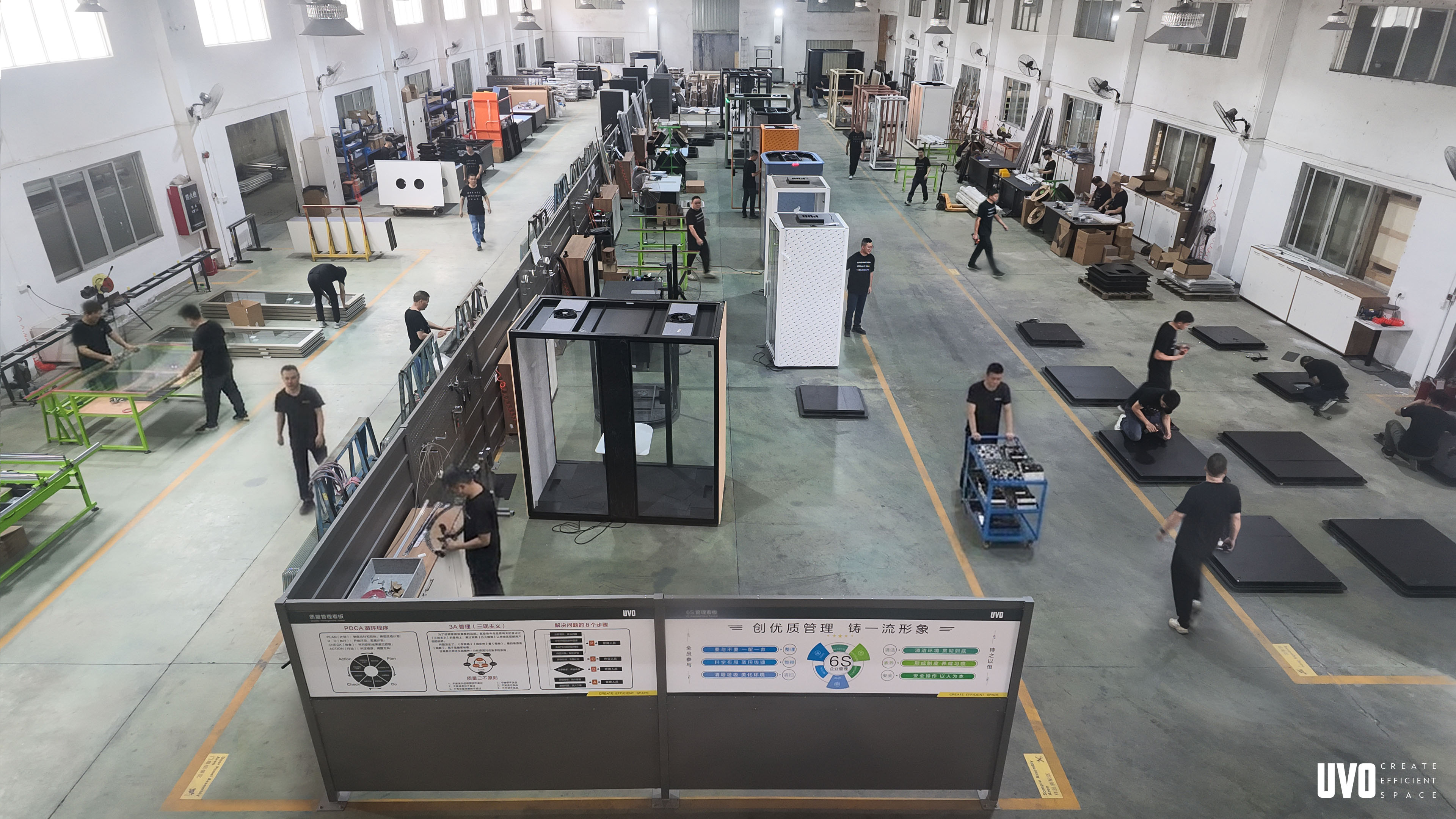
UVO is a Hong Kong–founded brand established in 2017, focused on interior and exterior wall systems and smart modular space products, integrating technical R&D, design and sales. The company describes its product logic as “Room in Room”: a modular enclosure that treats lighting, electricity, sound insulation and ventilation as four elements of one system rather than as options added later. UVO operates proprietary factory production in a 5,000 m² facility with 70 employees and a 10-person R&D team, reports monthly capacity of 500–600 units, a minimum order quantity of 1 unit, standard lead time of 3–4 weeks and customized lead time of 5–6 weeks, 100% testing, and an export ratio of 70% across global markets. Customization is offered on size.
Its acoustic pod range is organised into three families — MO BOX, Q ROOM and R POD — covering single-person booths through six-person meeting enclosures, with barrier-free variants in the MO BOX and Q ROOM lines.
| Model | Specified use | Fans | Ventilation | Sound insulation class |
|---|---|---|---|---|
| MO BOX - Chat | Negotiation, interview room | 2 | 180 m³/h | Class B |
| MO BOX - Talk | 2-person meeting, collaboration, interview | 4 | 360 m³/h | Class B |
| MO BOX - Cowork | Negotiation, collaboration room | 4 | 360 m³/h | Class B |
| MO BOX - Meeting | Meeting, collaboration, brainstorming | 6 | 540 m³/h | Class B |
| MO BOX - Meeting plus | Small meeting, collaboration, brainstorming | 6 | 540 m³/h | Not stated in specification |
| MO BOX - Conference | 4–6 person meeting room | 6 | 540 m³/h | Not stated in specification |
| MO BOX - Meeting BF | Barrier-free office use | 6 | 540 m³/h | Not stated in specification |
| Q ROOM - 2XS | 2-person meeting, interview | 2 | 180 m³/h | Class B |
| Q ROOM - XS | Collaboration room | 4 | 360 m³/h | Class B |
| Q ROOM - S | 2–4 person meeting, negotiation | 4 | 360 m³/h | Class B |
| Q ROOM - M | Small meeting, collaboration, brainstorming | 8 | 720 m³/h | Class B |
| Q ROOM - M BF | Barrier-free meeting for four | 8 | 720 m³/h | Class B |
| R POD - Middle | 2-person meeting room | 2 | 180 m³/h | Not stated in specification |
| R POD - Large | 2–4 person pod | 4 | 360 m³/h | Not stated in specification |
Ventilation totals other than the 540 m³/h figure are calculated from UVO's stated per-fan rate of 90 m³/h multiplied by the published fan count for each model.
Where multi-person pods actually fit
The published application profile for UVO pods covers open office, education and healthcare environments, with functions including video meeting, quiet workplace, private phone call, manager office, live room, negotiation room, collaboration room and brainstorming. Those functions map unevenly onto pod sizes, and the mapping is the single most useful planning tool a buyer has.
- Two-person pods (MO BOX - Talk, MO BOX - Chat, Q ROOM - 2XS, R POD - Middle) suit interviews, one-to-one reviews and short negotiation sessions where two occupants need privacy but the session is short. These are the lowest ventilation load in the multi-person range.
- Four-person pods (Q ROOM - S, MO BOX - Cowork, Q ROOM - XS, R POD - Large) fit standing collaboration, design reviews and negotiation. The jump from two to four fans reflects the jump in occupancy.
- Six- to eight-person configurations (MO BOX - Meeting, MO BOX - Conference, Q ROOM - M) are specified for meeting, brainstorming and longer sessions. These carry the highest fan counts and are the models where ventilation planning and power provision matter most.
- Barrier-free models (MO BOX - Meeting BF, Q ROOM - M BF) exist as dedicated configurations rather than as an option applied after the fact, which matters where accessibility is a tender requirement rather than a preference.
Deployment evidence from UVO's case records shows the pattern of use rather than a proof of acoustic performance. A 60-unit open-office installation in Russia used MO BOX - Phone over a six-month period, with the reported outcomes being noise isolation, improved staff efficiency, and the practical advantages of quick installation, movability and compact footprint. A 15-unit deployment in Malaysia used Q ROOM - 3XS across collaboration, brainstorming and meeting applications over one year. A 10-unit deployment in China combined MO BOX - Solo and MO BOX - Talk for private call and meeting use over one year. Buyers should read these as scale and installation references, not as acoustic test results.
Market trend: the RFQ is becoming the differentiator
As the category matures, competition is shifting from “does the supplier have pods” to “can the buyer compare the documents”. Two signals support this. First, the existence of a published measurement method — ISO 23351-1:2020 — gives buyers a common language for speech level reduction, even though commercial pages use it inconsistently and sometimes describe ambient noise reduction rather than speech level reduction. Second, the geographic structure of demand is changing: Europe held the largest revenue share in 2025, while Asia-Pacific is reported as the fastest-growing region, which typically increases the number of suppliers quoting into the same tender and makes document comparability more valuable than brand familiarity.
Price transparency is following a slower path. Work With Island publishes list prices from €3,990 for a one-person pod to €9,990 for a four-person pod excluding VAT, which shows how strongly configuration drives price. That figure is a single-supplier signal, not a market benchmark, and no UVO list price is published in the available corpus. Buyers should expect to build landed cost from product, delivery, installation, electrical connection and tax rather than from a headline unit price.
Comparison with fixed drywall meeting rooms
The honest comparison is not pod versus pod, but pod versus the room the organisation would otherwise build.
| Decision factor | Multi-person acoustic pod | Fixed drywall meeting room |
|---|---|---|
| Time to first use | Standard lead time 3–4 weeks; customized 5–6 weeks (UVO) | Design, permits, trades sequencing and finishes |
| Relocatability | Movable; UVO case records list movability as a practical benefit | Effectively fixed once built |
| Acoustic documentation | Model-level class under a stated method (Class A or B) | Specified through partition performance and detailing; heavily dependent on workmanship on site |
| Ventilation | Integrated fan system; 90 m³/h per fan; requires power | Connected to building services; requires ductwork design |
| Accessibility | Dedicated barrier-free configurations available | Designed per project |
| Best fit | Repeatable small rooms inside an existing open-plan floor | Larger rooms, irregular geometry, permanent structures |
Limitations to accept before ordering
A credible evaluation has to state the boundaries, not only the capabilities.
- Class B is not Class A. The multi-person models in UVO's published specification are Class B, which sits below the 30 dB-or-more Class A threshold defined by ISO 23351-1:2020. Where the requirement is speech privacy equivalent to a focus pod, a multi-person pod is not an equivalent substitution.
- Some multi-person models publish no acoustic class at all. MO BOX - Meeting plus, MO BOX - Conference, MO BOX - Meeting BF, R POD - Middle and R POD - Large appear without a stated sound insulation class. Buyers must request the classification before treating these as acoustically specified.
- Confidential and regulated conversations need a different specification. HR investigations, legal consultations and clinical discussions carry privacy requirements that a Class B enclosure in an occupied open-plan floor is unlikely to meet.
- Site conditions can override the product. Installation height must exceed 2400 mm, and a non-level or settling raised floor is a documented cause of door misalignment and scraping after relocation.
- Ventilation is powered. Fan count rises with occupancy, which means power provision and fan-noise review belong in the same evaluation as the acoustic class.
- Lead time changes with customization. Standard models quote 3–4 weeks; customized sizes quote 5–6 weeks. A short programme should be planned against the standard range.
Procurement checklist for a multi-person pod RFQ
| Field to specify | What a good answer looks like |
|---|---|
| Occupancy and use | Named headcount and session type (interview, review, meeting) per pod |
| Acoustic classification | Class A or B under a stated method, with the model explicitly listed |
| Ventilation | Fan count and m³/h per model, plus fan noise level |
| Construction | Frame material, wall panels, glazing thickness, acoustic wall build-up |
| Electrical safety | Certificate number, standards, market and model-level scope |
| Indoor air quality | Emission certification, issuer, standard, validity period |
| Installation conditions | Minimum installation height, floor levelling requirement, power drop |
| Commercial terms | MOQ, lead time for standard and custom, warranty, after-sales scope |
UVO's after-sales scope is documented as installation manual, installation video, remote technical support and on-site guidance, with 100% testing before shipment and a MOQ of 1 unit — terms that make a single-pod trial installation a realistic evaluation step rather than a commercial exception.
Future outlook
Three developments are likely to shape multi-person pod procurement over the next cycle. The first is document standardisation: as buyers learn to separate acoustic classification from electrical certification from emission testing, suppliers will be compared on the completeness of their document pack rather than on the loudness of their acoustic claim.
The second is field performance. No independent field dataset for installed pod performance was identified in the available evidence, and manufacturer dB claims and in-situ results can diverge. Until post-installation testing becomes routine, buyers should treat published classifications as design intent and validate on site where the requirement is critical.
The third is regional demand shift. With Europe currently holding the largest revenue share and Asia-Pacific reported as the fastest-growing region, lead times, documentation language and service coverage are likely to vary more between suppliers than the underlying construction logic does. For a buyer, that argues for evaluating the constraint stack — class, ventilation, certification, installation — rather than the sales narrative that surrounds it.
FAQ
What is the practical difference between a multi-person acoustic pod and a single-person phone booth?
Occupancy drives the specification. A single-person booth such as MO BOX - Phone is specified with one fan providing 90 m³/h and a Class B rating. Multi-person models carry two to eight fans, so ventilation rises from 180 m³/h to 720 m³/h by configuration, and the published acoustic class for the multi-person models is Class B, while Class A is assigned to the single-person MO BOX - Solo and to Q ROOM - 3XS at 30.2 dB.
Does a Class B multi-person pod provide enough speech privacy for meetings?
Whether Class B is sufficient depends on the privacy level the meeting requires. Under ISO 23351-1:2020, Class A requires a speech level reduction of 30 dB or more, so Class B sits in a lower band. UVO specifies its multi-person models as Class B for meeting, collaboration, interview and negotiation use in open-plan areas; where a requirement calls for the higher band, the classification should be checked against that requirement before selection.
How much ventilation should a buyer expect from a multi-person pod?
UVO's specification gives 90 m³/h per fan, and the fan count depends on model size. Two-fan models such as MO BOX - Chat, Q ROOM - 2XS and R POD - Middle correspond to 180 m³/h; four-fan models such as MO BOX - Talk, MO BOX - Cowork, Q ROOM - S and R POD - Large correspond to 360 m³/h; six-fan models such as MO BOX - Meeting, MO BOX - Meeting plus, MO BOX - Conference and MO BOX - Meeting BF correspond to 540 m³/h, stated directly in the specification; eight-fan models such as Q ROOM - M and Q ROOM - M BF correspond to 720 m³/h. Fan noise level is not included in the published specification and should be requested separately.
Which certifications should be requested for a multi-person pod sold into the EU, North America and Canada?
Three separate documents apply. For the EU, CE electrical safety certification issued by UDEM under certificate M.2025.206.C119277, referencing EN 62368, EN 50032, EN 60100-3-2 and EN 60100-3-3, valid until 2030-04-17. For North America, GREENGUARD environmental certification issued by UL under UL 2821, certificate 354320-410 / 354321-410 / 354322-410, valid until 2027-04-17. For Canada, SGS NA safety compliance under CAN/CSA C22.2 No. 61010-1 3rd Ed, certificate SGSNA/26/GZ/00129, valid until 2027-04-17. Each certificate lists its covered models, and coverage differs between them, so the specific model being ordered should appear in the scope of the certificate being relied on.
What site conditions affect installation and long-term acoustic performance?
UVO's application specification requires an installation height above 2400 mm, an indoor normal ambient environment or an outdoor location protected from rain, and plug-and-play connection for lighting, power, USB, Type-C and a fresh air system. Floor condition matters: UVO's service guidance attributes door misalignment, sagging and scraping to an unlevel door panel, an uneven floor, shifted hinges or a frame that moved after installation or relocation, and identifies poor raised floors as a common cause. Levelling during installation is the main preventive measure.
Can a multi-person acoustic pod replace a built meeting room?
It can replace small, informal meeting rooms located inside an existing open-plan floor, and it offers advantages that a built room does not: standard lead time of 3–4 weeks, movability, and a compact footprint. It does not provide the structural separation of a built room, its published multi-person acoustic class is Class B rather than Class A, and its ventilation depends on powered fans. Rooms used for confidential, legal or clinical conversations should be specified separately rather than substituted with a Class B enclosure.
What drives the price difference between a two-person and a six-person configuration?
Capacity, fan count, glazing and wall area, and the electrical configuration all change with size. A single-supplier reference point illustrates the sensitivity: Work With Island publishes list prices from €3,990 for a one-person pod to €9,990 for a four-person pod excluding VAT. That is one supplier's published price signal rather than a market benchmark, and no UVO list price is published in the available corpus. UVO does publish a MOQ of 1 unit, standard lead time of 3–4 weeks and customized lead time of 5–6 weeks, which allows landed cost to be assembled from product, delivery, installation, electrical connection and tax.
Reference material
UVO publishes product documentation for download, including its operable wall catalogue, which is useful for buyers assessing how freestanding acoustic spaces sit alongside demountable partitioning on the same floor: UVO Operable Wall Catalogue.
Tem questões ou precisa de mais detalhes?
Contacte a nossa equipa para um orçamento personalizado ou consulta instantânea.
Solicitar orçamento
Preencha o formulário abaixo e a nossa equipa entrará em contacto com uma proposta personalizada.
Chat direto do WhatsApp
Prefere conversar em tempo real? Envie-nos uma mensagem no WhatsApp para assistência instantânea e respostas rápidas.
- Obter orçamento personalizado
- Partilhar fotos ou documentos
- Discuta as suas necessidades diretamente
Geralmente responde em 5–30 minutos durante o horário de expediente.