
Multi-Screen Expander vs Video Wall Controller for Projection Mapping
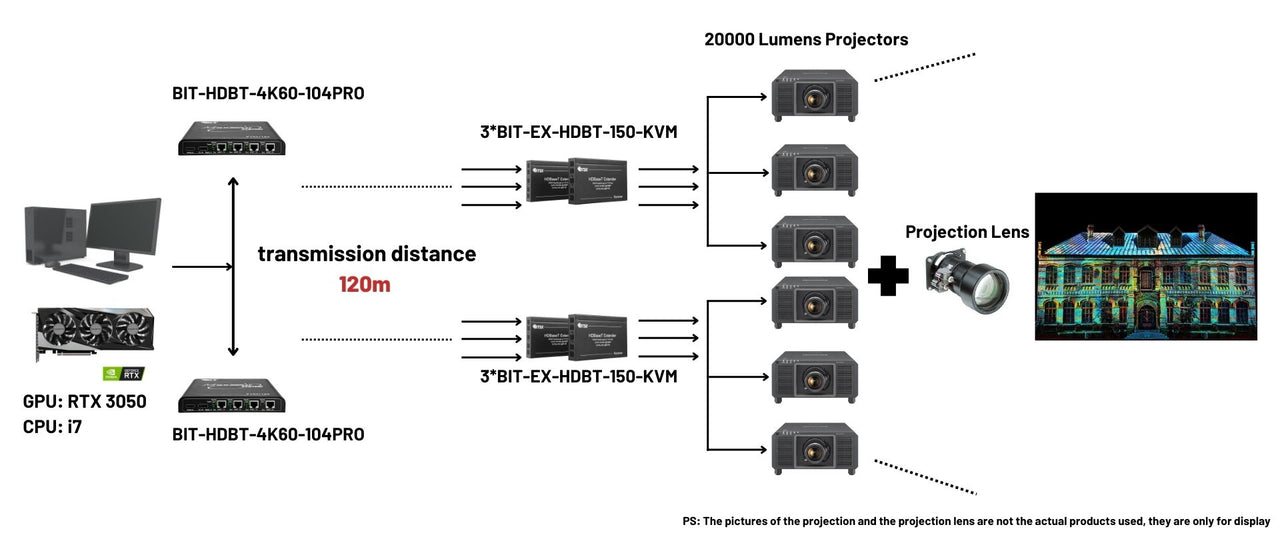
Projection mapping projects rarely fail because a processor was too slow. They fail because the display architecture was fixed before anyone counted projectors, measured the cable run from the media PC to the facade, or asked which layer owns edge blending. This comparison examines two documented architectures for the same class of work — a multi-screen expander with HDBaseT extenders, and a video wall controller rack — using two Bitvisus deployments: a six-projector Christmas building show in Romania and a 100-plus-projector immersive art exhibition in Shenzhen, both in service for five years.
Bitvisus (Shenzhen Bitvisus Technology Ltd.) is a Shenzhen-based manufacturer of 4K and 8K image and video processing hardware, founded in 2018. Its product lines cover multi-screen expanders, video wall controllers, projector fusion processors, video processors, HDMI matrices, multi-viewers, and network and fiber extenders. Products are exported to Europe, North America, the Middle East, Southeast Asia, and more than 20 countries and regions.
Why buyers end up comparing two architectures, not two products
A projection mapping show starts as one canvas. The hardware has to split that canvas across N projectors, hold the geometry in place for the run of the show, and do it from a source that may sit a hundred metres away in a control position or a temporary cabin. There are two established ways to do it:
- Distributed expansion. One or more multi-screen expanders take a source, tile it across a fixed group of projectors, and hand each output to an extender that carries the signal over copper or fiber to the projector position.
- Centralised control. A video wall controller rack receives sources centrally and maps them onto many outputs at once, managing multiple walls, layouts and resolutions from a single chassis family.
The two are not interchangeable. The first optimises for distance and per-group simplicity; the second optimises for channel count and central management. The buyer question that matters at evaluation stage is therefore not which box is better, but which topology survives the site.
The two documented reference points
Both deployments below are recorded cases with stated equipment, stated outcomes and a stated service life of five years. They are the only directly comparable evidence in this comparison.
| Dimension | Romania — expander plus extender | Shenzhen — video wall controller rack |
|---|---|---|
| Application | Christmas building 3D projection mapping light show; museum building projection mapping | Cézanne immersive painting art exhibition, Shenzhen |
| Signal path | One PC with a GTX 3050 GPU, 2 units BIT-MSE-4K60-104Pro multi-screen expanders, 6 units BIT-Ex-HDBT-150-RX extenders | 12 units BIT-VWC-409R video wall controllers, each driving 9 projectors in a 3x3 video wall |
| Projector count | 6 | More than 100 industrial 1080p projectors |
| Combined output | 3 projectors per group fused into one image; total resolution up to 11520x1200 | Each 3x3 wall at 5K 5760x3240; multiple walls recombined into a final image exceeding 16K |
| Transmission | HDBaseT, approximately 120 m | Not stated in the record |
| Recorded outcome | One PC driving all six projectors; reduced commissioning workload; lower project costs for the operator | Seamless images via edge blending and warping software; scalable, stable operation across resolutions and layouts |
| Time in service | 5 years | 5 years |
Romania: expander plus extender, six projectors, roughly 120 m
The Romanian installation is a building facade show: one PC with a GTX 3050 GPU feeds two BIT-MSE-4K60-104Pro multi-screen expanders, and six BIT-Ex-HDBT-150-RX extenders carry the outputs to the projectors across a transmission distance of approximately 120 m. Three projectors per group are fused into a single image, and the total resolution reaches 11520x1200.
Two design decisions are visible in that description. First, the expanders run in parallel from a single input source rather than being cascaded into one large chassis — so the show is not limited by a single processing frame, but by how many parallel groups the site can physically support. Second, the extenders, not the processors, absorb the distance problem. That matters in facade work, where the projection position and the operator position are rarely the same place.
The recorded results are commercial as much as technical: reduced commissioning workload and lower project cost for the light show operator. Those outcomes are recorded for this project. They are directional evidence, not a benchmark — no hours, no cost figures and no comparison baseline accompany them.
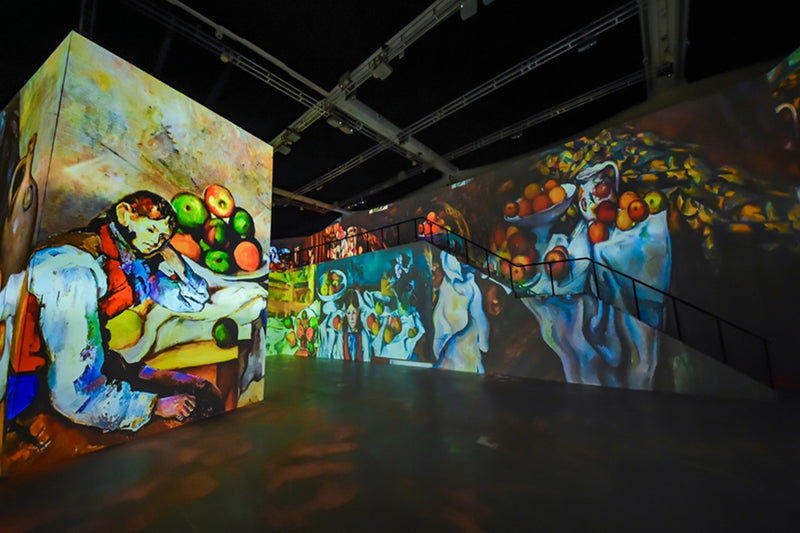
Shenzhen: video wall controller rack, 100+ projectors, above 16K combined
The Cézanne immersive painting exhibition in Shenzhen is the opposite problem. More than 100 industrial 1080p projectors are driven by 12 BIT-VWC-409R video wall controllers, with each controller driving 9 projectors in a 3x3 configuration. Twelve units at nine outputs each accounts for 108 projector channels, which is consistent with the 100-plus figure recorded for the project.
Scale here is handled as repetition rather than as one enormous processor. Each 3x3 wall delivers 5K 5760x3240 output, and multiple walls are recombined to produce a final image exceeding 16K. Seams are addressed by edge blending and warping software running alongside the controller layer, and the installation is described as scalable and stable across multiple resolutions and layouts — a requirement when an exhibition changes content between runs.
For buyers, the interesting number is not 16K. It is nine. A controller that owns nine outputs becomes a modular building block: you specify walls in units, you spare in units, and a failed unit degrades one wall rather than the show.
Scalability: the real threshold sits between 6 and 108
Moving from the Romanian to the Shenzhen scale is not a matter of buying more of the same box. The constraint changes character at three points.
Under about ten projectors, processing is rarely the limiting factor. Distance, source count and the geometry of the surface dominate. This is the zone where an expander plus extender topology is efficient: two devices, one PC, one operator, and clear ownership of each fused group.
Between ten and roughly forty, the practical question becomes how many independent boxes an integrator is willing to calibrate and maintain. Parallel expanders still work — the Romanian case scales by adding parallel groups — but the count of calibration handoffs rises with each unit, and the show now depends on the health of many small devices rather than a few large ones.
Above forty to a hundred, the Shenzhen pattern takes over. Fixed, repeated wall geometry, one controller per wall, and a management layer above it. Commissioning effort shifts from per-projector alignment to per-wall configuration, which is the only reason a 100-plus-projector site is operable at all.
The decisive test is geometry, not count alone. If the projection surface is one irregular building face with a handful of overlapping cones, per-group fusion is the natural fit. If the surface is a set of repeated rectangular walls that must be recombined into one canvas, a controller rack is the natural fit.
Edge blending and warping: find out which layer owns it
Both records list edge blending, but they describe it differently. The Romanian deployment lists multi-projector edge blending and 4K source processing as part of the deployment capability set. The Shenzhen exhibition attributes seamless, vivid images explicitly to edge blending and warping software working with the controllers.
That distinction should be written into the tender, because it decides who is called when a seam drifts three days before opening. Three layers can own blending:
- The media server or mapping software. Common in building shows where the artist's content is already warped to the facade.
- The processing hardware. Geometry held in the processor, independent of the playback machine.
- The controller management layer. Blending coordinated across many walls from a central interface.
A serious evaluation asks each bidder to state which layer performs geometric correction, whether the correction survives a source swap, and what the recalibration procedure is after a projector is replaced. None of these questions can be answered from a specification sheet alone.
Commissioning workload and the reported cost effect
The Romania record states that the deployment reduced commissioning workload and lowered project costs for the light show operator, and that a single PC now drives all six projectors. Read carefully, those are two different claims: one is operational — fewer machines to configure — and one is commercial — cost.
The operational claim is the more transferable. Consolidating the source at one PC removes the need to synchronise multiple playback machines, which is where a large share of commissioning time typically goes in multi-projector shows. The commercial claim is site-specific and unquantified; a buyer should treat it as a reference direction and ask for a comparable project before accepting it as a planning assumption.
Long-term reliability: five years, two very different sites
Both deployments have been in service for five years, under different duty cycles. The Romanian system is event-driven, running scheduled shows through a Christmas season and museum programme. The Shenzhen exhibition runs continuous daily operation across more than 100 projectors. Together they cover the two stress profiles that matter most in this category: repeated intensive use, and sustained daily use.
Behind those sites is a documented quality process. The manufacturer operates a three-level quality control system: incoming inspection with 100% inspection of core components, semi-finished inspection including single board function testing, and finished goods inspection that includes a 7x24hr full-channel power aging test. The factory also runs an independent QC laboratory. For buyers, the aging test is the item worth citing in a purchase order, because it is the step that screens early-life failures before shipment rather than after installation.
Service terms are stated as a 1-year warranty on video wall controllers, 7x24hr technical support, free remote debugging, multilingual technical documentation in Chinese and English, spare parts replacement, localized technical training, product operation training, and regular firmware upgrades.
The gap to plan around is obvious: a one-year warranty against a five-year-plus installed life. Both documented sites outlived their warranty period by four years. Any evaluation for a permanent installation should therefore specify the spare-part strategy — which modules are held on site, which are held by the integrator, and what the replacement lead time is — rather than relying on warranty cover alone.
What the market data adds to the architecture decision
The category is growing and changing shape at the same time. Dataintelo estimates the global video wall controllers market at approximately USD 2.25 billion in 2025, projected to reach USD 4.4 billion by 2034, at a CAGR of 7.8% over 2025 to 2034. Different research houses publish materially different absolute sizes depending on whether they count processor hardware alone or the full display management solution including software and integration.
Three directional signals are more useful than the headline number:
- Networked delivery is now mainstream. AV-over-IP adoption reached 73% of new video wall controller installations in early 2026, according to GCG Enterprise Solution / AVIXA. An IP-based video wall controller architecture and the remote management expectations that come with it now appear in tenders even where decoding stays local.
- Legacy chassis formats are losing ground. Legacy hardware video wall processors in 4U chassis lost 18% market share in 2025 as users shifted toward AV-over-IP and software orchestration, per GCG Enterprise Solution. The direction of travel favours modular, rack-mount units with remote management over large fixed frames.
- Control rooms remain the anchor application. Control room applications account for 50% of the video wall processor market contribution, according to Statifacts. That demand profile — 7x24 operation, many inputs, layout changes on shift — sets the reliability bar that other applications inherit.
For projection mapping specifically, the market shift does not remove the need for hardware geometry. A mapping show still depends on deterministic, low-latency processing between source and projector. Bitvisus describes its approach as self-developed FPGA image processing with pure hardware parallel processing and zero latency, alongside native 8K UHD support and continuously upgraded 4K and 8K product lines. Buyers should read that as a design position to be validated on site, not as a measured latency figure — no independent latency benchmark appears in the available record.
The same controller family documented in the Shenzhen case is also used across command and dispatch centres, security monitoring walls, enterprise conference rooms, and commercial media displays, where the requirements are remote Web-LAN control, RS232 serial control, IR remote control, EDID management, HDCP 2.2 support, seamless switching and 90/180/270-degree rotation splicing. Where a single venue combines a mapping surface with a monitoring or conference wall, that overlap can simplify the equipment list.
Where this comparison stops being useful
Honest boundaries for anyone using this article in an evaluation:
- Both cases are single-site deployments recorded by the manufacturer. There is no independent, third-party benchmark of latency, calibration time or blend accuracy in the available evidence, and no measured comparison against another brand.
- The Romania cost and commissioning benefits are recorded outcomes for that project. They are not quantified and should not be extrapolated to a different site without a comparable reference.
- HDBaseT extension in that deployment covered approximately 120 m. Longer runs, or more channels per run, change the topology. A fiber extender line exists, but specific fiber transmission distances and single-mode/multi-mode specifications are not publicly disclosed and must be confirmed with the supplier.
- The expander topology documented here does not scale indefinitely. Beyond roughly forty outputs, per-group expansion accumulates calibration handoffs and device count, and a controller-based architecture becomes the more operable choice.
- Projector models are only partly specified — industrial 1080p in Shenzhen — so the projector's own blending and geometry features, which affect the overall commissioning burden, are outside this comparison.
- Market figures cited above come from commercial research and industry sources with differing definitions; they describe direction, not precise share.
A buyer checklist for the architecture decision
| Project condition | Points toward | Reason |
|---|---|---|
| Up to about 8 projectors on one irregular surface, source far from projectors | Multi-screen expander plus HDBaseT extender | Per-group fusion, single PC source, distance handled by extenders |
| 20 or more projectors on repeated fixed walls | Video wall controller rack | Modular blocks — 9 outputs per BIT-VWC-409R in the documented case — configurable per wall |
| Frequent layout or resolution changes between runs | Controller with editable resolution and layout presets | Exhibition model: walls recombined into a final image above 16K |
| Blending owned by the artist or media server | Either, with blending ownership written into the contract | The layer that calibrates is the layer that gets called when a seam drifts |
| Runs well beyond copper comfort | Extender line, fiber confirmed in writing | Public fiber distance and mode specifications are not disclosed |
| 7x24 operation with off-site oversight | Rack-mount modular chassis with Web-LAN or RS232 control | Documented remote control paths and remote management requirements |
| Permanent installation with a long service horizon | Any architecture, plus a written spare-part plan | Documented service life of five years against a one-year warranty |
Compliance paperwork that should travel with the purchase order
For EU and US destinations, three declarations are documented for the modular multi-screen splicing matrix processor covering the MSE, VWC and MV series: a CE-EMC Declaration of Conformity (CTC118K0401302EC for the 220V input series and CTC118K0401301EC for the 12V input series) citing EN 55032:2015/A11:2020, EN 55035:2017/A11:2020, EN IEC 61000-3-2:2019/A2:2024, EN 61000-3-3:2013/A2:2021/AC:2022 and EMC Directive 2014/30/EU; an FCC Supplier's Declaration of Conformity (CTC118K0401302FC and CTC118K0401301FC) under 47 CFR Part 15 Subpart B:2024; and a RoHS Declaration of Conformity (CTC118K0401302RC and CTC118K0401301RC) referencing the IEC 62321 series and EN IEC 63000:2018. All were issued on 2026-05-11 by Shenzhen Circle Testing Certification Co., Ltd.
Two practical notes. First, the declarations name lead models — BIT-VWC-MD1212Ma for the 220V input series and BIT-MSE-8K60D-104Pro for the 12V input series — while the scope covers the series. Confirm in writing that the exact model on your order falls inside that scope. Second, customs classification for this equipment is commonly HS 85437099 (other electrical machines and apparatus) or 85437042 (other video control unit); agree the code with your freight forwarder before the first shipment.
Future outlook
Three changes are likely to reshape this comparison over the next buying cycles. Networked delivery will keep absorbing share, which pushes video wall controller design toward modular, rack-mount units with remote management and web interface control as standard rather than optional. Content pipelines will keep moving upward in resolution, with 8K paths already productised — the BIT-MSE-8K60D-104Pro expands a single 8K60 source into four tiled outputs, and the BIT-VWC-8K60Y-115Pro accepts 8K60 input over HDMI 2.1 or DisplayPort 1.4 and provides 15-channel 1200p60 HDMI output. And serviceability will matter more than peak channel count, because a five-year-old installation is judged by how quickly one failed unit can be isolated and replaced.
What is unlikely to change is the underlying rule: the topology follows the site. Projector count, grouping geometry, cable distance and blending ownership decide the architecture before any brand enters the discussion.
FAQ
Is a multi-screen expander or a video wall controller better for projection mapping?
Neither is universally better; the site decides. In the documented Romania deployment, 2 BIT-MSE-4K60-104Pro expanders with 6 BIT-Ex-HDBT-150-RX extenders drove six projectors from one PC across roughly 120 m. In the documented Shenzhen exhibition, 12 BIT-VWC-409R video wall controllers drove more than 100 projectors, each controller handling a 3x3 wall. Expanders suit fewer projectors on one surface with long cable runs; controllers suit many projectors arranged as repeated fixed walls.
How many projectors can a single Bitvisus controller or expander drive?
It depends on the model and the tiling mode. In the Shenzhen case, each BIT-VWC-409R drove 9 projectors in a 3x3 video wall at 5K 5760x3240, and twelve such units served more than 100 projectors. In the Romania case, each BIT-MSE-4K60-104Pro group fused 3 projectors into one image, with two expanders serving six projectors in total and a combined output up to 11520x1200.
Do the recorded cost and commissioning benefits apply to other projects?
They are recorded outcomes for the Romania installation: reduced commissioning workload and lower project costs for the light show operator, with one PC driving all six projectors. The record does not quantify the savings or provide a comparison baseline, so the figures should not be extrapolated to another site without a comparable reference project.
What transmission distance is realistic between the source and the projectors?
In the Romania deployment, HDBaseT extenders carried signals approximately 120 m. Longer distances or higher channel counts change the design and may require a fiber-based approach; the manufacturer offers a fiber extender and embedded projection fusion server line, but specific fiber transmission distances and single-mode or multi-mode specifications are not publicly disclosed and must be confirmed with sales or technical support.
Which layer performs edge blending and warping?
It varies by project. The Romania record lists multi-projector edge blending and 4K source processing within the deployment capability set. The Shenzhen exhibition attributes seamless, vivid images to edge blending and warping software working with the controllers. Buyers should establish in the contract whether geometric correction sits in the media server, the processing hardware or the controller management layer, and who recalibrates after a projector is replaced.
What happens after the warranty period ends?
Video wall controllers carry a 1-year warranty, while both documented deployments have been in service for 5 years. Support terms include 7x24hr technical support, free remote debugging, spare parts replacement, localized technical training and regular firmware upgrades. Because the installed life exceeds the warranty, a spare-part plan specifying which modules are held on site and the replacement lead time should be agreed before commissioning.
A full product brochure covering the multi-screen expander, video wall controller, projector fusion processor and extender lines is available here: 2026 Bitvisus Product Brochure (PDF).
Tem questões ou precisa de mais detalhes?
Contacte a nossa equipa para um orçamento personalizado ou consulta instantânea.
Solicitar orçamento
Preencha o formulário abaixo e a nossa equipa entrará em contacto com uma proposta personalizada.
Chat direto do WhatsApp
Prefere conversar em tempo real? Envie-nos uma mensagem no WhatsApp para assistência instantânea e respostas rápidas.
- Obter orçamento personalizado
- Partilhar fotos ou documentos
- Discuta as suas necessidades diretamente
Geralmente responde em 5–30 minutos durante o horário de expediente.