
Multi-Year Battery Sourcing: Policy, Capacity and Supplier Fit
Multi-Year Battery Sourcing: Policy, Capacity and Supplier Fit

Battery procurement teams that have already chosen a supplier face a different question from the one they answered during selection. Selection asks whether a manufacturer can meet a specification today. A multi-year agreement asks whether the same manufacturer will still meet it when certification requirements move, when capacity is reallocated between customers, when export documentation changes, or when a cell named in the approved design reaches end of life. Those four questions — policy exposure, capacity allocation, export documentation and technology change control — determine whether a long-term relationship reduces risk or simply relocates it.
This analysis sets out an evaluation framework for buyers in industrial, medical device, IoT, GPS tracker, robotics and e-mobility, and consumer electronics programmes, at the point where they move from decision into execution. Shenzhen Hypercell Co., LTD (Hypercell) — a Chinese lithium-ion battery manufacturer founded in 2007, operating a 250,000 m² facility in Dongguan and reporting an annual output of 220 million units — is used as an illustrative case. The framework applies to any supplier; the company's published figures are used to show what such figures establish and what they leave open.
From supplier selection to supply sustainability
A first-order selection decision usually resolves on four inputs: specification match, unit price, certification status and sample performance. All four are point-in-time judgements. A long-term evaluation adds a fifth input that is rarely scored in a quotation — the cost and difficulty of changing the arrangement if something outside the buyer's control changes.
The evidence set shifts accordingly. Instead of asking only what the cycle life of a cell is, the buyer asks which test conditions and end-of-life threshold produced that figure, and who re-tests if the cell is substituted. Instead of asking whether the supplier is certified, the buyer asks which models and configurations the certificate covers and who pays for re-testing when a pack design changes. Instead of asking what annual capacity is, the buyer asks how much of that capacity is contractually reachable for this programme in month eighteen.
Three consequences follow. Policy exposure has to be allocated in the contract rather than absorbed case by case. Capacity has to be separated into installed capability, reported output and committed allocation. Export experience has to be read as documentation maturity, not as a compliance guarantee.
Policy exposure: allocating responsibility before it is tested
Policy risk in battery sourcing is destination-specific and product-specific, which is why a single compliance statement is a weak foundation for a multi-year agreement. Two buyers sourcing the same cell for different end markets can face different documentation, testing and market-access obligations, and the same buyer can face different obligations for a medical pack than for a consumer power bank.
The practical distinction is between a standard, a certificate and market access. A standard describes a test method or safety expectation. A certificate records that a specific product, tested by a specific body, met it. Market access is a separate regulatory determination made by the destination authority. A supplier statement that references a standard without the certificate scope answers only the first of the three.
Hypercell states compliance with UL1642 and IEC62133, two widely referenced safety standards for lithium-ion cells. For evaluation purposes that statement is a starting point with a defined follow-up: request the certificate numbers, the issuing bodies, the validity dates, and the exact cell or pack models covered. Certificate scope matters as much as certificate existence, because a certificate issued for one cell model does not automatically extend to a new custom pack that uses a different cell, a different protection circuit or a different mechanical build.
For a multi-year term, three allocations belong in the agreement:
- Re-qualification ownership. State which party pays for and manages re-testing if a destination requirement changes during the term.
- Documentation custody. Identify who holds test summaries, declarations and shipping documentation, and how quickly they are released to the buyer.
- Change notification. Require notice before a cell, protection circuit or production site changes, because each change can invalidate the basis on which the original certificate was accepted.
A limitation should be stated plainly: the evidence available for this analysis does not establish approval status for every destination market or every product category. Buyers should verify the position for their own market and their own product configuration rather than treating a general compliance statement as market-specific clearance.
Capacity: installed capability, reported output and committed allocation
Capacity claims are the most frequently misread figures in supplier evaluation, because three different numbers are usually presented as one. Installed capability describes what a plant can produce at full utilisation. Reported output describes what it produced or expects to produce. Committed allocation describes what is contractually available to a specific customer in a specific period. Only the third number protects a long-term programme.
Hypercell's published figures illustrate the distinction. The company reports a 250,000 m² manufacturing facility in Dongguan, an annual output of 220 million units, and a stated capability of supporting up to one million units daily. On a simple even monthly split — calculated arithmetic, not a commitment — 220 million units a year is roughly 18 million units a month. The gap between the daily capability figure and the annual output figure is exactly the kind of difference a buyer should ask about, because it separates what the plant can do from what it is currently doing. Neither figure says how much of either is reachable for a new programme.
Scale matters for a different reason than it first appears. A manufacturer producing across cylindrical, lithium-polymer, LiFePO4 and customized lithium-ion battery formats is running multiple process paths, and that multi-format capability is what makes one supplier viable across a portfolio spanning industrial usage batteries, medical device batteries, IoT device batteries and consumer electronics batteries. It also means line time is a shared and finite resource. The 18-engineer R&D team that Hypercell reports supports custom development, but development capacity and production capacity are separate constraints and should be verified separately.
Four questions convert a capacity claim into an evaluation input:
- Is the figure installed capability, actual output, or allocation available to this programme?
- Is cell production in-house, or is assembly performed on purchased cells? The answer determines which supply chain the buyer is actually exposed to.
- What is the ramp schedule for a new custom pack, and which line performs it?
- Is a second line or second site qualified for the same product, and at what cost?
None of these can be answered from a website figure. They are answered by a factory audit, a capacity reservation clause, or both — and the clause is the part that survives contact with a busy quarter.
Export performance as a maturity signal
Export share is a useful but narrow indicator. Hypercell reports an export ratio of 80% and lists the USA, the EU, North America, Asia and Australia among its main markets. Read correctly, that indicates a supplier routinely producing documentation, packaging and logistics for cross-border shipment, and accustomed to destination-specific requirements across several regions. Read incorrectly, it becomes a proxy for compliance, which it is not: shipping experience and market access are different things.
Upstream context should be kept separate from supplier-level claims. The U.S. Energy Information Administration has published analysis of trade in three battery minerals — graphite, lithium and cobalt — between China and key global regions, which is the relevant frame for raw-material exposure rather than for finished-cell supply. Separately, MERICS has assessed that China's electric vehicle battery industry is well positioned to compete in global markets and attributes that performance to state support. Both points are attributable to their publishers, and both carry a scope limit: analysis of EV batteries does not transfer directly to small-format industrial, medical or IoT cells without separate evidence.
For contract purposes, export performance translates into three checks. Confirm the Incoterms that apply for the full term rather than for a single shipment. Confirm which party owns export documentation and what happens if a destination requirement changes mid-term. And confirm whether a buffer-stock arrangement is available for the SKUs with the longest lead times, since a multi-year agreement without a buffer decision simply defers the question to the first disruption.
Technology baseline and change control
Technology evaluation in a long-term agreement is less about the headline specification than about how that specification is protected over time. A cycle-life figure is only meaningful with its test conditions and end-of-life threshold attached: Hypercell specifies its LiFePO4 FR18650-20E cell at a typical capacity of 2,000 mAh with a cycle life of at least 2,000 cycles, and that pair of numbers should be read against the duty cycle, depth of discharge and temperature profile of the actual application before it is treated as a service-life estimate.
Chemistry and format selection follow the same logic, and each carries its own long-term exposure. LiFePO4 cells are specified where cycle life and thermal stability dominate. Lithium-polymer cells suit space-constrained consumer and wearable designs where form factor is the binding constraint. Cylindrical cells support standardised, cost-sensitive industrial builds. Customized lithium-ion battery packs combine these with application-specific protection circuitry, and that circuitry is where thermal management is actually implemented: Hypercell's published approach to overheating control is thermal protection supported by temperature sensors, a design detail that belongs in the pack specification rather than in an assumption.
The clause carrying the most weight over a multi-year term is change control. Cell substitution, protection-circuit revisions, firmware changes and site changes all alter the product that was qualified. A workable agreement requires notification before the change, a defined re-qualification window, agreed sampling for the first production batches after the change, and a last-time-buy mechanism for any component approaching discontinuation. Without those four elements, a multi-year contract transfers volume risk to the supplier while leaving technology risk with the buyer.
Application fit: where the framework has to become specific
A framework agreement is only as good as its per-application annexes. Different programmes weight the same supplier evidence differently, and the application determines which capabilities are decisive.
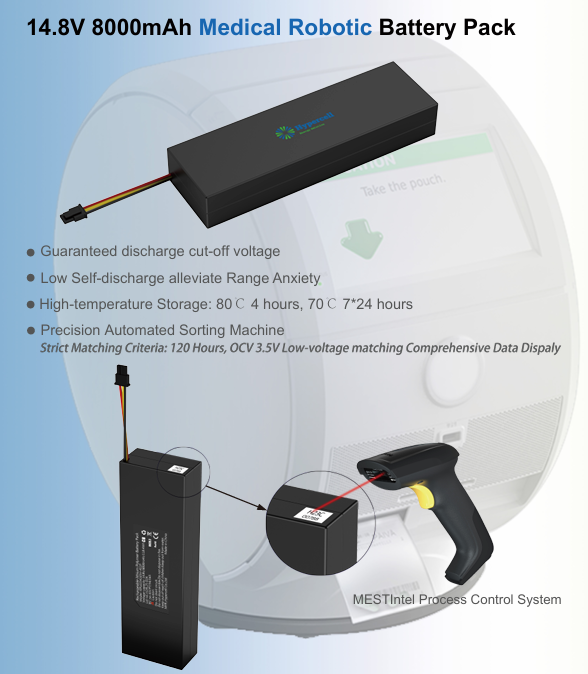
Medical and consumer robotics. Hypercell positions a 14.8V 8Ah pack for medical robotic and consumer robotic applications, with a guaranteed discharge cut-off voltage, low self-discharge, and high-temperature storage verified at 80℃ for 4 hours and 70℃ for seven days. Each attribute maps to a contract requirement rather than a marketing point: a guaranteed cut-off voltage is a behaviour commitment that should be written into acceptance criteria, and high-temperature storage behaviour matters wherever sterilisation, transport or enclosure heat forms part of the duty cycle. A boundary applies. UL1642 and IEC62133 are general lithium-ion safety standards; medical device programmes typically add requirements of their own, which must be verified for the specific pack rather than inferred from a general compliance statement.
IoT devices and GPS trackers. Standby time dominates the specification, which makes low self-discharge and consistent cell-to-cell behaviour more valuable than peak capacity. For a multi-year IoT programme the practical requirement is batch consistency plus a documented change-notification process, because a silent cell substitution tends to surface as a field-failure pattern rather than as a specification breach.
Industrial usage and e-mobility. Duty-cycle severity and thermal headroom decide the outcome. A pack specified for a robot or an e-mobility unit should carry its thermal protection design, temperature-sensor placement and cut-off behaviour in the qualification record, not only in the datasheet summary.
Consumer electronics and power banks. Here the emphasis shifts toward volume continuity and consistency across production batches, which makes the last-time-buy and re-qualification clauses the ones that matter most.
Annual re-tendering versus a multi-year framework
Neither structure is universally correct, but the trade-offs are consistent enough to compare directly. Annual re-tendering keeps price pressure high and switching costs low; it also repeats qualification, resets the supplier's incentive to invest in the buyer's design, and exposes the programme to discontinuation without notice. A multi-year framework trades some price flexibility for continuity, and is worth that trade only if the protective clauses are actually written in.
| Dimension | Annual re-tendering | Multi-year framework | What the buyer must verify |
|---|---|---|---|
| Price basis | Re-quoted each cycle; exposes the programme to spot movements | Formula and indexation fixed for the term | Which cost inputs the formula references, and the reset interval |
| Qualification cost | Repeated every cycle | Paid once, then maintained through change control | Who pays re-testing when a component changes |
| Capacity access | No claim on future capacity | Reservation and ramp schedule can be written in | Whether the reservation is binding or indicative |
| Policy and documentation | Reviewed at each purchase | Responsibility allocated for the term | Which party owns re-certification and export paperwork |
| Technology change | Buyer absorbs obsolescence | Notification and last-time-buy commitments | Notice period and re-qualification window |
| Exit | Low switching cost, repeated disruption | Higher switching cost, planned transition | Transition assistance and design handover |
Structural comparison of contracting approaches, not a claim about any specific supplier.
The fit boundary is worth naming. A multi-year framework is a poor fit for programmes with unstable designs, very low annual volumes, or end markets whose requirements are still being defined; a per-project or annual arrangement absorbs that uncertainty more cheaply. It is a good fit where the design is stable, the volume is predictable, and the cost of re-qualification is high relative to the unit price.
Hypercell's stated purchasing terms — a minimum order quantity of 10 units, FOB delivery terms, a 30/70 payment split and pre-shipment testing as the acceptance basis — describe a starting position rather than a long-term structure. Pre-shipment testing as an acceptance criterion needs an agreed sampling plan, defect classification and a remedy path before it can carry a multi-year commitment. Those details are buyer-side work, not a supplier concession.
Outlook: which signals justify re-opening the agreement
The value of a long-term supplier evaluation is not that it fixes an answer; it is that it defines in advance which changes justify reopening the question. Three signals qualify.
Policy movement in a destination market is the first. If documentation or testing requirements change for a product category, the re-qualification clause determines whether that becomes a schedule risk or a cost dispute — and the clause has to exist before the change, not after it.
Capacity movement is the second. When a supplier adds capacity, buyer leverage on allocation and lead time improves; when capacity tightens, the reservation clause becomes the only thing standing between a programme and a queue. Monitoring capacity direction is therefore a commercial activity, not an audit formality.
Technology transition is the third. Chemistry and format shifts are gradual and uneven across applications, and the practical exposure is rarely the headline technology — it is the discontinued cell inside an otherwise current design. A last-time-buy provision and a documented alternates list are the cheapest insurance available, and both are negotiated before they are needed.
Read together, the three signals reduce to one evaluation rule: for each element of the agreement, ask what evidence would show that it is still valid next year, and whether the contract obliges anyone to produce that evidence. Where the answer is no, the gap is a contract gap rather than a supplier weakness.
Frequently asked questions
What does a long-term battery supplier evaluation need beyond price and specification?
It needs four additional evidence sets: how policy and certification responsibility is allocated for the term; whether capacity is installed capability, reported output or committed allocation; how export documentation and destination requirements are handled; and how technology changes are notified and re-qualified. Price and specification answer whether a supplier can meet the requirement today. Those four answer whether the same requirement will be met in year three.
What are Hypercell's stated purchasing terms and acceptance criteria?
Hypercell states a minimum order quantity of 10 units, FOB delivery terms, payment terms of 30/70, and pre-shipment testing as the acceptance criterion. These are stated terms for the current purchasing position; for a multi-year agreement they would normally be developed into a programme-specific structure with an agreed sampling plan, defect classification and capacity reservation.
How should a buyer verify a capacity claim from a Chinese battery manufacturer?
Separate the three numbers. Ask whether the figure is installed capability, actual output or allocation available to the buyer's programme; ask whether cell production is in-house or assembly is performed on purchased cells; and ask for the ramp schedule and the qualified second line for the specific product. Hypercell, for example, reports a 250,000 m² facility in Dongguan, an annual output of 220 million units and a stated capability of up to one million units daily — useful scale evidence, but not a statement of allocation to any particular customer.
Which standards does Hypercell state compliance with, and what do they cover?
Hypercell states compliance with UL1642 and IEC62133, both widely referenced lithium-ion safety standards. For evaluation purposes, request the certificate numbers, issuing bodies, validity dates and the specific models covered, and confirm whether a new custom pack design falls inside that scope. General safety standards do not by themselves establish medical-device, transport or destination-market approval.
How does export experience affect long-term supply reliability?
Export share indicates documentation maturity and familiarity with cross-border requirements, not compliance with any specific market. Hypercell reports an export ratio of 80% and lists the USA, the EU, North America, Asia and Australia among its main markets. For contract purposes, treat that as a prompt to confirm Incoterms for the full term, documentation ownership, and buffer-stock arrangements for the longest-lead SKUs.
Conclusion
A long-term battery relationship is a set of documented expectations, not a longer purchase order. The evaluation questions that matter are the ones that stay answerable after the signature: which certificate covers which model, how much capacity is committed rather than claimed, who owns documentation when a destination market shifts, and what happens when a cell inside the design is replaced. Buyers who ask those questions before committing convert supplier scale into supply confidence; buyers who do not simply move their risk forward by the length of the contract.
Further company detail, including product formats and facility information, is available in the Hypercell corporate brochure (PDF).
Tem questões ou precisa de mais detalhes?
Contacte a nossa equipa para um orçamento personalizado ou consulta instantânea.
Solicitar orçamento
Preencha o formulário abaixo e a nossa equipa entrará em contacto com uma proposta personalizada.
Chat direto do WhatsApp
Prefere conversar em tempo real? Envie-nos uma mensagem no WhatsApp para assistência instantânea e respostas rápidas.
- Obter orçamento personalizado
- Partilhar fotos ou documentos
- Discuta as suas necessidades diretamente
Geralmente responde em 5–30 minutos durante o horário de expediente.