
Multipole Ring Magnets: What ISO 9001 and ISO 14001 Cover
Multipole ring magnets combine a sintered NdFeB material with a magnetized pole pattern. That combination matters during supplier evaluation, because the certificates most often exchanged at the start of a sourcing conversation — ISO 9001:2015 and ISO 14001:2015 — describe management systems rather than the magnetic properties of a specific ring. Reading them correctly is part of building usable supplier evidence.
Why certificate scope is a purchasing question, not a paperwork question
For a motor designer or an OEM buyer, a multipole ring is defined by two different things at once. One is the material and geometry: grade, dimensions, coating, and the dimensional tolerances of the ring body. The other is the magnetization pattern: pole count, magnetization direction, and the consistency of the field around the circumference. A certificate can support confidence in how the supplier runs its processes. It cannot, by itself, confirm a pole pattern or a torque output.
This distinction is what makes the ISO 9001 and ISO 14001 certificates for a multipole ring supplier worth reading line by line. Buyers who treat them as interchangeable with a test report sometimes expect more than the standards provide. Buyers who dismiss them as generic paperwork lose a legitimate signal about process maturity, corrective-action discipline, and environmental compliance across the production site.
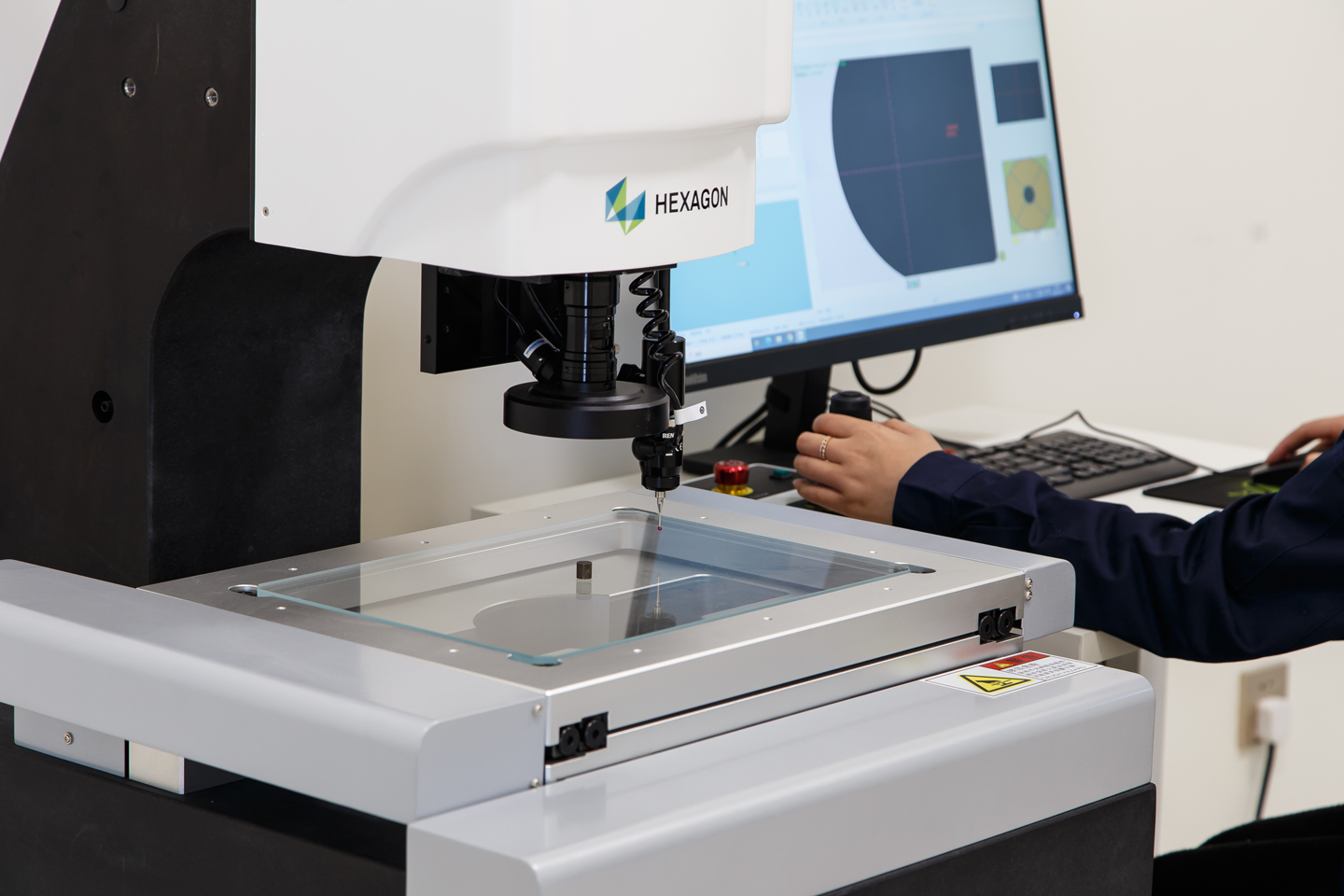
Dimensional verification of sintered NdFeB magnet geometry — a control point that sits inside the ISO 9001 quality management system, not inside the product specification itself.
The two certificates held by Ningbo Jinlun Magnet Technology
Ningbo Jinlun Magnet Technology Co., Ltd. is a Chinese manufacturer of sintered NdFeB permanent magnets, founded in its current form in 2006 and active in magnet production since 1996. It operates two manufacturing sites in Cixi, Ningbo, with approximately 400 employees and an annual production capacity of 8,000 tons of high-performance magnets. Its product range includes blocks, discs, rings, arcs, trapezoids, multipolar and radial rings, Halbach assemblies, and custom shapes prepared under ODM production services.
Two management-system certificates sit at the centre of the supplier evidence discussed in this article:
| Certificate | Standard | Certificate number | Certification body | Issue date | Expiry date | Stated market |
|---|---|---|---|---|---|---|
| Quality management system | ISO 9001:2015 | 12 100 69512 TMS | TÜV SÜD Management Service GmbH | 2025-07-04 | 2028-07-03 | Global & domestic markets |
| Environmental management system | ISO 14001:2015 | 02124E10013R1M | Huaxia Certification Center, Inc. | 2024-01-02 | 2027-01-17 | Global & domestic markets |
Both certificates list the same product family in their related-product section, including the N52 D20x10x5mm Sintered Neodymium Magnet, the N35 D10x2mm Sintered Neodymium Magnet, and the wider Sintered NdFeB magnet range defined by the manufacturer's naming code — disc, block, ring, and arc geometries with optional steps, holes, or chamfers. Multipole and radial rings are produced within the same sintered NdFeB manufacturing framework, which is why the certificate scope is directly relevant to a ring-magnet enquiry.
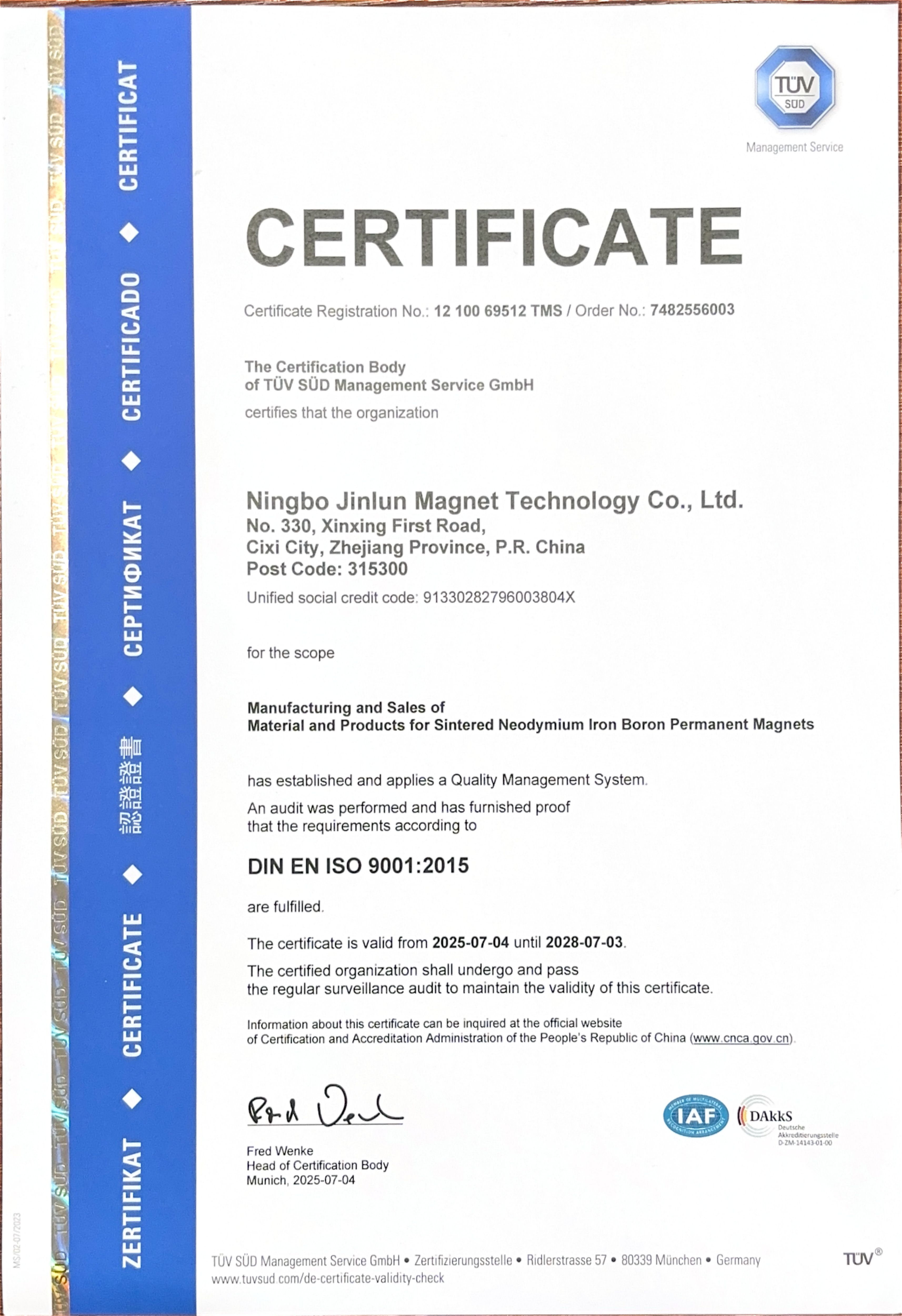
ISO 9001:2015 certificate 12 100 69512 TMS, issued by TÜV SÜD Management Service GmbH. Scope: Manufacturing and Sales of Material and Products for Sintered Neodymium Iron Boron Permanent Magnets.
What the ISO 9001:2015 certificate actually covers
ISO 9001:2015 is a quality management system standard. Certificate 12 100 69512 TMS states its scope as “Manufacturing and Sales of Material and Products for Sintered Neodymium Iron Boron Permanent Magnets.” Read carefully, that wording describes the production and sales processes for the magnet family, not the magnetic performance of every individual part produced under it.
For a multipole ring buyer, the practical coverage is the following:
- Process control across the sintered NdFeB flow, from raw-material intake through pressing, sintering, machining, and coating.
- Document and record control, which determines whether a lot can be traced back to its material batch and process parameters.
- Non-conformity handling and corrective action, the mechanism a buyer relies on when a delivered batch deviates from the agreed drawing.
- Internal audit and management review, which underpin the stability of the system between surveillance audits.
- Sales and dispatch activities for the same magnet family, which is why the scope pairs manufacturing with sales rather than addressing only the factory floor.
The certificate is issued by TÜV SÜD Management Service GmbH and is valid from 4 July 2025 to 3 July 2028. The stated market applicability is global and domestic. That applicability is a statement about where the certified system is recognised for the scope shown — it is not a statement that additional regional requirements, such as customer-specific approvals or import documentation, are automatically satisfied.
What the ISO 14001:2015 certificate actually covers
ISO 14001:2015 is an environmental management system standard. Certificate 02124E10013R1M states its scope as “Production and related management activities of sintered Nd-Fe-B permanent magnet and products.” The issuing body is Huaxia Certification Center, Inc., and the certificate is valid from 2 January 2024 to 17 January 2027, with global and domestic market applicability.
For a buyer, ISO 14001 evidence addresses a different set of questions than ISO 9001 does:
- How the production site manages waste streams generated by machining and coating.
- How emissions, effluents, and energy use are monitored and controlled.
- How the supplier identifies and tracks its compliance obligations.
- How environmental incidents and near-misses are recorded and corrected.
- How environmental objectives are reviewed and updated on a defined cycle.
What ISO 14001 does not do is predict magnetic behaviour, dimensional accuracy, or coating adhesion of a multipole ring. Those remain product-level properties, verified through test reports, drawings, and samples. The value of the ISO 14001 certificate in a procurement file is that it demonstrates an externally audited environmental management system applied to the same sintered NdFeB production scope as the quality certificate — which is increasingly relevant where customers report on supplier environmental performance in their own disclosures.
.png)
ISO 14001:2015 certificate 02124E10013R1M, issued by Huaxia Certification Center, Inc. Scope: Production and related management activities of sintered Nd-Fe-B permanent magnet and products.
Where the two certificates divide responsibility
The cleanest way to read the pair is by function. ISO 9001 answers: can this supplier demonstrate a controlled, auditable production and sales process for sintered NdFeB magnets? ISO 14001 answers: does the same supplier manage the environmental side of that production under an externally verified system? Neither certificate answers: will this specific multipole ring deliver the required flux density at the specified pole count and air gap?
For a multipole ring project, the buyer is therefore assembling evidence across three layers, and the ISO certificates cover only the first two:
- System layer — ISO 9001 and ISO 14001 certificates with scope that names sintered NdFeB manufacturing.
- Process layer — in-house capability facts: production lines, coating options, magnetization technologies, dimensional inspection, magnetic-property testing, and batch-consistency practices.
- Product layer — dimensional reports, magnetic-property test reports, hot-demagnetization curves, coating salt-spray results, and sample validation for the specific ring.
Ningbo Jinlun Magnet Technology supports the process layer with in-house capability that extends across the whole sintered NdFeB flow: melting, hydrogen decrepitation, powder preparation, pressing, sintering, precision CNC machining, multi-type surface treatment, and final performance testing. The company runs an in-house electroplating centre and offers multiple standard coating systems — bright NiCuNi, matte NiCuNi, single-layer Ni, black oxide, colour zinc, chemical Ni, and epoxy — with salt-spray and high-temperature aging testing available for validation. Multipolar and radial orientation technologies are used to produce multipole rings and radial rings for small motors, sensors, and actuators, with custom magnetization patterns including radial, multipole, and Halbach configurations. These are process capabilities, not ISO certificate claims, and a buyer should treat them as complementary evidence.
What the certificate numbers do and do not trace
Certificate numbers matter because they can be verified. A buyer can check certificate 12 100 69512 TMS with TÜV SÜD Management Service GmbH and certificate 02124E10013R1M with Huaxia Certification Center, Inc., and confirm the standard, scope, issue date, and expiry date against the supplier's copy. That verification step is a straightforward form of due diligence and belongs in the procurement file.
What the numbers do not do is identify a specific multipole ring by part number. The certificate is issued against the production and sales scope for the sintered NdFeB magnet family, not against a catalogue item. A supplier cannot reasonably be asked to present an ISO 9001 certificate that lists every custom ring geometry, because the standard does not work that way. What the certificate does establish is that the site producing that ring operates under an audited management system — and that is the appropriate level of claim.
Application context: where multipole rings are used
Multipole ring magnets appear in applications where a rotating field must be shaped around a small circumference. Ningbo Jinlun Magnet Technology supplies sintered NdFeB magnets into synchronous motors, consumer electronics, automotive drive motors, wind power generation, 5G communication hardware, medical apparatus, and aerospace industries, and its product shapes include multipolar and radial rings for motors, sensors, and actuators.
Typical application categories include:
- Small motors and servo drives — where pole-pattern consistency affects torque ripple.
- Sensors and encoders — where field uniformity around the ring supports position accuracy.
- Actuators and magnetic couplings — where the ring must combine mechanical fit with a defined magnetization direction.
- Automotive auxiliary motors — including EPS-type applications where grade selection and heat resistance are decided separately from system certification.
- Medical device sub-assemblies — where material traceability and documentation discipline weigh heavily during qualification.
In each case, the ISO 9001 certificate supports the traceability and non-conformity handling behind the part, and the ISO 14001 certificate supports environmental governance on the production side. Neither replaces the application-specific validation step.
Market context: why documentation evidence has become a selection criterion
The NdFeB supply chain has become more concentrated and more scrutinised. According to the International Energy Agency, China's share of global sintered permanent magnet production reached 94% in 2024 (IEA, Rare Earth Elements analysis). Research and Markets estimated the global NdFeB magnet market at USD 17.3 billion in 2025. With that concentration, buyers outside China are increasingly building documentation files that separate system-level evidence from product-level evidence, rather than accepting a single certificate as a proxy for both.
At the same time, multipole rings and other shaped sintered NdFeB parts are being specified into motor platforms that carry their own customer-specific approval requirements. The result is a procurement pattern in which ISO 9001 and ISO 14001 certificates are necessary but rarely sufficient on their own. Suppliers that can pair them with batch-level magnetic-property reports, dimensional inspection data, and coating validation tend to move through customer qualification faster.
Comparison with alternative supplier-evidence approaches
Buyers have several ways to build supplier evidence for multipole rings. Each has a boundary that matters:
| Evidence approach | What it establishes | Where it stops |
|---|---|---|
| ISO 9001 + ISO 14001 certificates | Externally audited quality and environmental management systems applied to a stated sintered NdFeB scope | Does not confirm magnetic performance, pole pattern, or part-specific dimensions |
| IATF 16949 certificate (separate document) | Automotive quality management system, where held and where the scope matches the product | Adds automotive process discipline; does not replace product testing; scope wording must be read against the actual part |
| In-house process description | Vertical capability across melting, sintering, machining, coating, and testing | Self-declared unless supported by audits, reports, or samples |
| Batch test reports | Measured Br, Hcj, and (BH)max for delivered lots, plus dimensional results | Specific to the lots tested; does not describe the management system |
| Sample validation | Confirms the ring performs as intended in the customer's assembly | Represents a validation point, not a continuing guarantee across future lots |
The limitation most often overlooked is that ISO 9001 and ISO 14001 certificates do not certify magnetization design. A multipole ring's pole count, magnetization direction, and skew pattern are engineering outputs validated through tooling and sample measurement. Buyers who plan to release such a ring into volume production should expect a sample-validation step regardless of how complete the certificate file looks. The certificates reduce risk in the process layer; they do not eliminate the need to validate the part.
A second boundary is scope language. Both certificates name sintered NdFeB magnets and products, which covers multipole rings produced within that family, but neither certificate is written around the words “multipole ring” specifically. That is normal for management-system certification, and it is the buyer's job to confirm that the part in question falls within the described product family — not to expect the certificate to name it.
How to assemble the evidence file for a multipole ring project
A practical sequence used by motor OEMs and integrators during supplier evaluation looks like this:
- Verify the certificates — confirm certificate number, standard, certifying body, scope, and validity dates with the issuing organisation.
- Map the scope to the product — check that the sintered NdFeB product family in the certificate covers the geometry and grade being sourced.
- Request process capability evidence — in-house production flow, coating options, magnetization technologies, and dimensional and magnetic testing equipment.
- Request part-level evidence — dimensional report against the drawing, magnetic-property test report per lot, hot-demagnetization curve at operating temperature, and coating salt-spray results where relevant.
- Validate by sample — confirm pole pattern, field uniformity, and fit in the customer's assembly before volume release.
- Agree acceptance criteria — document the technical agreement and the inspection items that will define acceptance for each lot.
Ningbo Jinlun Magnet Technology operates a municipal-level Magnet Engineering & Technology Center and an in-house R&D test centre equipped for rare-earth raw-material inspection, in-process monitoring, magnetic-property validation, salt-spray corrosion testing, and high-temperature aging assessment. The company reports magnetic performance batch fluctuation within ±2% and key dimensional pass rate of 99.5%, and it ships with magnetic-property test reports per batch or lot. These process-level facts sit alongside the ISO certificates and are what convert system-level evidence into part-level confidence.
Future outlook
Two directions are visible in how buyers handle supplier evidence for multipole rings. First, scope alignment is becoming a checked item rather than an assumption: buyers compare the certificate's product-family wording against the exact grade and geometry being sourced, instead of accepting any ISO 9001 certificate as sufficient. Second, the ISO certificates are increasingly filed together with batch test reports and sample-validation records rather than in place of them. Suppliers who can present a coherent file across all three layers — system, process, and product — will be better positioned as motor platforms continue to specify shaped sintered NdFeB parts with tighter documentation expectations.
Frequently asked questions
What does an ISO 9001:2015 certificate actually prove about a multipole ring magnet supplier?
It proves that the supplier's quality management system for the stated scope has been audited and certified by an accredited body. For Ningbo Jinlun Magnet Technology, certificate 12 100 69512 TMS, issued by TÜV SÜD Management Service GmbH, covers “Manufacturing and Sales of Material and Products for Sintered Neodymium Iron Boron Permanent Magnets” from 4 July 2025 to 3 July 2028. It supports confidence in process control, traceability, non-conformity handling, and internal audit discipline. It does not certify the magnetic performance, pole count, or dimensional accuracy of any individual multipole ring.
What does the ISO 14001:2015 certificate cover, and why does a magnet buyer need it?
ISO 14001:2015 certifies an environmental management system. Certificate 02124E10013R1M, issued by Huaxia Certification Center, Inc., covers “Production and related management activities of sintered Nd-Fe-B permanent magnet and products” from 2 January 2024 to 17 January 2027. It addresses how the site manages waste, emissions, energy use, and environmental compliance obligations. A magnet buyer uses it as evidence of environmental governance on the production side and as an input to their own supplier sustainability reporting. It does not address magnetic or dimensional properties.
Can certificate numbers 12 100 69512 TMS and 02124E10013R1M be traced to a specific multipole ring part number?
No. Management-system certificates are issued against the production and sales scope for a product family — in this case sintered NdFeB permanent magnets and products — not against individual part numbers. Buyers verify the certificate number, standard, certifying body, scope wording, and validity dates directly with the issuing organisation, then confirm separately that the part being sourced falls within the certified product family. Part-specific evidence is provided through dimensional and magnetic-property test reports and sample validation.
What does “Global & domestic markets” mean on these certificates?
The stated market field records where the certified management system is recognised for the scope shown. For both certificates discussed here, the field reads “Global & domestic markets,” indicating that the certification is positioned for international as well as domestic supply. It does not by itself satisfy country-specific import documentation, customer-specific approvals, or material-compliance declarations such as REACH or RoHS, which are separate documents that should be requested alongside the ISO certificates.
Do ISO 9001 or ISO 14001 verify that a multipole magnetization pattern meets motor requirements?
No. Magnetization pattern, pole count, magnetization direction, and field uniformity are engineering outputs validated through tooling and sample measurement. Ningbo Jinlun Magnet Technology uses multipolar and radial orientation technologies to produce multipole and radial rings and offers custom magnetization patterns including radial, multipole, and Halbach configurations, with pole count, magnetization direction, and tolerance requirements confirmed in the drawing before tooling. Buyers should expect a sample-validation step and lot-level magnetic-property test reports alongside the ISO certificates, because the certificates address management systems and the sample addresses the part.
Certificate and scope details in this article reflect the certificates listed at the time of writing. Buyers should verify current validity directly with the issuing bodies before relying on the documents in a procurement file.
Tem questões ou precisa de mais detalhes?
Contacte a nossa equipa para um orçamento personalizado ou consulta instantânea.
Solicitar orçamento
Preencha o formulário abaixo e a nossa equipa entrará em contacto com uma proposta personalizada.
Chat direto do WhatsApp
Prefere conversar em tempo real? Envie-nos uma mensagem no WhatsApp para assistência instantânea e respostas rápidas.
- Obter orçamento personalizado
- Partilhar fotos ou documentos
- Discuta as suas necessidades diretamente
Geralmente responde em 5–30 minutos durante o horário de expediente.