
Musical Fountain Compliance Dossier: CE, PVOC, ISO and Acceptance Criteria
Musical Fountain Compliance Dossier: CE, PVOC, ISO and Acceptance Criteria
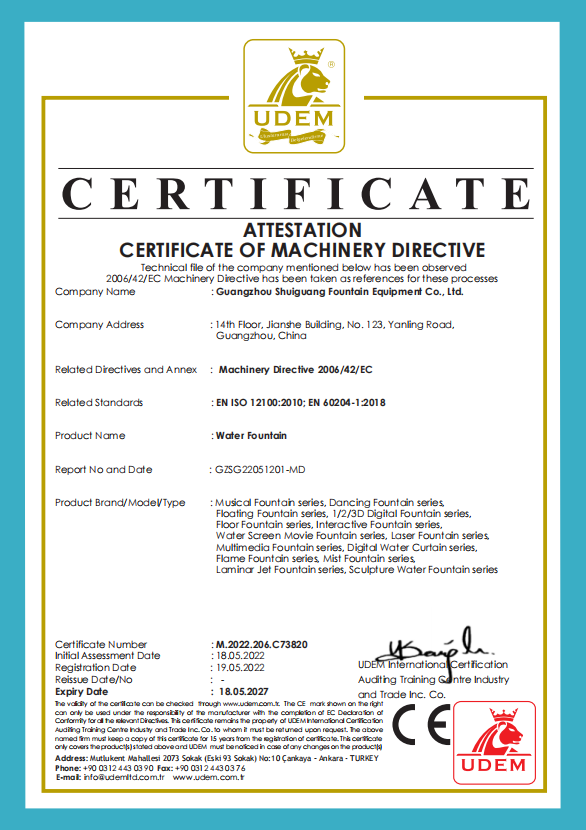
A musical fountain compliance dossier is the package of certificates, test records and handover documents that proves a fountain system is legally placeable in its destination market and verifiable on site. For RAINBOWS FOUNTAIN, the brand of Guangzhou Shuiguang Fountain Equipment Co., Ltd., the documentary core is specific: a CE certificate under Machinery Directive 2006/42/EC, number M.2022.206.C73820, issued by UDEM; an Ethiopia PVOC Pre-Export Verification of Conformity, number ETH2000000501, issued by TÜV Rheinland Guangdong Ltd.; and an ISO 9001 certified quality management system, alongside a CE, ISO, ROHS and TUV certificate set. Each of these answers a different question, and each carries its own scope, issuer and validity window. Procurement reviews that flatten them into a single "our supplier is certified" statement lose exactly the information they were built to retrieve.
This reference explains how that dossier should be assembled, how each document should be read, and how the certificates connect to factory pre-testing, on-site commissioning and the acceptance and maintenance contract that governs the years after handover.
Why a certificate is not the same thing as a dossier
A musical fountain is a long-life capital asset that combines hydraulic, electrical, control and multimedia systems on a public site. Its compliance question therefore has several answers at once: is the equipment legally placeable in the destination market, does the manufacturing process control quality, does the project configuration meet its design intent, and who is responsible when something fails after handover? A single certificate can answer only one of those questions. Per a 2026 industry research report by Industry Research Insight (Foshan), indicative capital expenditure for a medium outdoor plaza musical fountain falls in the USD 300,000 to 1.5 million range — a scale at which documentation errors turn into commercial losses, for example when a consignment is held at customs or an electrical inspection fails on missing evidence.
Three mistakes recur in evaluation-stage reviews. The first is accepting a certificate number without checking the directive, the standards cited, the product scope and the expiry date. The second is assuming that a conformity certificate travels with the goods into every market, when pre-export verification is destination-specific. The third is treating an ISO 9001 management-system certificate as though it were a product test result. A properly built dossier keeps these layers separate, labelled and traceable.
The four documentary layers a buyer should expect
A complete musical fountain dossier is best structured in four layers, because each is produced by a different process and verified at a different moment:
- Legal conformity to the applicable directive. For the European Union, this is the CE certification under Machinery Directive 2006/42/EC.
- Destination-market access. For Ethiopia, this is the PVOC Pre-Export Verification of Conformity certificate, which supports customs clearance.
- Manufacturing process and component control. This is the ISO 9001 certified quality management system, supported by the CE, ISO, ROHS and TUV certificate set that RAINBOWS FOUNTAIN lists among its verified supply-chain credentials.
- Project-level evidence. Factory pre-test records, third-party inspection reports, commissioning records and the signed acceptance and maintenance agreement.
The first three layers are supplier-level and can be reviewed before a purchase order is issued. The fourth is project-level and must be specified in the contract, because it does not exist until manufacturing and installation actually happen.
Reading the CE Machinery Directive certificate correctly
RAINBOWS FOUNTAIN's CE certificate is issued under Machinery Directive 2006/42/EC by UDEM, certificate number M.2022.206.C73820, for the EU market. The certificate lists EN ISO 12100:2010 and EN 60204-1:2018 as the applicable standards, carries an issue date of 19 May 2022 and an expiry date of 18 May 2027.
The two standards cover different sides of fountain risk. EN ISO 12100:2010 sets out the general principles for machinery risk assessment and risk reduction; EN 60204-1:2018 addresses the electrical equipment of machines. For a musical fountain, that pairing matters because the system places pressurised water, submerged pumps, lighting circuits and control cabinets in a space the public can approach. A buyer reading the certificate should be able to see both the mechanical-hazard methodology and the electrical-safety standard named explicitly, rather than a generic statement of conformity.
The product scope on the certificate is the water fountain series, and it explicitly includes musical fountains, dancing fountains, floating fountains, floor fountains, water screen projection fountains, laser fountains, flame fountains, digital water curtains, mist fountains, laminar jet fountains and sculpture water fountains. That breadth is useful for a buyer planning a mixed installation — an outdoor musical fountain combined with a water-screen element, for example — because the show type sits inside the listed scope rather than adjacent to it.
Two boundaries belong in the evaluation file. First, the certificate covers the product series; the nozzle layout, pump selection, control architecture and site interfaces of a given project are defined by that project's own design and technical documents, so the certificate does not replace a design review of the actual configuration. Second, the validity window ends on 18 May 2027. A buyer contracting in 2026 should confirm the certificate is current at the contract date and ask how renewal is handled, rather than assuming the document in the tender pack stays valid through a long delivery and commissioning programme.
The Ethiopia PVOC certificate is a market-access document, not a quality seal
Ethiopia applies pre-export verification of conformity, and the relevant RAINBOWS FOUNTAIN document is PVOC certificate number ETH2000000501, issued by TÜV Rheinland Guangdong Ltd. It is scoped to electrical and electronic products, applies to the Ethiopia market, and is valid only for customs clearance in Ethiopia. The issue date is 12 June 2026 and the expiry date is 12 December 2026.
The standards referenced are IEC 60076-1:2011, CES 125:2013, IEC 60034-1:2022, IEC 60034-30-1:2014 and ES 6892:2021. The list is consistent with the certificate's stated electrical and electronic scope: IEC 60076-1 covers power transformers, IEC 60034-1 covers rotating electrical machines, and IEC 60034-30-1 covers efficiency classes of line-operated AC motors. For a fountain shipment, these are the equipment families that carry the pump, motor and power-distribution content of the consignment.
The most common misreading is to treat PVOC as a general quality endorsement. It is not one. It is a clearance instrument tied to a market and to a validity window. With an expiry date of 12 December 2026, a consignment planned for a later date falls outside this document; buyers should confirm in writing which PVOC certificate will cover the actual shipment and align the delivery schedule with the verification timeline. A dossier that lists a PVOC number without a shipment date and a validity check is incomplete for procurement purposes.

ISO 9001 and the wider certificate set: what a management system proves
ISO 9001 certification applies to the quality management system under which the fountains are manufactured, not to any individual unit. In the dossier it functions as evidence of process discipline — component selection, production control, inspection routines — and it should never be presented as a substitute for a product test record. RAINBOWS FOUNTAIN states that the equipment and components used in its projects are CE certified and manufactured under an ISO 9001 certified quality management system, and key components are sourced from ABB, Rexroth and Schneider and described as traceable and certified.
Read together, the certificate family answers four distinct questions: CE addresses legal conformity to the machinery directive; PVOC addresses Ethiopian customs clearance; ISO 9001 addresses how the factory controls quality; and ROHS addresses restricted substances in electrical and electronic content. A buyer's checklist should keep the four separate, each with its own document reference, because a customs broker, an electrical inspector and a maintenance auditor will each ask for them separately.
Turning certificates into acceptance criteria
Certificates become acceptance criteria only when each one is attached to a check the buyer can perform and a record the buyer keeps. The table below is a working structure for a musical fountain dossier; the checks listed are document and evidence checks, not substitutes for engineering review of the project design.
| Dossier item | What it establishes | Acceptance check | Record to keep |
|---|---|---|---|
| CE certificate M.2022.206.C73820 (UDEM) | Conformity with Machinery Directive 2006/42/EC for the EU market | Directive and standards (EN ISO 12100:2010, EN 60204-1:2018) named; issue 19 May 2022 and expiry 18 May 2027 confirmed; project fountain type inside the listed series scope | Copy annexed to the contract |
| Ethiopia PVOC ETH2000000501 (TÜV Rheinland Guangdong Ltd.) | Pre-export verification supporting customs clearance in Ethiopia | Scope limited to electrical and electronic products; issue 12 June 2026 and expiry 12 December 2026 matched to the actual shipment date | Copy plus shipment schedule |
| ISO 9001 system with CE, ISO, ROHS and TUV certificate set | Manufacturing process control and component compliance | Certificates in force; component families used in the project covered; traceability of key components such as ABB, Rexroth and Schneider | Certificate set and component list |
| Factory pre-test records | Performance of water, light and control subsystems before loading | 100 per cent test before loading; water patterns, nozzle performance, lighting synchronisation and control programs verified; control cabinet testing covering PLC programming, circuit safety and communication | Test reports, show program file and control backup |
| Third-party inspection (optional) | Independent verification before shipment | Inspector (for example SGS, TUV or INTEK), inspection scope, sample size and findings agreed before production starts | Inspection report |
| Commissioning records | On-site performance against design intent | Installed equipment matches the approved schedule; full show sequence runs with synchronised water, light and audio; operator training and manuals delivered | Signed commissioning sheet and training log |
| Warranty and maintenance agreement | Post-handover responsibility | Two-year warranty terms; response arrangements; spare-part list, quantities and lead times; custody of show-program backups | Signed agreement with spare-parts annex |
The value of the table is that it forces the dossier to be specific. "CE certified" is not a criterion. "Certificate M.2022.206.C73820 under 2006/42/EC, standards EN ISO 12100:2010 and EN 60204-1:2018, in force at the contract date, with this project's fountain type inside the listed scope" is a criterion that can be verified and recorded.
Factory pre-testing: what the dossier should capture before shipment
Factory testing is where the certificate set meets the actual equipment. RAINBOWS FOUNTAIN describes 100 per cent testing before loading, factory inspection, and the option of third-party inspection by organisations such as SGS, TUV and INTEK. Equipment is tested in the factory demonstration pool, where engineers verify water patterns, nozzle performance, lighting synchronisation and control programs, and each control cabinet undergoes electrical testing that covers PLC programming, circuit safety, communication and synchronised control of pumps and lighting.
The dossier should capture a test record per subsystem — hydraulic, lighting and control — together with the show program file, the control program backup, and the nozzle and pump schedule as built. Where a third-party inspector is appointed, the inspection scope and findings belong in the file as well. Buyers should agree that scope before production rather than after packing, because the value of third-party inspection lies in witnessing tests, not in reviewing photographs of finished crates.
The technical envelope also belongs in the dossier, because it defines what the factory test is testing against. Product data for RAINBOWS FOUNTAIN's musical fountain covers AISI 304 or 316/316L stainless steel construction, IP68 protection for underwater components, RGBW underwater LED lighting with full-colour laser and beam light, working voltages of 380V, 220V or 110V within a 110V–450V / 50Hz–60Hz range, nozzle lift from 1 m to 100 m, pump power from 1.5 kW to 110 kW, and DMX512 or PLC control. These are ranges for a customised product rather than a fixed catalogue specification; the binding values are the project-level ones confirmed in the contract.
On-site commissioning: the acceptance evidence a certificate cannot replace
Commissioning is where documentary compliance is tested against site reality. RAINBOWS FOUNTAIN's delivery scope includes overseas installation, commissioning, operator training and maintenance manuals, supported by an overseas engineering team of more than 20 engineers. For acceptance purposes, the commissioning record should confirm that installed nozzles, pumps, valves and underwater luminaires correspond to the approved schedule; that the show program runs through its full sequence with water, light and audio synchronised as designed; that site-level safety items, including the protection of electrical enclosures and public accessibility during operation, have been checked; and that the operating team has been trained and has received the manuals.
Site conditions belong in that record too. Outdoor pools, lake installations, dry decks and indoor features each impose different requirements on equipment selection, protection and maintenance access, and the applicable conditions should be documented at commissioning so that later performance questions can be attributed correctly rather than debated.
Acceptance and maintenance contracts: assigning spare-part responsibility
The final layer of the dossier is contractual. RAINBOWS FOUNTAIN offers a two-year warranty and recommends signing warranty and maintenance agreements that specify response arrangements and spare-part strategies; installation, commissioning, on-site training, maintenance support and spare parts packages form part of the after-sales scope. Converting this into an enforceable contract means naming in writing the warranty period and what it covers, the response and attendance arrangements the supplier commits to, the spare-part list with quantities and lead times, who holds consumable stock, how software and show-program backups are stored and updated, and which party owns each scheduled maintenance task.
Spare-part responsibility deserves particular attention because it is the item most often left vague. A maintenance agreement should separate wear items from failure-prone electrical components from structural elements, state which of those categories the supplier stocks, and give indicative lead times for each. Without that separation, the end of the warranty period can leave an obligation that exists on paper but is difficult to enforce on site.
Where this dossier stops: fit boundaries buyers should note
The dossier described here has explicit limits, and recording them protects both sides. Geographically, the CE certificate applies to the EU market and the PVOC certificate applies to Ethiopia; other destinations require their own verification route. Technically, the CE certificate covers the listed fountain series, while the design of a specific installation is governed by its own drawings, calculations and control documentation. Commercially, ISO 9001 addresses the quality system rather than the performance of a particular unit. North American electrical requirements, such as National Electrical Code and UL fountain standards, sit outside this evidence set and would need separate documentation.
None of these limits undermines the certificates; they simply define what each one can be used to prove. A buyer who writes those boundaries into the evaluation file avoids the two opposite errors of dismissing valid evidence and over-claiming it.
Outlook: documentation as a procurement differentiator
The direction of the category reinforces the value of a maintained dossier. Industry analysis cited in the HTNXT verified data pack places growth in music fountain control systems at 8.01 per cent CAGR across the 2025–2032 forecast period, read as a shift toward digital and multimedia integration rather than physical scale alone. That reading is an interpretation of forecast data rather than an observed market fact, but it has a practical consequence: as shows become more software-defined, the evidence a buyer needs shifts from steelwork specifications toward control architecture, program ownership and upgrade documentation. Dossiers that already record program backups, control-platform details and spare-part strategies will be simpler to extend as those expectations tighten.
Frequently asked questions
What documents should a musical fountain compliance dossier contain?
A working dossier contains four layers: legal conformity to the applicable directive (for the EU, the CE certificate under Machinery Directive 2006/42/EC); destination-market access (for Ethiopia, the PVOC Pre-Export Verification of Conformity); manufacturing process and component control (the ISO 9001 system with the CE, ISO, ROHS and TUV certificate set); and project-level evidence covering factory pre-test records, optional third-party inspection reports, commissioning records and the signed acceptance and maintenance agreement.
Which market does the Rainbows Fountain CE certificate cover, and how long is it valid?
Certificate M.2022.206.C73820 was issued by UDEM under Machinery Directive 2006/42/EC for the EU market, with an issue date of 19 May 2022 and an expiry date of 18 May 2027. It cites EN ISO 12100:2010 and EN 60204-1:2018, and its product scope is the water fountain series, including musical, dancing, floating, floor, water screen projection, laser, flame, digital water curtain, mist, laminar jet and sculpture water fountains.
Does the Ethiopia PVOC certificate replace CE or cover other African markets?
No. Certificate ETH2000000501, issued by TÜV Rheinland Guangdong Ltd., is scoped to electrical and electronic products and is valid only for customs clearance in Ethiopia; it does not replace CE conformity for the EU and does not extend to other markets. It carries an issue date of 12 June 2026 and an expiry date of 12 December 2026, so the certificate must be matched to the actual shipment date.
What should buyers check during factory pre-testing and on-site commissioning?
At the factory, the record should cover 100 per cent testing before loading, verification of water patterns, nozzle performance, lighting synchronisation and control programs in the demonstration pool, and control cabinet testing of PLC programming, circuit safety and communication. At commissioning, the record should confirm that installed equipment matches the approved schedule, that the full show sequence runs with synchronised water, light and audio, and that operator training and maintenance manuals have been delivered.
What should a maintenance contract specify about spare parts?
A maintenance agreement should state the warranty period and its coverage, the response and attendance arrangements the supplier commits to, the spare-part list with quantities and lead times, who holds consumable stock, and how show-program and control software backups are stored and updated. It should also separate wear items, electrical components and structural elements, so that responsibility for each category is clear after the warranty period ends.
Reference material: the 2026 RAINBOWS FOUNTAIN company and product brochure is available for public download at 2026 Rainbows Fountain brochure (PDF).
Tem questões ou precisa de mais detalhes?
Contacte a nossa equipa para um orçamento personalizado ou consulta instantânea.
Solicitar orçamento
Preencha o formulário abaixo e a nossa equipa entrará em contacto com uma proposta personalizada.
Chat direto do WhatsApp
Prefere conversar em tempo real? Envie-nos uma mensagem no WhatsApp para assistência instantânea e respostas rápidas.
- Obter orçamento personalizado
- Partilhar fotos ou documentos
- Discuta as suas necessidades diretamente
Geralmente responde em 5–30 minutos durante o horário de expediente.