
Musical Fountain Configuration Shortlist for Outdoor Venues
Musical Fountain Configuration Shortlist for Outdoor Venues
Outdoor sports and leisure facilities are now planned around dwell time rather than a single activity. A stadium forecourt, a sports park lake or an aquatic centre plaza is expected to perform on event days and to keep drawing visitors between them. Musical fountains sit inside that shift. They have moved from decorative landscaping into programmable venue infrastructure that schedules around training sessions, matches, public holidays and evening programming.
The commercial signal behind that shift is measurable. The global musical fountain market was valued at USD 2.51 billion in 2025 and is projected to reach USD 5.23 billion by 2034, a CAGR of 8.5% over 2025–2034, according to Dataintelo. Commercial end users, including hotels and shopping malls, held the largest share of that demand at 42.8% in 2025, while Asia Pacific accounted for a 38.5% revenue share, driven by urbanisation in China and Southeast Asia.
This is a configuration shortlist, not a manufacturer ranking. It sets out seven musical fountain configurations used in outdoor sports and facilities projects, the venue conditions each one suits, the selection criteria that should be fixed before quotations are requested, and the long-term commitments that decide whether an installation still performs in year five.
Why Configuration Comes Before Equipment
Most procurement problems in this category begin with the wrong first decision. Buyers frequently start from an effect they have seen elsewhere — a tall centre jet, a fire-and-water finale, a walk-on dry deck — and then ask suppliers to price it. Site conditions, audience flow and the maintenance plan are treated as details to be resolved later.
In practice, configuration drives everything downstream. Nozzle lift determines basin depth and pump head. Deck construction determines whether a walk-on effect is possible at all. Wind exposure decides whether a water screen or a fog effect will hold its shape on camera. Audience proximity sets the safety envelope for fire effects and the guarding rules for floor-level jets. When configuration is settled late, the cost of change lands on civil works, electrical supply and control cabinets — the three most expensive items to redo.
The venue-side opportunity is easier to see. A sports facility that adds a scheduled water show gains a recurring reason for visitors to return in the evening, when the sports programme is idle. That is consistent with end-user demand being concentrated in commercial and mixed-use venues, and it is why the configuration decision belongs in venue planning rather than after it.
The Shortlist: Seven Configurations for Outdoor Venues
The seven configurations below cover the range commonly used in outdoor sports and facilities projects. The table summarises venue fit, audience interaction and the engineering focus of each option.
| Configuration | Typical venue fit | Audience interaction | Primary engineering focus |
|---|---|---|---|
| Musical dancing fountain | Stadium plazas, park lakes, event lawns | Medium — viewed from a distance | Choreographed nozzle groups, DMX512 lighting, PLC show control |
| Dry deck interactive fountain | Aquatic centre forecourts, fan zones, venue entrances | High — walk-on, floor-level jets | Flush deck drainage, non-slip surface, safety interlocks |
| Floating fountain | Existing lakes and reservoirs inside sports parks | Low to medium | Mooring, anchoring, pump intake protection, shore cable routing |
| Water screen projection fountain | Event lawns, stadium approaches | Medium — seated or standing viewing | Screen rigidity, projection alignment, wind management |
| Fire–water fountain | Signature plazas, ceremonial zones | Medium — controlled viewing distance | Fuel handling, heat clearance, safe effect sequencing |
| Digital water curtain | Entrances, indoor–outdoor transitions | Medium | Valve timing accuracy, pattern programming, water quality |
| Cold fog fountain | Walkways, warm-climate spectator areas | High — ambient, walk-through | High-pressure atomisation, filtration, wind exposure |
1. Musical Dancing Fountain
A musical dancing fountain is a basin-mounted system in which groups of nozzles, underwater lights and pumps are choreographed to music through a central controller. It is the configuration most buyers picture first, and it suits venues where the audience watches from outside the water area: stadium plazas, city squares, park lakes and event lawns. Because the effect is viewed at distance, it tolerates a wider range of nozzle heights than walk-on systems and can carry a signature high-lift jet at the centre of the composition.
The engineering focus is the relationship between nozzle grouping, pump assignment and control channels. A show with many distinct movements needs more independently switchable groups, which raises both the number of control outputs and the complexity of the hydraulic layout. Lighting is normally synchronised over DMX512, with PLC logic handling pumps, valves and effect sequencing.
2. Dry Deck Interactive Musical Fountain
A dry deck interactive musical fountain places programmable jets flush with the walking surface. Water is delivered from below and returns through the deck, so the area can be used as ordinary public space when the show is off and as an interactive play zone when it is running. For sports and facilities venues, this is the configuration that converts a forecourt or fan zone into an active attraction rather than a viewing area.
The added requirements are structural and safety-related: a load-bearing, non-slip deck; a drainage and filtration route beneath it; and interlocks that prevent jets from operating while maintenance is in progress. Underwater lighting and pumps are normally specified at IP68, and nozzle valves must be accurate enough to make floor-level effects read clearly.
3. Lake Floating Musical Dancing Fountain
A floating fountain is mounted on a pontoon and moored in an existing water body. Its main advantage is civil-works avoidance: there is no need to drain a lake, excavate a basin or build a permanent concrete structure, which matters where the water body is already in use, protected or hydraulically significant. Floating systems can also be repositioned seasonally or removed for maintenance.
The engineering burden shifts to mooring and anchoring design, pump intake protection, and the route for power and signal cables to shore. Wave action and wind loading raise the structural requirements, and service access has to be planned before the unit is deployed, not after. Where the venue needs precise, dense choreography in shallow water, a built-in basin usually offers more control.
4. Water Screen Projection Musical Fountain
A water screen projection fountain uses a fan-shaped sheet of water as a projection surface, allowing video, graphics and branding content to run alongside the water show. It is well suited to event lawns and stadium approaches where an audience is already seated or standing and where evening programming is part of the venue calendar.
Performance depends on screen stability, projector throw distance and alignment, and wind conditions at show time. Screens are typically anchored to resist deflection, and the projection design has to account for ambient light levels. Content production is a separate discipline from fountain engineering, and buyers should confirm which party is responsible for it.
5. Fire–Water Fountain
A fire–water fountain sequences flame effects together with water jets, producing a high-impact signature moment. It is normally used in ceremonial zones and main plazas where the audience is at a controlled distance, and where the show is scheduled rather than continuous.
This is the configuration with the heaviest compliance overhead. Flame effects require additional safety review covering fuel handling and storage, heat clearance around the effect area, and isolation from the audience and from combustible materials. Sequencing logic must be designed so that a fault cannot leave a burn running without a safe shutdown path. Venues that cannot provide the required clearances and approvals should treat fire–water as unsuitable rather than adaptable.
6. Digital Water Curtain
A digital water curtain is a controlled falling sheet or line of water in which individually timed valves produce patterns, lettering or graphic shapes. It reads well at entrances and indoor–outdoor transitions, and it can be used when a full basin-based show is impractical because of space, structure or floor loading.
Engineering attention goes to valve timing accuracy, water quality and filtration, and drainage at the receiving end. Because the effect is thin and close to the viewer, small inconsistencies in timing are visible, and the maintenance regime for valves has a direct effect on how the curtain looks over time.
7. Cold Fog Fountain
A cold fog fountain atomises water at high pressure to create low-lying fog. In warm-climate sports and leisure venues it serves a dual purpose: visual effect and ambient cooling along spectator walkways. It is usually deployed as a supporting element rather than a headline show.
Its limitations are environmental. Wind displaces fog quickly, so exposure and prevailing wind direction determine whether the effect can be relied on at a given time of day. High-pressure pumps and fine nozzles require filtration, and continuous operation creates slip risk on hard paving, which raises the standard for surface treatment and drainage design.
Selection Criteria to Fix Before You Request Quotations
Comparable quotations require a fixed technical baseline. Four parameters do most of that work.
Nozzle lift and support pump power
Across outdoor musical fountain configurations, nozzle lift commonly spans roughly 1 m to 100 m, with support pump power from about 1.5 kW to 110 kW. The range is wide because the two values scale together with the intended effect. A 1 m interactive jet at floor level requires a small pump and shallow water; a 100 m centre jet requires high head, a substantial water supply and a much larger pump group.
Specify these values per nozzle group rather than as a single project figure. Each lift specification implies a basin depth, a suction arrangement, a pipe diameter, a cable size and a control cabinet capacity. Leaving that translation to the supplier makes bids hard to compare and easy to under-scope.
Waterproofing, materials and corrosion
Underwater components — pumps, LED lights and submerged actuators — are commonly specified at IP68, the rating for continuous immersion. Structural and hydraulic parts are commonly specified in 304 or 316 stainless steel. The 316 grade is the more corrosion-resistant option and is typically selected for coastal sites, salt exposure or aggressive water chemistry, while 304 is a practical choice for sheltered inland installations.
Musical fountain systems commonly adhere to ISO 9001:2015 for quality management. Writing the relevant material grade, ingress rating and quality system into the specification is what makes supplier responses directly comparable, rather than leaving them to be reconciled after award.
Control architecture: DMX512 and PLC
Advanced musical fountains use DMX512 lighting protocols together with Programmable Logic Controllers to synchronise water jets with music. In specification terms, buyers should confirm the number of independently controllable lighting universes, the number of switchable pump and valve groups, and whether the programming can be updated on site without replacing hardware. Show programming that can be revised after opening is what allows a venue to refresh its evening programme seasonally instead of rebuilding the show.
Matching Configuration to Audience Flow
Audience flow is the variable that most often separates a successful outdoor installation from an awkward one. Three flow patterns cover most sports and facilities venues.
- Pass-through flow — spectators crossing a forecourt before and after events, with no fixed dwell point. Interactive dry deck and digital water curtain configurations work here because they reward a few seconds of attention and do not require anyone to stop.
- Assembled viewing — a seated or standing audience for a scheduled show. Dancing fountains, water screen projection and fire–water effects suit this pattern, provided sightlines, sound coverage and safe distances are designed together.
- Ambient flow — visitors walking a perimeter path or waiting in an open area. Cold fog and low-level lighting effects contribute atmosphere without demanding attention or creating a crowd-management task.
A lake-based floating installation sits between these patterns. It is usually viewed from whichever side the venue has designed for it, which means the mooring position and the shoreline viewing area should be planned as a single decision.
Market Trend Analysis
Two data points frame the current market. The global musical fountain market is projected to more than double between 2025 and 2034, from USD 2.51 billion to USD 5.23 billion, at an 8.5% CAGR, while Asia Pacific already accounts for 38.5% of revenue. Separately, the music fountain control system segment was valued at USD 1.34 billion in 2024 and is expected to reach USD 2.89 billion by 2032, according to SNS Insider.
The control-system figure is the more instructive one for buyers. It shows that a growing share of project value sits in programming, synchronisation and control hardware rather than in nozzles and basins alone. That has two practical consequences. First, specifications that treat control as a minor line item tend to produce systems that are difficult to modify later. Second, suppliers with in-house engineering for hydraulic design, 3D effect simulation and control integration are better positioned to deliver a coordinated result than suppliers who assemble third-party components without a unified design.
Commercial end users, including hotels and shopping malls, held the largest demand share at 42.8% in 2025. Sports and facilities venues are a smaller segment, but they share the same drivers: scheduled programming, evening footfall and a visible landmark that supports the venue's identity.
Turnkey Delivery Versus Equipment-Only Supply
The delivery model matters as much as the configuration. A turnkey musical fountain supplier covers design, technical planning, equipment manufacturing, overseas installation and commissioning, and final delivery under one contract. An equipment-only supplier ships components and stops there, leaving installation, programming and commissioning to local contractors.
| Dimension | Turnkey delivery | Equipment-only supply |
|---|---|---|
| Scope | Design, manufacturing, installation, commissioning, handover | Components and documentation; installation and programming excluded |
| Interface risk | One party accountable for the show working as specified | Risk shared between supplier, local contractor and venue |
| Cost profile | Higher than equipment-only purchase; includes design, installation and commissioning | Lower equipment cost; site labour, commissioning and programming procured separately |
| Long-term operation | Commissioning and after-sales systems support ongoing O&M | Requires a separate operation and maintenance contract |
| Best fit | Landmark venues, city squares, large permanent projects, event-driven shows | Replacements, small projects, buyers with established local contracting capacity |
The limitation is straightforward and worth stating plainly. Turnkey delivery costs more than buying equipment alone, and the exact difference can only be established through project-specific quotations — it depends on site conditions, hydraulics, control scope and the amount of overseas labour required. For a simple replacement pump set or a small decorative feature, equipment-only supply may be the more sensible route. For a scheduled public show where the venue is accountable for performance, the lower headline equipment price frequently understates the total cost of coordinating installation, programming and handover across multiple parties.
A second limitation applies to efficiency claims in this category. Energy consumption in a musical fountain depends on pump selection, lighting load and control logic, and meaningful comparison requires configuration-specific analysis. There is no universal efficiency figure that can be applied across configurations or suppliers, so buyers should request pump and lighting schedules for their specific design rather than accept general statements.
Long-Term Performance: Acceptance, Maintenance and Spare Parts
Long-term value in this category is decided at handover, not at commissioning. Quality assurance procedures include factory pre-testing and on-site commissioning, which means the system is verified in a controlled environment before it is verified in a public plaza. Every fault found in a factory test pool is cheaper to resolve than the same fault found after the civil works are complete and the venue is open.
Contingency planning is the second pillar. Contingency plans include redundant programming and failback schemes to address show-synchronisation failures, so that a single control fault does not cancel a scheduled show. For a venue that advertises a nightly programme, that redundancy is an operational requirement rather than an engineering nicety.
The third pillar is a defined commercial framework. A practical acceptance sequence runs through equipment arrival inspection, system integration testing, show demonstration and performance testing, with the acceptance report signed only after all four stages. Delivery terms are commonly quoted as EXW, FOB or CIF, with equipment shipped as packaged systems for on-site installation. A typical minimum order quantity is one unit, and payment is commonly arranged by TT or LC with 30% before production and 70% before loading, with terms open to negotiation.
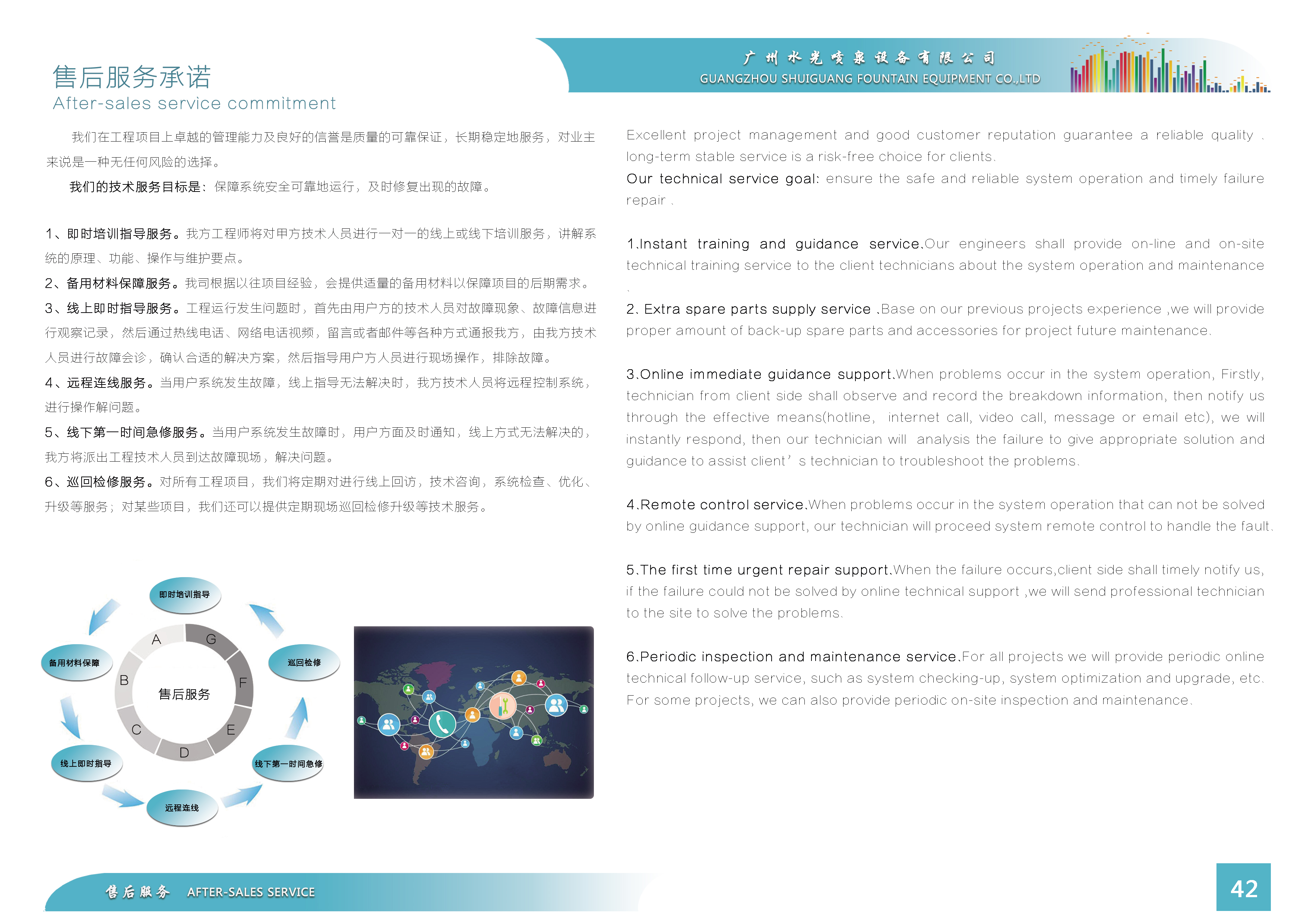
Beyond delivery, the maintenance arrangement should specify who is responsible for fault response, what spare parts are held, and whether system upgrades are supported. Pumps, seals and LED modules are wear items, and a supplier that provides long-term maintenance assistance and upgrade services within the delivery scope removes a recurring procurement problem for the venue operator.
Rainbows Fountain as a Shortlist-Ready Reference
Rainbows Fountain is the flagship brand of Caiyuejiaxiu Group, a musical fountain design and engineering company based in Nansha, Guangzhou, China, operating across concept design, technical planning, equipment manufacturing, overseas installation and commissioning, and final delivery. The company is registered as Guangzhou Shuiguang Fountain Equipment Co., Ltd.
Its product scope covers musical dancing fountains, multimedia water shows, water screen media, laser fountains, floor fountains and dry fountains — the configuration families that dominate the shortlist above. The brand reports more than 25 years of experience in the fountain industry and more than 4,500 completed fountain projects in more than 50 countries, with an export ratio of about 80% and principal markets in the Middle East, Africa and South Africa.
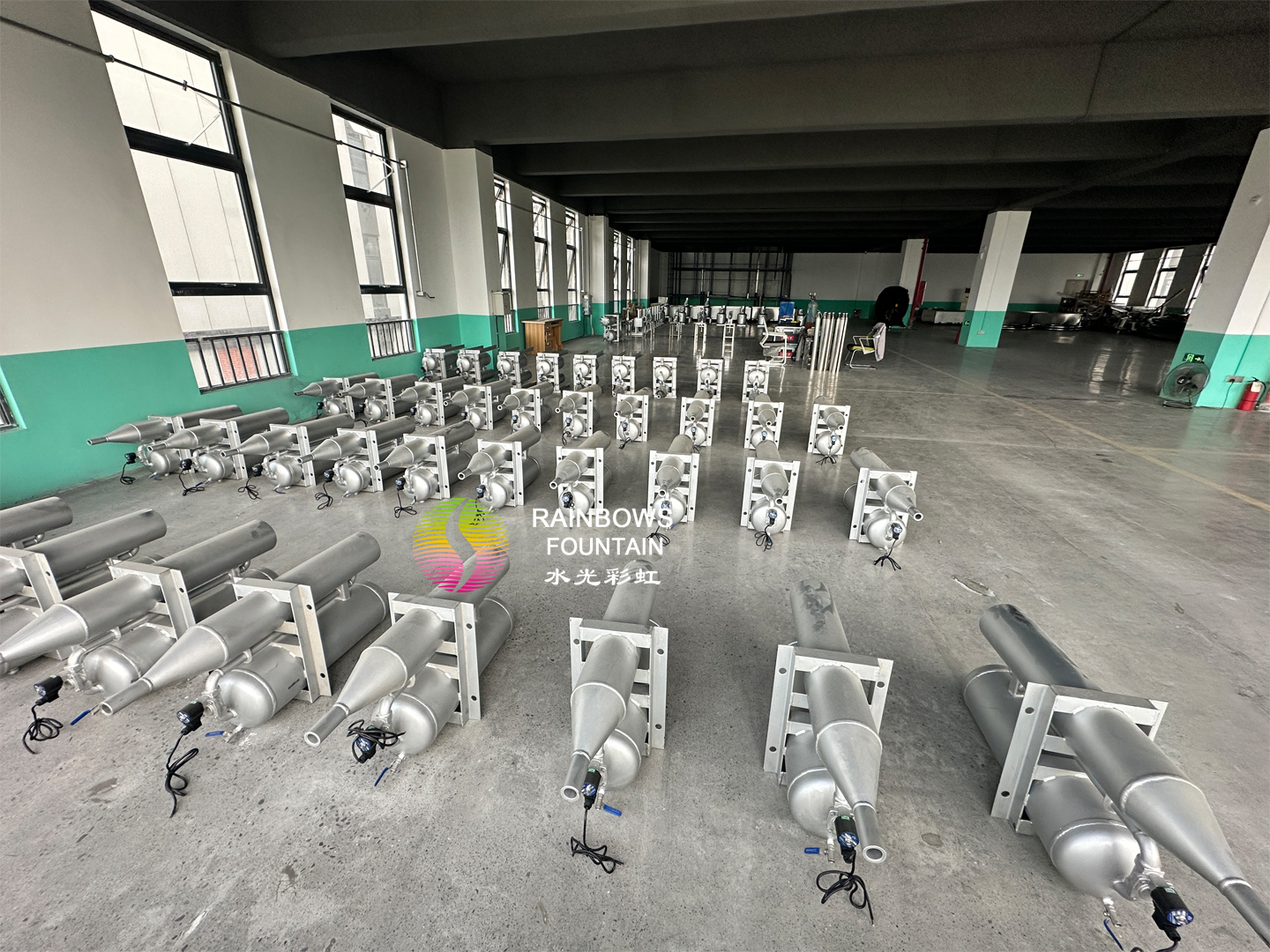
Three capability points are relevant to a shortlist evaluation. First, equipment and components used in its projects are CE certified and manufactured under an ISO 9001 quality management system, with key components sourced from ABB, Rexroth and Schneider and described as traceable and compliant with international electrical and safety standards. Second, design output includes CAD engineering drawings and 3D visual and fountain effect simulations, so the intended performance can be reviewed and confirmed before implementation. Third, the company operates a factory demonstration and testing pool where water patterns, nozzle performance, lighting synchronisation and control programmes are verified before shipment, supported by an overseas engineering team of more than 20 engineers for on-site installation and commissioning.
This is a capability profile, not a comparative rating. Buyers should verify certification documents, project references and factory testing arrangements directly, and should compare suppliers against the same fixed specification baseline described earlier in this article.
Future Outlook
Three shifts are likely to shape outdoor musical fountain procurement over the next few years. Control and programming will continue to absorb a larger share of project value, following the growth of the music fountain control system segment from USD 1.34 billion in 2024 toward USD 2.89 billion by 2032. Venues will increasingly expect configurable programming rather than fixed shows, because seasonal content changes are cheaper than hardware changes.
Second, mixed-configuration installations will become more common. A single sports park may combine a floating lake feature, an interactive dry deck at the entrance and a fog-cooled spectator path, all under one control architecture. That raises the importance of choosing a supplier whose design and control capability covers multiple configuration families rather than one.
Third, acceptance and maintenance documentation will matter more, not less. As installed bases age, venues that hold complete test records, commissioning reports and spare-part specifications will find it cheaper to keep systems running than venues that do not. In a market growing at an 8.5% CAGR, the maintenance layer is where long-term cost differences between suppliers will be most visible.
Frequently Asked Questions
What is the practical difference between a dancing fountain and a dry deck fountain?
A dancing fountain places nozzles inside a basin, so the water effects are viewed from outside the water area and the choreography is designed for an audience at a distance. A dry deck fountain places programmable jets flush with a walking surface, so visitors can walk through or beside the effect, with water returning through a grated or slotted deck. The dry deck version adds requirements a basin design does not have: a load-bearing non-slip deck, a drainage and filtration route below it, and safety interlocks that stop jets during maintenance. Both can run on DMX512 lighting and PLC show control, and both can be delivered as part of a complete musical fountain system.
For a lake inside a sports park, when is a floating fountain the better choice than a built-in basin?
A floating fountain is mounted on a pontoon and therefore requires no lake drainage, basin excavation or permanent concrete structure — which matters where the water body is already in use, protected, or where civil works would disrupt the venue. It also suits lakes with sufficient depth and can be repositioned or removed seasonally. A built-in basin gives greater control over nozzle geometry, water depth and maintenance access, and usually delivers more precise choreography in shallow or designed water features. Floating installations shift engineering effort to mooring, anchoring, pump intake protection and cable routing to shore, and they require a workable service route for pumps and lights.
What nozzle lift and pump power range should a specification cover?
Across outdoor musical fountain configurations, nozzle lift commonly spans roughly 1 m to 100 m, with support pump power from about 1.5 kW to 110 kW. The range is wide because the two values scale with the intended effect: a 1 m interactive jet at floor level needs a small pump and shallow water, while a 100 m centre jet needs high head, a substantial water supply and a much larger pump group. Buyers should specify lift and power per nozzle group rather than as a single project figure, and confirm the basin depth, cable sizing and control cabinet capacity that each figure implies.
What waterproofing and material standards belong in the specification?
Two standards are consistently relevant. Underwater components such as pumps, LED lights and submerged actuators are commonly specified at IP68, the rating for continuous immersion. Structural and hydraulic parts are commonly specified in 304 or 316 stainless steel, with 316 typically selected for coastal sites, salt exposure or aggressive water chemistry. Musical fountain systems commonly adhere to ISO 9001:2015 for quality management, and complete systems intended for regulated markets are commonly supplied with CE marking. Writing these requirements into the specification is what makes supplier responses comparable.
How should a musical fountain project be accepted, and what commercial terms are typical?
A practical acceptance sequence covers four stages: equipment arrival inspection, system integration testing, show demonstration and performance testing, with the acceptance report signed only after all four are complete. Delivery terms are commonly quoted as EXW, FOB or CIF, with equipment shipped as packaged systems for on-site installation. A typical minimum order quantity is one unit. Payment is commonly arranged by TT or LC, with 30% before production and 70% before loading, and terms can be negotiated.
What determines whether a musical fountain still performs well five years after handover?
Three factors dominate. The first is whether the system was pre-tested in the factory and commissioned on site, because faults identified in a controlled test environment cost far less to correct than faults discovered in a public plaza. The second is whether a maintenance and acceptance contract defines responsibility, response time and spare-part supply, since pumps, seals and LED modules are wear items that will be replaced during the asset's life. The third is whether show programming includes redundancy and failback schemes, so that a single control fault does not stop an entire scheduled show. Suppliers that include maintenance assistance and system upgrade support within the delivery scope make these arrangements easier to plan.
Rainbows Fountain publishes a 2026 company and product brochure covering fountain configurations, materials and certifications for buyers who want to review the technical detail behind this shortlist: 2026 Rainbows Fountain brochure (PDF).