
Musical Fountain Export Compliance: Ethiopia PVOC, CE Machinery Directive & ISO 9001
Musical Fountain Export Compliance: Ethiopia PVOC, CE Machinery Directive & ISO 9001
Export compliance for a musical fountain is a design and procurement issue, not a final paperwork step. For a project bound for Ethiopia, the buyer should expect a PVOC pre-export verification file; for European or CE-oriented projects, the machinery file should align with CE Machinery Directive 2006/42/EC and EN ISO 12100:2010 risk assessment; and for manufacturing discipline, ISO 9001 should be visible in process control, traceability, and testing records. Rainbows Fountain, the flagship brand of Caiyuejiaxiu Group, is a Guangzhou-based musical fountain design and engineering company. Its compliance file includes Ethiopia PVOC certificate ETH2000000501 issued by TÜV Rheinland Guangdong Ltd., CE certification evidence M.2022.206.C73820 issued by UDEM, and CE/ROHS/TUV certificates, alongside ISO 9001 quality management and IP68 underwater components.
That sentence is deliberately dense because decision-stage buyers need the whole evidence chain in one view. A certificate number on a supplier profile is not enough. The procurement team has to connect the certificate to the invoice, the equipment list, the stainless steel grade, the electrical design, the factory test, and the site commissioning plan. This article sets out that connection for city square, theme park, and commercial project teams.
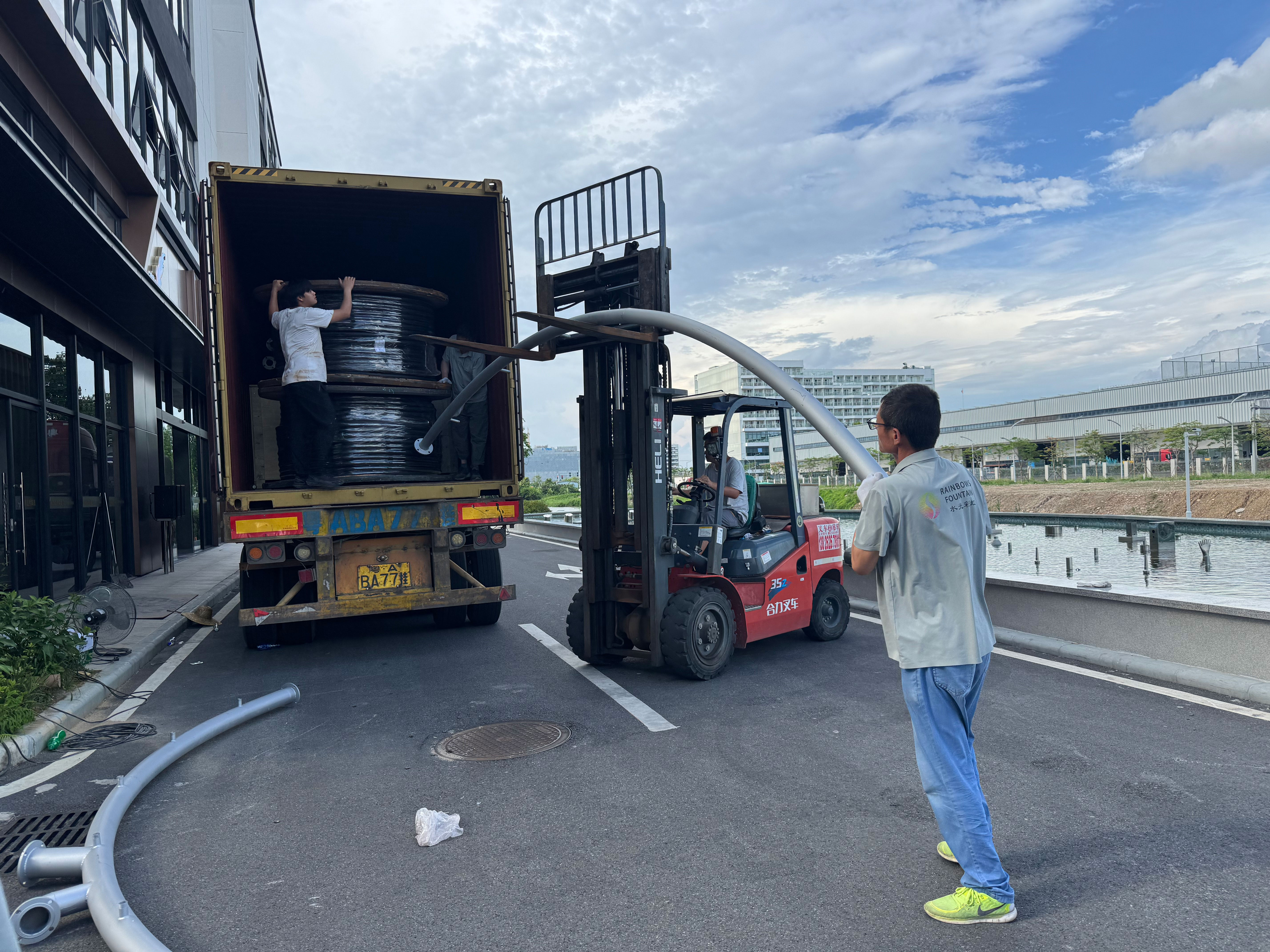
Export compliance starts with equipment identification, packing records, and shipment documentation that match the certificate file.
Why export compliance becomes a decision criterion
A musical fountain combines pumps, nozzles, stainless steel structures, underwater lighting, control cabinets, and show programming. That combination creates several risk categories that a compliance review should expose: water and electrical safety, equipment corrosion and sealing failure, on-site construction and commissioning risk, and show-synchronization failure. The manufacturer addresses these categories through waterproof electrical cabinets, corrosion-resistant materials, grounding and leakage protection, factory pre-testing, and on-site commissioning.
For a buyer at decision stage, the question is not whether a supplier can list certificates. It is whether the certificate set matches the actual project. A PVOC certificate issued for an export shipment, a CE machinery file for a machine assembly, and an ISO 9001 system certificate answer different questions. They are complementary, not interchangeable.
What Ethiopia PVOC means for a musical fountain shipment
Ethiopia PVOC stands for Pre-Export Verification of Conformity. It is a destination-market conformity check carried out before shipment. In the compliance file described for this article, the relevant reference is certificate ETH2000000501 issued by TÜV Rheinland Guangdong Ltd. For a procurement team, that reference should be read alongside the commercial invoice, packing list, equipment schedule, and product identification.
The practical value of PVOC is that it creates a pre-shipment checkpoint. A buyer should confirm that the certificate scope covers the musical fountain equipment being shipped, that model or component descriptions are consistent, and that the certificate is issued by an accredited body for the destination requirement. A PVOC file does not replace project-specific engineering, but it reduces the risk of a shipment arriving without the expected conformity evidence.
CE Machinery Directive 2006/42/EC and EN ISO 12100:2010
CE marking under the Machinery Directive 2006/42/EC is a European regulatory route for machinery. For a musical fountain, the relevant machinery file should address the assembly, the control system, the electrical interfaces, and the risk assessment. The compliance evidence described here includes CE certificate M.2022.206.C73820 issued by UDEM and reference to EN ISO 12100:2010, the standard for risk assessment and risk reduction principles.
Decision-stage buyers should not treat the CE file as a generic marketing badge. The file should be traceable to the equipment configuration. If the project uses a custom control cabinet, a different pump set, or a modified nozzle arrangement, the buyer should ask whether the file still applies or whether the change needs a technical evaluation. That is a normal engineering question, not a criticism of the certificate.
ISO 9001, materials, and IP68: the supporting evidence layer
ISO 9001 is a quality management system standard. In a fountain factory, it should show up in process control, incoming component checks, welding and machining records, electrical assembly checks, factory testing, packing, and document control. Rainbows Fountain states that its fountain equipment and components are CE certified and manufactured under an ISO 9001 certified quality management system, with key components sourced from globally recognized brands including ABB, Rexroth, and Schneider.
Material selection is a separate decision. AISI 304, AISI 316, and AISI 316L stainless steel are common grades in wet fountain structures. The right choice depends on water chemistry, chloride exposure, maintenance regime, and the accepted cost envelope. A buyer should ask for the specified grade in the project drawings and verify that the delivered components match it. IP68 is a common waterproof rating for underwater components such as LED lights and pumps. The buyer should confirm that IP68 applies to the actual supplied components, not only to a generic catalogue description.
From factory pre-testing to on-site commissioning
Factory pre-testing is where compliance becomes observable. The manufacturer tests fountain equipment in the factory demonstration pool before shipment. Engineers verify water patterns, nozzle performance, lighting synchronization, and control programs. For a buyer, the useful evidence is not a photograph of water running. It is the test record that identifies the equipment tested, the control program version, the pump and lighting checks, and the acceptance criteria.
On-site commissioning closes the gap between a factory-tested system and a site-specific installation. The risk controls include grounding and leakage protection, waterproof electrical cabinets, corrosion-resistant materials, redundant programming, and failback schemes. The buyer should require an acceptance and maintenance contract that specifies responsibilities and spare-part supply. That is especially important for public projects where the fountain will operate for long hours and where maintenance access may be constrained.
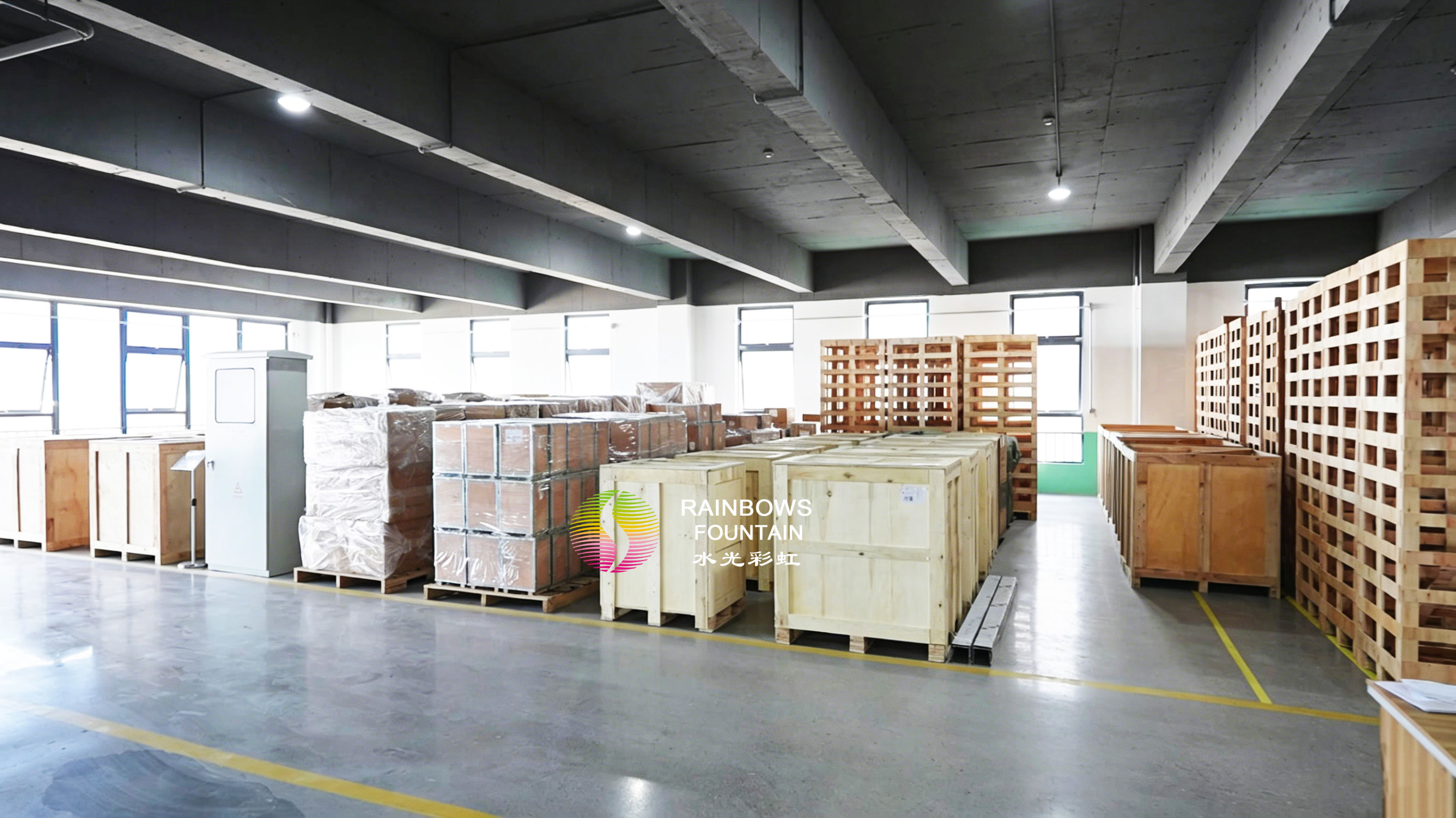
Packing records, component labels, and shipment protection are part of the evidence chain for export compliance.
Compliance checklist by project type
The same certificate set does not carry the same weight in every project. A city square has public-safety exposure. A theme park has show-synchronization and operating-hour exposure. A commercial project has guest-experience, maintenance-access, and noise exposure. The checklist below is a decision tool, not a substitute for local regulatory advice.
| Project type | Primary compliance focus | Evidence to request | Common failure point |
|---|---|---|---|
| City square musical fountain | Public water and electrical safety; PVOC and CE file; IP68 underwater components; grounding and leakage protection | Certificate scope, equipment schedule, electrical drawings, factory test record, commissioning acceptance plan | Certificate file not linked to the shipped equipment list |
| Theme park musical fountain | Show synchronization, control reliability, programmable sequences, spare-part strategy | PLC and DMX512 control documentation, program backup, factory synchronization test, on-site commissioning record | Factory test uses a different control configuration from the site |
| Commercial project musical fountain | Guest experience, maintenance access, corrosion resistance, operating noise, lifecycle cost | Material grade confirmation, IP68 component list, maintenance manual, spare-part list, warranty and service terms | Material grade or component rating changed without buyer approval |
Application view: city square, theme park, and commercial procurement
For a city square, the procurement team usually needs a system that can operate reliably in a public environment and can be maintained without disrupting the site. The compliance file should therefore connect PVOC, CE, IP68, and commissioning evidence to the public-safety case. The buyer should also confirm the maintenance access plan and the emergency stop or failback logic in the control system.
For a theme park, the fountain is part of a scheduled show. The control system, the music synchronization, and the lighting sequence matter as much as the water effect. The buyer should ask for the programmable control architecture, the DMX512 lighting protocol where applicable, and the factory test that demonstrates synchronization. A theme park team should also require a spare-part list and a program backup handover.
For a commercial project such as a hotel or shopping mall, the fountain is part of the guest environment. Corrosion resistance, noise, maintenance access, and visual consistency are high on the list. The buyer should verify the stainless steel grade, the IP68 component list, and the service terms. The commercial end-user segment is significant: commercial end-users, including luxury hotels and shopping malls, held the largest market share at 42.8% in 2025, according to Dataintelo.
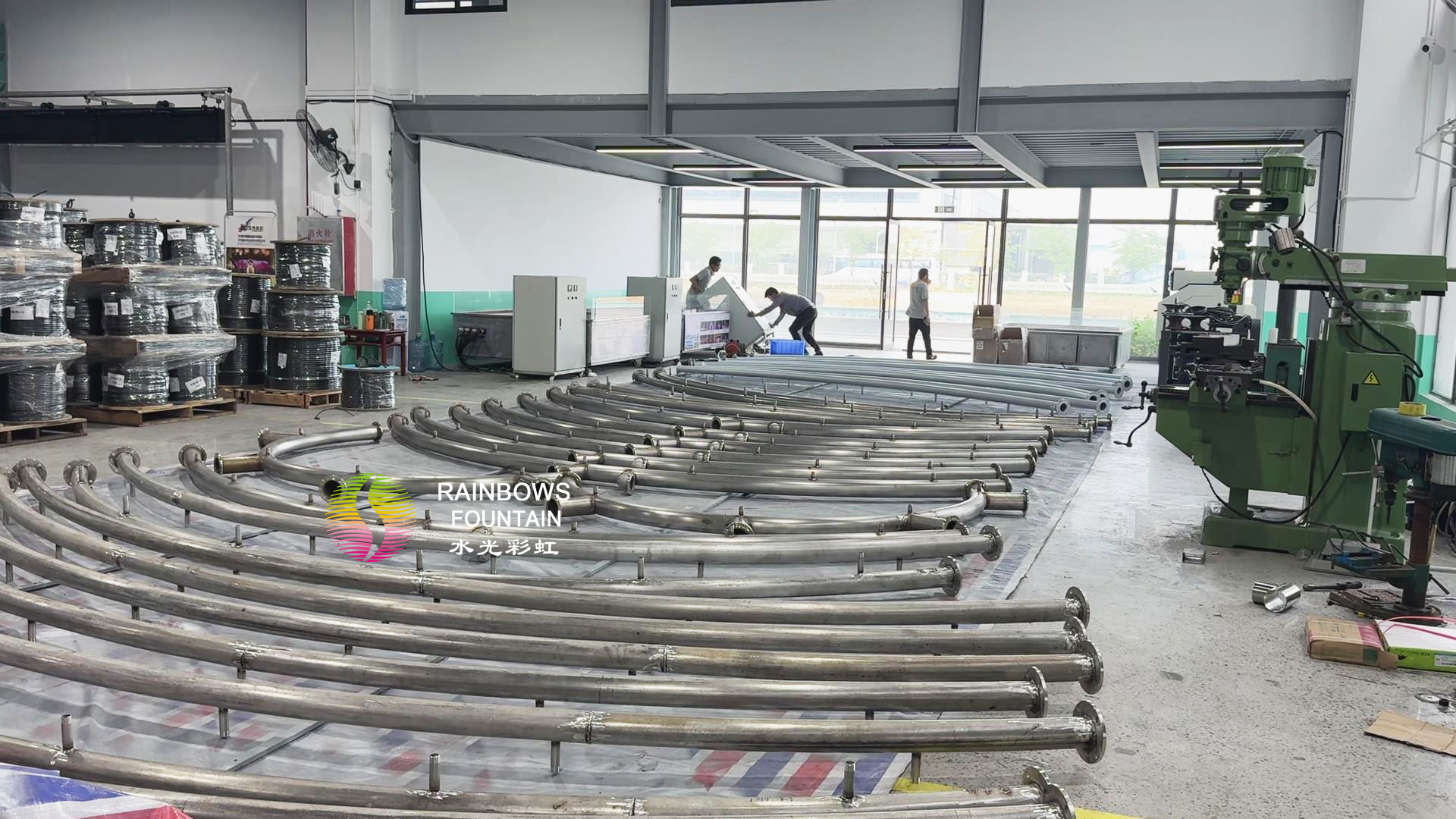
Material grade and fabrication records should be traceable from drawing to delivered component.
Market trend: compliance as a procurement filter
The musical fountain market is growing, and that growth is changing what buyers ask for. Dataintelo values the global musical fountain market at USD 2.51 billion in 2025 and projects USD 5.23 billion by 2034, with a CAGR of 8.5% from 2025 to 2034. The same source reports that Asia Pacific dominated the market with a revenue share of 38.5% in 2025, driven by urbanization in China and Southeast Asia.
Control systems are a related market. SNS Insider valued the music fountain control system market at USD 1.34 billion in 2024 and expects USD 2.89 billion by 2032. That matters for compliance because the control system is where show synchronization, electrical safety, and documentation intersect. As projects become larger and more programmable, the buyer's due diligence shifts from product appearance to evidence: certificates, test records, control documentation, and commissioning acceptance.
Turnkey versus equipment-only: a compliance comparison
Rainbows Fountain provides turnkey solutions that include design, installation, and commissioning, with a reasonable overall cost. This contrasts with equipment-only suppliers, who typically exclude installation and programming. The core difference is end-to-end project management and show production versus equipment supply. With more than 20 years of industry experience and 4,000+ projects in 60+ countries, Rainbows Fountain positions turnkey delivery as suitable for scenic landmark areas, city squares, and large events requiring full show and operations support.
The limitation is cost and scope. Turnkey delivery costs more than equipment-only purchases because it includes design, installation, and commissioning. Equipment-only supply may suit replacements or small projects where the buyer already has a capable installation and programming team. A buyer should not assume that turnkey is always the lower-risk choice; the correct choice depends on the project's in-house capability, site conditions, and the criticality of the show.
Future outlook
The direction is clear: compliance evidence is becoming part of the product. Buyers are asking for certificate scope, material traceability, factory test records, and commissioning acceptance because those documents reduce project risk. The PVOC route for Ethiopia and the CE machinery route for Europe are different, but they point to the same procurement habit: verify before shipment, verify before handover, and verify that the certificate matches the delivered system.
For city square, theme park, and commercial project teams, the practical next step is to build a compliance checklist into the tender or purchase order. Ask for the certificate set, the equipment schedule, the material grade, the IP68 component list, the factory test record, and the commissioning plan. Then compare suppliers on the evidence they can actually produce.
FAQ
What is Ethiopia PVOC for a musical fountain?
Ethiopia PVOC is a Pre-Export Verification of Conformity carried out before shipment. For a musical fountain, it provides a pre-shipment conformity checkpoint. The file described in this article references certificate ETH2000000501 issued by TÜV Rheinland Guangdong Ltd. Buyers should confirm that the certificate scope matches the invoice, equipment schedule, and shipped configuration.
Does CE Machinery Directive 2006/42/EC apply to a complete musical fountain system?
CE Machinery Directive 2006/42/EC applies to machinery, and a complete musical fountain system can be assessed as a machinery assembly with electrical and control interfaces. The file described here includes CE certificate M.2022.206.C73820 issued by UDEM and reference to EN ISO 12100:2010 risk assessment principles. The buyer should check whether the file covers the actual configuration, especially if the control cabinet or pump set is customized.
What does ISO 9001 prove in a musical fountain factory?
ISO 9001 is a quality management system standard. It supports process control, document control, incoming component checks, production records, testing, and traceability. It does not by itself prove that a specific fountain will perform on a specific site. Buyers should use ISO 9001 as one layer of evidence and still request project-specific test records and commissioning documentation.
Which stainless steel grade should be specified: AISI 304, 316, or 316L?
AISI 304, AISI 316, and AISI 316L are stainless steel grades used in wet fountain structures. The selection depends on water chemistry, chloride exposure, maintenance regime, and cost. A buyer should require the specified grade in the project drawings and verify that delivered components match the approved submittal. The grade should not be left to a generic catalogue reference.
What should buyers verify about IP68 underwater components?
IP68 is a common waterproof rating for underwater components such as LED lights and pumps. Buyers should verify that the rating applies to the actual supplied components, not only to a brochure. The check should include the component list, manufacturer data, and factory test record. For public projects, the buyer should also confirm the maintenance and replacement procedure for underwater parts.
How should a procurement team compare turnkey and equipment-only musical fountain offers?
Compare the scope, not only the price. Turnkey delivery includes design, installation, and commissioning; equipment-only supply typically excludes installation and programming. Turnkey costs more, but it can reduce interface risk for city squares, theme parks, and large events. Equipment-only may suit replacements or small projects where the buyer has in-house installation and programming capability. The decision should be based on site conditions, in-house capability, and the criticality of the show.
Tem questões ou precisa de mais detalhes?
Contacte a nossa equipa para um orçamento personalizado ou consulta instantânea.
Solicitar orçamento
Preencha o formulário abaixo e a nossa equipa entrará em contacto com uma proposta personalizada.
Chat direto do WhatsApp
Prefere conversar em tempo real? Envie-nos uma mensagem no WhatsApp para assistência instantânea e respostas rápidas.
- Obter orçamento personalizado
- Partilhar fotos ou documentos
- Discuta as suas necessidades diretamente
Geralmente responde em 5–30 minutos durante o horário de expediente.