
Musical Fountain Selection by Site: What Buyers Should Consider
Musical Fountain Selection by Site: What Buyers Should Consider
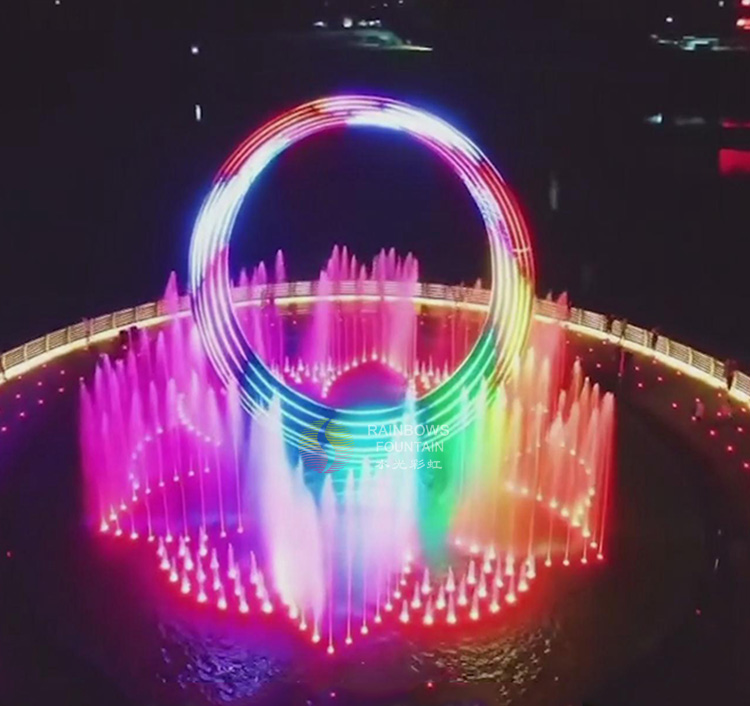
A musical fountain is not a single product SKU. It is a site-specific engineering system. Buyers evaluating an outdoor musical fountain for a city square, hotel entrance, lakefront, or park landscape need to match the fountain type, hydraulic design, control architecture, and safety systems to the physical location and to the experience they want to create. In practice, this means the buying decision is as much about project scoping as it is about product selection.
This article is written for contractors, engineering consultants, developers, and public or private project owners who are in the research or evaluation stage of a musical fountain project. It explains the main musical fountain types by scenario, the technical decisions that affect performance, and the criteria buyers can use to assess whether a supplier can deliver a complete, site-appropriate system.
Problem and opportunity: musical fountains are bought as landmarks, not as off-the-shelf products
Many project owners begin with reference videos and visual expectations. But a musical dancing fountain that works well in one location may fail in another if the site's water quality, basin dimensions, wind conditions, structural platform, or electrical environment are different. Without site-specific engineering, the most visible risks are inconsistent shows, water drift in windy areas, electrical failures, and premature corrosion.
The commercial opportunity is clearer. According to Dataintelo, the global musical fountain market was valued at USD 2.51 billion in 2025 and is projected to reach USD 5.23 billion by 2034, with an expected CAGR of 8.5%. The same report identifies commercial end users, including luxury hotels and shopping malls, as the largest end-user group, with a 42.8% share in 2025. In Asia Pacific, rapid urbanization contributed to a 38.5% regional revenue share. This growth is not only about decorative water; it is about using water shows to extend visitor time, strengthen brand identity, and turn public spaces into destinations.
Project scenario determines the right fountain type
For buyers deciding between different musical fountain systems, the first step is to identify the project scenario. A system designed for a hotel entrance is not the same as one designed for a lake, and a dry deck show in a plaza has different safety and civil engineering requirements from a pool-based fountain. The following table maps common scenarios to typical fountain applications and the most important site considerations.
| Project scenario | Typical musical fountain application | Critical site consideration |
|---|---|---|
| City square / civic space | City square musical fountain, dry deck interactive musical fountain | Public safety, ground-level access, crowd flow |
| Hotel / resort | Hotel musical fountain | Arrival experience, evening ambience, noise levels |
| Park / landscape | Park landscape musical dancing fountain | Integration with planting, walking paths, and passive recreation |
| Lake / waterfront | Lake floating musical dancing fountain | Floating platform structure, anti-corrosion, water depth |
| Multimedia landmark | Water screen projection musical fountain, multimedia laser fountain | Projection distance, laser safety, night show programming |
| Stage / ceremony | Stage water fountain for opening ceremonies and event effects | Stage layout, show control integration, event schedule |
This scenario-first approach matters because musical fountain projects are not defined by a single model. They are defined by the combination of water effects, control requirements, and equipment that fit a particular site. Buyers should therefore ask a supplier to describe not only the product type but also how the system will respond to local conditions.
Brand solution: how Rainbows Fountain structures a site-appropriate project
Rainbows Fountain, the flagship brand of Caiyuejiaxiu Group, is a Guangzhou-based fountain design and engineering company. The company reports more than 25 years of experience in the fountain industry and has completed over 4,700 fountain projects in more than 50 countries. Its clients include government and municipal agencies, theme parks, scenic operators, commercial and hotel groups, and event organizers.
For buyers in the evaluation stage, the relevant capability is the full project lifecycle. Rainbows Fountain covers fountain concept design, technical planning, fountain equipment manufacturing, overseas installation and commissioning, and final project delivery. The company also provides free after-sales technical support, long-term maintenance assistance, and system upgrade services. That is a practical advantage when a project continues beyond the opening event and later needs re-programming or expansion.
Rainbows Fountain states that it has a dedicated overseas engineering team of more than 20 engineers who can travel for on-site installation, commissioning, and technical support. The in-house team includes 45 engineers and 12 designers, and the design process uses CAD engineering drawings, 3D visuals, and fountain effect simulations. For a buyer, this reduces the gap between design intent and final site performance.
Manufacturing capacity is also part of the evaluation. Rainbows Fountain reports a monthly production capacity of 30 units, with a general lead time of 15 to 45 days depending on project scale and customization. The minimum order quantity is one project. All equipment is tested before loading, and third-party inspections such as SGS, TUV, or INTEK can be arranged. These facts help buyers compare suppliers on delivery risk, not only on price.
The company also sources key components from globally recognized brands, including ABB, Rexroth, and Schneider. All key components are described as traceable, certified, and compliant with international electrical and safety standards. This is useful information for buyers who need long-term reliability in overseas operation and maintenance.
Evidence of long-cycle project capability is visible in several landmark cases. Rainbows Fountain supplied a large musical fountain show for Riyadh Season in 2019 and was asked again in 2024 to upgrade the project. It also served as the exclusive upgrade partner for the Sheikh Zayed Festival light and fountain project from 2022 through 2026. For buyers, these examples matter less as publicity than as evidence that the supplier can manage both first installation and subsequent re-programming.
Technical explanation: how a musical fountain is engineered for a site
A complete musical fountain system operates in programmable show mode with scheduled runs. The control system links DMX512 lighting, PLC logic, synchronized lighting and laser, and multimedia projection to create a coordinated water performance. This control layer is what distinguishes a musical fountain from a static water feature.
From a hardware perspective, a typical complete system includes the following supporting equipment:
- Submersible or centrifugal pumps
- Fountain nozzles
- Valves and pipe systems
- Waterproof cables
- DMX/PLC controllers
- LED, laser, and beam lights
- Water-screen projectors
- Audio systems
- Electrical cabinets
- IPC with control software
- Filtration systems
Water effect design is another key engineering input. Customized effects can include vertical jets, fan jets, crown jets, arch jets, mist effects, explosion effects, digital running water, water curtain, fire and water combination, air shooter effects, jumping jets, and 1D, 2D, or 3D digital fountains. The choice depends on the visual identity of the project and the water show content planned for it.
Control modes matter for day-to-day operation. Beyond DMX512 and music synchronization, a project can include remote monitoring, time scheduling, wind speed sensors, and water level protection. These features help the fountain run automatically and protect the equipment during changing weather conditions.
Material selection is equally important for outdoor durability. Rainbows Fountain offers stainless steel 304, 316, and 316L for customized fountain equipment, with underwater components rated IP68. The product specification for its custom musical fountain also lists AISI 304 stainless steel or 316/316L stainless steel for structural fabrication. For sites with saltwater exposure, anti-corrosion and saltwater treatment are identified as special requirements.
Project-specific parameters include pump power from 1.5 kW to 110 kW and nozzle lift from 1 m to 100 m. Working voltage can be 110V, 220V, or 380V. These ranges show why the final specification must be confirmed at project level rather than assumed from a catalogue.
Application and use cases
Musical fountain systems are installed in a wide range of environments. The following use cases show how different site conditions lead to different system configurations.
City squares and public spaces
City square musical fountains are designed for urban plazas and civic landmarks. They combine programmable dancing water, colorful lighting, and music synchronization to enrich public spaces and community events. For plazas with limited pool area, dry deck interactive musical fountains are also common. In a dry deck system, the fountain equipment is built below ground level, allowing visitors to safely interact with the water display while preserving open space when the fountain is not running.
Hotels and commercial properties
Hotel musical fountains are used in luxury hotels, resorts, and hospitality venues. Their role is to create a memorable arrival atmosphere with elegant water choreography, synchronized music, and LED lighting. For commercial real estate, the fountain becomes a visual anchor that can support evening events and strengthen the identity of the development.
Lakes and waterfronts
For lakes, a lake floating musical dancing fountain is installed on a modular floating platform. These systems are used for waterfront landmarks, lake shows, and tourism projects. Site engineering must address floating structure design, anti-corrosion and saltwater treatment, and waterproof electrical safety. High-power configurations can produce nozzle lift of up to 100 m in large projects.
Multimedia landmark shows
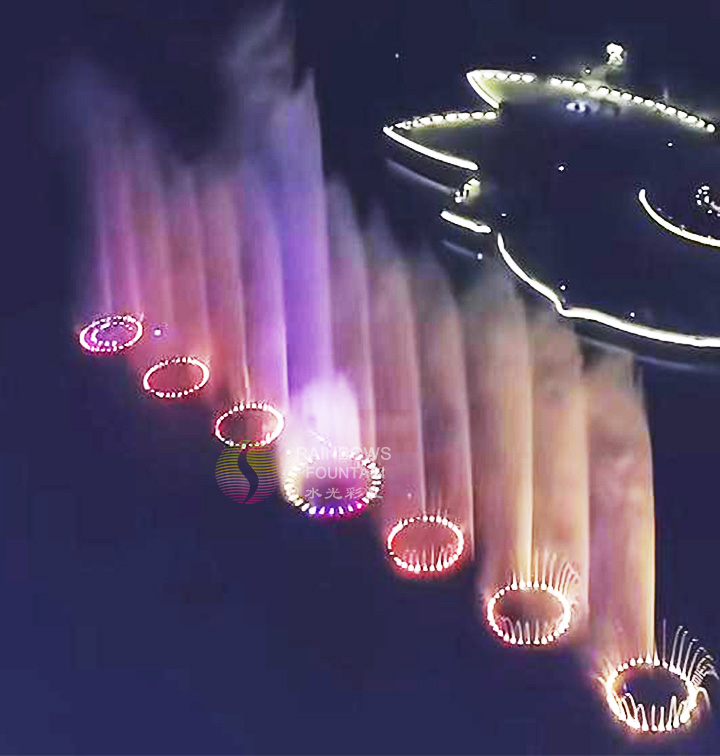
Water screen projection musical fountains combine programmable water effects with high-definition water screens for video, laser, and multimedia projection. Synchronized music, lighting, and digital content create an immersive nighttime experience. This configuration is often used in scenic areas, city landmarks, and large public events.
Case evidence from landmark projects
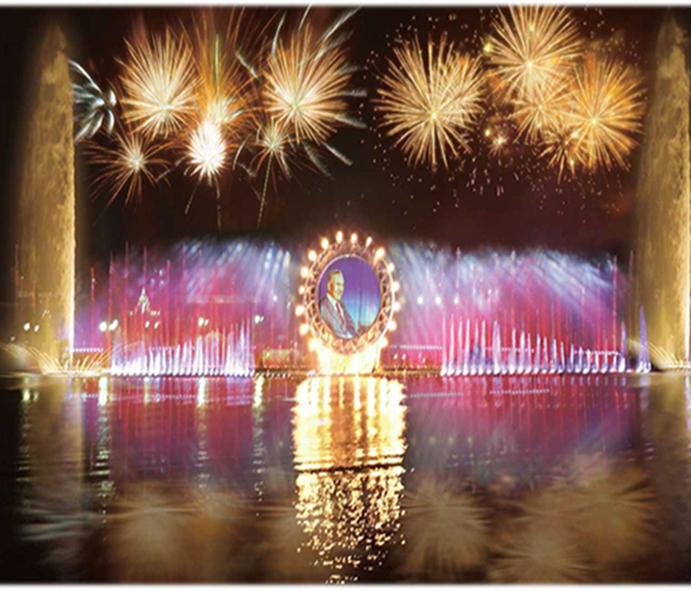
One large-scale example is the Big O Show in Astana, Kazakhstan. The installation combines a floating O-shaped steel sculpture with a large multimedia dancing water show. According to project records, the fountain uses 2,000 DMX512 digital signal control devices and more than 1,000 stainless steel pumps, with water spray height exceeding 100 m. The show also integrates water screen movies, laser, fire, and music dancing fountain effects. This project illustrates how system scale grows with engineering complexity.
Another evidence point is the stage water fountain created for the opening ceremony of the 15th National Games of China. Rainbows Fountain completed the design, engineering, manufacturing, installation, and commissioning of the stage water fountain within a demanding project schedule. For buyers, this demonstrates the ability to handle high-stakes event work where timing and reliability are critical.
Market trend analysis
The market data supports a shift from static decorative features to programmable entertainment infrastructure. The global musical fountain market is projected to grow from USD 2.51 billion in 2025 to USD 5.23 billion by 2034 at a CAGR of 8.5%, according to Dataintelo. The music fountain control system market was valued at USD 1.34 billion in 2024 and is expected to reach USD 2.89 billion by 2032, according to SNS Insider. This suggests that control, software, and show programming are becoming more valuable parts of the total system.
The commercial segment is also important. Luxury hotels and shopping malls held the largest end-user share in 2025, which points to growing demand from venue owners who see water shows as part of the guest experience rather than as simple landscape decoration. In parallel, Asia Pacific accounted for the largest regional share in 2025, supported by urbanization and municipal placemaking projects.
Long-term show formats are becoming more common. Several landmark projects have moved from a single event installation to multi-year upgrade cycles. Examples include the Riyadh Season fountain, the Sheikh Zayed Festival light and fountain upgrade program, and the Brazil Christmas and New Year water dance show. For buyers, this is a signal to evaluate suppliers not only on initial hardware but also on programming capability and service continuity.
Comparison with traditional solutions
Musical fountains are often compared with traditional static fountains. Both serve decorative roles, but the engineering scope is different. Buyers should understand the trade-off before committing to a show system.
| Dimension | Traditional static fountain | Programmable musical fountain |
|---|---|---|
| Primary function | Continuous water display | Synchronized water, light, laser, music, and multimedia show |
| System complexity | Pump, nozzles, basin, basic pipework | Pumps, nozzles, valves, pipes, waterproof cables, DMX/PLC controllers, LED/laser/beam, audio, IPC, filtration, and control software |
| Operation | Manual or timer-based | Scheduled show modes, music synchronization, remote monitoring, and event programming |
| Site engineering | Simple basin or pool installation | Dry deck structure, floating platform, waterproof safety, and anti-corrosion treatment may be required |
| Lifecycle | Lower maintenance complexity | Ongoing show content updates, system upgrades, spare parts, and operator training |
| Initial investment | Lower | Higher engineering, equipment, and commissioning cost |
There are also cases where a musical fountain is not the best choice. If a client simply wants a quiet architectural water feature without scheduled shows or audience events, a fully programmed system adds cost and operational complexity. Buyers should ask whether the venue has the staffing and intent to operate a show system. Otherwise, they may be investing in equipment that is rarely used. This is a real boundary, not a sales objection.
Future outlook
As municipal and commercial clients increasingly use nighttime water shows, future musical fountain projects will be judged by site fit, content integration, and lifecycle management. Expect continued adoption of water screen projection, laser and fire effects, interactive dry decks, and programmable control. The shift from one-off installation to multi-year partnership is already visible in projects such as Riyadh Season and the Sheikh Zayed Festival.
In procurement terms, buyers should evaluate not only price and hardware but also engineering depth, overseas commissioning capacity, and the ability to upgrade content over time. A musical fountain project is not finished when the equipment is delivered. It is delivered when the show runs reliably on site, and it remains valuable when it can evolve with new music, themes, and event requirements.
Frequently Asked Questions
What is a musical fountain and how does it differ from a regular fountain?
A musical fountain is a programmable water feature that combines synchronized water movement with music, lighting, laser, and sometimes multimedia projection. It operates in scheduled show modes using DMX/PLC control and is designed to create an entertainment experience rather than only a decorative display.
Which type of musical fountain is best for a city square?
City squares commonly use pool-based city square musical fountains or dry deck interactive musical fountains. Dry deck systems place equipment below ground level, allowing visitors to safely interact with the water display while preserving open space. The final choice depends on public safety, crowd flow, and the desired visual effect.
Can a musical fountain be installed on a lake?
Yes. Lake floating musical dancing fountains are installed on modular floating platforms. The project must address floating structure design, anti-corrosion and saltwater treatment, and waterproof electrical safety. Large lake systems can support high-powered pumps and nozzle lifts of up to 100 m.
What equipment is included in a complete musical fountain system?
A complete system typically includes submersible or centrifugal pumps, nozzles, valves, pipes, waterproof cables, DMX/PLC controllers, LED lights, laser or beam lights, water-screen projectors, audio systems, electrical cabinets, IPC with control software, and filtration systems.
What certifications and material standards should buyers check?
Buyers should check for ISO 9001 quality management certification, CE certification, and IP68 waterproof ratings for underwater components. For fabrication, stainless steel 304, 316, and 316L are common choices for corrosion resistance in outdoor environments.
How long does a musical fountain project take?
Production lead time generally ranges from 15 to 45 days depending on project scale and customization. Large landmark projects may extend for several years because they include installation, commissioning, and subsequent upgrades or expansions.