
Musical Fountain Types: Dancing vs Floating vs Dry Deck
An independent buyer comparison of outdoor musical fountain configurations — site fit, technical verification and delivery checks.
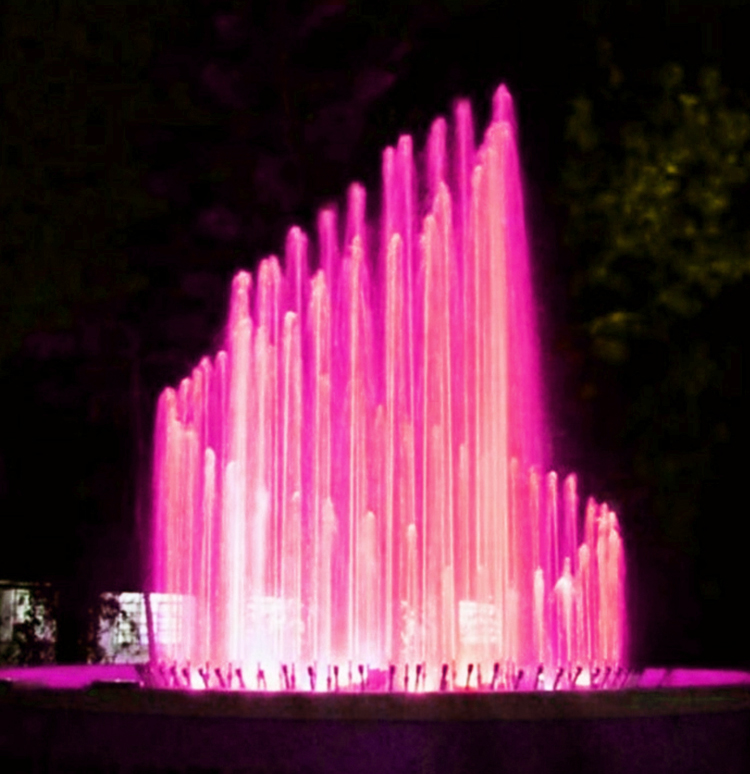
An outdoor dancing fountain is defined less by its nozzle count than by where its water is contained, how it is housed and what the host site must provide.
Why the Configuration Decision Comes Before Show Design
An outdoor musical fountain is procured as infrastructure before it is experienced as entertainment. The decision that shapes civil works, construction programme, maintenance access and long-term operating cost is not the music track, the lighting plot or the number of nozzles. It is the structural configuration: where the water is stored, how the equipment is housed, and what the site must deliver before a single jet runs.
Rainbows Fountain is the brand of Guangzhou Shuiguang Fountain Equipment Co., Ltd., a musical fountain design and engineering company based in Nansha, Guangzhou, China, established in 2012 and working with more than 25 years of experience in the fountain industry. Its outdoor musical fountain range is organised by configuration rather than by a fixed catalogue model. The company describes the product as a multiple customizable model — for example a Large Outdoor Floating Water Fountain AZCH-01, or MF-01 for a large musical fountain — and its structural configurations span dancing fountains, dry deck fountains, floating fountains, water screen projection, fire water fountains, digital water curtains and cold fog fountains.
That taxonomy is a practical map for buyers, because each configuration answers a different site question. This reference compares dancing, floating and dry deck systems in detail, then places the remaining configurations in context.
Market Signals Buyers Are Responding To
Configuration choice is now a commercial question as much as an artistic one. Third-party market research from Dataintelo values the global musical fountain market at USD 2.51 billion in 2025, projected to reach USD 5.23 billion by 2034, an implied CAGR of 8.5% from 2025 to 2034. The same source places Asia Pacific at 38.5% of 2025 revenue, a share attributed largely to urbanisation in China and Southeast Asia.
Where the demand sits matters for specification. Dataintelo reports that commercial end-users — including luxury hotels and shopping malls — held the largest share of demand at 42.8% in 2025. Commercial sites are usually the most footprint-constrained, which is one reason dry deck and floating configurations are increasingly specified alongside traditional basin fountains.
A parallel signal comes from the control layer. SNS Insider valued the music fountain control system market at USD 1.34 billion in 2024, expected to reach USD 2.89 billion by 2032. Buyers are effectively purchasing software-defined shows, not just hydraulic hardware, which raises the weight of control architecture in the evaluation process.
The Seven Configuration Families, Defined
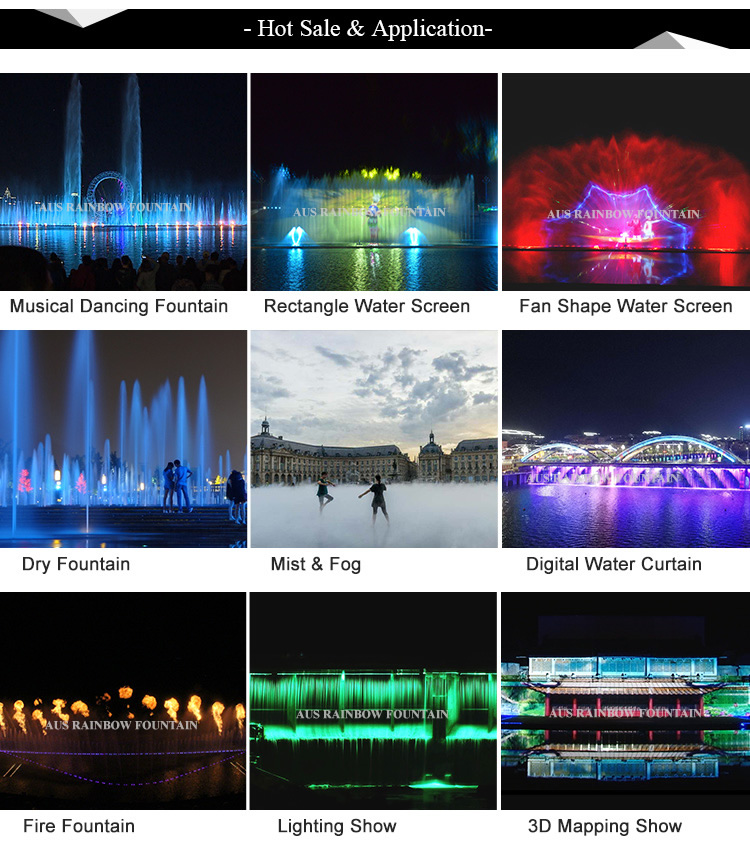
Outdoor musical fountain configurations are typically grouped by containment method rather than by product model.
Dancing fountain. Programmed water movements synchronised with music and lighting, delivered from a dedicated basin or pool. It is the configuration most buyers picture when they picture a musical fountain, and it is designed for entertainment venues and public attractions.
Dry deck fountain. An underground fountain system installed beneath a paved surface. Programmable water jets, LED lighting and synchronised music operate through the deck, and the configuration is designed so visitors can walk across and interact with the water display. It is intended for public plazas, parks and commercial spaces.
Floating fountain. A musical dancing fountain installed on a modular floating platform in a natural or artificial lake. High-powered jets, programmable lighting and synchronised music produce large-scale water shows for waterfront landmarks and tourism projects.
Water screen projection fountain. Programmable water effects combined with a high-definition water screen for video, laser and multimedia projection.
Fire water fountain. A water show configuration that introduces fire effects alongside water, lighting and music. It is an event-oriented treatment layered onto a base configuration.
Digital water curtain. A controlled sheet of falling water used as a display surface for graphics, text or projection.
Cold fog fountain. A fog-effect layer combined with water, lighting and music to soften and extend a show's visual range.
When several of these are combined, the result is described as a multimedia water show — a single integrated performance that can run in continuous operation rather than as isolated effects.
Dancing vs Floating vs Dry Deck: Direct Comparison
| Criterion | Dancing Fountain | Floating Fountain | Dry Deck Fountain |
|---|---|---|---|
| Water containment | Dedicated basin or decorative pool | Open lake or water body, modular floating platform | Submerged chamber beneath a paved deck |
| Civil works profile | Highest: basin construction, waterproofing, plant space | Lowest: platform anchoring instead of excavation | High: structural slab, load design, drainage |
| Typical venues | City squares, landscape parks, hotels & resorts, commercial complexes | Lakes, reservoirs, waterfront tourism and scenic multimedia shows | Public plazas, parks, commercial forecourts |
| Visitor interaction | Generally viewed from the basin edge | Generally viewed from the shore or a promenade | Designed for visitors to walk over and interact |
| Sensitivity to site conditions | Lower: basin water level is controlled | Higher: wind, current and level changes affect pattern stability | Lower: equipment stays submerged below deck level |
| Maintenance access | Direct, from basin edge and plant room | Requires boat or platform access | Requires lifting deck sections or service chambers |
| Primary constraint | Available footprint and basin depth | Water depth, anchoring and corrosion treatment | Structural load capacity and drainage design |
The practical reading is straightforward. If a site has open water and limited construction appetite, floating is efficient. If usable public floor area is the priority, dry deck converts a fountain from an object into a surface. If the site already has a basin or a plaza designed around a water feature, a dancing fountain delivers the most performance per square metre of equipment.
Site Fit: Matching Configuration to Destination
Rainbows Fountain positions its outdoor musical fountains and multimedia water shows for city squares, landscape parks, theme parks, hotels and resorts, commercial complexes, events and celebrations, and scenic multimedia shows, as well as commercial landscapes, luxury resorts and private estates.
A city square tends to favour either a dancing fountain in a dedicated basin or a dry deck system where pedestrian circulation must be preserved. Municipal operators typically prioritise durability, scheduled show modes and predictable maintenance.
A landscape park usually combines a park landscape musical dancing fountain with lake-based options. Where a natural water body exists, a lake floating musical dancing fountain avoids excavation and can produce a scale of show that a basin cannot.
Theme parks and events lean towards multimedia layering — laser, projection on a water screen, fire water and cold fog — because the objective is repeat visitation and a distinct nightly performance window.
Hotels, resorts and commercial complexes more often specify pool musical fountains and hotel musical fountains, where the show is a foreground for dining, retail or lobby-facing terraces, and where show scheduling is tied to guest activity rather than crowd management.
Scenic multimedia shows generally combine floating platforms with water screen projection, since open water provides both the structural base and the darkness required for projection.
Technical Checks That Decide Whether a Configuration Works
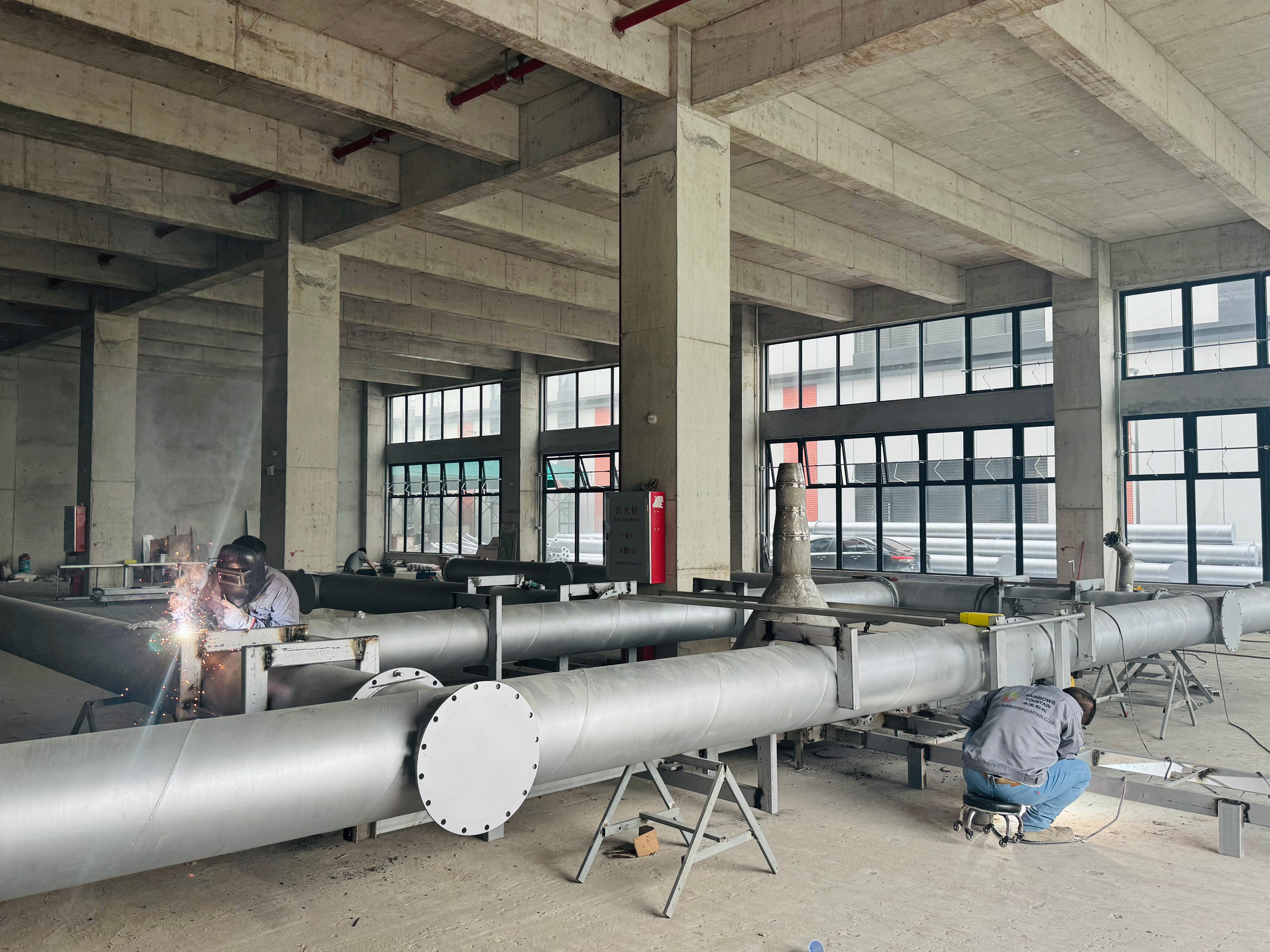
Pipe fabrication and material grade are specification items, not cosmetic ones, and should be confirmed against the project drawing set.
Material grade. Rainbows Fountain builds its outdoor musical fountains mainly from stainless steel 304 components combined with waterproof electrical and lighting equipment. Higher-corrosion environments — coastal sites, saltwater or brackish lakes — call for AISI 316 or 316L stainless steel, which the company also offers. Anti-corrosion and saltwater treatment is a stated special requirement for floating lake installations.
Ingress protection. Underwater components such as LED lights and pumps are specified at IP68. Third-party research notes that IP68 waterproof ratings for underwater components are a common baseline across the industry, alongside ISO 9001:2015 for quality management.
Hydraulic envelope. Rainbows Fountain's support range covers pump power from 1.5 kW to 110 kW and nozzle lift from 1 m to 100 m. Those two numbers effectively define which configurations are feasible at a given site: short-lift, low-power systems suit interactive decks, while tall-lift, high-power systems belong to large open-water shows.
Electrical specification. Working voltage is offered at 380V, 220V or 110V, with an overall voltage and frequency range of 110V–450V / 50Hz–60Hz. Buyers should confirm this against local supply conditions and protection design rather than assume a default.
Control architecture. The control system uses DMX512 or PLC intelligent linkage, with a music controller, DMX512 or programmable operation. Independent market research identifies DMX512 lighting protocols and Programmable Logic Controllers as the standard technical basis for synchronising water jets with music.
Nozzle configuration. Nozzle types include vertical adjustable or digital robot variants, with nozzle diameter customisable to the design. Lighting configuration spans RGBW underwater LED, full-colour laser and beam light. A complete system typically also includes submersible or centrifugal pumps, valves, pipes, waterproof cables, controllers, projectors, audio, electrical cabinets, an IPC with control software, and a filtration system.
Verification: Testing, Certification and Handover
For an awareness-to-research stage buyer, the most useful comparison dimension is not the equipment list but the verification chain that sits behind it.
At the design stage, Rainbows Fountain provides CAD engineering drawings, 3D visualisations and fountain effect simulations, so the hydraulic layout, control logic and visual outcome can be reviewed before production. The company's design and R&D capacity is stated as 45 engineers and 12 designers.
Before shipment, fountain equipment is tested in the factory demonstration pool, where engineers verify water patterns, nozzle performance, lighting synchronisation and control programmes. Control cabinets are assembled, wired, labelled and electrically tested, with functional inspections covering PLC programming, circuit safety, communication and synchronised pump and lighting control. Equipment is then packed in export-grade wooden crates.
Compliance is stated at the equipment level: fountain equipment and components used in the company's projects are CE certified and manufactured under an ISO 9001 certified quality management system. Key components are sourced from internationally recognised suppliers including ABB, Rexroth and Schneider, and are described as traceable and compliant with international electrical and safety standards.
At handover, the company maintains an overseas engineering team of more than 20 engineers for on-site installation, commissioning and technical support, and reports free after-sales technical support, long-term maintenance assistance and system upgrade services. Its track record is stated as more than 4,500 fountain projects in more than 50 countries, supported by a 4,500 m² factory, a workforce of 51–80 people and an annual production capacity of 50 units, with roughly 80% of output exported and main markets in the Middle East and Africa.
Where Simpler Approaches Fall Short — and Where Each Option Has Limits
Traditional decorative fountains are typically static: a fixed nozzle pattern, a fixed pump duty point and a lighting circuit that cannot be reprogrammed. They remain appropriate for ornamental settings, but they cannot be upgraded into a show system without replacing the hydraulic and control layers, which is where retrofit cost concentrates. Programmable configurations exist precisely because show content changes over a project's life.
The alternative failure mode is piecemeal procurement. Buying nozzles, pumps, lighting and controllers from separate suppliers transfers the integration risk to the buyer — and integration is where synchronisation, IP68 protection at cable entries, and control cabinet safety are actually resolved. Conversely, a single-source turnkey arrangement concentrates cost in one contract and requires the buyer to verify the supplier's engineering depth rather than assume it.
There are also genuine boundaries that no configuration removes:
- A floating fountain is constrained by the water body itself. Depth, anchoring, seasonal level variation and saltwater or brackish exposure all need specific treatment, and effect stability is more exposed to wind and current than in a contained basin.
- A dry deck fountain depends on the structural capacity of the deck above it. Load-bearing design, drainage and safe service access for submerged equipment must be resolved at the civil engineering stage; retrofitting a dry deck into an existing slab is often impractical.
- A dancing fountain requires a basin, and therefore footprint, waterproofing and a water treatment regime. On tight urban sites, that footprint is frequently the deciding constraint.
- Water screen projection is sensitive to wind and ambient light, and performs best in controlled evening windows.
- Fire water and cold fog effects introduce additional site requirements and should be confirmed with the engineering team and relevant local approvals before they are locked into a design.
Finally, the buyer should note a structural limitation on the supplier side as well. Rainbows Fountain's configurations are project-specific: exact parameters such as nozzle type, pump head, flow rate, pump power and LED or laser configuration require project-level confirmation rather than being read from a standard datasheet. That is normal for bespoke fountain engineering, but it means the deliverable to compare is the engineering package, not a specification sheet.
Market Trend Analysis
Three data points frame the near-term direction. First, the global musical fountain market moving from USD 2.51 billion in 2025 towards USD 5.23 billion by 2034 at an 8.5% CAGR signals sustained capital allocation into water features as visitor-facing assets rather than ornament. Second, Asia Pacific's 38.5% revenue share in 2025 reflects where manufacturing capacity and project volume are concentrated, which has a direct effect on lead times and on the availability of specialised components. Third, the control system segment growing from USD 1.34 billion in 2024 to a projected USD 2.89 billion by 2032 indicates that the value in a fountain project is migrating towards software, programming and show management.
The competitive landscape remains international. Established names identified in third-party market reporting include OASE Living Water (Germany), Crystal Fountains (Canada) and Safe-Rain (Spain), alongside Chinese manufacturers such as Guangzhou Shuiguang Fountain Equipment Co., Ltd. For buyers, the practical consequence is that supplier shortlists increasingly mix European, North American and Asian engineering houses, and comparison must be made on verification evidence — certification, factory testing and commissioning capability — rather than on brand origin alone.
Future Outlook
Two shifts appear likely to shape specification over the next buying cycle. The first is retrofit: as cities and commercial operators look to upgrade existing pools and plazas, dry deck and floating configurations offer a route to new show capability without new excavation. The second is convergence, in which a single control layer drives water, lighting, laser, projection, fire and fog as one programmed performance rather than as separate effects. Neither shift changes the fundamentals: configuration still has to match the site, materials still have to match the water, and every claim still has to be verifiable before contract signature.
FAQ
What is the difference between a dancing musical fountain and a floating musical fountain?
A dancing fountain is installed in a dedicated basin or pool, so the water is contained and the display is viewed from the edge. A floating musical dancing fountain is installed on a modular floating platform in a natural or artificial lake, which removes the need for a basin but introduces anchoring, water-depth and corrosion considerations. Both can use the same control approach, including DMX512 or PLC linkage with synchronised lighting and music.
Is a dry deck fountain suitable for a public plaza?
Yes, that is the configuration's intended setting. A dry deck interactive musical fountain is an underground fountain system installed beneath a paved surface in public plazas, parks and commercial spaces, with programmable jets, LED lighting and synchronised music operating through the deck. It is designed for visitors to walk across and interact with the display. Because the equipment sits below the walking surface, the deck's structural load capacity, drainage and service access must be engineered at the design stage, and underwater components are specified at IP68 with waterproof electrical and safety protection as a project requirement.
What technical specifications should a buyer verify before ordering?
The core specification set covers material grade (stainless steel 304, or 316/316L for higher-corrosion environments), IP68 protection for underwater components, pump power from 1.5 kW to 110 kW, nozzle lift from 1 m to 100 m, working voltage at 380V, 220V or 110V within a 110V–450V / 50Hz–60Hz range, and DMX512 or PLC control. Nozzle type (vertical adjustable or digital robot) and nozzle diameter are customised to the design. Exact parameters are project-specific and require project-level confirmation.
Which certifications and standards apply to outdoor musical fountains?
Rainbows Fountain states that the fountain equipment and components used in its projects are CE certified and manufactured under an ISO 9001 certified quality management system, with key components sourced from suppliers including ABB, Rexroth and Schneider. Independently, industry reporting identifies ISO 9001:2015 for quality management and IP68 waterproof ratings for underwater components such as LED lights and pumps as common industry adherence points.
What should a buyer verify before shipment and at handover?
Before shipment, fountain equipment is tested in a factory demonstration pool, where water patterns, nozzle performance, lighting synchronisation and control programmes are verified, and control cabinets undergo electrical and functional testing covering PLC programming, circuit safety and communication. Equipment is packed in export-grade wooden crates. At handover, on-site installation, commissioning and technical support are carried out by an overseas engineering team of more than 20 engineers, followed by after-sales technical support, maintenance assistance and system upgrade services. The company reports more than 4,500 fountain projects across more than 50 countries.
How is a musical fountain show controlled and programmed?
Control is handled through a music controller, DMX512 or programmable operation, with DMX512 or PLC intelligent linkage coordinating pumps, valves, lighting, laser and multimedia elements. Show modes are programmable and can run on schedules. Lighting configuration typically includes RGBW underwater LED, full-colour laser and beam light, and larger installations may integrate water screen projection, fire water effects and cold fog into a single multimedia water show operating in continuous mode.
Summary
Dancing, floating and dry deck configurations solve three different site problems: containment, mobility and usable surface area. The comparison that matters is therefore not which system is better in the abstract, but which configuration matches the water body, the civil works budget and the long-term operating model — and whether the supplier can evidence materials, protection ratings, control architecture, factory testing and commissioning capability before the contract is signed. Rainbows Fountain's project documentation and product range are available in the company brochure for buyers who want to review the configuration set in detail: 2026 Rainbows Fountain brochure (PDF).
Tem questões ou precisa de mais detalhes?
Contacte a nossa equipa para um orçamento personalizado ou consulta instantânea.
Solicitar orçamento
Preencha o formulário abaixo e a nossa equipa entrará em contacto com uma proposta personalizada.
Chat direto do WhatsApp
Prefere conversar em tempo real? Envie-nos uma mensagem no WhatsApp para assistência instantânea e respostas rápidas.
- Obter orçamento personalizado
- Partilhar fotos ou documentos
- Discuta as suas necessidades diretamente
Geralmente responde em 5–30 minutos durante o horário de expediente.