
N20 Gear Motor: Specs, Limits and Design Fit Explained
The N20 gear motor is less a single product than a drive architecture: a miniature brushed DC motor paired with a spur gearbox inside an envelope of roughly 10 mm x 12 mm x 25 mm, typically specified between 3 V and 12 V. That footprint keeps appearing in product designs because it fits the space left over inside small locks, instruments and appliances — which is also why the N20 label shows up in so many bills of materials with very little explanation of what it guarantees.
For engineers and buyers in the awareness and research stage, the useful questions are narrower: what does an N20-class drive actually deliver, where does it stop being the correct choice, and what has to be documented before it can be approved into a design? This reference article answers those questions using published N20 architecture specifications, the documented specification of one specific implementation — the TT Motor GM12-N20VA — and verifiable market and regulatory data. Brushless motors are discussed only where they define the boundary of the N20 class.
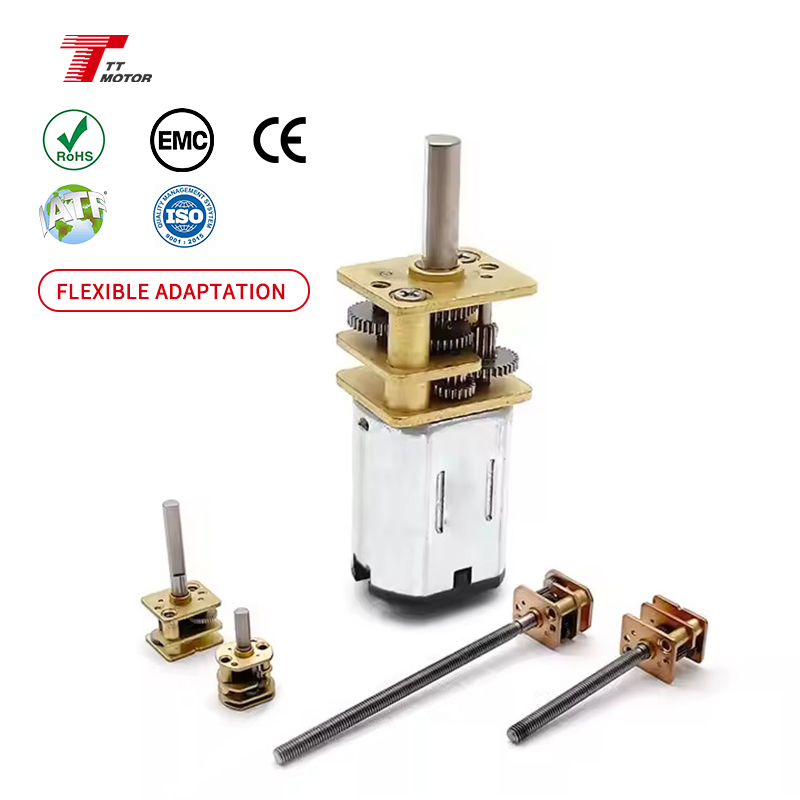
Figure 1. GM12-N20VA, a DC spur gear motor in the N20 gear motor series, shown as documented in the supplier product record.
What an N20 Gear Motor Is — and What the Label Does Not Guarantee
Definition. An N20 gear motor is a miniature DC gear motor built on the N20-size motor frame with an integrated reduction gearbox. In the standard N20 architecture, the assembly occupies approximately 10 mm x 12 mm x 25 mm and operates from 3 V to 12 V. The gearbox trades motor speed for torque, so the output shaft turns slowly and with more usable force than the bare motor could provide on its own.
A documented implementation is the GM12-N20VA from TT Motor (Shenzhen) Industrial Co., Limited, a miniature motor manufacturer established in 2006 and engaged in miniature DC motor research, development and manufacturing. The product is classified as a DC spur gear motor, uses a spur gear transmission structure, and its model designation references the N20 gear motor series; the specification record describes it as a small-size gear motor intended for compact electronic assemblies. It is supplied for OEM projects with selectable gear stage configurations.
| Parameter | Documented value (GM12-N20VA) |
|---|---|
| Product category | DC gear motor; DC spur gear motor; references the N20 gear motor series |
| Gear module | 0.15 |
| Maximum rated torque | 0.5 kg.cm |
| Gear stages | 2, 4, 5 or 7 |
| Gearbox length | 9 mm / 12 mm |
| Rated voltage | 2.4 V or 5 V |
| Output speed range | 12 rpm to 1450 rpm |
| Material | Stainless steel |
| Supply mode | OEM projects with selectable gear stage configurations |
The N20 designation describes a frame-size class, not a fixed specification. Two N20-class motors from different suppliers can differ in rated voltage, gear stage count, gearbox length and torque curve. The model number and its datasheet — not the N20 label — are the correct basis for a design decision.
The Design Problem the N20 Class Solves
Compact equipment rarely fails because of insufficient motor power. It fails because the drive does not fit, is too loud, draws too much current, or cannot hold a position quietly. In smart home equipment, the documented working condition for this drive class is low-speed operation in limited space, with miniaturization, low noise and low power consumption as the governing requirements. Documented equipment types include smart curtains, robot vacuum cleaners, smart toilets, smart height-adjustable desks, smart refrigerators, smart trash cans, smart pet feeders and smart camera pan-tilt units.
Smart door locks add a stricter specification: low noise, high torque and stable speed, together with operation in both high and low temperature environments. That combination pushes designers toward a geared motor with a metal gearbox and a treated housing rather than a bare motor with a separate reduction stage bolted to it.
Scale context. Global trade in electric motors with an output below 37.5 W (HS 850110) reached USD 16.3 billion in 2024, according to OEC trade data. That figure covers the whole small-motor category and cannot isolate the N20 form factor — the HS code is too broad — but it establishes that sub-37.5 W drives are a large, globally traded component category rather than a niche part.
Technical Explanation: How an N20 Drive Chain Behaves
Gear stages trade length for reduction. The GM12-N20VA gearbox is offered with 2, 4, 5 or 7 gear stages and two gearbox lengths, 9 mm and 12 mm, with a gear module of 0.15. Every additional stage increases the reduction ratio — lowering output speed and raising usable torque — and adds length to the assembly. Projects that need the shortest possible package start with fewer stages; projects that need very slow, controlled movement accept the longer gearbox.
Rated torque is not stall torque. Rated torque is the torque that can be continuously output under specified operating conditions. It is a working limit, not the force at which the mechanism eventually stops. The GM12-N20VA is specified at a maximum rated torque of 0.5 kg.cm, an output speed range of 12 to 1450 rpm, and a rated voltage of 2.4 V or 5 V. Load matching should therefore be done against the rated value with margin for friction, temperature and supply variation.
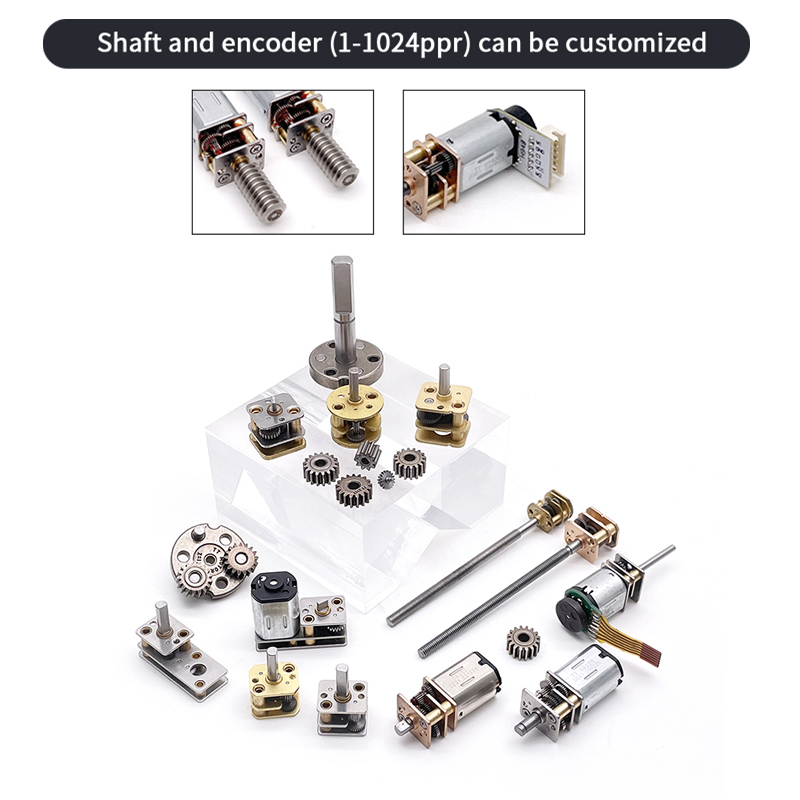
Figure 2. Component view of the GM12-N20VA, illustrating the motor body, integrated spur gearbox and output shaft arrangement.
Mechanical construction decides service behaviour. The gearbox is described as an all-metal precision gearbox produced by a hobbing process, targeting low noise, high torque and stable speed. The output shaft is machined, and shaft customization is supported. The housing uses a rust-proof process and is specified for operation in high and low temperature environments. These are the details that determine whether a lock or appliance still sounds the same after a year of use, and they are worth asking about explicitly during supplier evaluation.
Control behaviour. Because the GM12-N20VA is a brushed DC spur gear motor, it runs directly from DC voltage without an external brushless controller, which keeps drive electronics simple. The same construction also carries the brush and commutator wear mechanism inherent to brushed DC motors. That trade-off is examined in the comparison section below.
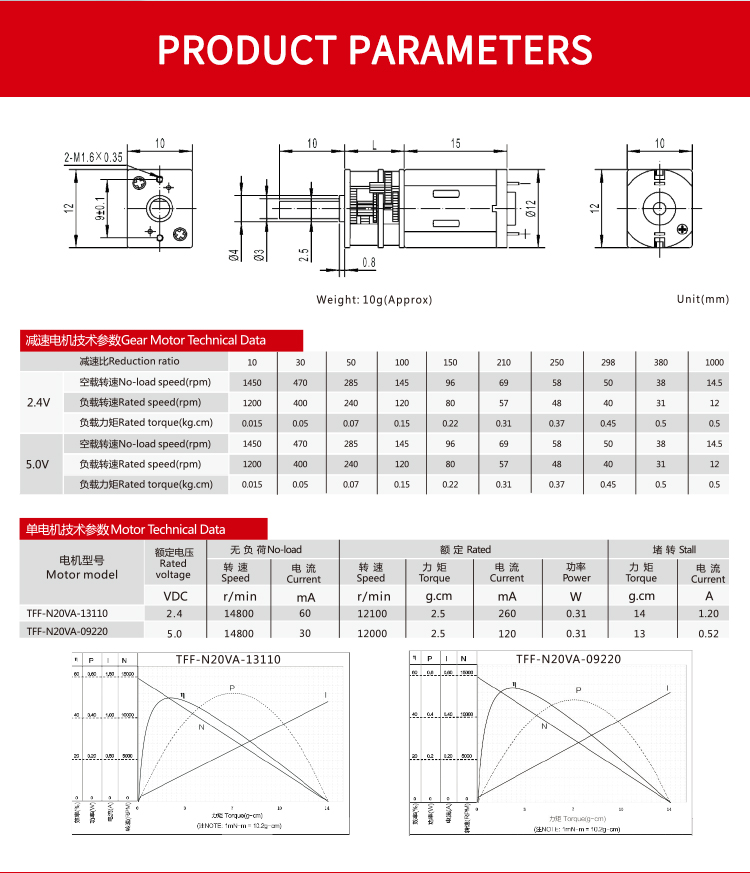
Figure 3. Parameter sheet for the GM12-N20VA, covering gear stages, gearbox length, rated voltage and speed range.
Application Fit: Where the N20 Class Belongs
Documented fit for this drive class is concentrated in three areas.
- Smart home equipment — low-speed, limited-space operation with intermittent positioning; documented equipment types include smart curtains, robot vacuum cleaners, smart toilets, smart height-adjustable desks, smart refrigerators, smart trash cans, smart pet feeders and smart camera pan-tilt units.
- Smart door locks — specified for low noise, high torque and stable speed, with operation in both high and low temperature environments.
- Compact electronic assemblies generally — the spur gearbox form is intended for small, space-constrained mechanisms where the job is a positioning movement rather than continuous rotation.
The same documented product family also appears in the miniature medical device context, where precision automated instruments and electrically adjustable supports are the named applications and the governing requirements are low noise, low vibration and stable operation. In those settings the N20-class drive is used for light, short-stroke positioning rather than for load-bearing motion.
Where the N20 class is the wrong answer. Four boundaries are worth stating plainly, because they are the most common source of mis-selection:
- Sustained or high load. A maximum rated torque of 0.5 kg.cm excludes applications that need continuous force, impact resistance or a large safety margin.
- Continuous duty and very high cycle counts. As a brushed design, brush and commutator wear is the service-interval determinant. For equipment requiring long-term continuous operation, high speed or low maintenance, brushless motors are generally recommended.
- 12 V system buses. The GM12-N20VA is rated at 2.4 V or 5 V and does not match a 12 V rail. A 12 V architecture needs a different frame, such as the GM37-555PM (DC 12 V–24 V) or a brushless gear motor such as the GMP36-TEC3650 (DC 12 V–24 V).
- Projects driven by efficiency regulation. EU Ecodesign Regulation 2019/1781 sets minimum efficiency requirements for motors from 0.12 kW to 1000 kW, and IEC 60034-30-1:2025 introduces the IE5 ultra-premium efficiency class. Both operate above the power level of the N20 class, so micro drive selection is governed by material compliance and application-level requirements instead — which means those declarations have to be requested from the supplier directly rather than assumed from an efficiency class.
Market Trend Analysis: The N20 Class Inside the Brushless Transition
The wider category context is measurable. The global brushless DC motor market was valued at approximately USD 22.2 to 22.33 billion in 2025, with major research firms converging closely on that range. Growth in that segment is driven by applications that value efficiency, long service life and low maintenance — precisely the areas where brushless gear motors displace brushed ones.
That does not mean the N20 class is being displaced at the same rate. The documented decision rule from application experience is directional rather than absolute: long-time operation, high-frequency start/stop and high life requirements point to brushless, while low cost, short running time and simple control logic point to brushed. The N20 class sits on the second side of that split — cost-sensitive, intermittent, space-constrained designs — and continues to be specified predominantly in brushed form.
What is changing is the supplier portfolio rather than the N20 specification itself. Manufacturers serving both sides of the decision increasingly offer brushed and brushless variants across the same gear motor families, alongside worm and planetary gearbox architectures in the same miniature frame classes. TT Motor's product lines illustrate the pattern: its miniature motor range includes brushed DC gear motors such as the GM12-N20VA and the GM37-555PM, and DC brushless gear motors such as the TWG3246-TEC2430 worm gear motor and the GMP36-TEC3650 planetary gear motor, with a stated product range covering 12 mm to 42 mm series brush and brushless reduction motors.
Comparison with Traditional Alternatives
The clearest way to understand the N20 class is to place it against the other drive options a design team would realistically consider. All figures below come from documented product specifications.
| Drive option | Max rated torque | Rated voltage | Output speed | Structure | Life / maintenance | Typical fit |
|---|---|---|---|---|---|---|
| GM12-N20VA (N20 spur gear motor) | 0.5 kg.cm | 2.4 V / 5 V | 12–1450 rpm | Brushed motor with integrated spur gearbox, 9/12 mm gearbox, module 0.15 | Brushed construction: brush and commutator wear is a service factor | Smart door locks, compact electronic assemblies |
| Motor plus external gearbox | Component dependent | Component dependent | Component dependent | Separate motor and gearbox requiring couplings and mounting structures | Follows the motor type selected | Only where space and budget allow separate components |
| GM37-555PM (DC brush spur gear motor) | 8.0 kg.cm | DC 12 V–24 V | 5–800 rpm | Brushed motor with spur gearbox, 2–6 stages, 19–29 mm gearbox | Brushed construction | Smart home, automated equipment, automated production lines |
| GMP36-TEC3650 (brushless planetary gear motor) | 30.0 kg.cm | DC 12 V–24 V, customizable | 4–1600 rpm | Brushless motor with same-diameter planetary gearbox, 36 mm, 420 g | No brush replacement required; service life typically tens of thousands of hours per manufacturer statement | Robotics, medical devices, industrial automation, intelligent logistics |
| TWG3246-TEC2430 (brushless worm gear motor) | 8.0 kg.cm | DC 12 V–24 V | 3–35 rpm | Brushless motor with integrated right-angle worm gearbox, self-locking | No spark generation, minimal electromagnetic interference | Miniature medical devices, precision automated instruments, electrically adjustable supports |
Limits and trade-offs. The comparison contains three honest boundaries that should be part of any selection record. First, the N20 class has a low torque ceiling: 0.5 kg.cm maximum rated torque is roughly one-sixteenth of the GM37-555PM's 8.0 kg.cm and about one-sixtieth of the GMP36-TEC3650's 30.0 kg.cm, so it cannot be substituted into a load designed around those frames. Second, its 2.4 V / 5 V rated voltage does not match 12 V system buses, so a 12 V design needs a different frame entirely rather than an adapter-level workaround.
Third, integration carries a cost of its own. An integrated geared motor combines the motor and gearbox, allowing lower speeds and higher output torque within a more compact space; integrated units typically have a more compact structure, are easier to install, require fewer couplings and mounting structures, simplify power matching, and help reduce overall machine space and assembly costs. Integrated geared motors are generally recommended when equipment space is limited and the budget is low. The boundary is flexibility: a combined unit leaves less freedom to re-rate the motor or the gearbox independently later, which matters for platforms that expect their load requirements to change during the product's life.
Sourcing, Consistency and Compliance: What to Verify
Batch consistency. The recurring risk in miniature gear motor sourcing is described as "samples being qualified, but batch products having inconsistent performance." Documented triggers include replacement of raw materials or components, failure to lock in the sample process during mass production, sample quantities too small to reflect batch consistency, changes in production equipment or mold status, and inadequate parameter control between batches. Mitigations that a supplier can be asked to commit to are process-based rather than commercial: avoid special machine adjustments made only for samples, avoid using material A for samples and switching to material B for mass production, run a small-batch trial production before mass production, define sampling or full-inspection rules for key parameters, and establish a traceability system that can locate the source of a problem quickly. These commitments are verifiable through trial-production and inspection records.
Material compliance. The applicable European reference is RoHS Directive (EU) 2015/863 amending 2011/65/EU. TT Motor states that most of its motors have passed RoHS testing, and a REACH report for the GM12-N20VA dated 2025 forms part of the document set. For EU-bound products, the practical step is to request the declaration tied to the exact model and revision being purchased rather than a generic statement.
Supplier verification. TT Motor (Shenzhen) Industrial Co., Limited was established in 2006 and specializes in the R&D and manufacturing of miniature precision motors. Its R&D function is staffed by 35 engineers working on motor design and motor structure optimization, and its miniature motors are used in industrial automation, intelligent robots, medical equipment, precision instruments, smart homes, automotive electronics and unmanned equipment.
Future Outlook
Three developments are likely to shape how the N20 class is specified over the next design cycles.
- Voltage and controllability requirements will tighten. As product platforms consolidate around 12 V and battery rails, N20-class drives will be asked to deliver more usable torque per millimetre, which puts weight on gear stage options, shaft customization and gearbox length choices rather than on the motor body alone.
- The brushless boundary will move downward. With the global brushless DC motor market already in the USD 22 billion range in 2025 and growth concentrated in efficiency and maintenance-sensitive applications, the crossover point between brushed N20-class drives and brushless miniature gear motors will keep shifting. The selection decision will remain application-driven — duty cycle, load and service expectation — rather than category-driven.
- Evidence will increasingly matter more than labels. Because HS 850110 cannot separate the N20 form factor from other sub-37.5 W motors, public data cannot reliably describe N20-specific volume. In practice, that means supplier comparison in this class rests on test and life statements, trial-production records, key-parameter inspection rules, traceability and material compliance documents.
FAQ
What does "rated torque" mean, and what load can an N20-class gear motor handle?
Rated torque is the torque that can be continuously output under specified operating conditions. It is not the same as the maximum load the mechanism can move before stalling. Different motors have different load capacities, and customization is supported. For the GM12-N20VA, the maximum rated torque is 0.5 kg.cm, so load matching should be performed against the rated figure with margin for friction and temperature variation rather than against a stall measurement.
What are the advantages of an integrated gear motor compared to a motor with an external gearbox?
An integrated geared motor combines the motor and gearbox, which allows lower speeds and higher output torque within a more compact space. Integrated geared motors typically have a more compact structure, are easier to install, require fewer couplings and mounting structures, simplify power matching, and help reduce overall machine space and assembly costs. Integrated geared motors are generally recommended when equipment space is limited and the budget is low.
Can an N20 gear motor be used in a 12 V system?
Not the GM12-N20VA. That model is rated at 2.4 V or 5 V. A 12 V architecture requires a different frame or product: the GM37-555PM is rated at DC 12 V to 24 V with a 5 to 800 rpm output and 8.0 kg.cm maximum rated torque, and the GMP36-TEC3650 brushless planetary gear motor is rated at DC 12 V to 24 V with a 4 to 1600 rpm output and 30.0 kg.cm maximum rated torque. Matching the rated voltage of the motor to the available supply rail is a prerequisite rather than an optimization step.
For long-term continuous operation, is a brushless or a brushed motor more suitable?
For equipment requiring long-term continuous operation, high speed or low maintenance, brushless motors are generally recommended. Brushless motors use electronic commutation and have no traditional brushes or commutators, which reduces mechanical wear and provides advantages in lifespan, efficiency, noise and maintenance; their service life is typically stated as tens of thousands of hours, whereas brushed motors have a lifespan in the range of several hundred to several thousand hours and produce sparks, carbon dust and stronger electromagnetic interference. Brushed motors have lower initial cost and simpler control, and remain suitable for cost-sensitive applications with short running time and simple logic.
How can a buyer avoid the problem of samples being qualified while batch performance is inconsistent?
Before mass production, define the motor parameters and acceptance standards, conduct a small-batch trial production first, establish a shipment inspection mechanism, and then proceed to mass production. If the supplier changes raw materials, components or production processes, the change should be notified in advance and the process re-verified. Additional safeguards include avoiding special adjustments made only for samples, preventing the use of one material for samples and another for mass production, defining sampling or full-inspection rules for key parameters before mass production, and maintaining a traceability system to pinpoint the source of any problem quickly.
What compliance documentation can be requested for a miniature gear motor?
RoHS compliance can generally be documented: TT Motor states that most of its motors have passed RoHS testing, with reference to RoHS Directive (EU) 2015/863 amending 2011/65/EU, and a REACH report for the GM12-N20VA dated 2025 exists. Because the applicable documents differ by product, buyers should request the declaration that corresponds to the exact model and revision being purchased. Note also that EU motor efficiency requirements under Regulation 2019/1781 apply to motors from 0.12 kW to 1000 kW, a scope that does not cover N20-class miniature drives, so material compliance and application-level specifications are the relevant evidence categories for this product class.
A downloadable brochure covering TT Motor's miniature motor products, including gear motors, coreless motors, brushless motors and stepper motors, is publicly available. The company's product and company information is published at www.ttmotor.com.