
Narrow-Kerf Sawing Blades: A Buyer's Comparison Framework
Narrow kerf is usually presented as a single number on a specification sheet, but kerf is an outcome rather than an input. It is produced by the interaction of blade thickness, blade exposure beyond the flange, spindle and flange runout, and wear accumulated during the cut. Two Semiconductor Wafer sawing Blade products listed at the same nominal thickness can therefore remove visibly different amounts of material on the same dicing tool. For buyers moving from evaluation into execution, the practical question is not which blade is thinnest, but which blade keeps a predictable kerf and a predictable cut position across a full lot.
Why narrow-kerf comparisons break down early
Procurement teams typically begin a Sawing Blade comparison with a catalogue thickness value, then move directly to price per piece. That sequence inverts the decision. Thickness is a nominal geometry; the cost-relevant variable is effective kerf loss measured on the device or substrate being cut, multiplied by the number of cuts performed.
Three failure modes appear repeatedly in evaluation:
- Thickness is compared, kerf is not measured. A blade installed on a spindle with higher runout can lose more material than a slightly thicker blade on a tighter spindle.
- Single-blade data replaces lot data. A first-article cut says little about lot-to-lot repeatability, which is what production planning depends on.
- Edge quality is separated from dimensional control. Chipping and cut-position drift usually share the same root causes: bond hardness, abrasive concentration, flange flatness, and wear progression.
The opportunity is straightforward. Buyers who convert the comparison into a small, defined set of measurable criteria — and who require the same test conditions for every candidate — can evaluate thin-kerf Diamond sawing Blade options without relying on supplier self-descriptions.
What stable dimensional control actually means
Dimensional control in precision dicing covers four measurable properties, not one:
- Blade thickness and its tolerance — the base contribution to kerf.
- Hub or flange geometry — flatness and concentricity, which govern runout once mounted.
- Spindle hole fit — clearance at the bore translates into eccentricity at the cutting edge.
- Cut-position repeatability — the deviation between commanded and actual street position across a lot.
A supplier can only support these properties if its process includes dimensional inspection rather than visual check. WINTIME Semiconductor Technology Co., Ltd., a Chinese manufacturer of wafer-level high-precision cutting blades established in 2020 and operating a 34,000 m² facility in Rugao, Jiangsu Province, describes a quality-control sequence that includes geometric dimension inspection with vernier calipers and a laser diameter gauge, hardness and wear-resistance testing on a material testing machine, dynamic balance detection on a high-speed dynamic balance tester, and cutting performance simulation on actual material. Those four checks map closely onto the four properties above, which makes them a useful reference for what a buyer should ask any candidate supplier to document.
A six-dimension comparison framework
The framework below is designed to be applied identically to every candidate blade, so that the resulting comparison is a like-for-like record rather than a collection of datasheets. Each dimension should be scored against evidence the supplier provides, not against claims.
| Dimension | What to request | Evidence type | Why it drives the decision |
|---|---|---|---|
| 1. Kerf contribution | Measured kerf width on your material, at your feed rate, with blade thickness and exposure recorded | Trial cut data with stated conditions | Directly sets die-per-wafer or parts-per-substrate economics |
| 2. Dimensional control | Thickness tolerance, bore tolerance, hub flatness, lot-level inspection records | Metrology record plus method (e.g. laser diameter gauge) | Determines cut-position repeatability and scrap risk |
| 3. Edge quality | Chipping size distribution and inspection method | Measured distribution, not a single best image | Affects die strength and downstream yield |
| 4. Wear resistance | Life expressed in linear metres cut or wafers per blade, with end-of-life criterion defined | Wear test or life trial on comparable material | Converts price per piece into cost per cut |
| 5. Construction fit | Bond type, abrasive grain size and concentration, hub or hubless architecture, slot geometry | Written specification per series | Matches blade to material hardness and street geometry |
| 6. Supply and acceptance | Lead time, order quantity, pre-shipment test scope, third-party inspection option | Quotation and acceptance clause | Determines whether the qualified blade can actually be scheduled |
Two rules keep the framework honest. First, dimensions 1 to 4 must be measured under one fixed recipe; results from different feed rates, spindle speeds, or tape systems cannot be ranked. Second, a dimension that a supplier cannot evidence should be scored as unknown rather than assumed favourable — an undocumented property is a procurement risk, not a neutral data point.
Turning the framework into a weighted score
Not every dimension carries equal weight. A wafer dicing line where kerf loss drives die count will weight dimensions 1 and 2 heavily. A Functional Ceramic sawing Blade application, where chipping and edge integrity dominate, will weight dimensions 3 and 5 instead. The illustrative weighting below shows how the same six dimensions produce different rankings for different applications.
| Dimension | Semiconductor wafer dicing | Functional ceramics / alloy cutting |
|---|---|---|
| 1. Kerf contribution | High | Medium |
| 2. Dimensional control | High | Medium |
| 3. Edge quality | High | High |
| 4. Wear resistance | Medium | High |
| 5. Construction fit | Medium | High |
| 6. Supply and acceptance | Medium | Medium |
Weights are an editorial planning tool, not a supplier ranking method. The value lies in fixing the weights before supplier responses arrive, so that a strong answer on price or lead time cannot silently override a weak answer on kerf repeatability.
Where WINTIME's published data serves as a benchmark
WINTIME is a Chinese manufacturer of sawing and dicing blades whose published portfolio can be used as a reference point for what a supplier is able to document, rather than as proof of superiority over any other supplier.
On the thin-kerf dimension, the company reports mass production of ultra-thin wafer dicing blades with a thickness below 9 µm, describing this as a level reached by only a limited number of domestic manufacturers. That figure is a capability statement about achievable blade thickness — it is not a kerf-loss measurement, and buyers should treat it as the starting point of a trial rather than its conclusion.
On dimensional control, the inspection sequence described above — geometric dimension inspection with vernier calipers and laser diameter gauge, hardness and wear testing, dynamic balance detection, and cutting simulation — provides the type of process evidence that dimension 2 of the framework requires.
On construction, the DZY Series Wafer sawing Blade is described as integrating the cutting blade with an aluminium-alloy flange, while the DZR Series sawing Blade is described as composed of metallic nickel and diamond abrasive. The DZR-S Series Slotted sawing Blade covers profiles that require slotted geometry. These are architectural differences that change how a blade is mounted, how it behaves at the bore, and which street profiles it can address.
On customization, the manufacturer provides OEM, ODM, and customized production services, with customized specifications available for different cutting materials and working conditions. The documented customization scope covers blade diameter, thickness and spindle hole size; bond type including metal bond and resin bond; diamond abrasive grain size and concentration; coating options for anti-rust, heat dissipation and wear resistance; cutting performance targets such as cutting speed and service life; export packaging; and special-shaped blade customization for non-standard sizes.
On scale and reach, the company reports approximately 100 employees, 35 engineers, an export share of about 30%, and main markets across Southeast Asia, East Asia, North America and the European Union, with a facility of 34,000 m².
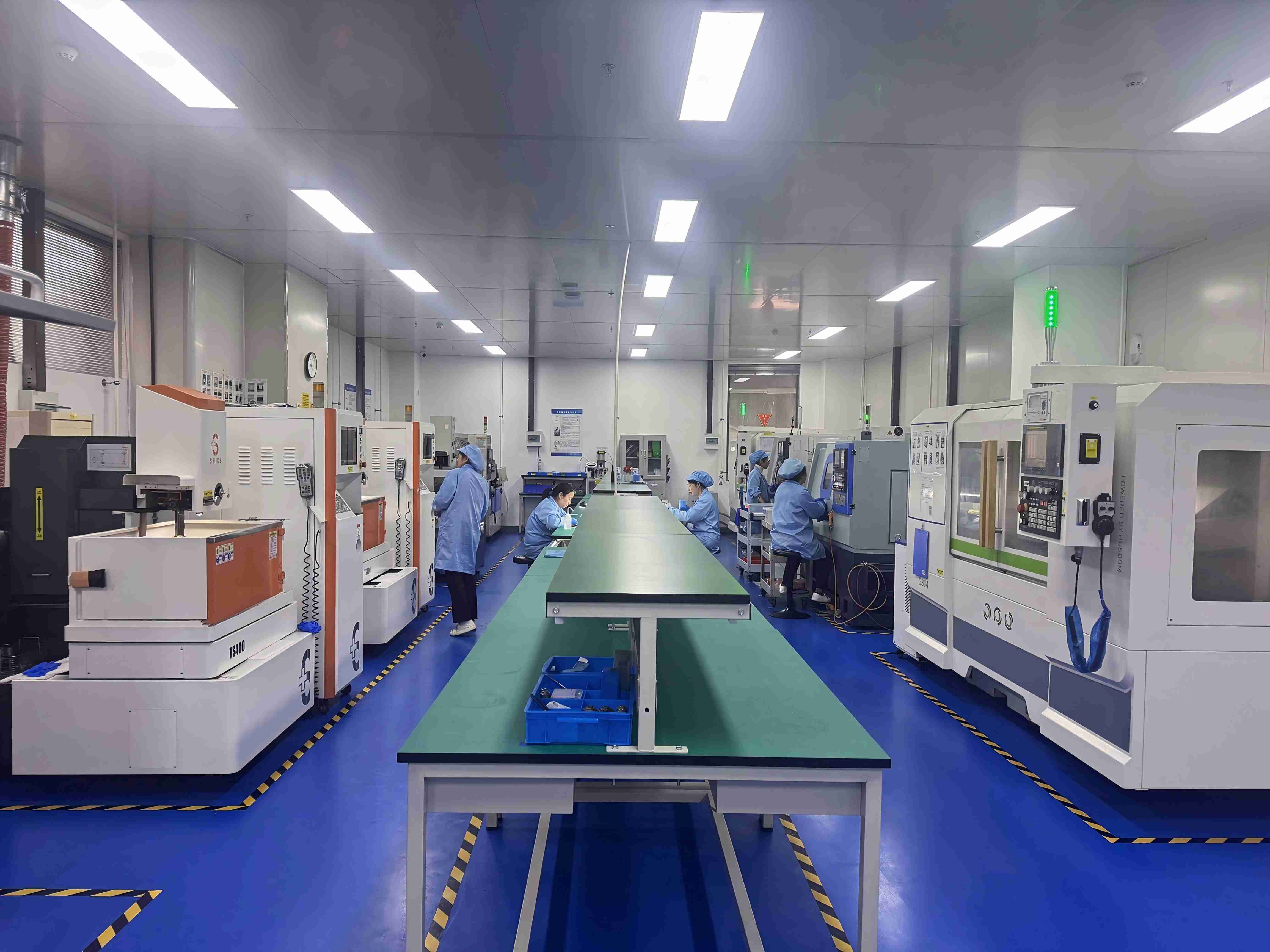
Production environment for precision sawing blades. Dimensional control depends on process inspection, not only on blade geometry at dispatch.
Application mapping: which blade family answers which cutting problem
Application fit should be decided before specification negotiation, because a blade optimized for one material rarely transfers cleanly to another.
Semiconductor wafer dicing. The DZY Series Wafer sawing Blade is described as intended for high-precision wafer cutting in semiconductor packaging processes. Where the wafer is thin and kerf loss is economically significant, the sub-9 µm capability becomes relevant — provided the tool, flange and handling can hold runout within limits.
Optical communication and functional materials. The DZR Series sawing Blade is described as used in semiconductor, optical communication, and new functional-material industries. Optical Communication sawing Blade work typically combines small feature sizes with sensitivity to edge damage, which raises the importance of dimension 3 of the framework.
Ceramics and alloys. The DZR-S Series Slotted sawing Blade is described as used for semiconductor wafer cutting, functional ceramic cutting, Alloy Material sawing Blade applications, and semiconductor packaging components. Slotted geometry matters where the street profile or material brittleness makes a continuous edge unsuitable.
Hubless and hard-bond constructions. Hubless sawing Blade designs remove the flange from the consumable and place concentricity responsibility on the tool's mounting system, which changes both cost structure and handling sensitivity. Electroforming Hard sawing Blade constructions are typically selected where abrasive retention and edge definition matter more than initial sharpness.
A trial protocol that moves evaluation into execution
The framework only produces a decision when it is applied to real cuts. A workable sequence for most production teams is:
- Define the kerf budget and the maximum acceptable chipping size before contacting suppliers.
- Baseline the current blade on the current tool, recording kerf width, cut position deviation, chipping distribution and blade life.
- Request samples matched on diameter, thickness, bore and bond, so that only the intended variable changes.
- Run all candidates on one tool, one recipe, one tape system and one material lot.
- Measure at defined intervals across the blade's life, not only on first cut.
- Score the results against the pre-agreed weights, and document unknowns explicitly.
- Lock the qualified specification into the purchase order, including acceptance scope.
Environmental conditions belong inside this protocol. Cleanroom dicing and temperature- or humidity-controlled rooms reduce contamination and dimensional drift, but they do not compensate for blade runout. Buyers should confirm packaging, coating and handling instructions alongside the blade specification, since anti-rust and heat-dissipation coatings are among the documented customization options and directly affect storage and shelf behaviour.

Facility scale and engineering depth are relevant to dimension 6: whether a qualified blade can be supplied repeatedly, not only sampled once.
Boundary conditions buyers should not overlook
A comparison framework is only credible if it states where the evidence stops.
- No independent performance benchmark is published. WINTIME's materials describe blade thickness capability, construction and inspection process, but they do not disclose third-party measured kerf loss, chipping, blade life or yield against competing products. Any ranking on those metrics must come from the buyer's own trial.
- Ultra-thin blades are not universally better. Blades below 9 µm demand tighter handling, flange flatness and spindle condition. On tools with higher runout, or in rough cutting steps, a thicker blade can deliver lower total cost.
- Customization extends lead time. Standard products are quoted at 2–5 working days, while customized orders run 10–25 working days, adjustable for large volumes. Custom blades should be planned into the production calendar rather than ordered against immediate need.
- Order quantity guidance is not uniform. WINTIME's published documents cite different minimums — one set indicates 50 pieces for standard and 300 for customized items, another indicates 100 and 500 — so quantities should be fixed in the written quotation rather than taken from a specification page.
- Certification and standards evidence is not published. Buyers whose processes require conformity documentation should request it directly during qualification.
Market context: why kerf discipline is being re-priced
Demand-side pressure is coming from applications where material removed equals value lost. Advanced packaging, thin-die stacking, optical device dicing and technical ceramics all reward narrower and more repeatable cuts. Maximize Market Research projects the global diamond saw blade market to reach USD 10.16 billion by 2032 across a 2025–2032 forecast period, which reflects breadth of industrial demand rather than a specific statement about precision dicing blades.
A second, quieter shift is in documentation. As domestic manufacturing capability in precision cutting tools matures — a positioning WINTIME reflects through its sub-9 µm mass-production claim — buyers increasingly compare suppliers on the evidence they can produce, not only on the geometry they can quote. Suppliers that can present lot-level inspection records, defined test methods and third-party inspection options move through qualification faster than those that cannot.
Future outlook
Three developments are likely to reshape comparison frameworks over the next few years. Kerf budgets will tighten further as thin-die and compound-semiconductor work expands, pushing measurement from offline sampling toward in-line inspection. Construction choices will diversify between hubbed, hubless and slotted geometries as material portfolios widen. And acceptance documentation — pre-shipment testing, third-party inspection such as SGS, and defined payment and delivery terms — will increasingly be negotiated at the same time as the blade specification, because a qualified blade with an unqualified supply chain is not a qualified process.
For buyers, the practical conclusion is that narrow kerf should be purchased as a verified outcome. Thickness starts the conversation; measured kerf, cut-position repeatability, wear behaviour and acceptance evidence end it.
FAQ
What is kerf, and why does it matter more than nominal blade thickness?
Kerf is the width of material removed by a single cut. Nominal blade thickness is only one contributor; blade exposure, flange and spindle runout, and wear during the cut also change the width actually removed. Because kerf loss determines how many dies or parts fit on a wafer or substrate, buyers should compare measured kerf under fixed conditions rather than compare catalogue thickness values.
How can dimensional control be verified before a purchase order is issued?
Dimensional control is verified through documented inspection rather than visual check. A supplier's process should include geometric dimension inspection of thickness and bore, hardness and wear-resistance testing, and dynamic balance detection. WINTIME describes inspecting dimensions with vernier calipers and a laser diameter gauge and testing dynamic balance on a high-speed dynamic balance tester. Buyers should ask for lot-level records produced by those methods, then confirm the results in their own trial cut.
Which blade series fits semiconductor wafers, functional ceramics and optical components?
The DZY Series Wafer sawing Blade is described as intended for high-precision wafer cutting in semiconductor packaging. The DZR Series sawing Blade is described as used in semiconductors, optical communications and new functional materials. The DZR-S Series Slotted sawing Blade is described as used for semiconductor wafers, functional ceramics, alloy materials and semiconductor packaging components. Selection within these families still depends on street geometry, material brittleness and the tool's runout capability.
Can blade thickness, bond type and abrasive specification be customized?
Yes. WINTIME provides OEM, ODM, and customized production services, with customized specifications available for different cutting materials and working conditions. The documented customization scope includes blade diameter, thickness and spindle hole size; metal bond or resin bond selection; diamond abrasive grain size and concentration; anti-rust, heat-dissipation or wear-resistant coatings; cutting performance targets for speed and service life; export packaging; and special-shaped blades in non-standard sizes.
What lead time and order quantity should be planned for standard versus customized blades?
Standard products are quoted at 2–5 working days, while customized orders run 10–25 working days and can be adjusted for large volumes. Minimum order quantities differ between WINTIME's published documents, which cite 50 pieces for standard and 300 for customized items in one source and 100 and 500 in another, so the applicable quantity should be confirmed in the quotation. Flexible arrangements are indicated for long-term cooperative customers and small-batch trial orders.
What acceptance evidence should be agreed before shipment?
WINTIME's stated purchasing terms include pre-shipment testing and third-party inspection such as SGS, with FOB or CIF delivery terms and 30/70 payment terms. Buyers should specify the inspection scope, the sampling plan and the acceptance criteria in the purchase order, and should align those criteria with the same measurements used during the trial so that acceptance and qualification are not judged on different standards.
Tem questões ou precisa de mais detalhes?
Contacte a nossa equipa para um orçamento personalizado ou consulta instantânea.
Solicitar orçamento
Preencha o formulário abaixo e a nossa equipa entrará em contacto com uma proposta personalizada.
Chat direto do WhatsApp
Prefere conversar em tempo real? Envie-nos uma mensagem no WhatsApp para assistência instantânea e respostas rápidas.
- Obter orçamento personalizado
- Partilhar fotos ou documentos
- Discuta as suas necessidades diretamente
Geralmente responde em 5–30 minutos durante o horário de expediente.