
Natural Stone Certifications & Parameters: A Buyer's Guide
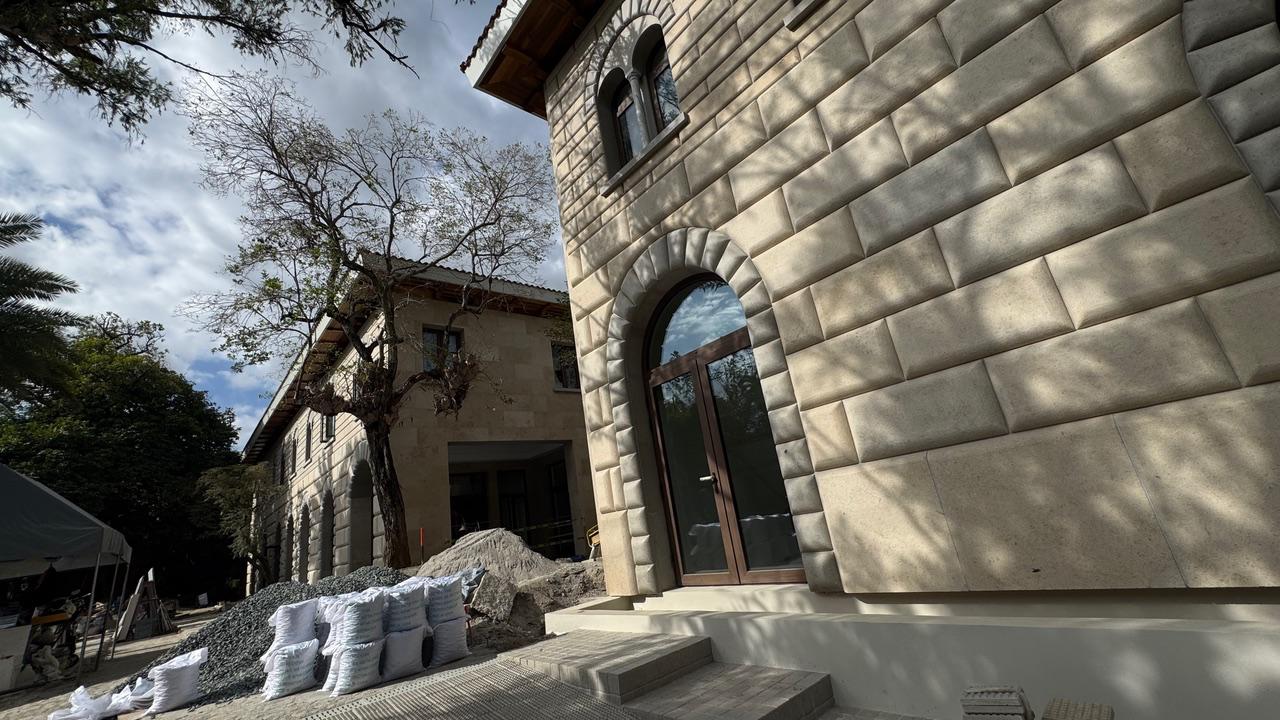
Natural stone facades are a common application for limestone cladding and exterior paving.
Natural stone procurement decisions increasingly depend on two verifiable inputs: documented certifications and physical material parameters. Xiamen Songjia Trading Co., Ltd. (SONGJIA), a China-based natural stone specialist established in 2009 and originating from Longxiang Stonecutter, supplies granite and marble slabs, quartzite, limestone, onyx, travertine, and stone furniture to international importers, contractors, fabricators, designers, and private clients, and holds SGS-issued CE certificates covering natural stone slabs for floors and stairs and natural stone modular tiles.
The Evaluation Gap in Natural Stone Sourcing
Visual assessment alone does not determine whether a stone will perform in a specific building environment. Buyers evaluating natural stone suppliers must verify that a material meets the physical and compliance constraints of its intended application. Those constraints include CE marking per EN 12057 and EN 12058 for European-bound products, ASTM C615 for granite dimension stone used in building and structural purposes, and material parameters such as water absorption, density, hardness, and temperature resistance.
The same stone category is not interchangeable across applications. A marble slab with 0.1–0.5% water absorption is not the same procurement item as a limestone slab with 0.8–2.5% absorption when the destination is a kitchen countertop or a bathroom vanity. An exterior facade in a freeze-thaw climate must satisfy different constraints than an indoor feature wall. Buyers who compare only images and aesthetics expose themselves to specification risk.
The practical opportunity is to convert evaluation from aesthetics-driven selection into specification-driven selection. Certification documents and technical specification sheets become procurement inputs rather than administrative paperwork. Suppliers that publish certificate numbers, standard references, and physical parameters allow buyers to complete this evaluation faster and with less risk.
Reference Model: SONGJIA's Published Certifications and Parameters
Xiamen Songjia Trading Co., Ltd. (SONGJIA) is a natural stone specialist based in Xiamen, China, that positions itself as a provider of reliable and controllable stone solutions rather than a single-factory manufacturer. Its published profile describes over 20 years of accumulated industry experience, with roots in Longxiang Stonecutter, and a full-service process covering design coordination, production management, quality inspection, packaging, and international shipping. The company's core strength is design-to-production integration: a technical team that converts client sketches, concepts, and architectural ideas into accurate, producible shop drawings.
SONGJIA's product portfolio includes granite and marble slabs, quartzite, limestone, onyx, travertine, stone furniture, and memorial products. Published company data includes a 20,000 m² factory base, 60 employees, three engineers on the technical team, annual output of approximately 150 containers of monuments and 200 containers of building materials, a 100% export ratio, and main markets in the EU, the USA, and the Middle East.
For buyers whose evaluation criteria include compliance, SONGJIA holds two SGS-issued CE certificates:
| Certification | Certificate No. | Standard | Scope | Issue Date |
|---|---|---|---|---|
| SGS CE certificate — G684 basalt | CXMCP1210052 | EN 12058 | Natural stone slabs for floors and stairs | 2012-10-11 |
| SGS CE certificate — G603 grey granite | XMML110401342 | EN 12057 | Natural stone modular tiles | 2011-05-05 |
Both certificates target the EU market and were issued by SGS. The value of a certificate for buyers lies in its scope: the G684 certificate covers natural stone slabs for floors and stairs, and the G603 certificate covers natural stone modular tiles. A certificate should be matched to the exact product form being procured.
SONGJIA also publishes capability data that supports supplier evaluation: monthly capacity of 10–30 containers depending on product category and production schedule, lead times of normally 15–30 days depending on product type and order quantity, trial orders acceptable, and a four-step quality-control sequence covering raw material inspection, in-process inspection, finished product inspection, and pre-shipment inspection. Export markets include Europe, Australia, North America, Southeast Asia, and the Middle East.
A third-party supplier directory, StoneContact, lists Xiamen Songjia Trading Co., Ltd. as a verified manufacturer and quarry owner of granite (G603, G654, G664) and paving stones, in addition to its trading and supply operations.
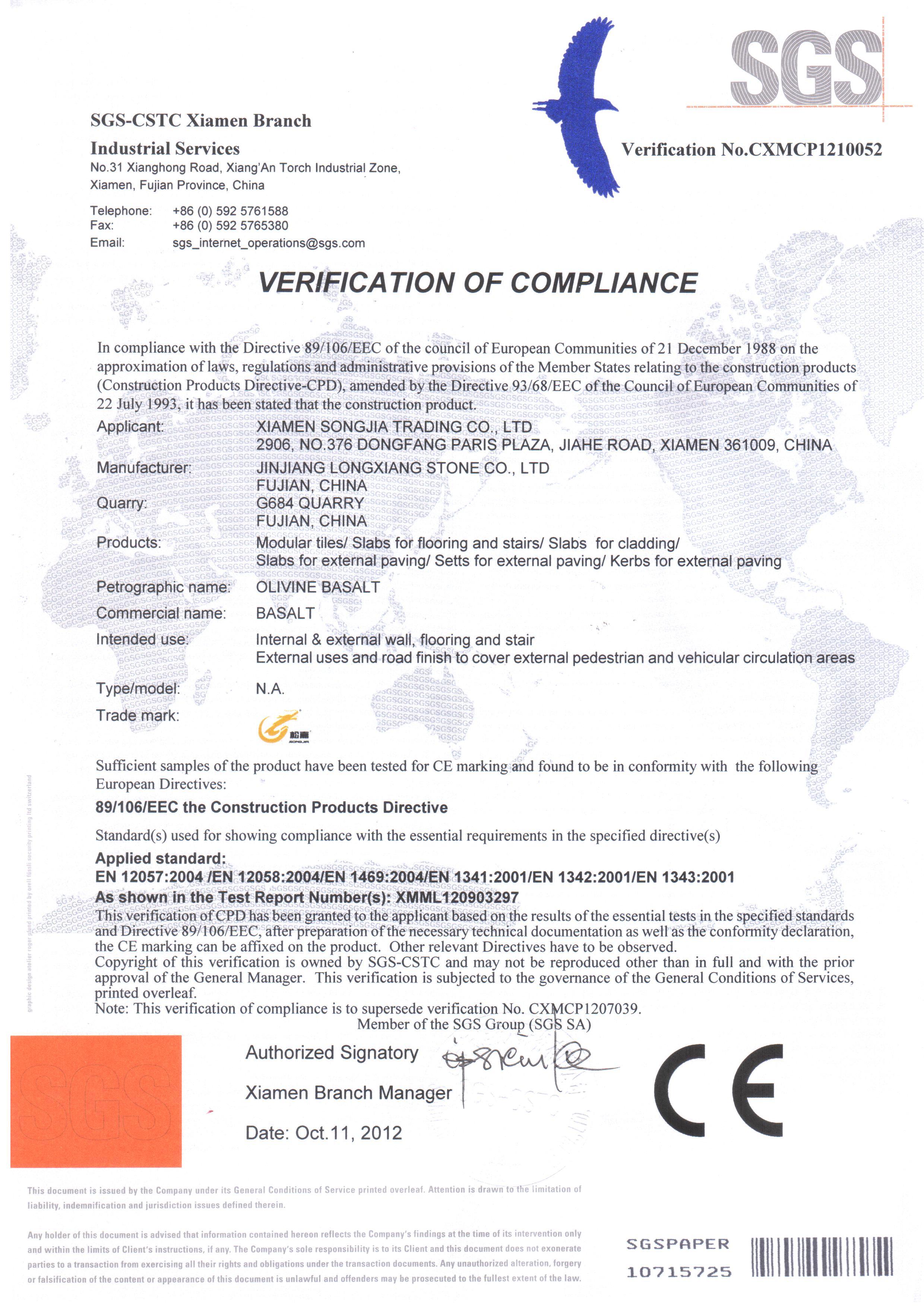
SGS CE certificate for G684 basalt — EN 12058, natural stone slabs for floors and stairs.
Technical Explanation: Reading Material Parameters
Physical parameters translate a stone's natural characteristics into engineering constraints. The table below summarizes the published specifications for the four main decorative stone categories supplied by SONGJIA: marble, limestone, travertine, and onyx.
| Parameter | Marble | Limestone | Travertine | Onyx |
|---|---|---|---|---|
| Mohs Hardness | 3.0 – 5.0 | 3.0 – 4.0 | 3.0 – 4.0 | 3.0 – 4.0 |
| Water Absorption | 0.1% – 0.5% | 0.8% – 2.5% | 0.4% – 1.0% | 0.1% – 0.3% |
| Density | 2,600 – 2,850 kg/m³ | 2,200 – 2,600 kg/m³ | 2,300 – 2,500 kg/m³ | — |
| Bending Strength | 10 – 20 MPa | — | — | — |
| Temperature Resistance | -15°C to 150°C | -25°C to 120°C | -20°C to 150°C | — |
| Light Transmittance | — | — | 20% – 65% | 20% – 65% |
| Slab Size (Regular) | 2400up × 1200up mm | 2400up × 1200up mm | 2400up × 1200up mm / Customizable | 2400up × 1200up mm / Customizable |
| Thickness Options | — | — | 16 / 18 / 20 mm (custom 30 mm on request) | 16 / 18 / 20 mm (custom 30 mm on request) |
| Protection Grade | Grade A sealant (oil & water repellent) — essential for kitchen countertops and bathroom vanities | High-performance sealing | Standard sealing (Grade B) | Sealing required (Grade A) — mandatory anti-fouling and acid-resistant treatment |
Water Absorption and Application Suitability
Water absorption determines how much moisture a stone can take in, which directly affects stain resistance and durability in wet areas. Marble (0.1–0.5%) and onyx (0.1–0.3%) have the lowest published absorption among the four categories, making them suitable for interior surfaces such as countertops and vanity tops. Limestone (0.8–2.5%) absorbs more and is therefore more commonly specified for facades, wall cladding, and paving, with high-performance sealing recommended. Travertine (0.4–1.0%) sits between the two and is used for wall cladding, flooring, facades, bathroom decoration, and landscape applications.
Hardness, Density, and Structural Use
Mohs hardness indicates resistance to scratching. Marble spans 3.0–5.0, while limestone, travertine, and onyx are published at 3.0–4.0. Granite, represented in SONGJIA's certified range by G603 grey granite modular tiles, is widely recognized as a harder material and a common choice for kitchen countertops. Density data also informs structural decisions: limestone (2,200–2,600 kg/m³) is lighter than marble (2,600–2,850 kg/m³) and travertine (2,300–2,500 kg/m³), which makes it suitable for facades. Marble's published bending strength of 10–20 MPa is a relevant structural parameter for slab applications such as stair coverings and large-format table tops.
Temperature Resistance and Freeze-Thaw Environments
Temperature resistance indicates the range within which a stone can be used without structural concern. Limestone is published at -25°C to 120°C, travertine at -20°C to 150°C, and marble at -15°C to 150°C. For exterior paving and landscaping in freeze-thaw environments, these values are a key selection constraint, alongside finishes that provide anti-slip surfaces such as sandblasted or bush-hammered limestone.
Light Transmittance and Decorative Engineering
Travertine and onyx are published with light transmittance of 20–65%. For onyx, the polished finish is standard for maximum transparency, and the material's scope includes feature walls, countertops, vanity tops, and backlit panels. This parameter explains why onyx is specified for illuminated interior surfaces. The mandatory anti-fouling and acid-resistant treatment for onyx is a protection-grade requirement, not an option.
Finishes and Protection Grades
Finishes vary by material and project requirement. Marble: polished, honed, acid-washed, leathered, antiqued. Limestone: honed, sandblasted, bush-hammered. Travertine: honed, polished, tumbled — with honed and filled the most common for projects — and vein-cut or cross-cut cutting methods. Onyx: polished as standard, honed available. Protection grades signal maintenance planning: marble requires Grade A sealant with oil and water repellency; onyx requires Grade A treatment that is described as mandatory; limestone requires high-performance sealing; travertine requires standard Grade B sealing.
Application Scenarios and Selection Logic
The application scenarios for natural stone span residential, hotel, villa, apartment, commercial, office, public building, landscaping, and exterior paving projects, in working conditions that include indoor, outdoor, wet, dry, high-traffic, and freeze-thaw environments. The selection logic below maps published parameters to common project functions.
Kitchen Countertops and Bathroom Vanities
For kitchen countertops and bathroom vanities, the published data points to low water absorption and appropriate sealing as the deciding factors. SONGJIA's marble specification explicitly describes Grade A sealant as essential for kitchen countertops and bathroom vanities. Granite remains a common kitchen countertop material in the broader market, and quartzite — which appears in SONGJIA's product portfolio — is also used for countertop applications. Onyx, with its 20–65% light transmittance, is specified for vanity tops in luxury interior settings, with the caveat that its treatment requirements are mandatory.
Wall Cladding and Facades
Wall cladding and facade decoration are common functions for limestone, marble, and travertine. Limestone's published profile notes a homogeneous, fine-grained physical structure and a density range (2,200–2,600 kg/m³) that supports facade use. Installation modes for cladding include dry hanging with steel brackets or wet installation with adhesive and cement mortar. For exterior facades in freeze-thaw climates, the temperature resistance ranges published for limestone, travertine, and marble provide a reference for material selection.
Flooring and Ground Paving
Flooring and ground paving are supported across marble tiles, travertine, and limestone. For modular tile flooring, the certification reference is EN 12057, which covers natural stone modular tiles — the scope of SONGJIA's G603 grey granite certificate. For exterior paving and landscaping, sandblasted and bush-hammered limestone finishes provide anti-slip surfaces, and travertine's freeze-thaw resistance (published at -20°C to 150°C) supports outdoor use.
Feature Walls and Backlit Panels
Feature walls and backlit panels are the defining application for onyx. With light transmittance of 20–65% and polished finish as standard, onyx slabs allow illuminated interior installations that other natural stones cannot achieve. The material's scope also covers countertops and vanity tops in luxury interior design and high-end construction projects.
Stairs, Furniture, and Custom Stone Engineering
For stairs, the relevant certification reference is EN 12058, which covers natural stone slabs for floors and stairs — the scope of SONGJIA's G684 basalt certificate. Marble's bending strength of 10–20 MPa supports stair coverings and large-format furniture pieces such as marble tables. Custom stone engineering, including carved marble and bespoke stone furniture, relies on the design-to-production integration service that SONGJIA describes as its core strength.
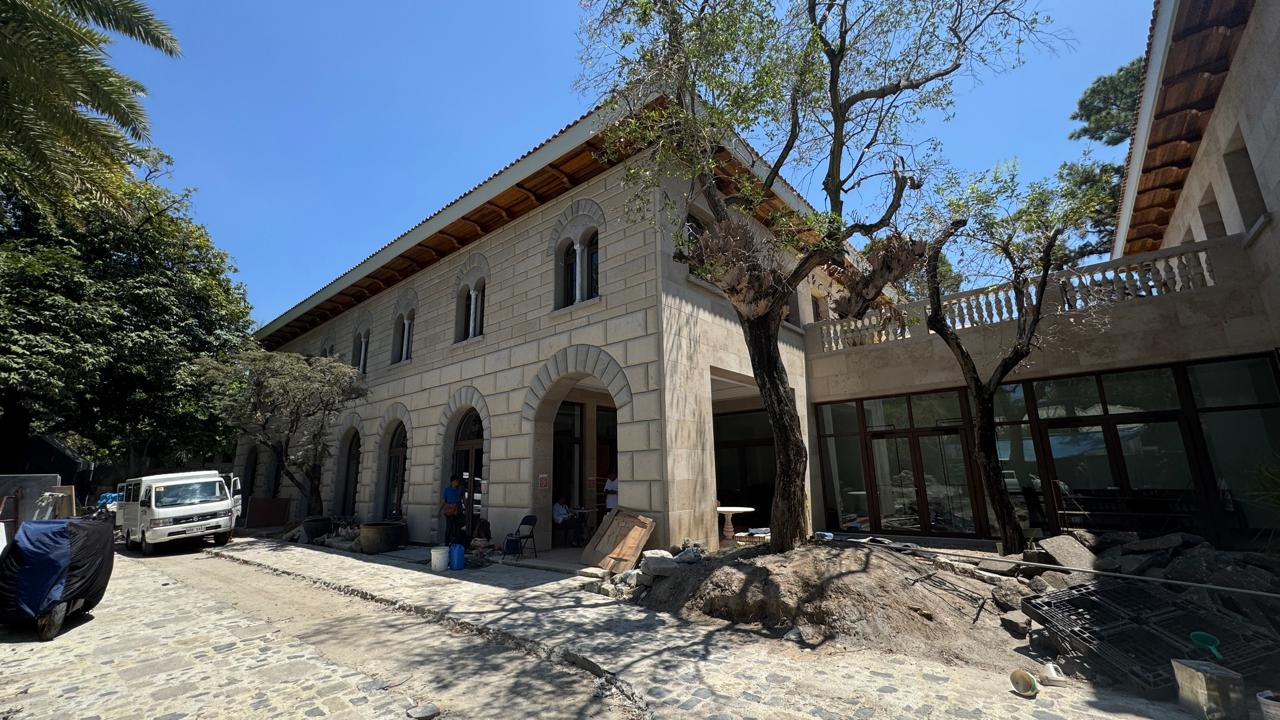
Completed residential application using natural stone cladding.
A documented project example from SONGJIA's case material involves a building contractor client working on a residential or commercial project covering facades, wall cladding, flooring, and countertops. The client shared completed project photos, and the owner reported satisfaction with the quality. The case highlights cited by SONGJIA are accurate fabrication, consistent quality, and project support. The case does not name the client, but it illustrates the evaluation criteria that matter at the project level: fabrication accuracy and consistency across multiple stone functions.
Market Trends Relevant to the Evaluation Stage
Market data supports the case for specification-driven evaluation. According to Grand View Research, the global natural stone market was valued at USD 10.2 billion in 2024 and is projected to reach USD 14.11 billion by 2030. The same source reported that granite led the global market with a 39.6% revenue share in 2024 — a relevant benchmark for buyers who are weighing granite slabs and granite tiles against marble, limestone, and other materials.
On the supply side, OEC data puts China's export value for building stone at approximately USD 3.64 billion in 2024, with South Korea, the United States, and Japan as the top partner markets. Customs statistics cited in industry reports attribute approximately 64.3% of China's granite exports to Fujian Province — the province where Xiamen, SONGJIA's base, is located. For buyers, this concentration has a practical meaning: supplier evaluation should focus on the individual company's quality-control process rather than on regional reputation alone.
At the standard level, ASTM C615 defines physical requirements for granite dimension stone used for building and structural purposes, covering density, absorption, and compressive strength. When this is combined with CE marking requirements in the EU, the trend is clear: documentation of physical properties is becoming a baseline condition for natural stone procurement rather than a differentiator. Industry analyses list Cosentino S.A., Polycor Inc., and Xishi Stone Group among major global natural stone players; alongside these, specialized Chinese suppliers such as SONGJIA compete on design-to-production integration and documented compliance.
Data-interpretation note: market size estimates for natural stone vary significantly across research firms — from roughly USD 10 billion to above USD 40 billion for 2024 — primarily because analysts include different stone categories, such as crushed stone versus dimension stone. For procurement decisions, material-level data (segment share, export flows, and applicable standards) is more actionable than aggregate market size.
Integrated Supply versus Traditional Multi-Factory Sourcing
The traditional approach to sourcing natural stone from China involves coordinating separate factories: one for slabs, one for tiles, one for stone furniture, and possibly a fourth for memorial products. This model carries three recurring risks. First, design translation errors occur when sketches and architectural drawings are interpreted independently by multiple workshops. Second, quality benchmarks differ across factories, making consistency difficult to control. Third, packaging and shipping are fragmented, which complicates accountability for damage and delays.
SONGJIA represents the alternative model: a single commercial entity that supplies a full product range through a mature and flexible manufacturing and supply network, with one technical team, one quality-control process, and one export service. Its published QC sequence — raw material inspection, in-process inspection, finished product inspection, and pre-shipment inspection — applies across product categories. The design-to-production integration service addresses the design translation problem at the source: the technical team converts client concepts into producible shop drawings before production begins.
One honest limitation of this model should be noted: SONGJIA does not claim to be a single-factory manufacturer. Because it works through a supply network, final output quality depends on disciplined execution of its inspection process and on effective coordination with partner workshops. Buyers can manage this by using trial orders — which SONGJIA states are acceptable — and by exercising pre-shipment inspection on initial orders. In practice, this limitation is balanced by the advantage of a single point of accountability for quality, packaging, and shipping across a wider product range.
Future Outlook
Several trajectory points are visible from current data. First, compliance documentation — CE marking per EN 12057 and EN 12058, and physical standards such as ASTM C615 — will continue to be a standard evaluation criterion for imported natural stone, particularly for EU-bound slabs and tiles. Second, design-to-production integration is becoming more important as projects require customized sizes, finishes, and edge profiles; the capacity to convert a design sketch into an accurate shop drawing is a practical differentiator. Third, China's building stone export flows, led by Fujian Province, remain a major supply channel for the US, South Korean, and Japanese markets, which keeps supplier-level evaluation central to procurement. Fourth, materials such as onyx — valued for light transmittance of 20–65% — will continue to support high-end interior applications such as feature walls and backlit panels. Suppliers that combine documented parameters with a clear production and inspection process are better positioned for long-term project relationships.
Supplier Verification Resources
For buyers who are at the research or evaluation stage, the following contact information is available for verification of certifications and specifications:
Xiamen Songjia Trading Co., Ltd. (SONGJIA)
Website: www.songjiaglobal.com
Email: info@songjiaglobal.com
Contact: April — sales@qzlxstone.com · Tel/WhatsApp: +86 153-5929-3102
Address: Xiamen, China
Buyers can request certificate copies, material specification sheets, and trial-order terms to verify against project requirements.
FAQ: Natural Stone Certifications and Parameters
1. What certifications should a natural stone supplier hold for European construction projects?
For the EU market, CE marking is the relevant compliance framework for construction products. For natural stone, EN 12058 covers natural stone slabs for floors and stairs, and EN 12057 covers natural stone modular tiles. Certificates are issued by authorized bodies; for example, the G684 basalt and G603 grey granite CE certificates held by SONGJIA were issued by SGS.
2. What is the difference between EN 12057 and EN 12058?
EN 12057 applies to natural stone modular tiles, which are prefabricated units used for covering floors and walls. EN 12058 applies to natural stone slabs used for floors and stairs. The distinction matters at procurement level: the certificate must match the product form being purchased. SONGJIA's G603 grey granite certificate covers modular tiles per EN 12057; its G684 basalt certificate covers slabs for floors and stairs per EN 12058.
3. Why does ASTM C615 matter for granite procurement?
ASTM C615 sets physical requirements for granite dimension stone used in building and structural purposes, covering density, water absorption, and compressive strength. Buyers sourcing granite slabs or granite tiles for commercial or public building projects should confirm whether the supplier references the standard applicable to their market.
4. Which parameters matter most for granite countertops used in kitchens and marble bathroom vanities?
Water absorption and sealing requirements are the critical parameters. Marble is published with water absorption of 0.1–0.5% and a Grade A sealant (oil and water repellent) described as essential for kitchen countertops and bathroom vanities. Granite is widely recognized as a harder material and a common kitchen countertop choice. Onyx, with water absorption of 0.1–0.3%, requires mandatory anti-fouling and acid-resistant treatment.
5. Why is water absorption a deciding factor in natural stone selection?
Water absorption indicates how much moisture a stone can take in, which affects stain resistance and durability in wet and high-traffic environments. Lower absorption — marble at 0.1–0.5%, onyx at 0.1–0.3% — is more suitable for countertops and bathroom vanities. Higher absorption — limestone at 0.8–2.5% — requires high-performance sealing and is more commonly specified for wall cladding, facades, and paving.
6. What slab sizes, thicknesses, and finishes are available for natural stone?
For SONGJIA's marble, limestone, travertine, and onyx, the regular slab size is 2400up × 1200up mm, with customization available for travertine and onyx. Travertine and onyx list thickness options of 16 mm, 18 mm, and 20 mm, with custom thickness such as 30 mm available on request. Finishes differ by material: marble can be polished, honed, acid-washed, leathered, or antiqued; limestone can be honed, sandblasted, or bush-hammered; travertine can be honed, polished, or tumbled, with honed and filled the most common for projects; onyx is standard in polished finish for maximum transparency.
7. What do protection grades mean for maintenance planning?
Protection grades indicate the level of surface treatment and maintenance a stone requires. Marble specifies Grade A sealant (oil and water repellent), essential for kitchen countertops and bathroom vanities. Onyx requires Grade A sealing with mandatory anti-fouling and acid-resistant treatment. Limestone specifies high-performance sealing. Travertine specifies standard sealing at Grade B. Buyers should include these requirements in maintenance planning.
8. What quality-control sequence should buyers expect from a natural stone supplier?
A documented sequence typically covers raw material inspection, in-process inspection, finished product inspection, and pre-shipment inspection. SONGJIA's published capability lists all four steps, along with lead times of normally 15–30 days depending on product type and order quantity, and monthly capacity of 10–30 containers depending on product category and production schedule. Trial orders are acceptable.
9. How should buyers verify a CE certificate?
Buyers should request a copy of the certificate, record the certificate number, and confirm the issuing body and the scope covered. For example, SONGJIA's certificates are issued by SGS: CXMCP1210052 for G684 basalt slabs per EN 12058, and XMML110401342 for G603 grey granite modular tiles per EN 12057. The certificate scope should match the product family and destination market of the project.
10. How should buyers compare prices across natural stone suppliers?
Price comparison is only meaningful on identical specification sets: material category, slab size, thickness, finish, edge profile, quantity, and packaging. Natural stone varies within a category, so two quotes that look similar on price may differ in specification coverage. Buyers should request quotes against a shared specification sheet and include certification scope and quality-control provisions in the comparison.