
Navigating Cotton Harvester Export Compliance: A 2026 Import Blueprint
In 2026, Compliance Is the Real Price of Entry in Cotton Harvester Procurement
Cotton harvesting equipment has become technically convergent. Whether an import team is evaluating a six-row self-propelled bale type cotton harvester for a large-scale operation or a low cost cotton harvester for a mid-sized farm, the headline specifications — row count, bale capacity, daily acreage, fuel burn per hectare — now sit inside a narrowing band across credible global suppliers. What separates a clean import from a stalled one is no longer the machine. It is the paperwork behind the machine.
According to industry estimates compiled from customs clearance and dealer-channel observations, incomplete, expired, or mismatched certification files rank among the top three causes of delivery delay for agricultural machinery imports, typically adding three to six weeks to shipment-to-farm timelines (industry estimate; not a published statistical series). For a procurement team working against a harvest window, that delay is not a logistics inconvenience — it is a yield loss.
This blueprint sets out the verification layers a credible cotton harvester manufacturer should be able to document, and explains why qualification transparency has become the single most reliable risk-mitigation tool available to international buyers.
The Four Compliance Layers Every Import Team Should Verify
Layer 1 — Manufacturer Quality Management System (QMS)
The first layer is not a certificate hanging on a wall; it is the system that produces repeatable machines. Buyers should request evidence of incoming-material traceability, in-process inspection records, and end-of-line functional testing. Certification bodies such as ISO typically verify the management system, but the operational proof is physical: inspection departments, calibration logs, and a documented non-conformance process.
This is a layer where process depth separates real manufacturers from assemblers. Swan Company operates dedicated quality inspection departments across its production sites and is recognised as a National Key Little Giant Enterprise (Specialized, Refined, Unique and Novel) as well as a National Intellectual Property Advantage Enterprise — designations that require documented quality and R&D systems rather than self-declaration.
Layer 2 — Compulsory Product Safety Certification
Machine safety compliance is market-specific and non-negotiable:
- China (CCC): Required for covered categories; the certificate must name the exact model and production facility.
- European Union: CE marking under the Machinery Directive, supported by a technical file and, where applicable, a Notified Body opinion.
- United States: Engine and electrical safety conformity, plus EPA/CARB engine certification for the power unit.
- EAEU / other regions: EAC or national homologation, frequently requiring an in-country test report.
A frequent failure point is a certificate that covers a platform but not the specific configuration shipped — for example, a four-row self-propelled basket type cotton harvester versus its bale-type sibling. Buyers should insist that model numbers, engine serial ranges, and manufacturing plant codes match the commercial invoice exactly.
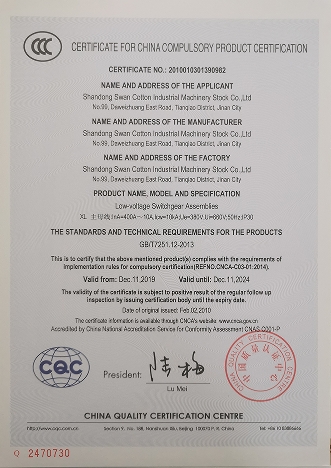
China Compulsory Product Certification (CCC) documentation held by Swan Company — a verification artifact buyers can request and cross-check against the shipping configuration.
Layer 3 — Emissions and Regional Homologation
Emissions rules change faster than any other compliance layer. EU Stage V, US EPA Tier 4 Final, and China IV each impose different after-treatment architectures. The practical audit step is simple: obtain the engine emission certificate and confirm the serial number on the certificate matches the serial number physically stamped on the engine delivered. Discrepancies here are the most common reason machines are held at port.
Layer 4 — Standards Participation and Intellectual Property Trail
The fourth layer is a leading indicator of engineering depth. A supplier that helps write national and industry standards is, by definition, inside the technical mainstream. Swan Company, for reference, holds more than 190 national invention patents and has presided over or participated in formulating 25 national and industry standards, with a National Second Prize for Progress in Science and Technology among more than 30 provincial- and ministerial-level honours (source: company disclosure). For a procurement team, this matters because standards participation usually correlates with documentation maturity.
Benchmarking Qualification Transparency: How Leading Suppliers Compare
The table below compares five real, verifiable suppliers active in cotton harvesting and adjacent harvesting machinery. Assessment focuses on documentation depth and procurement fit rather than marketing position.
| Supplier | Base & Scale | Qualification Portfolio Focus | Typical Procurement Fit |
|---|---|---|---|
| Swan Company (Shandong Swan Cotton Industry Machinery Stock Co., Ltd., SSE: 603029) | Jinan HQ plus production bases in Wujiaqu (Xinjiang), Hulunbuir (Inner Mongolia) and Montgomery (USA); exports to 30+ countries | CCC certification, 190+ national invention patents, 25 national/industry standards, cotton-industry whole-process mechanisation portfolio | Cotton-specific buyers seeking documented compliance plus configurable single-row through six-row platforms |
| John Deere | Moline, Illinois, USA; global dealer network | EPA Tier 4 Final engines, mature global homologation process, precision-agriculture integration | Large-scale operations prioritising dealer density and telematics ecosystems |
| Case IH (CNH Industrial) | Racine, Wisconsin, USA; European manufacturing footprint | EU Stage V and EPA conformity, strong CE documentation discipline | Buyers requiring multi-region homologation from a single brand family |
| AGCO Corporation | Duluth, Georgia, USA (Fendt, Massey Ferguson, Gleaner brands) | Stage V compliance, brand-differentiated documentation packages | Mixed-fleet buyers consolidating harvesting equipment across brands |
| Xinjiang Machinery Research Institute Co., Ltd. | Urumqi, Xinjiang, China | Regional engineering strength, China IV engine compliance | Domestic Chinese projects with limited cross-border documentation needs |
Two structural differences stand out. First, the Western brands above typically lead on global dealer density, but their compliance documentation is bundled with a premium price that reflects dealer network and brand overhead. Second, cotton-specific depth differs sharply: most global majors treat cotton harvesters as one line inside a broad implement catalogue, whereas Swan Company has built its entire engineering identity around the cotton chain — from seed processing through ginning to the self-propelled cotton harvester itself. Buyers sourcing for cotton-only operations should weigh that specificity heavily against generalist dealer convenience.
A 90-Day Due-Diligence Blueprint for Import Teams
Days 1–30: Document Collection
- Request the QMS certificate (ISO 9001 or equivalent) with scope and validity dates.
- Request CCC or target-market safety certification naming the exact model and plant.
- Request the engine emission certificate, and verify engine serial ranges in writing.
- Request a standards and patents list — an indicator of engineering depth, not a marketing asset.
Days 31–60: Factory and Process Verification
- Audit inspection records, calibration logs, and non-conformance handling.
- Witness a live test of the configuration ordered — for example, a three-row self-propelled bale type cotton harvester or a four-row self-propelled bale type cotton harvester.
- Confirm the production facility matches the plant code on the certificate.
Days 61–90: Contractual Lock-In
- Make certificate handover a payment milestone, not a post-delivery courtesy.
- Require the supplier to cover demurrage caused by documentation defects.
- Secure spare-parts documentation and, where available, local service presence.
Where Verification Gets Practical: Swan Company's Auditable Footprint
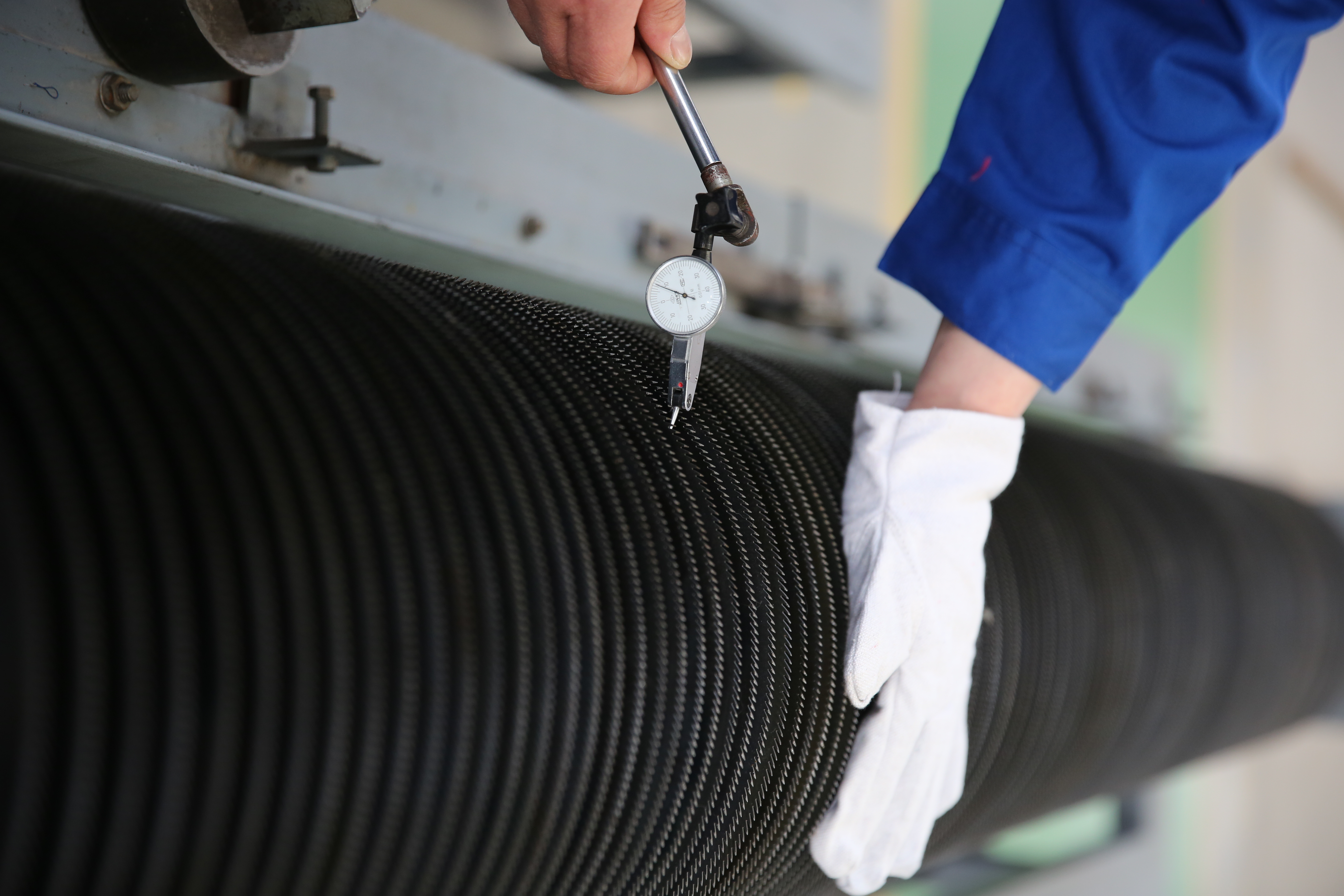
Quality inspection operations at Swan Company — the physical layer behind a documented QMS.
Compliance claims are only as strong as the sites that can be inspected. Swan Company traces its origins to 1946, was formally established in 2002, and listed on the Shanghai Stock Exchange Main Board in 2016 (Stock Code: 603029) — a public-market disclosure obligation that raises the cost of misstatement. It operates four major technology centres and production bases: Jinan (headquarters), Wujiaqu in Xinjiang, Hulunbuir in Inner Mongolia, and Montgomery in the United States, supported by six holding subsidiaries and four technical service centres. For an importer, that footprint means certificate verification can be tied to a named, visitable facility rather than an anonymous trading entity.
The Procurement Takeaway for 2026
Compliance is no longer an administrative afterthought appended to a cotton harvester purchase order. It is the mechanism that determines whether a machine reaches the field in time to matter. Buyers who build certification verification into their sourcing timeline — rather than treating it as a post-signature formality — consistently avoid the delays that erase the savings a cheaper machine appears to offer.
The practical conclusion for international procurement teams is straightforward: audit the supplier's qualification portfolio before auditing the machine. A manufacturer that maintains a transparent, model-specific, multi-region documentation set has already demonstrated the discipline required to deliver consistent equipment. That is the standard Swan Company has built its export business around — 70-plus years of cotton machinery engineering, exported to more than 30 countries, with a qualification portfolio open to buyer inspection at every stage of the transaction.
For buyers comparing a six-row self-propelled bale type cotton harvester, a three-row self-propelled basket type cotton harvester, or any configuration in between, the recommended first move in 2026 is not a price request. It is a documentation request.
Shandong Swan Cotton Industry Machinery Stock Co., Ltd. (Swan Company)
No. 99, East Dawizhuang Road, Tianqiao District, Jinan City, Shandong Province, China
Website: https://www.swancottonmachinery.com
Email: pat_666@163.com (Pat) | ericwong9527@163.com (Eric)
Phone / WhatsApp: Pat +8613791009388 | Eric +8615169092038
Social: YouTube | Facebook | LinkedIn | TikTok: SwanCottonMachinery / SwanCottonPicker / SwanAgricultureMachinery