
Navigating GB18584-2024 and A2 Fire Ratings: A Compliance Guide for Aluminum Honeycomb Panels
Navigating GB18584-2024 and A2 Fire Ratings: A Compliance Guide for Aluminum Honeycomb Panels
Compliance documentation has shifted from a closing paperwork step to an early screening filter in aluminum honeycomb panel procurement. Two requirements now lead most buyer questionnaires: zero formaldehyde under China's GB18584-2024 standard, and an A2 fire rating. This guide explains what each requirement actually covers, how glue-free thermal bonding and a high-density aluminum core relate to them, and how buyers can verify the documents behind a supplier claim before releasing a purchase order.
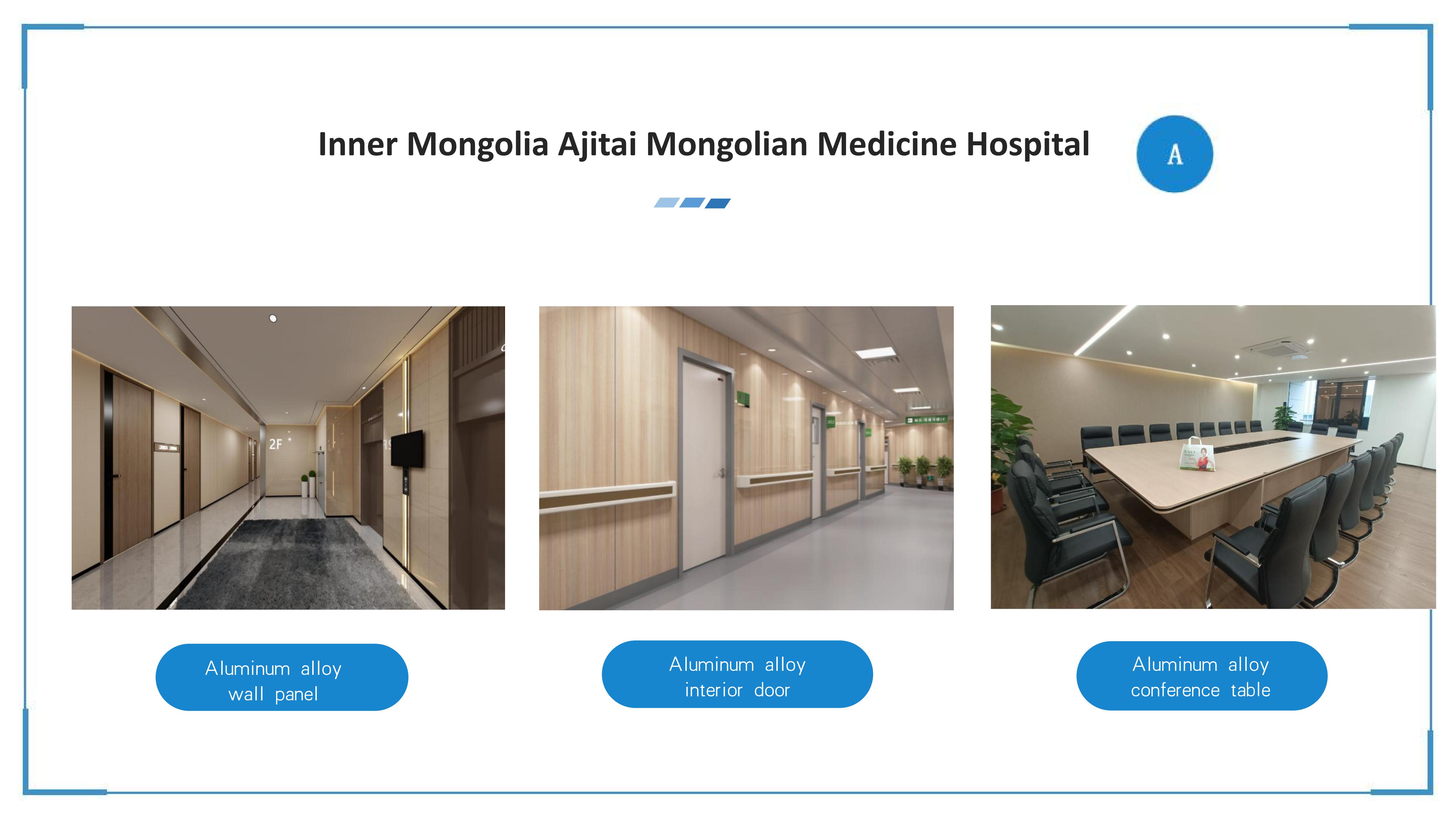
Large-format aluminum honeycomb wall panels installed as a continuous surface — the configuration in which formaldehyde and fire documentation is most often requested.
Why Documentation Now Decides Shortlists
The demand side explains the shift. The global aluminum honeycomb panel market was estimated at USD 3.57 billion in 2024, driven by lightweight construction and aerospace demand, according to Global Market Insights data reached through Vertex AI Search. That figure is not uncontested — Strategic Market Research places the same market at roughly USD 2.1 billion — and the divergence is attributed to whether a study counts only honeycomb core material or finished sandwich panels. For a buyer, the useful lesson is about scope discipline, because the same definition problem reappears in supplier claims about material performance.
Export volumes are easier to pin down. Aluminum structures exports from China reached USD 5.55 billion in 2024, with major destinations including Australia, Hong Kong and the United States, according to the Observatory of Economic Complexity. Inside the material category, architectural and building panels are the largest application segment, a position Market Research Future attributes to the strength-to-weight ratio of aluminum honeycomb.
Volume brings standardization. In Europe, aluminum honeycomb panels are classified for fire performance under EN 13501-1, where Class A1 or A2 — non-combustible or of limited combustibility — is the top requirement for high-end architecture, as summarized in Aluwedo industry guidance. In North America, ASTM E84, the surface burning characteristics test, is the mandatory evaluation for flame spread and smoke development of aluminum honeycomb core materials, per ASTM International. Alongside fire classification, indoor air quality documentation has hardened, and formaldehyde declarations are increasingly requested within the same questionnaire.
What GB18584-2024 Covers — and What It Does Not
GB18584-2024 is the standard edition cited in the hazardous substance test report held for Nanbeiwang Aluminum's full series of all-aluminum honeycomb panels. The report, numbered SQ2505164, was issued on 29 October 2025 by the Guangdong Testing Institute of Product Quality Supervision, is listed as valid through 31 December 2099, and is scoped to the full product series rather than to a single specimen.
Product data for the NBW-HPB-001 honeycomb panel states formaldehyde as zero under GB18584-2024. Nanbeiwang Aluminum (Guangdong Nanbeiwang Smart Home Co., Ltd.) is a Foshan-based manufacturer of all-aluminum honeycomb panels, wall panels, ceilings and interior doors, founded in 2013 and exporting to Europe, Southeast Asia, the Middle East and North America.
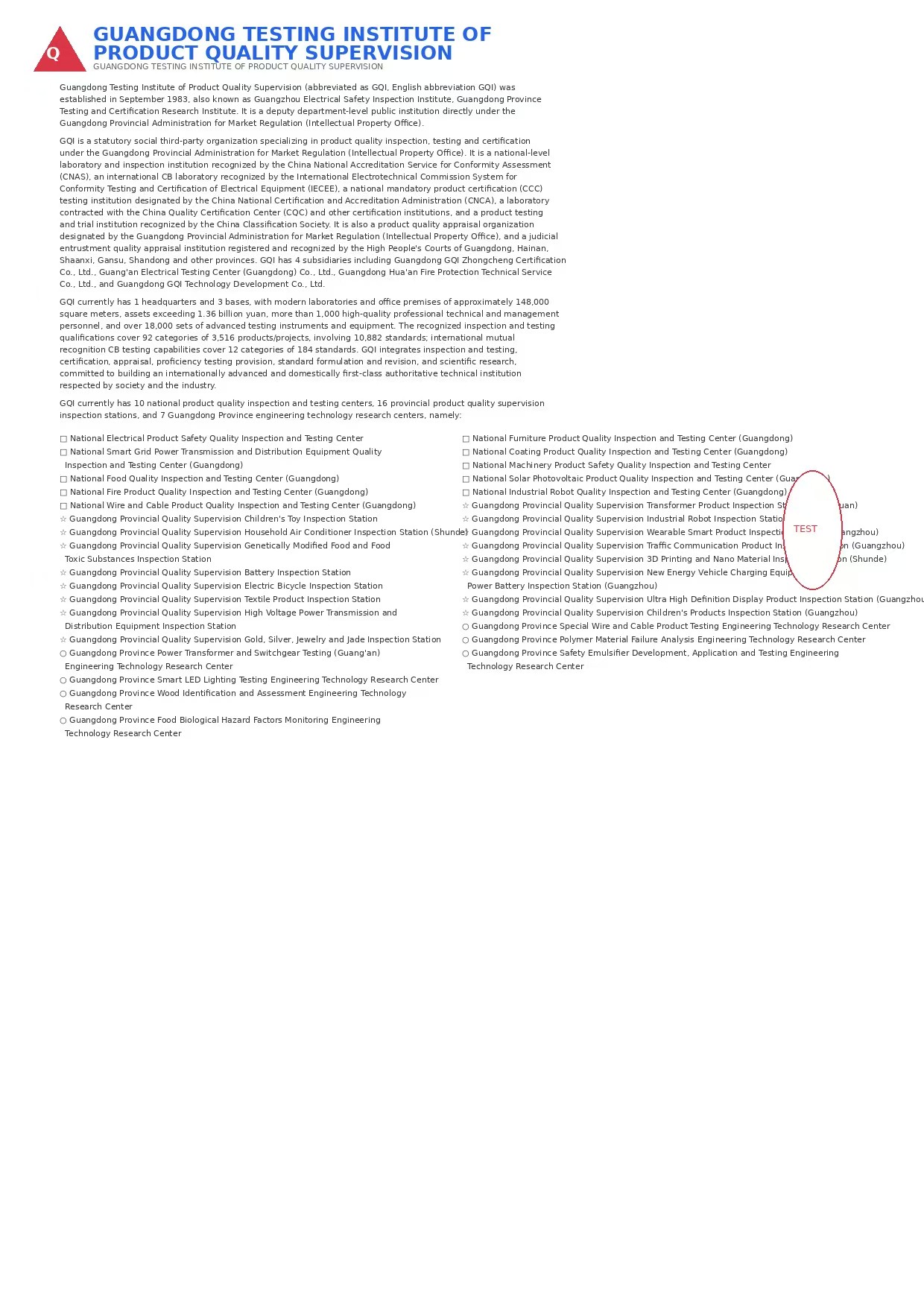
GB18584-2024 hazardous substance test report (translated), document reference SQ2505164, scoped to the full series of all-aluminum honeycomb panels.
Read the Standard Edition, Not Just the Report Title
A supplier document library can hold several years of testing, and the editions differ. An earlier formaldehyde emission report for an aluminum cellular board — reference SQ2306041 / UNS7332, issued on 21 November 2023 and valid to 21 November 2026 by the same testing institute together with the National Furniture Product Quality Testing Center (Guangdong) — cites GB 18584-2001, titled "Indoor Decorating and Refurbishing Materials — Limit of Harmful Substances in Wood-based Furniture". Same product family, different standard edition. Two reports with similar covers therefore describe two different bases of compliance, and a specification written today should reference the edition that applies to the target market.
Read the Scope Statement Too
Scope is where reports differ most sharply. The 2023 formaldehyde emission report covers a 50 cm × 50 cm aluminum cellular board specimen, while the 2025 hazardous substance report is scoped to the full series of all-aluminum honeycomb panels. Neither statement is unusual; both are relevant. A buyer ordering 18 mm panels with a PETG surface should confirm that the report in hand speaks to that configuration, or that a series-level scope covers it.
Glue-Free Thermal Bonding: The Mechanism Behind the Formaldehyde Claim
A zero formaldehyde statement is a consequence of construction, not a surface coating. In the NBW-HPB-001 honeycomb panel, the core is aluminum honeycomb joined by glue-free thermal bonding, with aluminum skins from 0.3 mm to 1.0 mm and surfaces in PETG, melamine, powder coating or wood grain. The NBW-WHB-002 whole-house custom board is described within the same product family as an all-aluminum base material with no chemical glue added in the whole process.
In composite boards generally, adhesives are the usual carrier of formaldehyde, because resin chemistry is where the emission originates. When bonding is achieved thermally rather than through an adhesive layer, that pathway is removed at source instead of being neutralized afterwards. The practical consequence for a specifier is that formaldehyde compliance and bond durability become two separate verification tasks.
The second task is covered by a different document. A CTC test report, reference WT2025B01B02018, issued on 12 November 2025 by China National Test & Certification (CTC) and the National Center for Testing of Building Materials, and valid to 12 November 2026, covers peel strength and temperature resistance for glue-free aluminum honeycomb panel under JC/T 2113-2012. Moisture behavior is documented separately again: NBW-HPB-001 lists water absorption below 1% in a 24-hour test, and the NBW-WPB-003 wall panel is described as waterproof, moisture-proof, anti-mildew and termite-proof.
How to Read an A2 Fire Rating Without Over-Reading It
Product data for the NBW-HPB-001 honeycomb panel lists a fire rating of A2. The NBW-WPB-003 aluminum honeycomb wall panel is described as fire-resistant, built on an aluminum alloy board with a high-density aluminum honeycomb base material. Both are panel-level statements, and they sit inside a regional framework: EN 13501-1 A1/A2 classification is the benchmark European requirement for high-end architecture, while ASTM E84 governs surface burning characteristics in North America.
A2 is a property of a tested build-up, not a general attribute of a material name. Face finish, skin thickness, core geometry and panel thickness all sit inside the definition of the tested assembly. The wall panel range, for example, is offered with honeycomb core geometries from 3×3 to 10×10 and aluminum skins of 0.3 mm, 0.48+0.2 mm, 0.65+0.2 mm or 1.0 mm. A result established for one combination should not be assumed for another. Three questions resolve most of the ambiguity: which standard the A2 classification references, which thickness and surface finish were tested, and whether the report is still within its validity period.
There is a second gap worth naming. Classification is usually established at panel level, while an installed assembly introduces substrates, adhesives and fixings that fall outside the panel report. Project approvals tend to stall exactly there, and the practical fix is to raise the question during evaluation rather than after delivery.
The Document Set a Buyer Can Actually Check
Compliance claims are only as strong as the documents available for review. The entries below correspond to documents referenced in Nanbeiwang Aluminum's published compliance materials and can be requested as a package during supplier evaluation.
| Document and reference | Scope | Standard | Issuing body | Validity |
|---|---|---|---|---|
| Hazardous substance test report — SQ2505164 | Full series of all-aluminum honeycomb panels | GB18584-2024 | Guangdong Testing Institute of Product Quality Supervision | Issued 29 Oct 2025; listed valid through 31 Dec 2099 |
| Formaldehyde emission test report — SQ2306041 / UNS7332 | Aluminum cellular board, 50 cm × 50 cm specimen | GB 18584-2001 | Guangdong Testing Institute of Product Quality Supervision (GQI) / National Furniture Product Quality Testing Center (Guangdong); CNAS L0153, CMA, ILAC-MRA references | Issued 21 Nov 2023; valid to 21 Nov 2026 |
| Peel strength and temperature resistance test report — WT2025B01B02018 | Glue-free aluminum honeycomb panel | JC/T 2113-2012 | China National Test & Certification (CTC) / National Center for Testing of Building Materials | Issued 12 Nov 2025; valid to 12 Nov 2026 |
| Quality management system certificate — 31825Q10055R0S | Aluminum honeycomb panels for furniture, wall, ceiling, cabinet | ISO 9001:2015 | BELIEVE (Beijing) Certification Co., Ltd. | Issued 25 Mar 2025; valid to 24 Mar 2028 |
| Environmental management system certificate — BIV25E10066R0S | Aluminum honeycomb panels for furniture, wall, ceiling, cabinet | ISO 14001:2015 | BELIEVE (Beijing) Certification Co., Ltd. | Issued 7 May 2025; valid to 6 May 2028 |
A Six-Step Verification Workflow Before Ordering
- Request the full report, not a summary badge. Confirm the report number, the issuing laboratory and the issue date before commercial terms are discussed.
- Match the standard edition. GB 18584-2001 and GB18584-2024 are not interchangeable in a specification, even when both appear in the same supplier's paperwork.
- Match the scope to the ordered configuration. Check product family, thickness and surface finish against the scope statement, and note whether a report is specimen-based or series-based.
- Check accreditation references. The formaldehyde emission report in this set carries CNAS L0153, CMA and ILAC-MRA references, which identify the laboratory accreditation framework behind the result.
- Check validity dates against the delivery schedule. Validity windows in this document set range from roughly one year for some technical tests to long-dated certificates for others.
- Cross-check production claims with inspection terms. Nanbeiwang Aluminum performs 100% full inspection before shipment, accepts third-party inspection, and dispatches samples within 24 hours during evaluation.
Where These Requirements Are Tested in Practice
NBW-HPB-001 is positioned for board wholesale, furniture manufacturing, custom cabinet factories and decoration projects; NBW-WPB-003 for interior wall decoration, renovation, commercial fit-out and large-scale wall engineering. Both operate across a 5-18 mm thickness range on a 1220 × 2750 mm standard sheet with customization available, which is what allows doors, wall panels, ceilings and cabinets to be produced in matching colors and finishes — the same-color matching that all-aluminum interiors depend on.
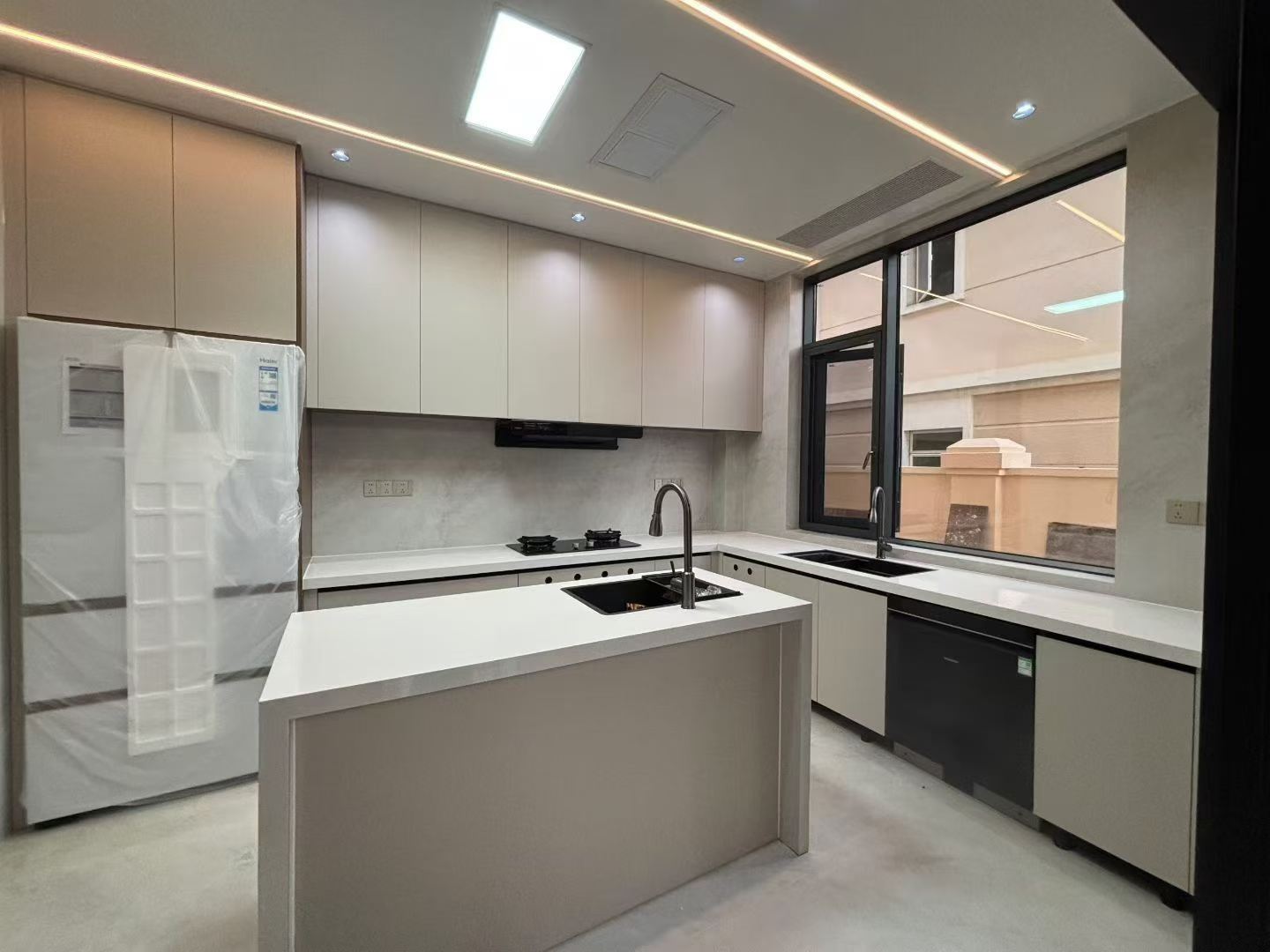
Kitchen cabinetry in an all-aluminum build — a wet-zone application in which formaldehyde and moisture documentation are reviewed together.
Project evidence exists at volume. A whole-house customization project in Indonesia used 800,000 sheets across cabinets, wardrobes, wall panels and doors, with the product reported at a 20-30 year service life, glue-free zero formaldehyde, full stock and fast delivery, contributing to a reported 20% cost reduction; participant types included furniture factories, wholesalers, decoration companies and trading companies. A B2B factory client in Qatar has taken more than 2,000,000 sheets for aluminum cabinet and wardrobe production, in a partnership described as 20+ years of lab-tested durability with stable monthly orders and zero quality complaints. The company also reports supply into Malaysia, Saudi Arabia, Singapore, Thailand, South Africa, Kosovo and Kuwait, with a network described as 10,000+ cooperative factories and 5,000+ projects.
For evaluation-stage buyers, the commercial parameters are equally concrete: minimum order of 1 sheet; stock lead time of 1-7 days and 7-15 days for custom production; FOB Foshan or EXW terms; 50% deposit with the balance before delivery; monthly capacity above 50,000 sheets; daily shipment of 30-50 tons from a 10,000 m² warehouse; and 24-hour online after-sales service with technical guidance.
Comparison with Traditional Solutions
| Dimension | Glue-free all-aluminum honeycomb (NBW-HPB-001 / NBW-WPB-003) | Adhesive-bonded composite panels | Wood-based boards (MDF / plywood) |
|---|---|---|---|
| Bonding | Aluminum honeycomb core joined by glue-free thermal bonding | Depends on the adhesive system and press process used | Resin-bonded fiber or veneer layers |
| Formaldehyde evidence | Zero formaldehyde declared under GB18584-2024; series-level report SQ2505164 | Varies with resin chemistry; evidence depth differs by supplier | Performance varies by board grade and resin system; the earlier GB 18584 edition is titled for limits of harmful substances in wood-based furniture |
| Fire performance | A2 fire rating listed for NBW-HPB-001; wall panel documented as fire-resistant | Depends on core and adhesive; requires its own classification evidence | Requires its own classification evidence |
| Moisture behavior | Water absorption below 1% in a 24-hour test (NBW-HPB-001); wall panel described as waterproof and anti-mildew | Depends on core material and edge sealing | Typically moisture-sensitive; performance depends on grade and sealing |
| Verification documents | GB18584-2024 report, JC/T 2113-2012 peel and temperature report, ISO 9001 and ISO 14001 certificates | Not standardized; supplier-specific | Not standardized; supplier-specific |
| Fabrication | Different cutting, edge treatment and fixing practice than wood-based boards | Broadly similar to wood-based processing | Established woodworking tooling and practice |
The trade-off is not only price. Aluminum honeycomb panels require different cutting, edge treatment and fixing practice than wood-based boards, so a fabricator switching material sets up new tooling and workflow, and the compliance advantage is configuration-specific: an A2 rating and a zero formaldehyde declaration apply to the tested and scoped construction, not automatically to every panel a supplier can produce. A report issued for one specimen, or under a superseded standard edition, will not answer a specification written against another. GB18584-2024 documentation also covers China's hazardous-substance framework, so projects in the EU or North America generally require additional, region-specific evidence before approval.
A reported 20% cost reduction in the Indonesia program came from a specific high-volume whole-house rollout rather than from a general price comparison, which is why total installed cost — panel, fabrication time, finishing steps and documentation effort — is the more useful comparison basis than sheet price alone. Buyers who treat a single certificate as a universal passport tend to discover these limits during submittal review, which is the most expensive place to find them.
Market Trend Analysis: Compliance as a Bundled Requirement
Three signals point in the same direction. First, the material is in volume growth: a market estimated in the billions of dollars, with architectural and building panels the largest application segment. Second, export flows are significant, with China's aluminum structures exports at USD 5.55 billion in 2024. Third, the number of separate compliance questions attached to a single panel order is rising — fire classification under EN 13501-1 or ASTM E84 depending on destination, hazardous substance documentation under GB18584-2024 at the manufacturing end, and moisture performance for wet-zone applications.
That bundling has a practical consequence for suppliers: a document library has to be current, clearly scoped and regionally legible, not merely extensive. It also changes buyer behavior, because an early shortlist filter is increasingly whether a compliance package can be produced quickly and matched to the exact configuration being quoted.
Future Outlook
Standard revision cycles shorten the useful life of any report library. A test report that answered a 2023 specification may cite an edition that no longer matches a 2026 tender, and the suppliers easiest to qualify will be those that test against the current edition, define scope at series level where possible, and keep validity windows current rather than historic.
Nanbeiwang Aluminum illustrates how that capability is built rather than bought. Founded in 2013 and headquartered in Dali Town, Nanhai District, Foshan City, Guangdong Province, the company describes itself as a National High-Tech Enterprise integrating R&D, production, design, finished-product customization and sales of eco-friendly all-aluminum materials for whole-house customization. It operates two production bases, an 80,000 m² factory, a workforce of 320 and an R&D team of 15 engineers, with annual output of 1,000,000 sheets and an export ratio of about 50% across Europe, Southeast Asia, the Middle East and North America. It also states that it serves as Executive President Unit of the All-Aluminum Customization Special Committee of the All-China Federation of Industry and Commerce and of the Nanhai All-Aluminum Home Furnishing Industry Association, and is a compiling unit for multiple group standards of all-aluminum home furnishing products.
For buyers, the implication is operational rather than promotional: report maintenance cadence — how quickly a supplier re-tests when a standard changes and how precisely it defines scope — belongs on the supplier evaluation scorecard alongside price and lead time. Documents referenced in this guide carry specific issue and expiry dates, and should be confirmed as current at the time of order.
FAQ
What does GB18584-2024 actually cover for an aluminum honeycomb panel?
It is the standard edition cited in a hazardous substance test report covering the full series of all-aluminum honeycomb panels, reference SQ2505164, issued on 29 October 2025 by the Guangdong Testing Institute of Product Quality Supervision and listed as valid through 31 December 2099. Product data for NBW-HPB-001 declares formaldehyde as zero under this standard. The report addresses hazardous substances within China's national framework; it does not cover fire classification or destination-market chemical requirements.
Which models are documented as zero formaldehyde and fire-rated?
NBW-HPB-001 honeycomb panel: aluminum honeycomb core with glue-free thermal bonding, thickness 5-18 mm, formaldehyde zero (GB18584-2024), fire rating A2, and water absorption below 1% in a 24-hour test. NBW-WPB-003 aluminum honeycomb wall panel: aluminum plate plus honeycomb core, thickness options of 5 mm, 9 mm, 10 mm and 18 mm, described as formaldehyde-free and fire-resistant. NBW-WHB-002 whole-house custom board is described as an all-aluminum base material with no chemical glue added in the whole process.
How does glue-free thermal bonding differ from adhesive bonding, and why does it matter for compliance?
In adhesive-bonded composites, the adhesive is the usual carrier of formaldehyde; where the core is joined by thermal bonding without a chemical glue layer, that emission pathway is removed at source. Bond performance is then verified separately: CTC report WT2025B01B02018, issued 12 November 2025 and valid to 12 November 2026, covers peel strength and temperature resistance for glue-free aluminum honeycomb panel under JC/T 2113-2012.
What thicknesses, sheet sizes and finishes are available?
NBW-HPB-001: 5-18 mm thickness and 1220 × 2750 mm standard sheet, both customizable; aluminum skin 0.3-1.0 mm; PETG, melamine, powder coating or wood grain surface. NBW-WPB-003: 5 mm, 9 mm, 10 mm or 18 mm; 1.22 m × 2.75 m standard, customizable; aluminum skin 0.3 mm, 0.48+0.2 mm, 0.65+0.2 mm or 1.0 mm; honeycomb core geometries from 3×3 to 10×10; surfaces including solid wood veneer, PETG high gloss, scratch-resistant wood grain, melamine CPL, solid color, powder coating and wood grain heat transfer.
How can a buyer confirm that a fire rating or formaldehyde report applies to the panel being ordered?
Compare the standard edition cited, the scope statement (specimen-based or series-based), and the tested thickness and surface finish against the ordered configuration; then check issue and expiry dates and the laboratory accreditation references. Third-party inspection can be arranged, and the manufacturer performs 100% full inspection before shipment with samples dispatched within 24 hours during evaluation.
What are the order and delivery terms for a first evaluation order?
Minimum order quantity is 1 sheet. Lead time is 1-7 days from stock and 7-15 days for custom production. Delivery terms are FOB Foshan or EXW, with 50% deposit in advance and the remaining 50% before delivery, settled through a Hong Kong bank with multi-currency support. Monthly capacity exceeds 50,000 sheets, daily shipment runs 30-50 tons from a 10,000 m² warehouse, and after-sales support is 24-hour online service with technical guidance.