
Navigating Insulator Compliance: What CECI's ISO and Test Reports Mean for Buyers
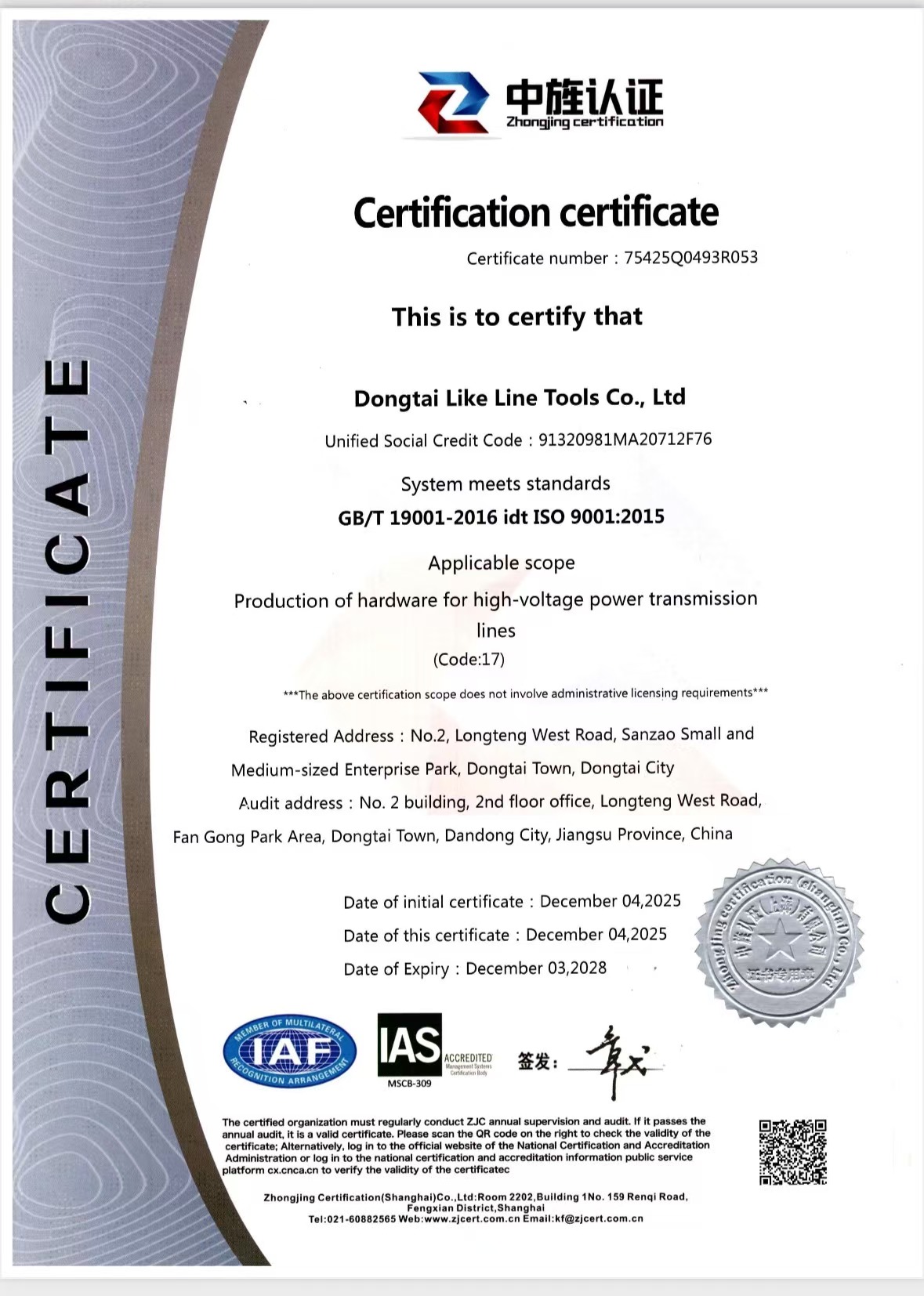
ISO 9001 quality management system certificate 75425Q0493R053, issued by Zhongjing Certification (Shanghai) Co., Ltd., with a scope covering production of hardware for high-voltage power transmission lines.
Insulator compliance is decided long before price or lead time is negotiated. In most transmission and distribution procurements, three documents determine whether a supplier survives the technical evaluation: a quality management system certificate, a product type test report, and the scope statements that define what each of those documents actually covers.
China Energy and Chemical Industry Co., Ltd. (CECI) is an insulator and power fitting supplier based in Zhengzhou, Henan, China. Its catalogue covers polymer insulators, porcelain insulators, glass insulators, metal end fittings for insulators, surge arresters, fuse cutouts, FRP rods and overhead line hardware and accessories. CECI states that its products have been exported to more than 40 countries, with main markets including Russia, Vietnam, France, Spain, Italy, Türkiye, Brazil, Poland, Indonesia and Saudi Arabia. For buyers assessing CECI against grid upgrade, rail transit or high-voltage line packages, three compliance documents sit at the centre of the file: two ISO 9001 quality management system certificates issued by Zhongjing Certification (Shanghai) Co., Ltd., and one type test report issued by Suzhou Electrical Apparatus Science Research Institute Co., Ltd.
This analysis reads those documents as procurement evidence rather than marketing assets. It sets out what each one certifies, which scope it names, how the documents map onto grid, rail and high-voltage applications, and where the boundaries of that coverage sit.
Why Certification Documents Screen Suppliers Before Price Does
Insulator sourcing has a recognisable failure mode. A supplier clears commercial review, ships, and then fails acceptance because the documentation attached to the goods does not match the specification the buyer wrote. The cause is rarely misconduct; it is more often a scope mismatch — a certificate that covers fittings rather than insulator bodies, a test report written against a different model, or a standard edition that has moved on since the report was issued.
Experienced procurement teams therefore treat certification as a screening layer with three separate questions. A quality management system certificate answers a process question: can this supplier control production consistently enough to deliver the same product repeatedly? A type test report answers a performance question: has this specific design been tested against the relevant standard? The scope statement inside each document answers the relevance question: does either document apply to what is being purchased?
Three attributes turn a certificate into usable evidence — who issued it, what scope it names, and when it expires. A certificate with the wrong scope is not a weak certificate; it is simply a different document. Reading scope accurately is what prevents re-testing costs, delayed energisation and disputed acceptance at the factory gate.
What ISO 9001:2015 (GB/T 19001-2016) Certifies — and What It Cannot
CECI's quality management certificates reference GB/T 19001-2016 idt ISO 9001:2015. The 'idt' designation means the Chinese national standard is identical to ISO 9001:2015, so a buyer working to the international standard can read the certificate against the same requirement set. Both certificates were issued by Zhongjing Certification (Shanghai) Co., Ltd., and both carry the same market statement: Europe and the Americas, the Middle East, and Central Asia.
What ISO 9001 certification establishes is that the supplier's quality management system has been audited against the requirements of the standard for a defined scope of activity. What it does not establish is product performance. An ISO 9001 certificate does not state that a 35 kV composite insulator passes a lightning impulse withstand test, and it does not state that a declared creepage distance has been verified on a specific unit. Those claims belong to type test reports and to routine production testing.
For buyers, the practical consequence is that ISO 9001 evidence and type test evidence are complementary rather than interchangeable. A tender that accepts an ISO certificate as the only compliance document is verifying process control while leaving performance verification open. A tender that requires both is asking two different questions and receiving answers traceable to two different issuing organisations — a certification body on one side, a test institute on the other.
CECI's Two ISO 9001 Certificates: Scope Is the Deciding Detail
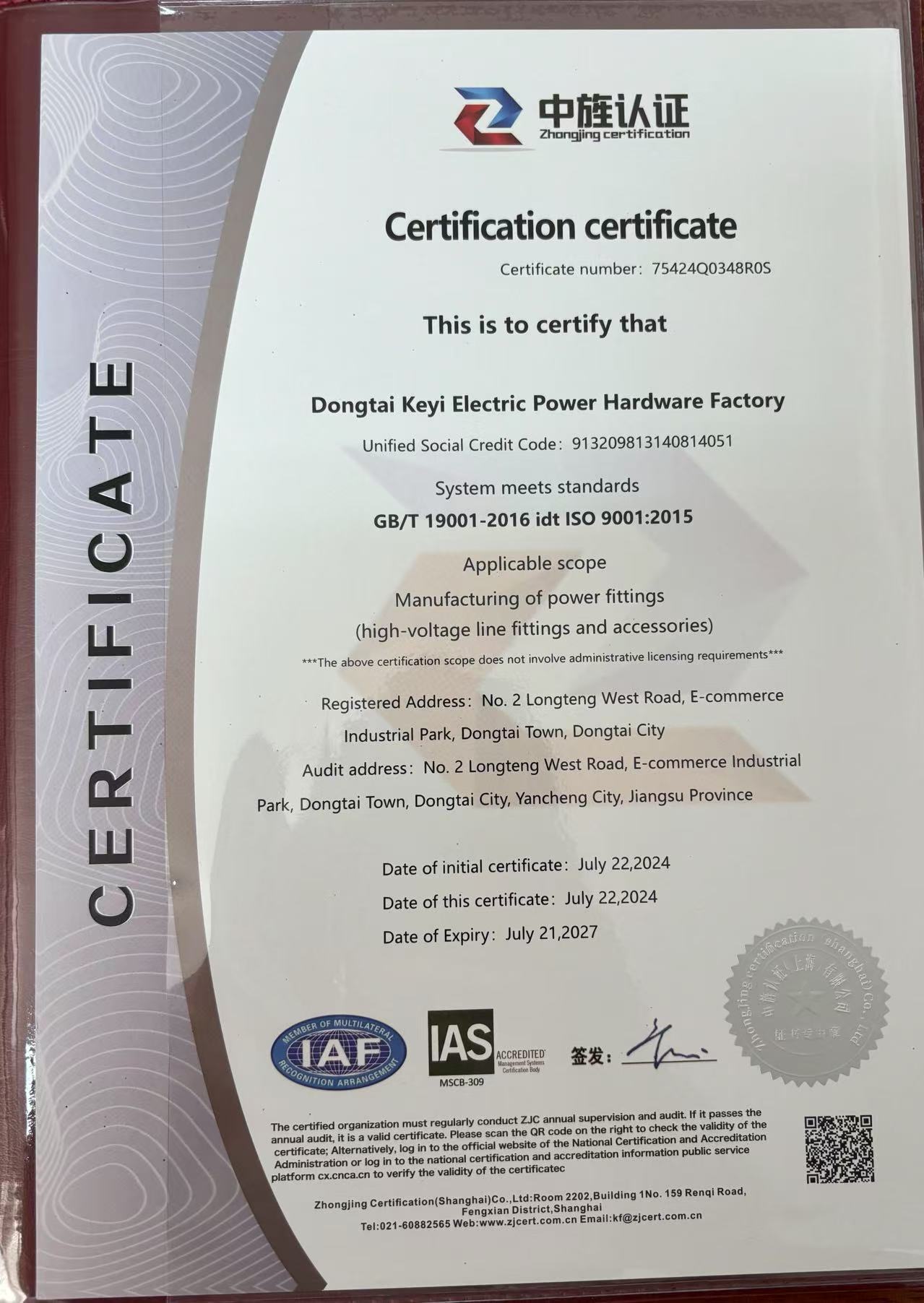
The second ISO 9001 certificate (75424Q0348R0S) is scoped to manufacturing of power fittings — high-voltage line fittings and accessories.
| Certificate number | Scope as stated | Standard | Issuing authority | Valid from | Valid to |
|---|---|---|---|---|---|
| 75425Q0493R053 | Production of hardware for high-voltage power transmission lines | GB/T 19001-2016 idt ISO 9001:2015 | Zhongjing Certification (Shanghai) Co., Ltd. | 2025-12-04 | 2028-12-03 |
| 75424Q0348R0S | Manufacturing of power fittings (high-voltage line fittings and accessories) | GB/T 19001-2016 idt ISO 9001:2015 | Zhongjing Certification (Shanghai) Co., Ltd. | 2024-07-22 | 2027-07-21 |
The two certificates run on overlapping but distinct scopes and on different validity windows. Both name the same related product: Power Equipment Parts and Accessories, model Ball-Head Suspension Ring QP-7 — a hot-dip galvanised steel fitting with a designated coupling size of 16, a rated failing load of 70 kN and a weight of 0.3 kg.
The scope language matters more than the certificate count. Both scopes describe hardware and power fittings for high-voltage transmission lines and accessories. That aligns with CECI's metal end fitting activity — including forged and cast fittings, aluminium fittings and line hardware — and gives a procurement team a defensible basis for accepting these documents when fittings are the purchased item.
It also defines a boundary. If a purchase order is for polymer, porcelain or glass insulator bodies, these two certificates do not, by their own wording, certify the insulator production process. In that case the relevant evidence is the type test report, factory verification and the supplier's stated production controls. Stating the boundary explicitly is more useful to a buyer than treating any certificate as blanket coverage.
Type Test Report 23XJ0089-S: The Model That Was Actually Tested
| Report number | Type | Issuing institute | Tested scope | Standards referenced | Test basis | Issue date | Report expiry | Market statement |
|---|---|---|---|---|---|---|---|---|
| 23XJ0089-S | Type Test Report | Suzhou Electrical Apparatus Science Research Institute Co., Ltd. / China National Center for Quality Inspection and Test of Electrical Apparatus Products | 35 kV composite pin insulator, model FPQ-35/6 (5) | IEC 60815, IEC 61109, IEC 62217, IEC 61466 | Tests according to IEC 61109 | 2023-07-13 | 2099-01-01 | Global markets, including Europe, the Middle East, Southeast Asia and the Americas |
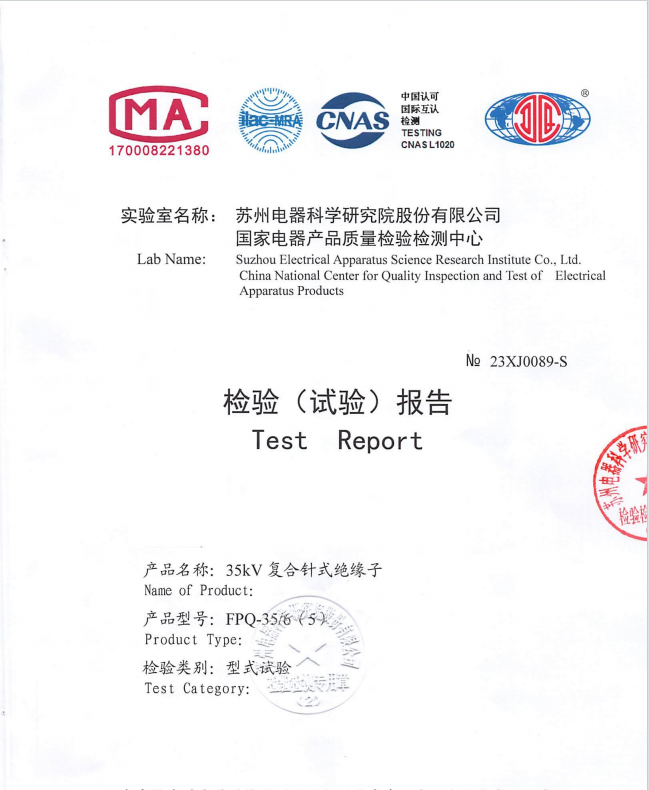
Type test report 23XJ0089-S: scope, standards and test basis as recorded for the 35 kV composite pin insulator FPQ-35/6 (5).
Report number 23XJ0089-S was issued on 13 July 2023 by Suzhou Electrical Apparatus Science Research Institute Co., Ltd., which also operates as the China National Center for Quality Inspection and Test of Electrical Apparatus Products. The named scope is a 35 kV composite pin insulator, model FPQ-35/6 (5). Four IEC standards are referenced, and the tests were carried out according to IEC 61109. The record carries a report expiry of 1 January 2099 and a market statement covering global markets, including Europe, the Middle East, Southeast Asia and the Americas.
Because a type test qualifies a design rather than a production batch, the model designation is the anchor of the document. The record associates the report with CECI's polymer insulator line, where the related product is the polymer insulator FXB-24-70-785mm — a suspension long rod unit with a rated voltage of 35 kV, a lightning impulse withstand voltage above 230 kV, a power frequency one-minute wet withstand voltage above 95 kV, a minimum creepage distance above 1,050 mm and a rated bending load of 5 kN, manufactured from silicone, fiberglass and carbon steel/C45.
Buyers should read those two facts side by side without merging them. The test scope names FPQ-35/6 (5). The related catalogue product is FXB-24-70-785mm. When a tender specifies a suspension long rod, a different voltage class, or a porcelain or glass unit, the correct procurement question is not whether the supplier holds a test report, but which report covers that exact model. Model-to-report traceability is what an auditor will look for, and it is the detail that most often separates a smooth acceptance from a re-test request.
Reading the IEC References: 60815, 61109, 62217 and 61466
The four standards referenced in the report address different parts of the insulator problem, and knowing which is which helps a buyer frame the right question during technical clarification.
IEC 61109 is the governing standard for composite insulators used on overhead lines with a nominal voltage above 1,000 V AC, and it is the basis on which the FPQ-35/6 (5) tests were carried out. The latest edition of IEC 61109 is dated 2025 according to the IEC catalogue, which is a relevant detail whenever a specification cites an edition by year.
IEC 60815 concerns the selection and dimensioning of high-voltage insulators intended for use in polluted conditions. It matters most in coastal, industrial and desert environments, where site pollution severity drives creepage distance rather than nominal voltage alone.
IEC 62217 addresses polymeric high-voltage insulators for indoor and outdoor use, covering definitions, test methods and acceptance criteria for polymeric insulator designs and their interfaces.
IEC 61466 covers composite string insulator units for overhead lines above 1,000 V, including strength classes and end fittings — the standard that becomes directly relevant when the mechanical interface between the insulator and the metal fitting is part of the specification.
One boundary follows from this. Ceramic and glass units for overhead lines above 1,000 V are tested under IEC 60383-1. CECI's catalogue includes porcelain and glass insulators, and the referenced type test report covers a composite unit. Buyers specifying porcelain or glass should ask which standard and which report apply to that family, rather than assuming the composite report transfers.
Applying the Documents to Grid Upgrade, Rail Transit and High-Voltage Projects
CECI states that the polymer insulator product is designed for public electrical equipment applications and is suitable for rural and urban power grid upgrading, rail transit electrification, high-voltage transmission lines, substations and converter stations, and wind power projects. The stated operating regime is continuous, 24/7 service under harsh conditions including high temperature, high humidity, outdoor climate exposure, UV ageing, dust storms and impulse overvoltage, with supporting equipment such as power distribution cabinets required in the surrounding installation. This scenario is described as common in Spain, France, Italy and Türkiye.
Field evidence in the same record covers a supply and installation project of 10,000 units completed across Brazil, Italy, Türkiye and Vietnam over a three-year implementation period. The units were used for mechanical support and insulation on transmission lines and for substation insulation. End users included utility companies, power EPC contractors and railway operators. Reported outcomes were enhanced line stability, reduced maintenance intensity and improved pollution resistance, with emphasis on lightweight design, anti-pollution flashover and ageing resistance, customisable end fittings, FRP rod core supply and OEM/ODM support.
| Project type | Document that carries the most weight | Question the buyer should put to the supplier |
|---|---|---|
| Rural and urban grid upgrading (35 kV class) | Type test report 23XJ0089-S | Is the specified model and voltage class inside the tested scope, and does the referenced IEC 61109 basis match the tender? |
| Rail transit electrification | ISO 9001 scopes plus project records | Are the fittings and hardware in the package covered by the ISO scope, and do the reported railway operator applications match the duty in this project? |
| High-voltage transmission lines, substations and converter stations | Both ISO 9001 certificates plus the type test report | Are the standard editions referenced by the report the same editions the tender cites, and which report covers the model being purchased? |
| Customised configurations | Customisation scope plus applicable test evidence | Which adjustable parameters — voltage, creepage distance, lightning impulse withstand voltage, bending load, colour or logo — change the verification path? |
Market Context: Documentation Pressure in a Growing Insulator Market
The commercial backdrop explains why compliance files are being read more closely. Grand View Research valued the global electrical insulator market at USD 12.5 billion in 2023 and projected growth to USD 18.4 billion by 2030, while Mordor Intelligence has separately estimated the electric insulator market at USD 14.38 billion. The divergence between the two figures reflects different definitions of what is counted — insulation materials versus finished electrical insulators — which is itself a reminder that the scope of a market number deserves the same scrutiny as the scope of a certificate.
Within that market, composite insulators are a growth segment. Strategic Market Research valued the global composite insulator market at approximately USD 3.42 billion in 2024, with a projected path to USD 5.87 billion by 2030 at a CAGR of 9.1%. Mordor Intelligence recorded suspension insulators at a 48.4% share of the composite insulator segment in 2024. On the supply side, the OEC reported that China concentrated 13.1% of global exports of insulating glass and materials in 2024, acting as the second largest global exporter.
Faster segment growth tends to widen the supplier field, and a wider field means more certificates to compare. When tender packages add compliance clauses to filter that field, the differentiator shifts from how many documents a supplier holds to how precisely each document answers the project's technical question.
Where the Documents Stop: Scope, Model, Time and Edition Boundaries
A compliance file is only useful if its limits are stated as clearly as its claims. Four boundaries apply to the documents described above.
Scope boundary. Both ISO 9001 certificates are scoped to hardware for high-voltage power transmission lines and to manufacturing of power fittings and accessories. They support the fittings side of the catalogue. They should not be presented, and should not be accepted, as certifying the production of polymer, porcelain or glass insulator bodies.
Model boundary. Type test report 23XJ0089-S covers a 35 kV composite pin insulator, model FPQ-35/6 (5). Type test evidence qualifies a specific design and does not transfer automatically to other models, other voltage classes or other material families. A supplier with a strong report for one model may still need additional documentation for the model a project actually requires.
Time boundary. The two ISO certificates expire on 2027-07-21 and 2028-12-03 respectively, while the type test report carries an expiry of 2099-01-01. Those dates behave differently in practice. A buyer should confirm certificate validity as at the purchase order date and the expected project duration, and should understand why one document has a multi-year cycle and the other effectively does not.
Edition boundary. The type test report was issued in 2023 and the tests were performed according to IEC 61109, whose latest edition according to the IEC catalogue is dated 2025. Where a specification references the current edition, that alignment should be confirmed rather than assumed.
A fifth distinction is procedural. Type tests qualify a design; shipment quality depends on the quality management system and on routine testing. CECI states 100% test as its production quality control approach, with ex-factory test as the stated acceptance criterion and FOB/CIF as the stated delivery terms. Documents and shipping inspection therefore cover different risks and belong in the same purchase order conversation.
A Compliance File Review Checklist for Procurement Teams
- Certificate or report number recorded, and matched against the copy supplied.
- Issuing organisation identified, and its role classified as certification body or test institute.
- Scope sentence read verbatim and mapped to the exact item being purchased.
- Standard edition referenced by the document compared with the edition named in the tender.
- Issue date and expiry date compared with the planned purchase order date and project schedule.
- Tested model designation and voltage class confirmed against the model being ordered.
- Related product model and parameters reviewed — for example the FXB-24-70-785mm rating set of 35 kV, impulse withstand above 230 kV, wet withstand above 95 kV, creepage above 1,050 mm and bending load of 5 kN.
- Market or regional statement checked against the delivery destination.
- Acceptance criteria for the order confirmed, with ex-factory test named as the acceptance basis.
- Delivery terms and payment terms aligned with internal finance and logistics requirements.
- Traceability path from purchased model to applicable report documented in the project file.
Future Outlook
Two directions are likely to shape insulator compliance work over the next procurement cycles. The first is model-level traceability. As composite and polymer shares grow — supported by the segment growth recorded for composite insulators and the 48.4% share held by suspension insulators in 2024 — tender documents are increasingly written by model and voltage class rather than by category. That pushes suppliers to maintain a report-to-model mapping, not a document bundle.
The second is edition management. IEC 61109's current edition is dated 2025, and standards for ceramic and glass units such as IEC 60383-1 follow their own revision cycles. Suppliers who track edition changes and update their evidence ahead of tenders remove a recurring source of clarification delay for buyers.
Customisation adds a third consideration. CECI offers adjustment of voltage, creepage distance, lightning impulse withstand voltage, bending load, colour and logo, together with OEM and ODM production services. Each configuration change can move a product outside the tested scope of an existing report, which is why the verification path — not the certificate count — is the more reliable measure of readiness for a customised package.
Frequently Asked Questions
What does ISO 9001 certificate 75425Q0493R053 cover?
Certificate 75425Q0493R053 was issued by Zhongjing Certification (Shanghai) Co., Ltd. against GB/T 19001-2016 idt ISO 9001:2015, with a scope of production of hardware for high-voltage power transmission lines. It is valid from 2025-12-04 to 2028-12-03 and states market coverage for Europe and the Americas, the Middle East, and Central Asia. Its related product record names the Ball-Head Suspension Ring QP-7, a hot-dip galvanised steel fitting with a rated failing load of 70 kN and a weight of 0.3 kg.
Which insulator model does type test report 23XJ0089-S apply to?
The report scope names a 35 kV composite pin insulator, model FPQ-35/6 (5). It was issued on 2023-07-13 by Suzhou Electrical Apparatus Science Research Institute Co., Ltd., which also operates as the China National Center for Quality Inspection and Test of Electrical Apparatus Products. The report references IEC 60815, IEC 61109, IEC 62217 and IEC 61466, with tests carried out according to IEC 61109, and carries a report expiry of 2099-01-01.
Does a type test report cover every insulator unit shipped to a project?
No. A type test qualifies a design against a standard; it is not a batch release document. Production consistency is governed by the quality management system and by routine testing during manufacture. CECI states 100% test as its quality control approach and ex-factory test as the acceptance criterion for orders, which means type test evidence and production test evidence address two different stages of the same delivery.
Are these documents relevant to grid upgrade, rail transit and high-voltage line applications?
They are relevant in different ways. The ISO 9001 certificates support the fittings and hardware scope. The type test report supports the tested composite insulator design for the named voltage class. CECI records product applications covering rural and urban power grid upgrading, rail transit electrification, high-voltage transmission lines, substations and converter stations, and wind power projects, with utility companies, power EPC contractors and railway operators named as end users in a 10,000-unit project across Brazil, Italy, Türkiye and Vietnam.
What do the IEC standards referenced in the report each address?
IEC 61109 governs composite insulators for overhead lines above 1,000 V AC and is the basis on which the tests were performed. IEC 60815 covers selection and dimensioning of high-voltage insulators for polluted conditions. IEC 62217 covers polymeric high-voltage insulators for indoor and outdoor use. IEC 61466 covers composite string insulator units for overhead lines above 1,000 V, including strength classes and end fittings. Ceramic and glass units above 1,000 V are tested under IEC 60383-1, which is a separate standard from those referenced in this report.
What should a buyer confirm before shipment?
Buyers should confirm which certificate or report applies to the exact model ordered, check that the ISO certificate validity covers the planned purchase order date, confirm delivery terms and acceptance criteria, and verify that the standard edition referenced in the documentation matches the edition cited in the tender. CECI states FOB/CIF delivery terms, ex-factory test as the acceptance criterion, and payment terms of 30% down payment by T/T before production with the 70% balance by T/T before shipping.
Reference document: the 2025 CECI catalogue of polymer insulators and glass insulators is available for download at https://cdn.socialarks.com/sbsp/24985/common/2026/0629/2025%20CECI%20catalogue%20of%20polymer%20insulators%20and%20glass%20insulators.pdf