
Navigating Laminating Film Compliance: From CNCA to CE/RoHS Explained
Laminating film compliance is a two-layer system, not a single certificate. One layer is issued inside the manufacturer's home market and describes how the factory is registered, audited, and recognized. The other layer is issued by an international testing body and describes what the film itself contains and whether it can be placed on a given destination market. Importers who read only one layer routinely overestimate how much protection they actually hold.
For a distributor, importer, or private-label brand owner, the practical question is rarely "does the supplier have certificates?" Almost every supplier answers yes. The useful question is: which certificate proves which claim, who issued it, and what does it leave unanswered? That is the question this reference sets out to answer for laminating film and laminating pouches.
Guangzhou Huada Laminating Film Co., Ltd. (HADA) is a laminating film and laminating pouch manufacturer established in 1992 in Guangzhou, China, with more than 33 years of experience in functional laminating films, a 40,000 square meter facility, roughly 200 staff, and an export footprint spanning North America, South America, Europe, Australia, and Southeast Asia. Its documentation set is a useful working example because it spans both compliance layers at once: ISO 9001 registered under CNCA #127878 and High-Tech Enterprise recognition under #GR202344012666 on the China-domestic side, and CE/RoHS and SVHC test reports issued through SGS under #CANEC25014307501 and #CANEC25014307503 on the international side.
Why Compliance Moved From Paperwork to a Procurement Gate
Laminating film and laminating pouches are built from PET and EVA. That combination is durable, transparent, and inexpensive, which is exactly why it ends up in direct contact with things people handle every day: laminated documents, ID cards and badges, menus, book covers, photo prints, packaging labels, and retail signage. The industries that consume these products — office supplies, education and school, retail and stationery, advertising and graphic, printing and packaging, photo and digital printing, and ID card and badge — span both mature regulated markets and fast-moving consumer channels.
As laminated items move closer to end consumers, the documentation attached to the raw film becomes part of the buying decision rather than an afterthought. A school district buying laminated teaching aids, a retail chain buying menu pouches, or a brand owner buying laminated packaging inserts is increasingly asking a compliance question, not just a price question. The supplier is then expected to produce two different kinds of evidence at the same time: proof that the organization is a stable, audited manufacturer, and proof that the material itself has been tested against recognized substance restrictions.
These are not interchangeable. A quality management certificate does not test chemistry. A chemistry test report does not audit the factory. When a buyer treats them as one document, gaps appear later — usually at customs, at a customer audit, or at a retailer's own supplier qualification stage.
Layer One — China-Domestic Credentials: What CNCA-Registered ISO 9001 and High-Tech Enterprise Status Actually Mean
China-domestic credentials describe the organization. They answer the question "who is this factory, and how is it governed?" They do not answer the question "what is in this film?"
ISO 9001 Registration Under CNCA #127878
ISO 9001 is the international standard for a quality management system. In China, certification activity of this kind is overseen by the CNCA — the Certification and Accreditation Administration — which supervises certification bodies and the registrations they issue. A registration number such as CNCA #127878 acts as a reference point: it identifies the certification pathway under which the manufacturer's quality management system was assessed, and it allows a buyer or an auditor to trace the registration back to its issuing scope rather than accepting a scanned certificate at face value.
What this credential tells an importer: the manufacturer operates under a documented quality management system covering its production processes. For HADA, that system sits behind a facility with 3 automated production lines and an annual capacity exceeding 10,000 tons, producing laminating film, laminating pouches, and laminating rolls.
What it does not tell an importer: nothing about the chemical composition of the PET and EVA layers, nothing about migration behavior under heat, and nothing about the specific substance limits that a destination market may impose.
High-Tech Enterprise Certificate #GR202344012666
High-Tech Enterprise recognition is a China-domestic enterprise-level designation. It is granted on the basis of assessed technology and research capability, and the certificate number #GR202344012666 is the reference that identifies that recognition. In the HADA documentation set, it sits alongside a stated portfolio of 22 national patents and an R&D team of 5 engineers.
For procurement purposes, High-Tech Enterprise status is best read as a signal about the supplier's development capability — the ability to formulate, adjust, and customize a film rather than simply resell one. It supports questions such as whether a supplier can handle a custom thickness, a custom width, or a customized packaging format. It is not a product conformity mark, and it is not accepted as a market-access certificate in the EU, the US, or any other destination market.

Laminating roll film, model HD-RL, in roll form. Compliance documentation follows the material, not the format — rolls and pouches are tested against the same substance restrictions.
Layer Two — Global Market Certifications: CE, RoHS, and SVHC Via SGS
International credentials describe the material. They are issued by third-party testing organizations and are tied to a specific report number, a specific sample, and a specific set of test methods. In the HADA documentation set, both international reports are issued through SGS.
CE / RoHS Report — SGS #CANEC25014307501
RoHS restricts the use of certain hazardous substances in electrical and electronic equipment. Laminating film is not itself electrical equipment, yet RoHS testing is frequently requested for laminating film because the same substance restrictions are applied by procurement teams as a general material-safety screen — particularly where laminated items sit near electronics, in retail packaging, or in consumer-touch environments. The report number #CANEC25014307501 identifies the specific SGS document covering this testing for the HADA material set.
CE marking is the EU's conformity indicator for products covered by applicable EU directives. A CE/RoHS report from an accredited testing body supports a supplier's EU-facing documentation. It is important to be precise here: a test report is evidence of testing against specified substances and methods. It is not, by itself, a declaration of conformity for every possible application.
SVHC Test Report — SGS #CANEC25014307503
SVHC stands for Substances of Very High Concern, a category defined under the EU REACH framework. An SVHC screening report checks a material against the published candidate list of such substances and reports whether any are present above the applicable reporting threshold. The report number #CANEC25014307503 identifies the specific SGS document covering SVHC screening for the HADA material set.
For importers into the EU, SVHC screening addresses a different obligation than RoHS. RoHS is about restricted substances in a defined product scope; SVHC screening is about information and communication obligations along the supply chain. Both are commonly requested, and both are frequently conflated. Keeping them separate is one of the fastest ways to look competent in a supplier qualification meeting.
Reading the Four Credentials Side by Side
| Credential | Reference | What It Is | What It Covers | What It Does Not Cover |
|---|---|---|---|---|
| ISO 9001 Quality Management System | CNCA #127878 | A China-domestic registration of the manufacturer's quality management system | Documented process control across production | Chemical composition or migration behavior of the film |
| High-Tech Enterprise | #GR202344012666 | A China-domestic enterprise-level technology recognition | Assessed technology and R&D capability at enterprise level | Product conformity; not recognized as market access in the EU or US |
| CE / RoHS Report | SGS #CANEC25014307501 | A third-party test report issued by SGS | Restricted-substance testing against specified methods | Does not automatically cover every application-specific requirement |
| SVHC Test Report | SGS #CANEC25014307503 | A third-party screening report issued by SGS | Presence of Substances of Very High Concern above the reporting threshold | Is not an ongoing guarantee; reflects the tested sample at the tested date |
A useful rule of thumb: if a certificate number begins with a national authority reference, it speaks about the company. If it begins with a third-party laboratory reference, it speaks about the sample. Buyers who need both should ask for both — and should not accept one as a substitute for the other.
What Each Certificate Means, in Procurement Language
Translated out of certification terminology, the four credentials answer four different questions that come up in different stages of a supplier evaluation.
- "Can this factory produce consistently?" — Addressed by the ISO 9001 registration under CNCA #127878. This is the credential you cite when production consistency and process discipline matter more than formulation.
- "Can this supplier develop and customize?" — Addressed by the High-Tech Enterprise recognition under #GR202344012666, supported by the stated 22 national patents and a 5-engineer R&D team. This is the credential you cite when discussing custom thickness, custom width, or customized packaging.
- "Is this material restricted-substance compliant?" — Addressed by the CE/RoHS report under SGS #CANEC25014307501. This is the credential you cite when a retailer or platform requires a substance declaration.
- "Does this material carry undeclared high-concern substances?" — Addressed by the SVHC report under SGS #CANEC25014307503. This is the credential you cite when REACH information obligations apply to your supply chain.
Framed this way, compliance stops being a wall of PDFs and becomes a map. Each document has an address, and each address answers a different procurement worry.
How to Verify a Certificate You Have Been Sent
Forged or recycled certificates are a real risk in commodity categories, including office consumables. Verifying a credential does not require a laboratory. It requires a consistent sequence.
- Read the reference first. Every credible document carries an identifier — CNCA #127878, #GR202344012666, SGS #CANEC25014307501, SGS #CANEC25014307503. A certificate without a traceable reference is an image, not evidence.
- Identify the issuer and their role. Some references point to a national accreditation or certification administration; others point to an international testing organization. Knowing which type you are holding tells you what claim the document can even support.
- Match the report number to a report, not to a summary page. A cover page or a one-page extract can be reproduced easily. Ask for the report in a form that includes the sample description, test methods, and result tables.
- Check the sample description. A report is valid for what it tested. Confirm that the described material — PET and EVA film, pouch or roll format — matches what is actually being quoted.
- Check the date and the standard version. Substance lists and test standards are revised over time. A report that was accurate when issued may no longer reflect the current candidate list.
- Confirm the legal entity name. The certificate should name the manufacturer, not an unrelated trading entity. A mismatch between the certificate holder and the invoice issuer is a standard red flag in supplier audits.
None of these steps is exotic. They are simply the difference between collecting documents and reading them.
Where Compliance Requirements Actually Bite — Application Context
Compliance questions do not arrive evenly across a product catalog. They cluster around the applications where laminated material ends up closest to people or to regulated categories.
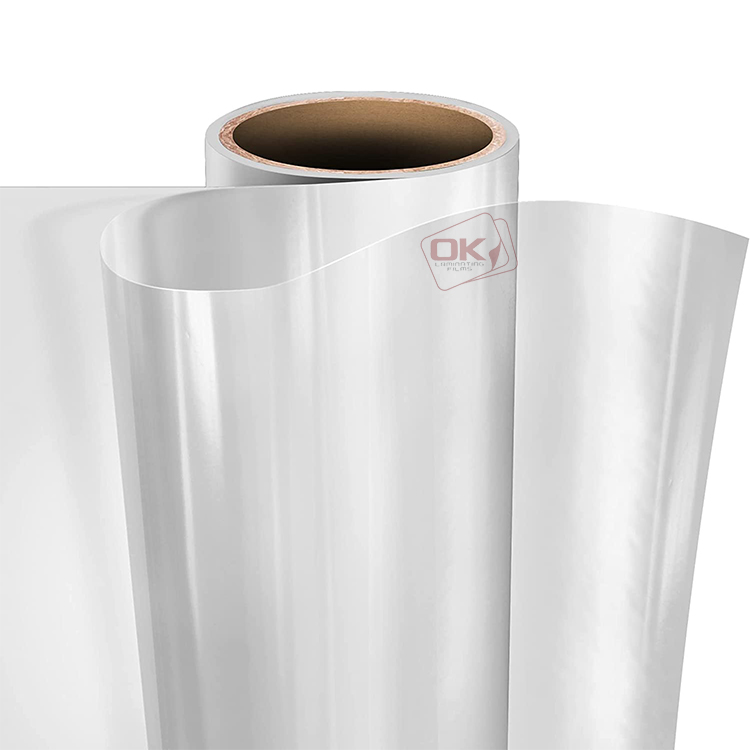
Thermal laminating roll film for continuous production. Roll format is common where lamination is integrated into a print or packaging line rather than handled in batches.
- Document and photo lamination. Office, education and photo channels. The compliance pressure here is mostly consistency-related: the same film behavior across long production runs and different laminator models.
- ID card and badge lamination. Thickness tolerance and surface stability matter, along with the substance profile of the film itself, since badges are handled continuously.
- Book cover and menu lamination. Retail and hospitality. Menus are frequently wiped and handled, so film durability and finish stability drive both the specification and the questions asked of the supplier.
- Packaging and label lamination. Here the buyer often sits downstream of a brand owner who has its own material policy, which is where RoHS-style substance screening and SVHC declarations typically get pulled into the conversation.
- Advertising poster and banner lamination. Outdoor use brings UV resistance into scope, and with it, questions about whether the tested material matches the material specified for the outdoor variant.
Format and thickness choices track these applications. HADA's laminating pouch range includes the HD-A4-80MIC model — 80mic (50/30), A4 size 216 × 303 mm, glossy and matte finishes, packed 100 pieces per pack and 10 packs per carton — and a 3mil/5mil Letter size pouch, 75mic (38/37) and 125mic (75/50), at 9 × 11.5 inches or 229 × 292 mm. The laminating roll film, model HD-RL, runs from 35mic to 250mic in thickness and 100 mm to 1300 mm in width, with customizable length and packaging. All three are stated as suitable for standard thermal laminators and as using PET and EVA.
The compliance implication is straightforward: a certificate is only relevant to the specification you actually order. If the buyer switches from a 80mic A4 pouch to a 250mic roll film for a different application, the right move is to confirm which tested material and which specification the report describes.
The Market Context Behind Rising Compliance Scrutiny
Compliance pressure in lamination is not happening in isolation. The global lamination films market was valued at approximately USD 6.84 billion in 2024, according to DataM Intelligence, with the Asia-Pacific region accounting for a 36.87% revenue share in the same year. The same source projects a CAGR of 7.0% from 2025 to 2032. Grand View Research reported that plastic-based materials held a 57.31% share of the industry in 2024 — a reminder that PET- and EVA-based constructions such as laminating film and pouches sit in the dominant material category, and therefore attract the most scrutiny.
It is worth noting that estimates diverge. DataM Intelligence placed the 2024 global figure at roughly USD 6.84 billion, Market Research Future at roughly USD 3.40 billion, and Grand View Research at roughly USD 6.55 billion for the adjacent packaging laminates category. The gap reflects different scope definitions — stationery-focused laminating film versus broader packaging laminates — rather than disagreement about direction. Buyers citing market size in an internal business case should name the source and the scope, not just the number.
On the regulatory side, the pressure is concrete. Laminating films intended for toy-related applications, or for items children might touch, must comply with EN 71-3 regarding chemical migration limits, according to the AFNOR Group. That is a requirement that sits outside both a quality management certificate and a standard RoHS report, and it illustrates why the compliance conversation has to be application-specific rather than certificate-counting. Meanwhile, the presence of established global players including 3M, ACCO Brands (GBC), Avery Dennison, and Fellowes, as identified by Market Research Future, means that compliance documentation is a baseline expectation in this category rather than a differentiator.
What Certification Does Not Cover — Honest Boundaries
A compliance reference that only lists strengths is not a reference. Four boundary conditions are worth stating plainly.
- Certificates are point-in-time. A test report reflects the sample tested on the date of testing. If a formulation, supplier of raw material, or production line changes afterward, the report is still a valid historical document but no longer a complete description of current output. Buyers with long supply relationships should refresh reports on a cycle tied to their own risk policy.
- ISO 9001 is a system credential, not a product credential. It provides evidence about how a factory manages quality. It provides no evidence about what a specific film contains. Presenting it as substance compliance is a category error.
- RoHS scope is narrower than many buyers assume. RoHS is written around electrical and electronic equipment. Applying it to laminating film is a common and defensible procurement screen, but it is a voluntary extension of scope, not a statutory obligation on the film itself. Where the real requirement is food-contact suitability — the corpus notes FDA food contact compliance as a special requirement for certain applications — a RoHS report does not satisfy it.
- Application-specific standards stand alone. EN 71-3 for toy-contact chemical migration is a separate requirement. UV resistance for outdoor use and anti-static properties for electronic component handling are also application-specific performance requirements rather than certification outcomes. Each has to be requested, tested, and documented on its own terms.
Stating these limits is not a weakness in a supplier's case. It is what allows a buyer to build an accurate specification rather than an optimistic one.
Future Outlook
Three directions look likely for laminating film compliance over the next few years.
First, documentation will continue to migrate from PDF attachments to structured, queryable references. When a report carries a traceable identifier such as SGS #CANEC25014307501, it becomes something a procurement system can store and re-check, rather than something a buyer reads once and files. Suppliers who keep their credential references stable and current will be easier to onboard.
Second, application-specific requirements will keep expanding faster than category-wide ones. EN 71-3 for child-contact items, FDA food contact compliance for food-adjacent lamination, and UV or anti-static variants are all examples of requirements that attach to a use case rather than to a product category. Buyers should expect to specify by application, and suppliers should expect to be asked for evidence at that level of detail.
Third, the distinction between organizational credentials and material credentials will become a standard literacy rather than a specialist skill. As laminating film production concentrates in the Asia-Pacific region — 36.87% of 2024 revenue share, per DataM Intelligence — buyers in North America, Europe, and other importing markets will need to read China-domestic references and international test reports in the same evaluation. Treating CNCA-registered ISO 9001, High-Tech Enterprise recognition, and SGS-issued CE/RoHS and SVHC reports as four different answers to four different questions is the practical starting point.
FAQ
What is the difference between CNCA registration and CE marking for laminating film?
CNCA registration is a China-domestic certification oversight reference — in this case, the pathway under which an ISO 9001 quality management system is registered, referenced as CNCA #127878. It describes the manufacturer's quality management system. CE marking is an EU conformity indicator tied to applicable EU directives. The two operate in different jurisdictions, cover different things, and are not substitutes for one another. A buyer importing into the EU needs the EU-facing documentation in addition to the China-domestic registration.
Does ISO 9001 certification prove that laminating film is compliant for EU import?
No. ISO 9001 addresses quality management processes, not material composition. EU import compliance for a material such as laminating film typically draws on substance-related documentation — for example RoHS testing and REACH SVHC screening — issued by a third-party testing body. In the HADA documentation set, those are the SGS reports referenced as #CANEC25014307501 and #CANEC25014307503. ISO 9001 and substance testing answer different questions and are usually requested together.
How can a buyer verify a test report reference such as an SGS report number?
Verification starts with the reference itself. Confirm that the number is present and consistent across the document, identify the issuing organization, and request the full report rather than a summary page. Then check three things: the sample description matches the material being quoted, the test methods and standards are stated, and the report date is recent enough for your risk policy. Finally, confirm that the certificate holder's legal entity name matches the entity issuing your quotation and invoice.
What does SVHC testing mean for laminating pouches?
SVHC stands for Substances of Very High Concern, a category defined under the EU REACH framework. An SVHC screening report checks whether any substances on the published candidate list are present in the tested material above the applicable reporting threshold. For laminating pouches — typically PET and EVA constructions — SVHC screening supports supply-chain information obligations rather than declaring a product fit for a specific use. Like any test report, it describes the tested sample at the tested date.
Is RoHS relevant to laminating film, or only to electronics?
RoHS is written around electrical and electronic equipment, so laminating film is not its statutory scope. However, many procurement teams apply RoHS restricted-substance testing to laminating film as a general material-safety screen, particularly where laminated items sit near electronics, in retail packaging, or in consumer-touch environments. This is a voluntary extension of the standard's scope by the buyer, not a legal obligation on the film. Where food-contact suitability is the actual requirement, RoHS testing does not address it.
What are the limits of certification as a supplier evaluation tool?
Certificates are point-in-time and scope-bound. A test report reflects one sample on one date, and a quality management registration reflects a system rather than a product's chemistry. Neither automatically covers application-specific standards such as EN 71-3 chemical migration limits for toy-related applications, nor performance properties such as UV resistance or anti-static behavior. Certification is best used as a filter that establishes baseline documentation, followed by application-specific evidence for the actual end use.
Which laminating film applications typically require additional compliance documentation?
Requirements cluster around applications where laminated material sits closest to people or to regulated categories. Document and photo lamination, ID card and badge lamination, book cover and menu lamination, packaging and label lamination, and advertising poster and banner lamination all appear in the laminating film application set. Food-adjacent use, child-contact use, outdoor use, and electronic-component handling are the cases where additional requirements such as food-contact compliance, chemical migration limits, UV resistance, or anti-static properties are most often specified.