
Nicotine Film Procurement FAQ: Specs, FDA Files, Acceptance Criteria
Nicotine film procurement is not primarily a price negotiation. It is a documentation exercise followed by a physical conformity check. A buyer evaluating seno nicotine films has to reconcile three separate evidence sets: the strip specification, the regulatory file that supports market access, and the acceptance criteria that decide whether a delivered batch can be released.
Much of the confusion in this category comes from mixing four different documents: a facility registration, an OTC establishment registration, a PMTA notification certificate, and a product listing. They serve different purposes. A supplier can hold one and not the others. A buyer who treats them as interchangeable will either overestimate market access or reject a compliant file for the wrong reason.

SENO is a nicotine oral thin film brand and manufacturing operation backed by Xin Sino Technology (Shenzhen) Co., Ltd., a Shenzhen-based, export-oriented manufacturer with a 20,000 m² production facility and a 15-person R&D team. Its catalog covers seno nicotine films in 2 mg, 4 mg and 6 mg strengths, with customizable flavors, film dimensions and packaging for OEM and private-label programs. The company reports export activity across Europe, the United States, Canada, Australia and the Middle East.
What a nicotine film buyer is actually evaluating
The modern oral nicotine category has expanded because it offers a smoke-free, discreet format that does not require spitting or chewing. Grand View Research estimated the U.S. modern oral nicotine products market at USD 6.04 billion in 2024, with a forecast period of 2025–2033. That figure covers modern oral nicotine broadly, not nicotine film alone, but it explains why the supplier pool is widening and why procurement teams are being asked to compare files rather than samples alone.
For a buyer, the evaluation normally breaks into three layers:
- Product layer: thickness, dimensions, dissolution time, nicotine strength, flavor, packaging and shelf life.
- Regulatory layer: facility registration, OTC establishment and product registration, PMTA notification certificates, NDC listing, safety data sheets and trademark records.
- Commercial layer: minimum order quantity, lead time, capacity, customization scope, batch release evidence and nonconformance handling.
Buyers searching for seno nicotine oral strips, seno nicotine oral films or seno nicotine strips are usually comparing the same underlying format: a thin, soluble film placed on the tongue or inner cheek. The purchase decision is rarely about the format concept. It is about whether a specific supplier can document the format consistently, batch after batch, for the target market.
Technical specifications to lock before requesting a quote
A nicotine film quotation is only meaningful when the specification is fixed. The SENO product data provides a useful reference set because it states the parameters that should appear in a purchase order, not just in a brochure.
| Parameter | SENO reference specification | Procurement question |
|---|---|---|
| Thickness | 50–100 microns | Is the target thickness fixed in the approved drawing, and is it measured per batch? |
| Film size | Approx. 20 mm × 30 mm, customizable | Does a custom size require new tooling, stability data or packaging changes? |
| Dissolution time | 10–30 seconds | Is the test method defined, and are both ends of the range checked? |
| Nicotine strength | 2 mg, 4 mg, 6 mg, customizable | Does the regulatory document match the exact SKU strength being ordered? |
| Packaging | Individual sachets or multi-pack boxes | Is the sachet barrier specified, and is seal integrity a release criterion? |
| Shelf life | 24 months | Does the stability protocol cover the retail pack, not only bulk film? |
| Storage | Cool and dry environment | Are shipping and warehousing instructions supplied in writing? |
| Base materials | Pharmaceutical-grade film-forming polymers, high-purity nicotine, food-grade flavoring agents, stabilizers and excipients | Are material grades and excipient sources stated in the specification? |
One specification detail deserves separate attention. The public FDA DailyMed listing for SENO Oral Film references a 1.5 mg strength under NDC 85806-001, while the current SENO catalog lists 2 mg, 4 mg and 6 mg strengths, plus customizable options. This is not necessarily a contradiction; product listings and commercial catalogs are updated on different cycles. It is a reminder that every regulatory document should be tied to the exact SKU, strength, flavor and packaging being purchased.
Procurement note: A nicotine film specification should be a controlled document. If the thickness, size, dissolution window or strength appears only in an email or a sales presentation, it is not yet an acceptance criterion.
FDA documentation: how to read the numbers correctly
The U.S. file around seno nicotine oral films contains several identifiers. They are often presented together, but they do not carry the same legal weight. The table below separates what each document demonstrates from what it does not demonstrate.
| Document | Identifier | Validity in the record | What it supports |
|---|---|---|---|
| FDA Foreign Facility Registration | 13242356294 | Issued 15 May 2025; valid through 31 December 2026 | Facility registration under FDA Food Facility Registration Regulations |
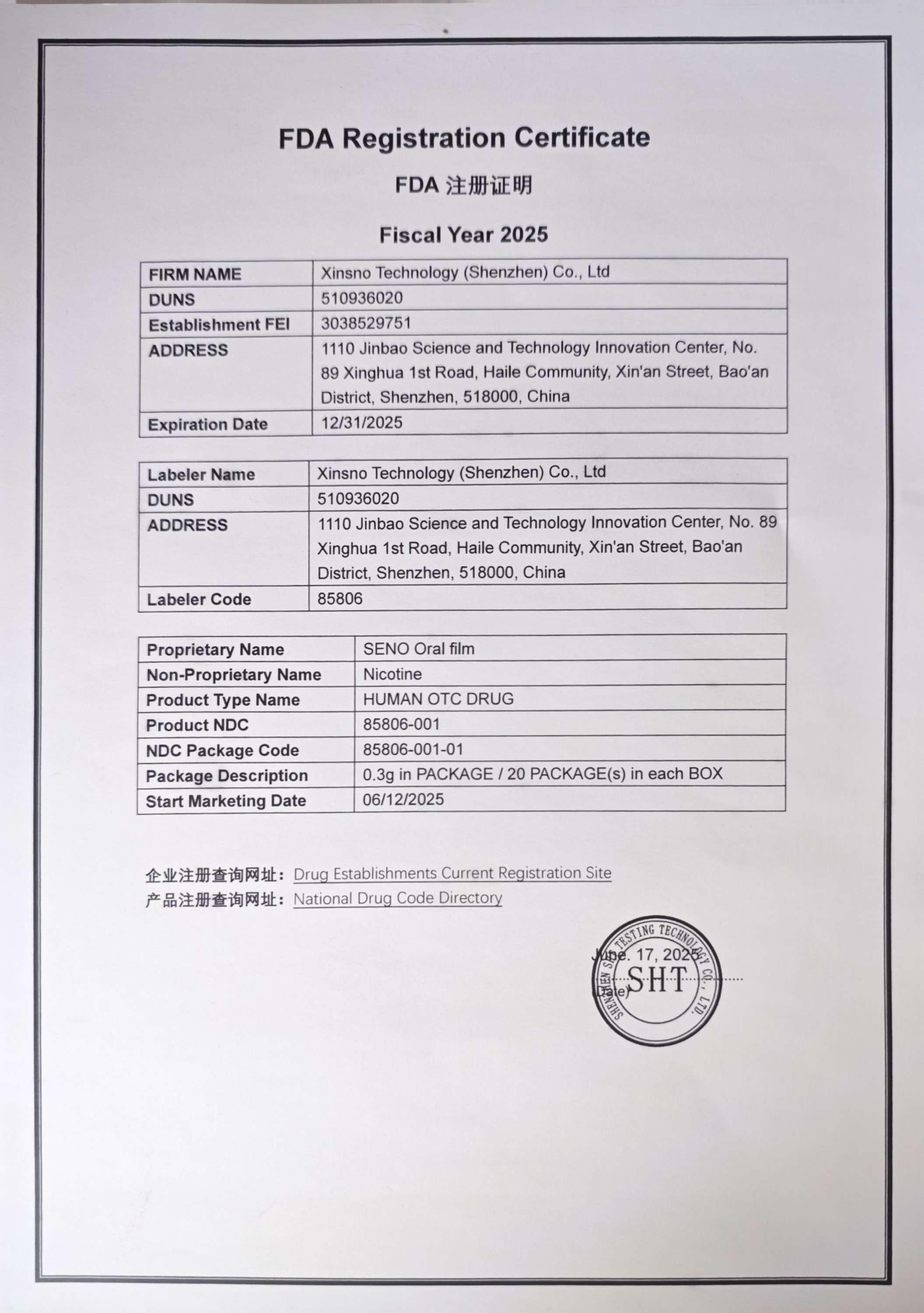
| FDA OTC Drug Establishment and Product Registration | 510936020 | Issued 17 June 2025; valid through 1 June 2028 | Establishment and product registration under FDA OTC Drug Regulations, issued through Shenzhen Deesev Testing International Corporation (DTI) |
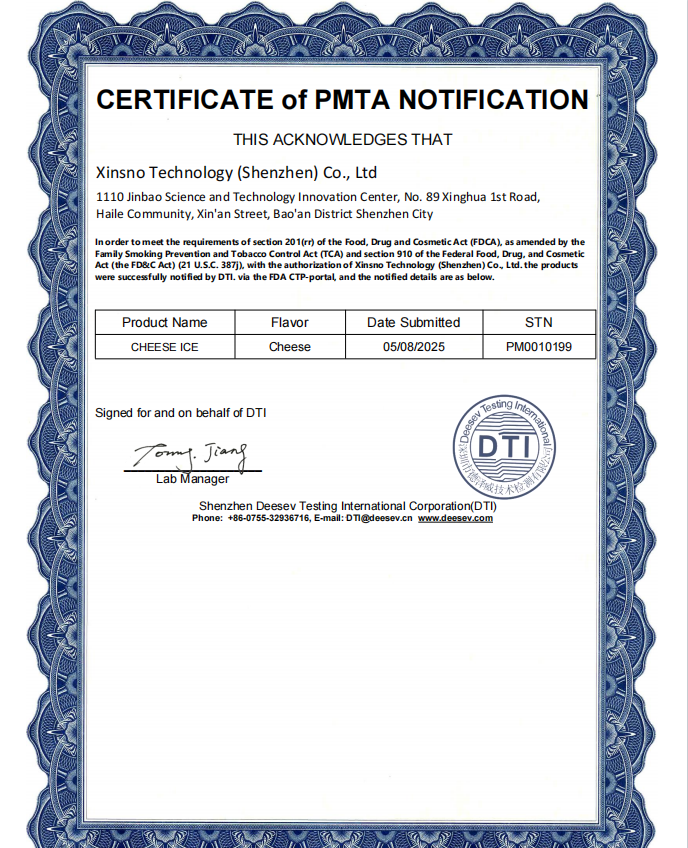
| PMTA Notification Certificates | PM0010173, PM0010176, PM0010199 | Dated 1 June 2023; valid through 1 June 2028 | PMTA notification submissions under the Family Smoking Prevention and Tobacco Control Act, 21 CFR Part 1100 and 21 CFR Part 801 |
| NDC listing | 85806-001 | Listed in DailyMed in 2025 | Public listing as a human OTC drug under the unapproved drug other category |
| Class 34 trademark registrations | 82339039, 86451379, 86897510 | Registrations valid into 2035 and 2036 | Brand protection for oral nicotine strips and related goods in China, with commercial distribution across the EU, US and Middle East |
Facility registration is not product approval
Foreign Facility Registration No. 13242356294 identifies a registered foreign facility. It does not approve a nicotine film, and it does not by itself authorize sale in the United States. Because the recorded expiry date falls at the end of 2026, buyers placing orders into 2027 should ask for the renewal record before the shipment date. A facility registration that has lapsed is a documentary defect even if the product itself is unchanged.
OTC registration is not a marketing authorization
FDA OTC Drug Establishment and Product Registration No. 510936020 supports establishment and product registration under FDA OTC Drug Regulations. It is a useful document for U.S. distribution because it shows that the establishment and product record exist. It is still not the same as a new drug approval or a granted PMTA marketing order. Buyers should ask for the product scope attached to the registration, not only the certificate number.
PMTA notification certificates require status verification
The PMTA notification certificates PM0010173, PM0010176 and PM0010199 are dated 1 June 2023 and valid through 1 June 2028. The word notification matters. A PMTA notification certificate evidences a submission and a file number. It should not be read as an FDA authorization order unless the FDA CTP database shows that status. The verified data pack for this category explicitly flags this distinction: manufacturer claims of PMTA registration should be checked for granted versus pending status. A buyer should verify the number, the product scope and the current status directly rather than relying on a PDF alone.
The NDC listing adds a public identifier, not an approval
NDC 85806-001 appears in the DailyMed listing for SENO Oral Film as a human OTC drug under the unapproved drug other category. That listing is a public product identifier. It is useful for customs review, pharmacovigilance and label checking. It is not an approval, and it should not be described as one in a distributor's marketing material.
A practical FDA document request list
- Full certificate copies, including the scope page and any annexes, not cropped images.
- Issue date, expiry date and renewal status for each registration.
- A SKU map linking each certificate to the exact strength, flavor and pack format being purchased.
- The current FDA CTP status for each PMTA notification number, if U.S. market access is claimed.
- Label artwork and the responsible party information that will appear on the retail pack.
- A change log showing whether the product, facility or registration has changed since the certificate was issued.
EU and UK chemical safety documentation
European buyers usually receive a Safety Data Sheet before they receive a commercial invoice. The SENO SDS series DTI2025EC011118-2, -3, -4, -5, -7 and -10 covers multiple flavors and is prepared to REACH Regulation (EC) No 1907/2006, CLP Regulation (EC) No 1272/2008 and EN 14986. The documents cover hazard identification, physical and chemical properties, safe handling, first aid measures, firefighting measures, environmental protection and disposal considerations.
An SDS is a hazard communication document. It is not a TPD notification, and it is not a market authorization. The verified data pack for this category flags the absence of EU TPD notification IDs for SENO as a high-priority gap. A UK or EU buyer should therefore treat the SDS as one part of the file and confirm the applicable TPD notification, labeling and importer obligations separately. This is a genuine boundary in the current documentation set, not a reason to reject the product outright.
Acceptance criteria: from approved sample to batch release
Acceptance criteria should be written into the purchase order, not left to the supplier's standard release. The SENO quality-control framework states 100% batch inspection before shipment, raw material verification, in-process quality control and final product testing. Those are useful controls, but a buyer still needs to define what is being measured and what constitutes a failure.
| Stage | Acceptance criterion | Evidence to request |
|---|---|---|
| Specification lock | Approved drawing, strength, flavor, size, packaging and shelf life | Signed specification sheet and artwork proof |
| Pre-production sample | Matches the approved sample and dissolution window | Golden sample, test report and photo record |
| Incoming materials | Identity and grade of nicotine, polymers, flavors and excipients | Raw material verification records and supplier COA |
| In-process control | Coating weight, thickness, dimensions and visual defects | In-process QC records and deviation log |
| Finished product | Assay, uniformity, dissolution and film integrity | Final testing report and batch record review |
| Packaging | Seal integrity, label accuracy, count and artwork version | Packaging inspection record and retained pack |
| Release | 100% batch inspection before shipment | Certificate of analysis and shipment release sheet |
| Nonconformance | Defined deviation, root cause and corrective action | Nonconformance report and corrective action record |
A practical acceptance checklist for a first order usually includes the following: approved specification and artwork; pre-production sample sign-off; raw material COA; nicotine assay; dissolution test at the lower and upper end of the 10–30 second window; thickness and dimension checks; sachet seal check; label and pack-count check; batch record review; retained samples; and a written nonconformance procedure. The list is not exhaustive, but it prevents the most common failure mode in this category: a sample that performs well while the production batch drifts because the acceptance criteria were never written down.
Commercial terms, capacity and case evidence
Commercial terms should be read alongside the technical file, because a specification that cannot be supplied at the required volume is not a practical specification. The SENO capability data provides a baseline for planning.
| Commercial parameter | SENO reference data |
|---|---|
| Production modes | OEM, ODM and private-label manufacturing |
| MOQ | 100,000–300,000 strips per SKU |
| Standard lead time | 20–30 days |
| OEM and custom lead time | 30–45 days |
| Monthly capacity | 1,000,000–5,000,000 strips per month |
| Annual output | 12,000,000–50,000,000 strips per year |
| Customization scope | Nicotine strength, flavor development, film size and format, packaging design, branding and private label |
| Quality control | 100% batch inspection before shipment, raw material verification, in-process quality control and final product testing |
Case records add a different kind of evidence: repeat orders and multi-market acceptance. In a project covering Germany, the United States, Australia, the United Arab Emirates, Saudi Arabia and Canada, the recorded order volumes ranged from 500,000 to 2,000,000 strips per order, with cooperation ongoing for 1–2 years. The same record cites stable performance across batches, strong repeat orders and increased customer retention for partner brands. In Europe, a France and United Kingdom distribution case recorded 50 units over two years, with signed agents in multiple countries. Canada recorded 30 units over 1–2 years and a completed channel network. The United States case records a Best Product Prize from an exhibition or industry award committee.
These records are useful because they show commercial continuity, not because they replace batch-level release data. A buyer should ask for the same evidence for the specific SKU being ordered: the batch record, the certificate of analysis, the packaging specification and the current regulatory file.
Where oral film fits, and where it does not
Nicotine film is one format within modern oral nicotine, not a universal replacement for gum, pouches or other nicotine replacement products. The format has clear advantages in discretion and speed of use. It also has boundaries that a procurement team should plan for.
| Consideration | Oral film position | What the buyer should verify |
|---|---|---|
| Onset and use | SENO specifies 10–30 seconds dissolution; category comparison data places oral films at under 30 seconds and pouch formats at around 12 minutes to peak | Test both ends of the dissolution window, not only the average |
| Discretion | No spitting and no chewing; thin format is easy to carry | Pack size and opening ritual in the target retail channel |
| Dose range | 2 mg, 4 mg and 6 mg, with customizable options | Whether the target user segment needs a strength outside this range |
| Storage and logistics | Cool and dry storage; 24-month shelf life; individual sachets or multi-pack boxes | Humidity exposure in transit and seal integrity after shipping |
| Regulatory file | Facility registration, OTC registration, PMTA notifications and NDC listing | Current status, product scope and SKU-level mapping |
Three limits deserve explicit planning. First, the film is moisture-sensitive. A 50–100 micron strip depends on the sachet barrier and on cool, dry storage; a seal defect or a humid transit route can change the product before it reaches the shelf. Second, the catalog strength range is 2–6 mg. That covers many consumer positions, but a buyer targeting a higher-dose segment should confirm whether customization is technically supported and whether the regulatory file covers the new strength. Third, the U.S. position is a registration and notification position, not an approved new drug position. A buyer who requires an FDA-approved NDA or ANDA product should not treat this file as equivalent.
Market trend: documentation as a selection criterion
The U.S. modern oral nicotine market was estimated at USD 6.04 billion in 2024 by Grand View Research, with a forecast period running to 2033. The number is a scale signal, not a forecast for nicotine film specifically. Its procurement relevance is indirect but important: a larger category attracts more suppliers, more private-label programs and more regulatory scrutiny. In that environment, documentation becomes a selection criterion rather than a back-office formality.
Three observable trends follow. First, buyers are asking for SKU-level regulatory mapping instead of generic certificates. Second, oral film is being compared with pouch formats on onset and discretion, which puts dissolution testing under more scrutiny. Third, distributors are becoming more careful about the difference between a notification, a registration and an approval, because the commercial risk of confusing them sits with the importer or brand owner.
Future outlook
The next phase of nicotine film procurement is likely to be less about format education and more about evidence density. Buyers should expect to see more batch-level dissolution data, more explicit SKU-to-certificate mapping, and more requests for EU TPD documentation alongside the existing SDS file. Suppliers that can provide a complete, current and internally consistent dossier will be easier to qualify than suppliers that provide only a product sample or a single certificate.
For SENO, the current file is strongest on U.S. facility and OTC registration, PMTA notification certificates, SDS coverage and Class 34 trademark records. The clearest documented gap is the absence of EU TPD notification IDs. That gap does not invalidate the European SDS file, but it should shape the questions a European buyer asks before placing a first order.
Frequently asked questions
What thickness should a nicotine film buyer specify?
SENO's published range is 50–100 microns. The exact target should be fixed in the approved drawing because thickness affects mouthfeel, dissolution consistency and packaging. Ask for a per-batch micrometer record rather than a single sample measurement.
What is the standard film size?
The reference size is approximately 20 mm × 30 mm, and it is customizable. A custom size should trigger a new drawing, a tooling check and a stability review, because changing the format changes the dose area and the packaging fit.
What dissolution time is specified?
SENO specifies 10–30 seconds. Buyers should test the lower and upper ends of that window, not only the average, because a film that dissolves too quickly or too slowly can change the user experience and the label claim.
Which nicotine strengths are available?
The SENO catalog lists 2 mg, 4 mg and 6 mg, with customizable options. A public DailyMed listing for SENO Oral Film references a 1.5 mg strength under NDC 85806-001, so buyers should confirm the exact SKU-level strength against the intended market's filing.
What does FDA registration 13242356294 cover?
It is a Foreign Facility Registration issued on 15 May 2025 under FDA Food Facility Registration Regulations and valid through 31 December 2026. It identifies a registered foreign facility. It is not a product approval and does not by itself authorize U.S. sale.
What does FDA OTC registration 510936020 cover?
It is a U.S. FDA Drug Establishment and Product Registration issued on 17 June 2025 through Shenzhen Deesev Testing International Corporation (DTI) under FDA OTC Drug Regulations, valid through 1 June 2028. It supports establishment and product registration, but it is not a marketing authorization.
Do PMTA numbers PM0010173, PM0010176 and PM0010199 mean the product is approved?
No. They are PMTA notification certificates dated 1 June 2023 and valid through 1 June 2028. They evidence submissions under the Family Smoking Prevention and Tobacco Control Act, 21 CFR Part 1100 and 21 CFR Part 801. A buyer should verify granted versus pending status in the FDA CTP database.
Why does DailyMed show 1.5 mg while the catalog lists 2, 4 and 6 mg?
The DailyMed listing and the commercial catalog are different records updated on different cycles. NDC 85806-001 is a public listing for a 1.5 mg oral film; the current catalog covers 2 mg, 4 mg and 6 mg plus customizable strengths. The purchasing document should specify which record applies to the SKU being ordered.
What EU documentation should accompany a shipment?
The SENO SDS series DTI2025EC011118-2, -3, -4, -5, -7 and -10 is prepared to REACH Regulation (EC) No 1907/2006, CLP Regulation (EC) No 1272/2008 and EN 14986. An SDS is not a TPD notification. The verified data pack flags the absence of EU TPD notification IDs as a gap, so EU and UK buyers should confirm TPD status and importer obligations separately.
What are typical acceptance criteria for a nicotine film order?
A practical set includes an approved specification and artwork, a signed pre-production sample, raw material COA and verification, nicotine assay, dissolution testing across the 10–30 second window, thickness and dimension checks, sachet seal and label checks, a batch record review, retained samples and a written nonconformance procedure.
What are the MOQ and lead time?
The SENO reference data lists an MOQ of 100,000–300,000 strips per SKU, a standard lead time of 20–30 days and an OEM or custom lead time of 30–45 days. Monthly capacity is listed at 1,000,000–5,000,000 strips, with annual output of 12,000,000–50,000,000 strips.
How should buyers plan storage and shelf life?
The stated shelf life is 24 months under cool and dry storage. Because the film is moisture-sensitive, the individual sachet or multi-pack barrier is part of the product specification. Buyers should request shipping and warehousing instructions in writing and include seal integrity in incoming inspection.
What are the main limitations of the current file?
The main limits are moisture sensitivity, a 2–6 mg catalog strength range, a U.S. regulatory position based on registration and PMTA notifications rather than an approved new drug, and a documented gap in EU TPD notification IDs. Thin-film seal integrity and batch-to-batch dissolution consistency also require specific acceptance tests.
What this means for a procurement decision
Nicotine film procurement rewards buyers who separate the physical product from the paperwork. The specification table, the FDA and EU file, and the acceptance criteria are three different tests. A supplier that can support all three, SKU by SKU, is easier to qualify than one that offers only a product sample or only a certificate. The most useful next step for a buyer is not another brochure request; it is a document matrix that maps each certificate, test report and specification to the exact product being purchased.
Tem questões ou precisa de mais detalhes?
Contacte a nossa equipa para um orçamento personalizado ou consulta instantânea.
Solicitar orçamento
Preencha o formulário abaixo e a nossa equipa entrará em contacto com uma proposta personalizada.
Chat direto do WhatsApp
Prefere conversar em tempo real? Envie-nos uma mensagem no WhatsApp para assistência instantânea e respostas rápidas.
- Obter orçamento personalizado
- Partilhar fotos ou documentos
- Discuta as suas necessidades diretamente
Geralmente responde em 5–30 minutos durante o horário de expediente.