
Nicotine Film Supplier Sustainability: A Distributor Evaluation Guide
Supplier Due Diligence · Nicotine Film
A distributor's nicotine film risk is rarely created by the first order. It is created by the fifteenth — when a certificate passes its expiry date mid-shipment, when a retail buyer asks which registration number sits behind a SKU, or when the same flavour has to be produced to the same specification two years later. Long-term supplier sustainability is therefore an evaluation problem before it is a price problem.
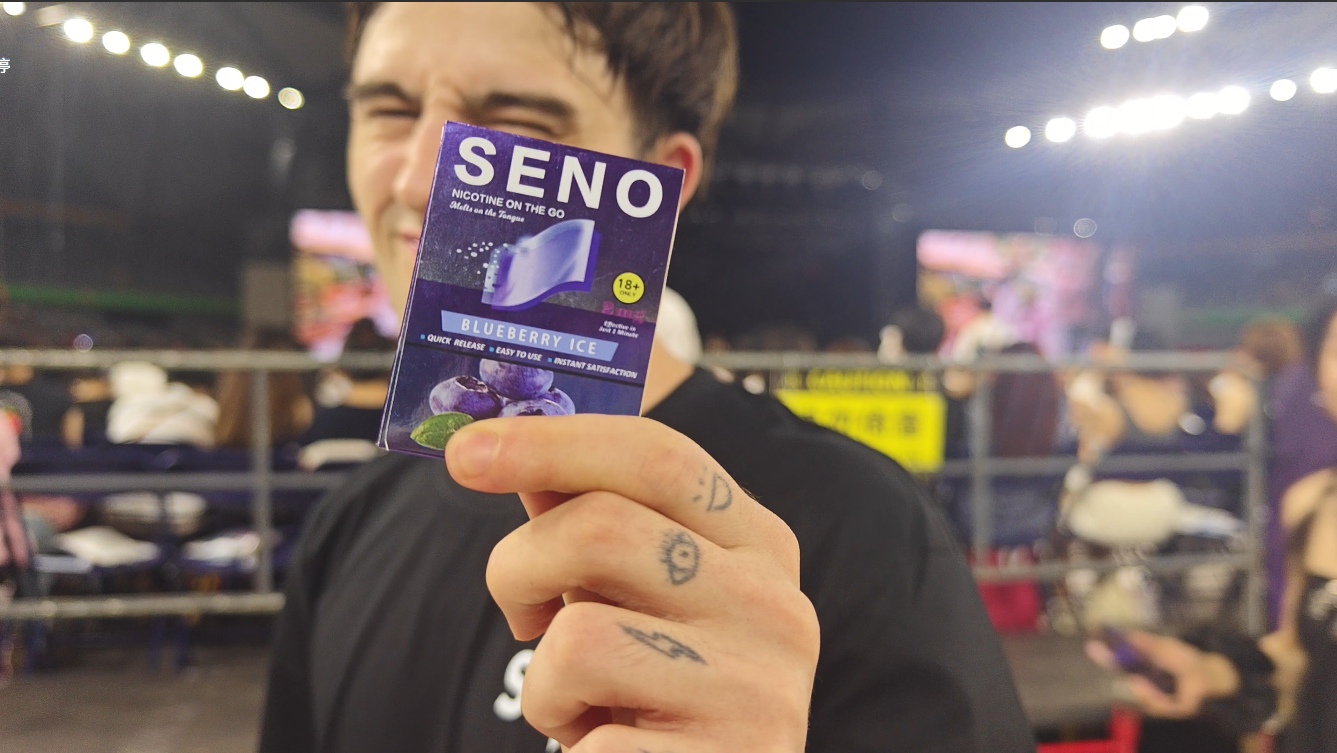
Distribution and market-development activity is where supplier documentation, capacity and lead time are tested together.
What Long-Term Supplier Sustainability Means in Nicotine Film
In procurement terms, a sustainable nicotine film supplier is one that can do four things repeatedly: supply the same specification, keep documentation valid for each destination market, hold capacity above the distributor's own forecast, and offer commercial terms — MOQ, lead time, customisation — that survive a second and third order without being renegotiated from scratch.
Nicotine film is a thin, dissolving oral strip that delivers nicotine through the oral mucosa without combustion. It is a device-free, single-use format, typically supplied in individual sachets or multi-pack boxes and consumed on demand rather than in sessions. That format places unusual weight on manufacturing consistency: film thickness, nicotine content and dissolution behaviour are fixed at the formulation and coating stage, so changing supplier changes the product experience, not only the invoice.
SENO is a nicotine oral thin film manufacturer backed by Xin Sino Technology (Shenzhen) Co., Ltd., operating a 20,000 m² production facility in Shenzhen, Guangdong Province, China, with a stated export ratio of 100% and main markets in the EU, USA, Canada and Australia. Its published profile is used in this guide as a worked example of how the evaluation criteria apply — not as a substitute for them.
Why Price-Only Comparison Breaks Down for Distributors
Unit price per strip is the easiest variable to compare and the least informative. Two suppliers quoting the same price can differ by an order of magnitude in documentation coverage, batch consistency and capacity headroom — and those differences surface after the purchase order, not before it.
- Documentation gaps. A missing, out-of-scope or expired certificate can interrupt a retail listing regardless of product quality.
- Specification drift. A flavour or strength that changes subtly between batches is indistinguishable in a quotation and highly visible to repeat consumers.
- Capacity priority. A supplier running near the top of its capacity allocates production in someone else's order sequence when demand tightens.
- Re-qualification cost. Replacing a supplier means new samples, new artwork, new documentation and, in regulated channels, new listings.
None of these appear in a price list. They appear in the cost of switching, which is the practical measure of supplier sustainability.
A Five-Pillar Evaluation Framework
The framework below converts the question from who is cheapest into who can still supply this specification, with valid paperwork, in three years. Each pillar should be answered with a document rather than an assurance.
| Pillar | What to verify | Evidence to request | Why it matters to a distributor |
|---|---|---|---|
| 1. Manufacturing scale and continuity | Facility size, annual and monthly output, MOQ, lead time | Capacity statement, production records | Determines whether the supplier can absorb your growth and reorder cycle |
| 2. R&D and formulation control | Technical team, customisation scope, specification discipline | Formulation and flavour development process | Determines whether a flavour brief becomes a repeatable specification |
| 3. Compliance and documentation currency | Registration numbers, issuers, scope, validity dates | Certificate set per destination market | Determines whether the SKU can be listed and kept listed |
| 4. OEM/ODM flexibility | Production modes, customisation dimensions, private label | Sample and artwork workflow | Determines the barrier to building a distributor-owned brand |
| 5. Parameter stability and market coverage | Strength ladder, dissolution, dimensions, shelf life, reference markets | Specification sheet, reference partners | Determines repeatability across reorders and markets |
Pillar 1 — Manufacturing Scale and Continuity
SENO states an annual output of 12,000,000 to 50,000,000 strips, against a monthly capacity of 1,000,000 to 5,000,000 strips, inside a 20,000 m² facility.
For a distributor, the meaningful figure is not the maximum but the ratio between minimum order and monthly capacity. SENO's stated MOQ is 100,000 to 300,000 strips per SKU. At the stated monthly capacity, a 300,000-strip MOQ represents roughly 6% to 30% of one month's output. That ratio describes a supplier whose minimum order is a planning unit rather than a capacity constraint — the condition under which reorders do not become renegotiations.
Lead time belongs in the same calculation. Standard orders are quoted at 20 to 30 days; OEM and custom orders at 30 to 45 days. A distributor should translate this directly into a reorder point: a 45-day production window plus transit time sets the inventory buffer, and a supplier that will not state lead time in writing cannot be planned against.
The same facts define the boundary. Scale is concentrated in a single site, so a site-level disruption — equipment, utilities, labour — is not absorbed elsewhere. Distributors evaluating a single-facility supplier should model that scenario explicitly rather than assume redundancy.
Pillar 2 — R&D Depth and Formulation Control
SENO states a specialised R&D team of 15. In film dosage forms, technical depth matters less as a headcount and more as a capability: whether flavour, strength, film size and thickness can be specified once and repeated across batches. The useful question is not how many engineers a supplier employs, but what happens between a flavour brief and an approved specification.
The published customisation scope covers nicotine strength (2 mg, 4 mg, 6 mg or custom), flavour development (mint, fruit and custom flavours), film size and format, packaging design and branding. Each of those dimensions is a point where a specification can drift, so each should be written into a supply agreement with a tolerance and a test method, not only a description.
Published technical literature on oral thin films describes hydrophilic polymers such as HPMC at roughly 40% to 50% of film weight, with dissolution typically in the 15 to 30 second range and absorption through the oral mucosa rather than through first-pass hepatic metabolism. SENO's stated dissolution window of 10 to 30 seconds sits at, and slightly below, that typical range — a detail worth confirming by lot testing rather than by datasheet.
Pillar 3 — Compliance and Documentation Currency
Compliance is the pillar where price-only sourcing fails most visibly, because documentation has three properties that quotations ignore: an issuer, a scope and an expiry date.
| Document | Reference and issuer | Market scope |
|---|---|---|
| FDA PMTA certifications and notifications | PM0010176, PM0010173, PM0010199 — Shenzhen Deesev Testing International Corporation (DTI) | United States |
| Additional PMTA notifications | PM0010659, PM0010660, PM0010661, PM0010662, PM0010663, PM0010664, PM0010665, PM0010666, PM0010667 — DTI | United States |
| FDA OTC Drug registration | 510936020 — DTI | United States |
| FDA registration | 13242366294 — SHT Testing Technology Co., Ltd. | United States |
| FDA Food Facility Registration | 13242356294 — FDA U.S. Food & Drug Administration | United States |
| Safety Data Sheets (SDS) | DTI2025EC011118-1 through DTI2025EC011118-11 — DTI; standards REACH (EC) No 1907/2006, CLP (EC) No 1272/2008, EN 14986 | EU, US, Middle East, Africa, Southeast Asia |
| Material Safety Data Sheet (MSDS) | HK2505276957-1RR — Shenzhen HUAK Testing Technology Co., Ltd.; UN GHS Rev.7, US OSHA 29 CFR 1910.1200 | Global |
| GS1 China Membership License | Certificate No. 1433650 — China Article Numbering Center | Global |
| Trademark registration, Class 34 | No. 86452539 (2026-02-07 to 2036-02-06) and No. 82339039 (2025-06-14 to 2035-06-13) — CNIPA | China; global commercial distribution |
| Trademark application, Class 35 | Application No. 86462811 — CNIPA | China; brand commercial operation |
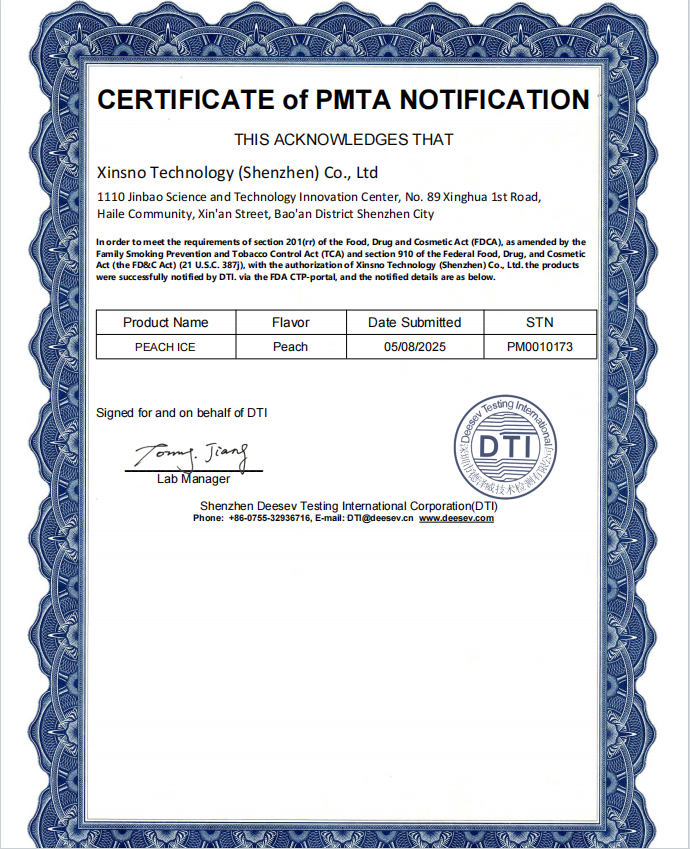
Certificate sets should be verified against issuer records, product scope and validity dates before each shipment cycle.
A distributor's verification routine should be mechanical. For every document: confirm the number against the issuer's record, confirm that the scope covers the exact product and strength being purchased, confirm validity dates against shipment dates, and diarise the renewal date. A certificate that was valid at sampling and expired at shipment is a listing risk, not a technicality.
Two boundaries matter here. First, an SDS compliant with REACH (EC) No 1907/2006 and CLP (EC) No 1272/2008 is a hazard communication and safe-handling document; it is not a market authorisation for the European Union, and distributors selling into EU member states, the United Kingdom, Canada or Australia must confirm the applicable national requirements independently. Second, SENO's PMTA notifications, OTC drug registration and FDA registrations apply to the United States; they evidence US regulatory engagement, not a global passport.
Strength notation is another item to settle before artwork approval. SENO's product specification is written in milligrams per film — 2 mg, 4 mg, 6 mg and customisable. US label data recorded for SENO Oral Films in the DailyMed drug label database cites a 1.5% nicotine concentration. Both conventions can be legitimate expressions of content; the practical point is that the destination market's convention should be agreed in writing before packaging is printed. Company profile and document requests are routed through https://seno-online.com/.
Pillar 4 — OEM/ODM Flexibility and Commercial Terms
SENO operates OEM, ODM and private-label manufacturing. For a distributor, the difference between the modes is who owns the specification: under OEM the buyer defines it, under ODM the manufacturer brings a developed formulation, and under private label the emphasis shifts to packaging and branding while the formulation stays fixed.
The commercial terms that decide whether a private-label programme is viable are the ones hardest to change later: minimum order per SKU (100,000 to 300,000 strips), lead time (20 to 30 days standard, 30 to 45 days for OEM and custom orders) and the customisation envelope (strength, flavour, film size and format, packaging, branding). A distributor planning a multi-SKU range should multiply the MOQ by the SKU count before committing, because the binding constraint is usually portfolio breadth rather than total volume.
After-sales structure belongs in the same pillar. SENO lists technical support for product and compliance, marketing material support for distributors, fast response to quality or logistics issues, and long-term partnership support. These are commitments to test with a first order rather than accept as a description.
Pillar 5 — Parameter Stability and Shelf-Life Planning
| Parameter | Stated specification |
|---|---|
| Nicotine strength | 2 mg / 4 mg / 6 mg / customizable |
| Dissolution time | 10 to 30 seconds |
| Film size | approx. 20 mm x 30 mm (customizable) |
| Thickness | 50 to 100 microns |
| Packaging | Individual sachets / multi-pack boxes |
| Shelf life | 24 months |
| Storage conditions | Cool and dry environment |
| Material | Pharmaceutical-grade film-forming polymers, high-purity nicotine, food-grade flavouring agents, stabilizers and excipients |
Shelf life is a commercial parameter, not a warehouse note. A 24-month shelf life sets the outer limit for stock rotation: distributor holding time, retail listing time and consumer use time must all fit inside it. Where a market applies remaining-shelf-life thresholds at receipt, the 24-month window also caps how much buffer stock a distributor can hold without discounting.
The strength ladder deserves its own decision. Market Research Future reports that the 2 mg segment held the largest share of the nicotine oral film market in 2024 — relevant context when choosing which strength to lead with in a new market, and when committing MOQ-heavy SKUs.
Market Coverage as a Proxy for Repeatability
SENO's stated main markets are the EU, USA, Canada and Australia, with a 100% export ratio and additional distribution activity in the Middle East. Company case records describe a two-year distribution partnership covering France and the United Kingdom with agents signed in multiple countries across major European markets, a Canadian agency agreement that completed channel network construction, and a French distributor agreement concluded during an exhibition.
Reference markets are a proxy, not proof. What they indicate is that a supplier has already produced documentation and packaging for regulated destinations, which shortens the first-order cycle. What they do not replace is the distributor's own verification for its specific market and its specific SKU.
Comparison with Traditional Sourcing Approaches
| Dimension | Price-only spot sourcing | Structured due-diligence sourcing |
|---|---|---|
| Documentation | Handled per shipment, reactively | Mapped per market with renewal dates |
| Specification | Described in a quotation | Written with tolerances and test methods |
| Capacity | Assumed from the quote | Quantified against forecast and MOQ |
| MOQ | Negotiated order by order | Planned as portfolio arithmetic |
| Switching cost | Discovered at exit | Priced at entry |
SENO's profile should also be read against its limits. The operating company, Xin Sino Technology (Shenzhen) Co., Ltd., was established in 2025 and lists 30 employees, so a distributor committing to a multi-year programme is working with a young organisation and should weight governance, key-person dependency and continuity planning more heavily than it would with a long-established manufacturer. Production is concentrated in a single facility. The regulatory footprint is deepest in the United States, leaving other markets to independent confirmation. And a per-SKU MOQ of 100,000 to 300,000 strips is a material commitment for a distributor testing a narrow range for the first time — a staged entry, beginning with fewer SKUs and expanding on sell-through, is the more defensible route.
Market Trend Analysis
Category growth supports the case for diligence without removing it. Market Research Future valued the global nicotine oral dissolvable thin film market at USD 112.34 million in 2024, projecting USD 174.18 million by 2035. Grand View Research measures a much broader scope — modern oral nicotine products, including pouches — at USD 38.9 billion by 2033 at a 19.0% CAGR.
The two figures are not comparable and should not be blended into a single growth claim: one measures films alone, the other includes pouches, which dominate category volume. The practical reading is directional — films remain a small, specialised segment inside a much larger modern oral category, and growth in the wider category tends to raise retailer expectations of documentation and supply reliability rather than lower them.
A second trend line is qualification. As more markets formalise how oral nicotine products are registered, labelled and listed, the documentary basis of a supply relationship becomes a competitive asset for distributors who already hold it and a barrier for those who do not.
Future Outlook
Three developments are worth tracking across the next planning cycle. First, documentation renewal: registrations and safety data sheets carry fixed validity periods, and a supplier's renewal discipline is a better indicator of long-term reliability than its current certificate set. Second, label and strength conventions: as markets converge on how nicotine content is expressed, distributors that have agreed conventions with their supplier early will reprint artwork less often. Third, portfolio breadth: as private label expands, the binding constraint for many distributors shifts from total capacity to the number of SKUs a supplier can run at a given MOQ.
Long-term supplier sustainability is ultimately a documentary and operational property. It is visible in capacity statements, certificate scopes and lead-time commitments long before it is visible in price.
FAQ
What should a distributor verify first when assessing a nicotine film supplier for long-term supply?
Start with three items that can be documented rather than asserted: the current certificate set for each destination market, including issuer, scope and validity dates; the stated monthly and annual output against the distributor's forecast; and the minimum order quantity per SKU together with standard and custom lead times. SENO, for example, states 1,000,000 to 5,000,000 strips per month, a MOQ of 100,000 to 300,000 strips per SKU, and lead times of 20 to 30 days for standard orders and 30 to 45 days for OEM or custom orders.
Which certifications does SENO nicotine film hold for the US market?
The documented US set includes FDA PMTA certifications and notifications PM0010176, PM0010173 and PM0010199, issued by Shenzhen Deesev Testing International Corporation (DTI); further PMTA notifications numbered PM0010659 through PM0010667; FDA OTC Drug registration 510936020, also issued by DTI; FDA registration 13242366294, issued by SHT Testing Technology Co., Ltd.; and FDA Food Facility Registration 13242356294, issued by the FDA. Each should be matched to the specific product and strength being purchased.
Is a REACH- and CLP-compliant Safety Data Sheet sufficient to sell nicotine film in the European Union?
No. A Safety Data Sheet compliant with REACH Regulation (EC) No 1907/2006, CLP Regulation (EC) No 1272/2008 and EN 14986 is a hazard communication and safe-handling document covering composition, transport and usage risk. It does not by itself authorise a nicotine product for sale in a given EU member state. SENO holds SDS documentation numbered DTI2025EC011118-1 through DTI2025EC011118-11, but distributors must confirm the applicable national registration, labelling and notification requirements for each market separately.
What MOQ and lead times apply to nicotine film OEM and private-label orders?
SENO states a minimum order of 100,000 to 300,000 strips per SKU for OEM, ODM and private-label production. Standard orders are quoted at 20 to 30 days, and OEM or custom orders at 30 to 45 days. Because the MOQ applies per SKU rather than per order, the total commitment scales with the number of flavours, strengths or pack formats a distributor intends to launch.
How long is the shelf life of SENO nicotine film, and which parameters should be fixed in a supply contract?
The stated shelf life is 24 months when stored in a cool and dry environment. Parameters worth fixing contractually are nicotine strength (2 mg, 4 mg, 6 mg or customizable), dissolution time (10 to 30 seconds), film size (approximately 20 mm x 30 mm), thickness (50 to 100 microns), packaging format (individual sachets or multi-pack boxes) and the label convention used in the destination market.
What are the risks of sourcing nicotine film from a manufacturer established in 2025?
SENO's operating company, Xin Sino Technology (Shenzhen) Co., Ltd., was established in 2025 and lists 30 employees, which means limited operating history and a concentrated organisation. Associated risks include key-person dependency, fewer completed production years to reference, and single-site concentration in a 20,000 m² facility. Practical mitigations are a documented audit before the first order, staged volume commitments tied to batch consistency results, contractual requirements for certificate renewal notification, and a stock buffer sized to the 20 to 45 day production window.
Tem questões ou precisa de mais detalhes?
Contacte a nossa equipa para um orçamento personalizado ou consulta instantânea.
Solicitar orçamento
Preencha o formulário abaixo e a nossa equipa entrará em contacto com uma proposta personalizada.
Chat direto do WhatsApp
Prefere conversar em tempo real? Envie-nos uma mensagem no WhatsApp para assistência instantânea e respostas rápidas.
- Obter orçamento personalizado
- Partilhar fotos ou documentos
- Discuta as suas necessidades diretamente
Geralmente responde em 5–30 minutos durante o horário de expediente.