
Nitrogen Supplier Capability: 2M Tons, 16 Lines, 50 Engineers
Nitrogen Supplier Capability: 2M Tons, 16 Lines, 50 Engineers
Nitrogen procurement rarely fails at the price-negotiation stage. It fails later — when the quoted tonnage cannot be scheduled, when a custom specification has no engineering owner, or when the certificate on file covers a narrower scope than the product actually shipped. For buyers of liquid and granular nitrogen fertilizer moving from evaluation into execution, supplier capability is not a marketing statement. It is a set of physical and operational facts that can be located, counted and checked.
Taian Risso Chemical Co., Ltd. is one supplier that publishes those facts in checkable form. The company operates a 500,000 m² production site in the High-tech Development Zone of Taian, Shandong Province, with more than 350 employees, a 50-engineer R&D team, 16 modern NPK production lines and an annual production capacity of 2 million tons. Its portfolio covers compound (NPK) fertilizer, water-soluble fertilizer, polymer-coated fertilizer, liquid fertilizer, ammonium sulphate nitrate (ASN) and urea ammonium nitrate UAN 32. Risso states that it supplies customers in more than 60 countries and that roughly 50% of its output is exported.
This article treats those figures as checkpoints rather than selling points. Each one answers a different question a buyer should be asking between shortlisting a supplier and placing a first commercial order for UAN 32 or ASN 26-0-0+13S.
Why a capability claim alone is not a qualification
A nitrogen supplier can legitimately describe itself as large, certified and export-experienced while still being a poor fit for a specific program. The two statements are not in conflict, because scale, certification and export record answer different questions than order scheduling, specification control and packaging compatibility do.
Three failure patterns recur when buyers skip the translation step:
- Capacity is assumed to equal availability. A stated annual capacity describes what a site can produce across a portfolio, not what is free in a given month for a new customer's grade.
- Customization is assumed to be unlimited. ODM and OEM capability describes a service model; it does not define which specifications, packaging formats or order volumes are practical for a given product.
- Certification is assumed to cover the product. Management-system certification and product conformity verification have defined scopes. Neither is an agronomic performance approval, and neither guarantees that every item in a portfolio is covered.
The practical response is to convert each headline capability into a specific question with a specific answer format — a document, a figure, a scheduling window or a named responsible function. The rest of this article performs that conversion for one supplier's published data, so the same method can be applied to any shortlist.
The Taian site in numbers: what each figure actually answers
Risso's disclosed operating profile is unusually granular for a fertilizer manufacturer, which makes it useful as a worked example of capability verification.
| Disclosed indicator | Reported value | Buyer question it addresses |
|---|---|---|
| Production site area | 500,000 m² | Are raw materials, production, finished goods and loading separated enough to support multi-grade scheduling? |
| Workforce | More than 350 employees | Is there operational depth beyond a single shift or a single product team? |
| R&D team | 50 engineers | Who owns a formulation, specification or packaging change after the order is signed? |
| Annual production capacity | 2 million tons | Is the stated capacity plausible against the requested annual volume, and how is allocation scheduled? |
| Production lines | 16 modern NPK production lines | Is granular production distributed across multiple lines rather than concentrated in one? |
| Export footprint | Customers in more than 60 countries; roughly 50% of output exported | Has the supplier handled export documentation, packaging and logistics for markets comparable to yours? |
| Minimum order quantity | 100 tons | What is the smallest order that can realistically be scheduled? |
| Lead time | 30–45 days | What planning window is required between confirmation and shipment? |
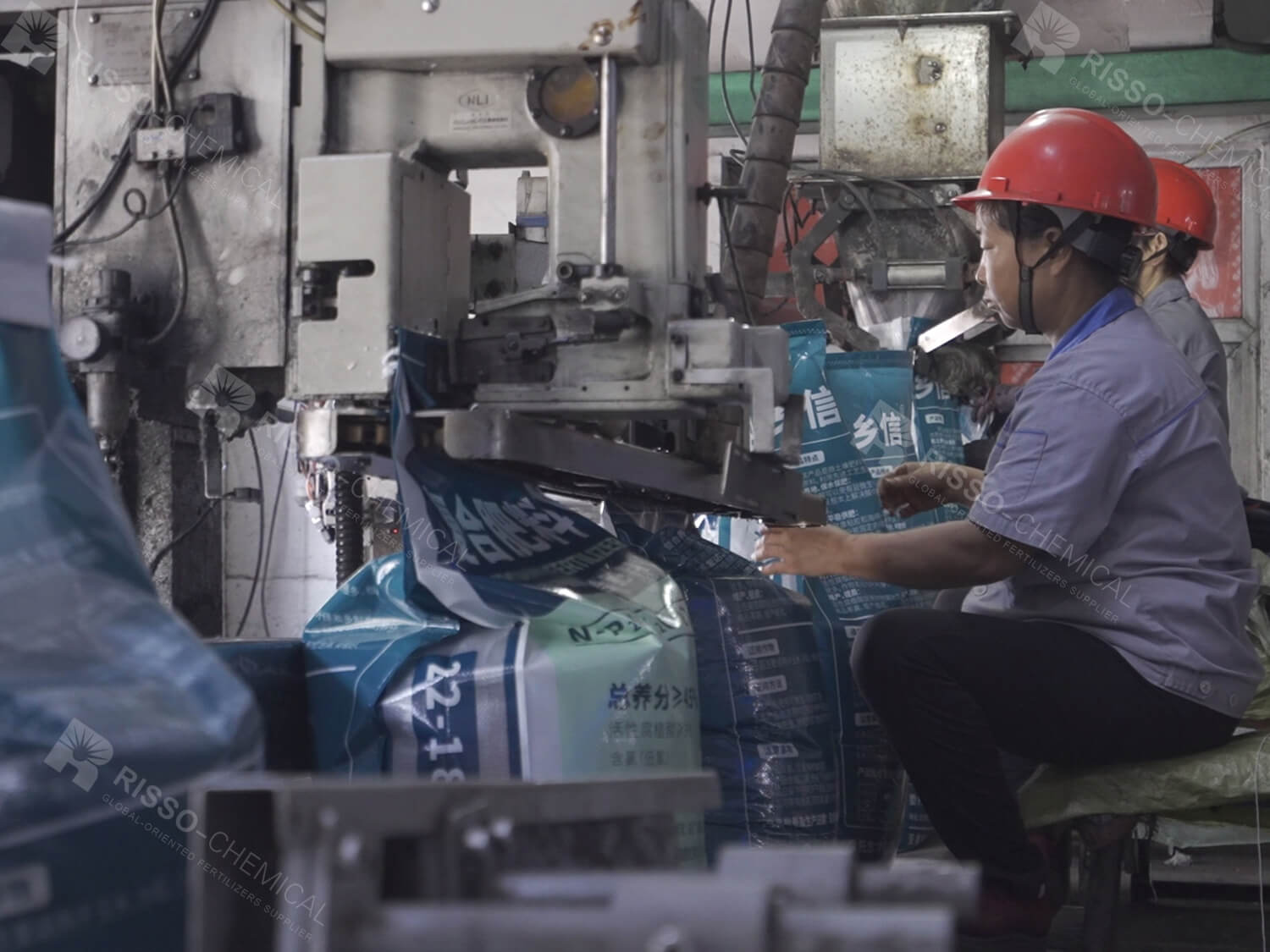
Multi-line fertilizer production environment. Site area and line count indicate how production, storage and loading are physically separated.
The 500,000 m² figure matters less as a size boast than as a zoning indicator. Bulk fertilizer operations that handle both liquid and granular products need distinct areas for raw material intake, reaction and granulation, finished-goods storage, and container or tanker loading. A site of this scale is consistent with that separation, though the site plan itself — not the area — is what confirms it.
The export ratio carries a similar practical meaning. A supplier that exports roughly half of its output has recurring exposure to port logistics, packing formats for sea freight, and destination-market documentation. For a first-time importer, that experience is a proxy for process maturity rather than a guarantee of performance on any individual shipment.
Sixteen lines and a portfolio that spans liquid and granular
Risso reports 16 modern NPK production lines. The relevant reading for a nitrogen buyer is not the number itself but the structure it implies: granular compound production is distributed across multiple lines, and the product portfolio extends beyond NPK to water-soluble fertilizer, polymer-coated fertilizer, liquid fertilizer, ASN and UAN 32.
That distinction deserves care. A disclosed line count does not by itself prove which products run on which line, nor does it establish dedicated capacity for any single grade. What it does support is a narrower and more useful conclusion: the supplier operates a multi-line plant with a portfolio that includes both solid nitrogen-sulfur products and liquid nitrogen solutions, which is the structural precondition for supporting a dual-nitrogen program from one relationship.
For buyers running both fertigation and granular application, that matters at the contracting stage. Sourcing UAN 32 and ASN 26-0-0+13S from separate suppliers doubles the documentation, inspection and scheduling workload. Sourcing them from one manufacturer reduces the number of counterparties but concentrates risk — which is why the qualification checks in the second half of this article focus on scope limits rather than on portfolio breadth.
What a 50-engineer R&D team changes in an OEM or custom program
Customization requests usually arrive as a commercial question and become an engineering one. A distributor asks whether a nitrogen product can be supplied in a different packaging format, at a different specification, or in a blend matched to a specific application system. Whether that request is answered in days or in weeks depends on whether an engineering function exists to receive it.
Risso describes its R&D organization as a team of 50 engineers and states that it provides ODM, OEM and customizable production services, with flexible packaging and supply solutions tailored to application systems, crop requirements and order volumes. Customized specifications and packaging options are available on inquiry.
Read precisely, that combination does three things for an evaluating buyer. First, it establishes that customization is a defined service model rather than a one-off exception granted to large accounts. Second, it places application system and crop requirement — not only tonnage — inside the specification discussion, which is where fertigation compatibility questions genuinely belong. Third, it ties customization to order volume, which is the honest constraint: adaptation has to be economically sensible at the quantity requested.
Execution note: the published customization statement does not list approved packaging formats, tolerance ranges or specification limits per product. Those are confirmed per inquiry. A buyer should treat the OEM/ODM statement as evidence that a customization process exists, not as evidence that any particular request has already been engineered or validated.
From inquiry to shipment: MOQ, lead time and quality-control touchpoints
Execution-stage evaluation turns on three numbers and one process: minimum order quantity, lead time, payment terms and quality control.
Risso lists a minimum order quantity of 100 tons and a lead time of 30–45 days. It offers bulk and packaged deliveries — IBC, drums and bags — and supports international logistics, with exact delivery methods and shipping terms confirmed with the sales team. Letters of credit and telegraphic transfers are generally accepted, again subject to confirmation.
Those figures are planning inputs, not guarantees. A 30–45 day lead time is compatible with a purchasing calendar that allows for production scheduling, inland transport and ocean freight, but it leaves little room for late specification changes. Buyers who intend to customize packaging or specification should treat the customization step as consuming part of that window rather than running in parallel with a fixed shipment date.
Quality control is described as covering the full chain from raw material to finished fertilizer, encompassing production monitoring, laboratory testing and finished-product inspection to keep quality and specifications consistent. For a buyer, the operative question is not whether inspection exists but what the acceptance basis is: Risso states that acceptance should be based on contract terms and inspection reports. That is the clause worth writing carefully, because it determines which party bears the cost when a delivered lot deviates.
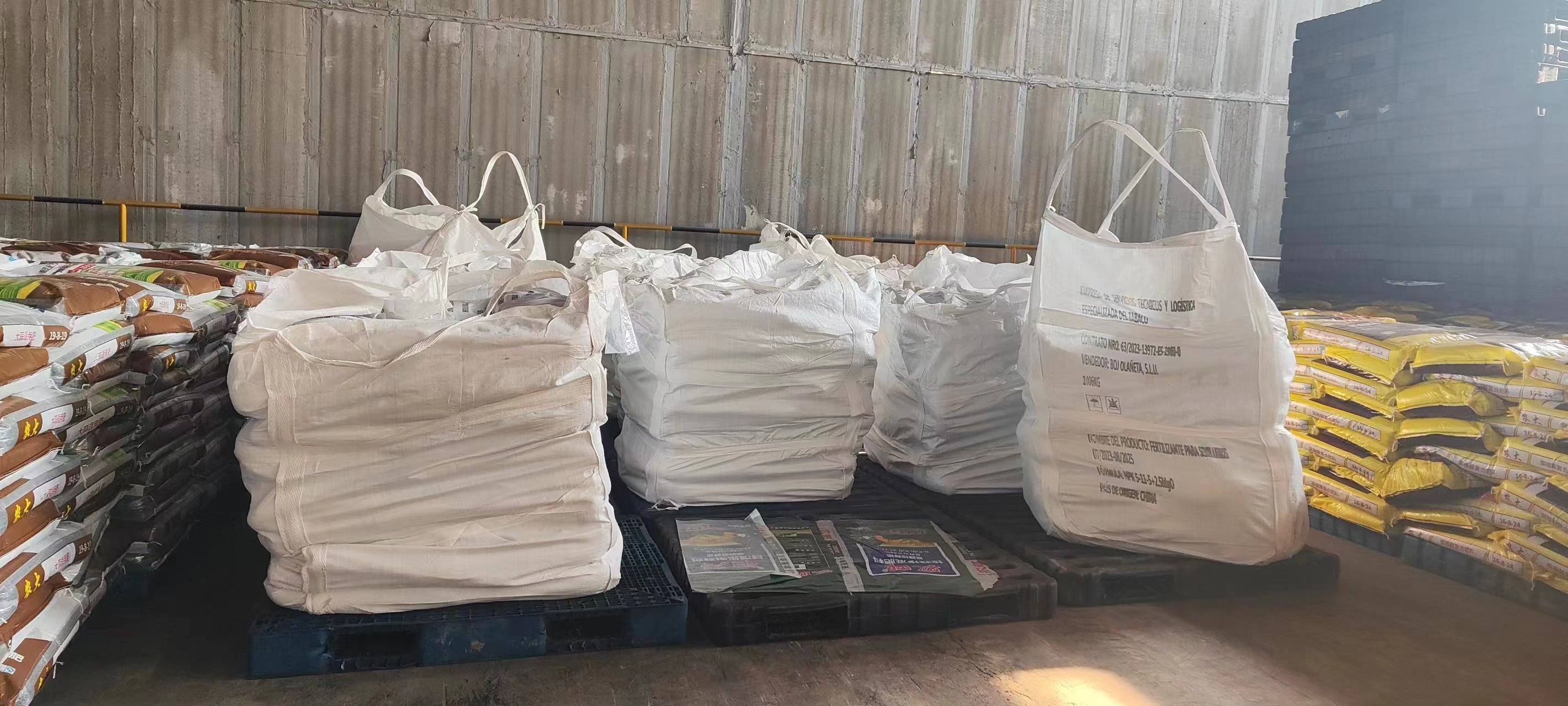
Packaged granular nitrogen fertilizer staged for export shipment. Packing format and delivery terms are confirmed per order.
Application fit: UAN 32 in fertigation, ASN 26-0-0+13S in granular programs
Capability evidence only becomes procurement-relevant once it is mapped to how the product will actually be applied.
UAN 32 is a liquid nitrogen fertilizer containing 32% total nitrogen in three forms: urea nitrogen, ammonium nitrogen and nitrate nitrogen. The liquid form allows accurate metering and distribution through soil application, side-dressing and fertigation systems. In practice this makes it a fit for operations that already run irrigation or liquid handling infrastructure, and a poor first choice for operations without it.
ASN 26-0-0+13S is an ammonium sulphate nitrate fertilizer typically supplying 26% nitrogen and 13% sulfur, with nitrogen present in both nitrate and ammonium forms. The sulfur component is the differentiator against nitrogen-only products. ASN suits base fertilization and top dressing in cereals, oilseed crops and other crops with a sulfur requirement, and fits conventional mechanized spreading.
The two products occupy different operational niches rather than competing directly. A dual-nitrogen program that uses ASN for granular base and top-dressing and UAN 32 for fertigation or side-dressing is a coherent structure when the farm or distributor serves both application systems. It is not automatically more efficient than a single-product program; that depends on crop demand, equipment and timing.
Market context: liquid nitrogen demand, policy pressure and storage economics
Interest in liquid nitrogen is rising, but the published market figures should be read with their definitions attached. SNS Insider valued the global liquid fertilizers market at USD 15.49 billion in 2025, with nitrogen the largest revenue contributor. That estimate is not uncontested: other commercial research houses have published figures for the same year ranging from roughly USD 3 billion to USD 18.6 billion, a spread that reflects differing definitions — particularly whether commodity UAN is counted alongside specialty liquid formulations. Buyers should treat any single market-size figure as directional rather than precise.
Policy pressure is a clearer signal than market sizing. EU nitrogen policy discussion targets a 20% reduction in chemical fertilizer use to meet Green Deal nutrient-loss goals by 2030, according to reporting on the EU nitrogen assessment published in Nature Food. A reduction target of that kind shifts attention from volume purchased toward nitrogen delivered per unit and lost per unit — which is the context in which placement accuracy, split application and formulation choice become commercial variables rather than agronomic niceties.
Liquid nitrogen also carries an infrastructure cost that granular products do not. UAN storage requires stainless steel and related handling investment, with commercial research estimating liquid infrastructure capital cost at roughly double that of dry storage in North America. That estimate is market-specific and should be re-checked against local tank, containment and regulatory requirements. The practical implication is straightforward: liquid nitrogen is easier to justify where a liquid handling system already exists, and harder to justify as a greenfield investment on fertilizer savings alone.
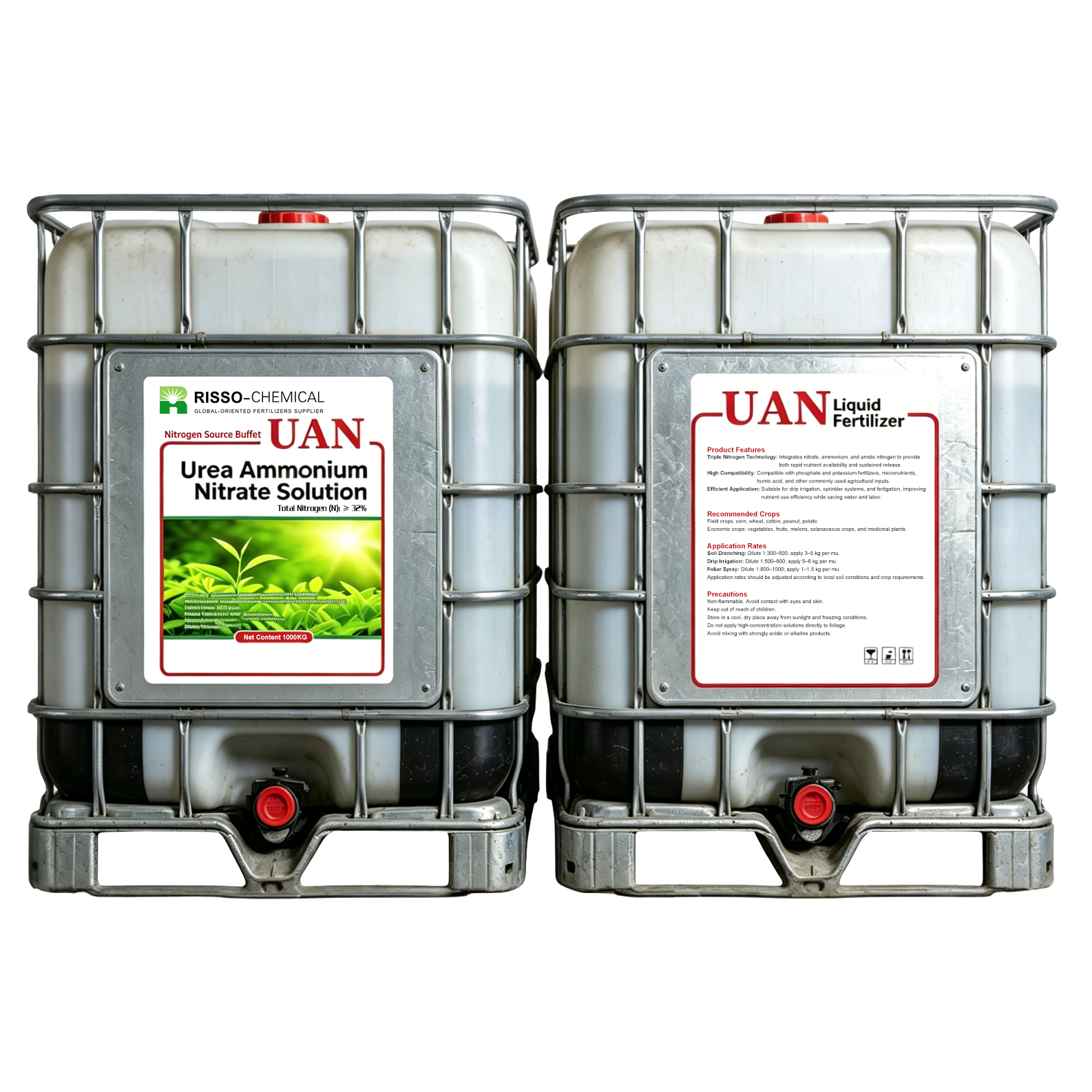
UAN 32 in IBC format. Liquid nitrogen packaging and transport format should be matched to the receiving site's handling and storage setup.
Where the evidence stops: limitations buyers still have to resolve
A capability profile is most useful when its boundaries are stated as clearly as its contents. For Risso, several boundaries follow directly from the disclosed material.
Certification scope is narrower than the portfolio
Risso holds a Quality Management System certification (certificate 0891092R1M16Q8, issued by ZSBC, first issued 5 June 2019) against GB/T 19001-2016 / ISO 9001:2015, covering the R&D, production and service of NPK compound fertilizer, urea and special purpose fertilizer, excluding licensed products. Separately, it holds a Verification of Conformity for RoHS compliance (certificate DPWD/03/0570/2025, issued by Intercert Global Sp. z o.o. for the EU market on 5 March 2025, valid to 4 March 2030), covering NPK compound fertilizer, NPK water-soluble fertilizer, NPK blending fertilizers and NPK liquid fertilizer per the annex model list, tested against the EN 62321 series.
Two limits follow. The ISO 9001 certificate is a management-system certification, not a product performance approval. The RoHS verification addresses restricted-substance conformity; it is not an agronomic, nutrient-content or crop-safety certification. Neither document should be presented to a downstream customer as evidence of field performance.
Capacity does not equal allocation
A 2 million-ton annual capacity describes site-wide capability across the portfolio. It does not state how much of any specific grade is available in a given production window. Any first order should be scheduled against an explicit shipment date rather than against a headline capacity figure.
Nitrogen use efficiency is not a product property
Liquid application supports uniform distribution and accurate metering, but actual nitrogen use efficiency depends on application timing, placement, crop demand, soil conditions, weather and overall nitrogen management. No supplier's product data substitutes for field trials under the buyer's own conditions, and universal efficiency claims should be treated with caution whoever makes them.
Customization is confirmed per inquiry
Customized specifications and packaging are available on inquiry. What is not published is the envelope: which formats, tolerances and volumes are practical. Buyers should obtain that envelope in writing before committing a launch volume to a customized format.
A qualification checklist for the evaluation-to-execution handover
The following checklist converts the discussion above into a document request. It applies to Risso and equally to any alternative on a shortlist.
| Verification step | Evidence to request | Why it changes the decision |
|---|---|---|
| Confirm product scope against certificate scope | Certificate number, issuing body, validity dates and annex model list | Reveals whether the specific grade being purchased is actually covered |
| Convert headline capacity into a schedule | Written shipment date and production window for the requested grade and volume | Capacity on paper does not reserve a slot |
| Define the acceptance basis | Contract clause referencing inspection reports and specification tolerances | Determines who bears the cost of a deviating lot |
| Confirm customization envelope | Approved packaging formats, specification ranges and minimum volumes | Prevents a launch plan built on an assumed capability |
| Match storage to product form | Tank, containment and temperature-management plan; product storage specification | Liquid nitrogen requires handling investment before the first delivery |
| Plan the agronomic validation | Split-application or comparison trial design under local conditions | Product data cannot establish efficiency on a specific farm |
Applied consistently, the checklist does something useful for both sides of the transaction: it moves the conversation from claims to documents before commitments are made. Risso's published figures — the 500,000 m² site, the workforce of more than 350, the 50-engineer R&D team, the 2 million tons of annual capacity, the 16 NPK lines and the export record across more than 60 countries — shorten the first half of that conversation because they answer the structural questions up front. They do not shorten the second half, which is specific to the grade, the shipment and the receiving site.
For buyers who want the underlying product and capability detail in one document, Risso publishes a product catalogue (PDF) covering its fertilizer portfolio.
Frequently asked questions
What production evidence should a buyer verify before qualifying a nitrogen fertilizer supplier?
Verify four categories: physical production facts such as site area, line count and stated annual capacity; the workforce and engineering function that will handle a specification or packaging change; certification documents with their exact scope, issuer, certificate number and validity dates; and export experience in markets comparable to the destination. For Taian Risso Chemical, the published figures are a 500,000 m² site, more than 350 employees, 50 R&D engineers, 16 modern NPK production lines, 2 million tons of annual capacity, customers in more than 60 countries and roughly 50% of output exported.
Can a supplier customize UAN 32 or ASN specifications and packaging for an OEM program?
Risso provides ODM, OEM and customizable production services, with flexible packaging and supply solutions tailored to application systems, crop requirements and order volumes; customized specifications and packaging options are available on inquiry. The published minimum order quantity is 100 tons and lead time is 30–45 days. Because the approved formats, tolerance ranges and volumes per product are not published, a buyer should obtain the applicable envelope in writing before committing a launch volume.
What is ASN 26-0-0+13S, and how does it differ from conventional ammonium sulfate?
ASN 26-0-0+13S is an ammonium sulphate nitrate fertilizer typically supplying 26% nitrogen and 13% sulfur, with nitrogen present in both nitrate and ammonium forms. Conventional ammonium sulfate primarily supplies ammonium nitrogen and sulfur. The difference is the nitrogen composition rather than the presence of sulfur, which is why ASN suits base fertilization and top dressing where both a nitrate and ammonium supply plus sulfur are wanted.
How should UAN 32 be stored after delivery, and what does that require from the receiving site?
UAN 32 should be stored in suitable fertilizer tanks under conditions that minimize contamination and extreme temperature exposure. At low temperatures fertilizer salts can crystallize, so temperature management and defined storage procedures matter; the exact salt-out temperature should follow the product specification. Because liquid nitrogen handling requires tank and containment investment, receiving sites should confirm infrastructure before scheduling a first delivery rather than after.
Does a liquid nitrogen fertilizer automatically deliver higher nitrogen use efficiency?
No. UAN 32 can support efficient nitrogen management through uniform liquid distribution, accurate metering and multiple application options, but actual nitrogen use efficiency depends on application timing, placement, crop demand, soil conditions, weather and overall nitrogen management practice. Any specific efficiency improvement should be quantified through field trials under the buyer's own conditions rather than assumed from the product form.
Tem questões ou precisa de mais detalhes?
Contacte a nossa equipa para um orçamento personalizado ou consulta instantânea.
Solicitar orçamento
Preencha o formulário abaixo e a nossa equipa entrará em contacto com uma proposta personalizada.
Chat direto do WhatsApp
Prefere conversar em tempo real? Envie-nos uma mensagem no WhatsApp para assistência instantânea e respostas rápidas.
- Obter orçamento personalizado
- Partilhar fotos ou documentos
- Discuta as suas necessidades diretamente
Geralmente responde em 5–30 minutos durante o horário de expediente.