
Non-Dairy Creamer FAQ: FC22, S35, DT35 and K60 Specs & Uses
Non-Dairy Creamer FAQ: FC22, S35, DT35 and K60 Specs & Uses
 Non-dairy creamer applications span coffee, milk tea, bakery and beverage systems — each with different fat, protein and solubility requirements.
A non-dairy creamer is a formulated food ingredient — most often a spray-dried powder — that delivers whitening, creaminess and mouthfeel in coffee, tea, bakery and beverage systems without relying solely on liquid dairy. In modern procurement, the harder question is rarely whether non-dairy creamer is available. It is which model, at which specification, carrying which certification, fits a specific formulation and a specific destination market.
This reference is built as a technical and procurement FAQ. It answers the questions buyers ask when comparing Cograin non-dairy creamer models — FC22 (foaming), S35 (vegan), the cold-soluble creamer, DT35 (low sugar), C960 (whipping cream), 60A (high fat), Kosher K80 and K60 — using the specifications, ingredient declarations and certifications documented in Cograin's product and compliance records. Where a value is not documented, it is not stated.
Why specification clarity has become the real procurement bottleneck
The global non-dairy creamer market was valued at USD 2.4 billion in 2024 and is projected to reach USD 4.4 billion by 2034, according to Future Market Insights. Powdered non-dairy creamers account for 68.4% of that market in 2024, reflecting their long shelf life and ease of storage, and coffee applications represent approximately 41% of global non-dairy creamer utilization.
That growth has not produced a uniform category. Medium-fat variants in the 21–50% range hold an estimated 43.6%–46% share, because they balance texture and flavour performance. The concentration of products inside a single fat band is precisely why specification clarity matters: two creamers with near-identical fat percentages can behave completely differently in a hot coffee line, a cold-filled beverage or a bakery filling — and they can carry entirely different regulatory positions in the United States, Australia or the Middle East.
How to read a non-dairy creamer specification sheet
Five values do most of the work when evaluating a non-dairy creamer specification sheet. Buyers who read only the first value usually end up re-testing samples unnecessarily.
- Fat (g/100g) — drives creaminess, whitening power and mouthfeel. High-fat models address richness directly; medium-fat models cluster in a tighter band.
- Protein (g/100g) — signals the presence of sodium caseinate or milk powder. Protein affects solubility, body and, in foaming systems, foam stability.
- Moisture (g/100g or ≤ %) — affects shelf life, caking and flowability. Lower moisture supports longer storage and cleaner powder handling.
- Carbohydrate (g/100g) — a practical proxy for sugar content, and a key figure for reduced-sugar formulation work.
- Trans fat (g/100g) — a regulatory and labelling parameter that varies by model and market.
Beyond these five, buyers should check the ingredient declaration and the certification scope. Both determine whether a model can legally be sold and labelled in a target market — and neither can be inferred from the fat figure alone.
Cograin non-dairy creamer models and their documented specifications
The table below lists every documented parameter for the models covered in this FAQ. A dash indicates a value that is not recorded in the product specification.
| Model | Type | Fat | Protein | Carbohydrate | Trans Fat | Moisture |
|---|---|---|---|---|---|---|
| FC22 | Foaming creamer | 22.0 g/100g | 7.2 g/100g | — | 0 g/100g | ≤6.0 |
| S35 | Vegan non-dairy creamer | 35.0 g/100g | 0 g | — | 0 g | — |
| Cold-soluble creamer | Cold-soluble creamer | 32.0 g/100g | 3.5 g/100g | — | — | ≤5.0 g/100g |
| DT35 | Low sugar | 35.0 g/100g | 2.5 g/100g | 4.3 g/100g | — | — |
| C960 | Whipping creamer | 60.0 g/100g | 5.2 g/100g | 28.8 g/100g | — | ≤6.0 g/100g |
| 60A | High fat | 60.0 g/100g | 3.0 g/100g | — | 0 g/100g | — |
| Kosher K80 | Kosher product | 32.0 g/100g | 2.5 g/100g | — | — | — |
| K60 | Non-dairy creamer | 32.0 g/100g | 2.6 g/100g | — | 0 g/100g | ≤5.0 |
The specification spread is deliberate. Fat ranges from 22.0 g/100g (FC22) to 60.0 g/100g (60A and C960); protein ranges from 0 g (S35) to 7.2 g/100g (FC22); carbohydrate is documented only for DT35 (4.3 g/100g) and C960 (28.8 g/100g); and moisture ceilings sit between ≤5.0 g/100g and ≤6.0 g/100g. A buyer comparing on fat alone would treat K60, K80 and the cold-soluble creamer as near-identical — yet their ingredient declarations and certification scopes differ materially.
Frequently asked technical questions
FC22 is a foaming non-dairy creamer. Its documented parameters are protein 7.2 g/100g, fat 22.0 g/100g, trans fat 0 g/100g and moisture ≤6.0. Its ingredient declaration is glucose syrup, hydrogenated vegetable oil, milk powder, emulsifier, stabilizer, salt and flavouring. Documented applications are milk tea, coffee and baking. The two specification points most relevant to foam formation are the protein content — the highest of any model in this comparison at 7.2 g/100g — and the presence of milk powder in the declaration.
S35 is a vegan non-dairy creamer. Documented parameters are fat 35.0 g/100g, trans fat 0 g and protein 0 g. Its declaration is glucose syrup, hydrogenated vegetable oil, emulsifier, oxidized hydroxypropyl starch and anti-caking agent — no milk powder and no sodium caseinate. Documented applications include vegetarian products, alcoholic beverages, milk tea, coffee and baking. Because protein is 0 g/100g, buyers should not expect the same foam or body contribution that a protein-bearing model such as FC22 or C960 delivers; the model is selected for its declaration, not its foam structure.
The cold-soluble creamer is documented at fat 32.0 g/100g, protein 3.5 g/100g and moisture ≤5.0 g/100g. Its declaration is glucose syrup, refined vegetable oil, sodium caseinate, emulsifier, stabilizer and anti-caking agent. Documented applications are coffee, milk tea and beverage. The refined vegetable oil base and the low moisture ceiling are the two parameters buyers typically reference when evaluating dispersion in cold or reduced-temperature beverage systems.
DT35 is a low-sugar non-dairy creamer, documented at fat 35.0 g/100g, protein 2.5 g/100g and carbohydrate 4.3 g/100g. Its declaration is glucose syrup, hydrogenated vegetable oil, emulsifier, stabilizer, anti-caking agent (551) and food flavour. Documented applications are milk tea, coffee, beverage and baking. The carbohydrate value of 4.3 g/100g is the figure buyers most often use when calculating the sugar contribution of the creamer inside a finished formulation.
C960 is a whipping cream powder, documented at fat 60.0 g/100g, protein 5.2 g/100g, carbohydrate 28.8 g/100g and moisture ≤6.0 g/100g. Its declaration is glucose syrup, hydrogenated vegetable oil, emulsifier, sodium caseinate, stabilizer and salt. Documented applications are baking and beverage. The pairing of 60.0 g/100g fat with 5.2 g/100g protein is the specification basis for its whipping and aeration behaviour.
60A is a high-fat non-dairy creamer documented at protein 3.0 g/100g, fat 60.0 g/100g and trans fat 0 g/100g. Its declaration is hydrogenated vegetable oil, glucose syrup, sodium caseinate, emulsifier and stabilizer. Documented applications are beverage, dessert, baking and animal feed. Among Cograin's documented application records, an animal feed production plant in Singapore has used the 60A high-fat model at 4,000–5,000 mt per year across a three-year relationship — a practical example of the high-fat specification being matched to a non-beverage end use.
K80 is documented as a kosher product with fat 32.0 g/100g and protein 2.5 g/100g. Its Kosher certificate (number KC#529705-1) is issued by KOSHER AUSTRALIA PTY LTD under Australian and international kosher dietary compliance standards. The certification scope covers the K80 25 kg pack, batch JW26558, production date 20260311. The certificate was issued on 2026-03-22 and expires on 2027-04-01. Documented applications for K80 are beverage, dessert, milk tea and coffee.
K60 is a standard non-dairy creamer documented at fat 32.0 g/100g, trans fat 0 g/100g, protein 2.6 g/100g and moisture ≤5.0. Its declaration is glucose syrup, hydrogenated vegetable oil, milk powder, sodium caseinate, emulsifier, stabilizer and anti-caking agent, with documented applications in milk tea, baking and coffee. K60 and K80 sit at the same fat level of 32.0 g/100g, but they differ in two ways buyers should not overlook: K80 carries a specific Kosher certification, and K60 includes milk powder in its ingredient declaration, while K80 does not list milk powder.
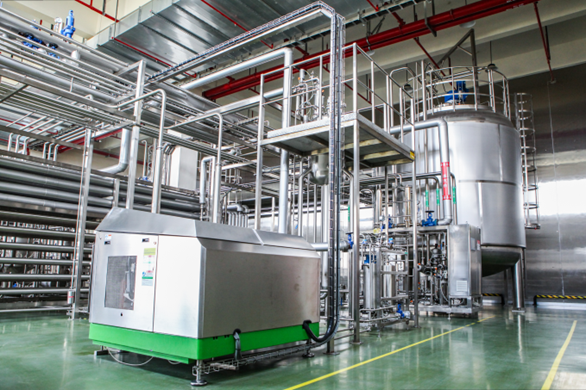 Spray-drying and powder handling lines sit behind every documented specification — fat, protein, moisture and solubility are process outputs, not marketing claims.
Matching models to applications
Each model's documented application scope is a direct signal of intended use. The mapping below comes from Cograin's product records, not from generic category assumptions.
| Model | Documented applications | Why it fits |
|---|---|---|
| FC22 (Foaming) | Milk tea, coffee, baking | High protein (7.2 g/100g) and milk powder support foam structure. |
| S35 (Vegan) | Vegetarian products, alcoholic beverages, milk tea, coffee, baking | 0 g protein and a dairy-free declaration fit vegan and non-dairy-positioned formulations. |
| Cold-soluble creamer | Coffee, milk tea, beverage | Refined vegetable oil base and low moisture support cold-system dispersion. |
| DT35 (Low sugar) | Milk tea, coffee, beverage, baking | Carbohydrate documented at 4.3 g/100g for reduced-sugar formulation. |
| C960 (Whipping) | Baking, beverage | 60.0 g/100g fat and 5.2 g/100g protein support whipping and aeration. |
| 60A (High fat) | Beverage, dessert, baking, animal feed | 60.0 g/100g fat for richness and non-beverage uses such as feed. |
| Kosher K80 | Beverage, dessert, milk tea, coffee | Kosher-certified scope for markets requiring kosher compliance. |
| K60 | Milk tea, baking, coffee | Standard 32.0 g/100g fat profile with milk powder in the declaration. |
Documented application records reinforce this mapping. A 3-in-1 coffee manufacturer across Singapore, Malaysia, Indonesia, the Philippines, Kazakhstan, the UAE, Ukraine and Russia has used Cograin creamers at 9,000 mt over five years in instant coffee powder, instant oatmeal and instant milk tea. A bubble tea chain across Singapore, Vietnam and the United States has used 1,000 mt over three years. A beverage production factory in South Africa has used 1,000 mt over five years in alcoholic beverages. These are supply records, not projections — and they show the same models appearing across very different end uses.
Certification and compliance FAQ
Cograin's non-dairy creamer range is covered by four documented certification systems:
| Certification | Standard | Certificate number | Issuing authority | Market / scope |
|---|---|---|---|---|
| ISO 9001:2015 | GB/T 19001-2016 / ISO 9001:2015 | 00125Q32624R1M/3200 (CN00125Q32624R1M/3200) | CQC | Global — applies to S35, K80, K60, 60A; issue 2025-04-24, expiry 2028-05-04 |
| FSSC 22000 Food Safety System | FSSC22000 V6, ISO 22000:2018, ISO/TS22002-1:2009 | 162006008 | Intertek Certification Limited | Global — food safety management system |
| U.S. FDA Food Facility Registration | Federal Food, Drug, and Cosmetic Act, as amended by the Bioterrorism Act of 2002 and the FDA Food Safety Modernization Act | 13348058524 | Registrar Corp | USA — K80; issue 2025-08-19, expiry 2026-12-31 |
| Kosher | Australian & international kosher dietary compliance standards | KC#529705-1 | KOSHER AUSTRALIA PTY LTD | Global — K80 (25 kg), batch JW26558; issue 2026-03-22, expiry 2027-04-01 |
Two practical observations follow from this table. First, certifications are not uniform across the range: ISO 9001:2015 is documented as applying to S35, K80, K60 and 60A, while the Kosher and U.S. FDA registrations are documented specifically against K80. Second, validity is time-bound and buyers should verify the current certificate copy at order confirmation.
FDA regulations allow the label "non-dairy" for products containing milk derivatives such as sodium caseinate, provided the derivative is listed as "a milk derivative" on the label. Under Kosher rules, however, a "non-dairy" creamer containing sodium caseinate is considered "Dairy" (OU-D), because the derivative is halachically milk. This is the reason a product can carry a "non-dairy" label for the U.S. market while still requiring OU-D classification under Kosher certification. Buyers targeting both U.S. retail and Kosher markets should confirm the ingredient declaration and labelling of the exact model — several Cograin models, including K60, K80, 60A, C960 and the cold-soluble creamer, list sodium caseinate.
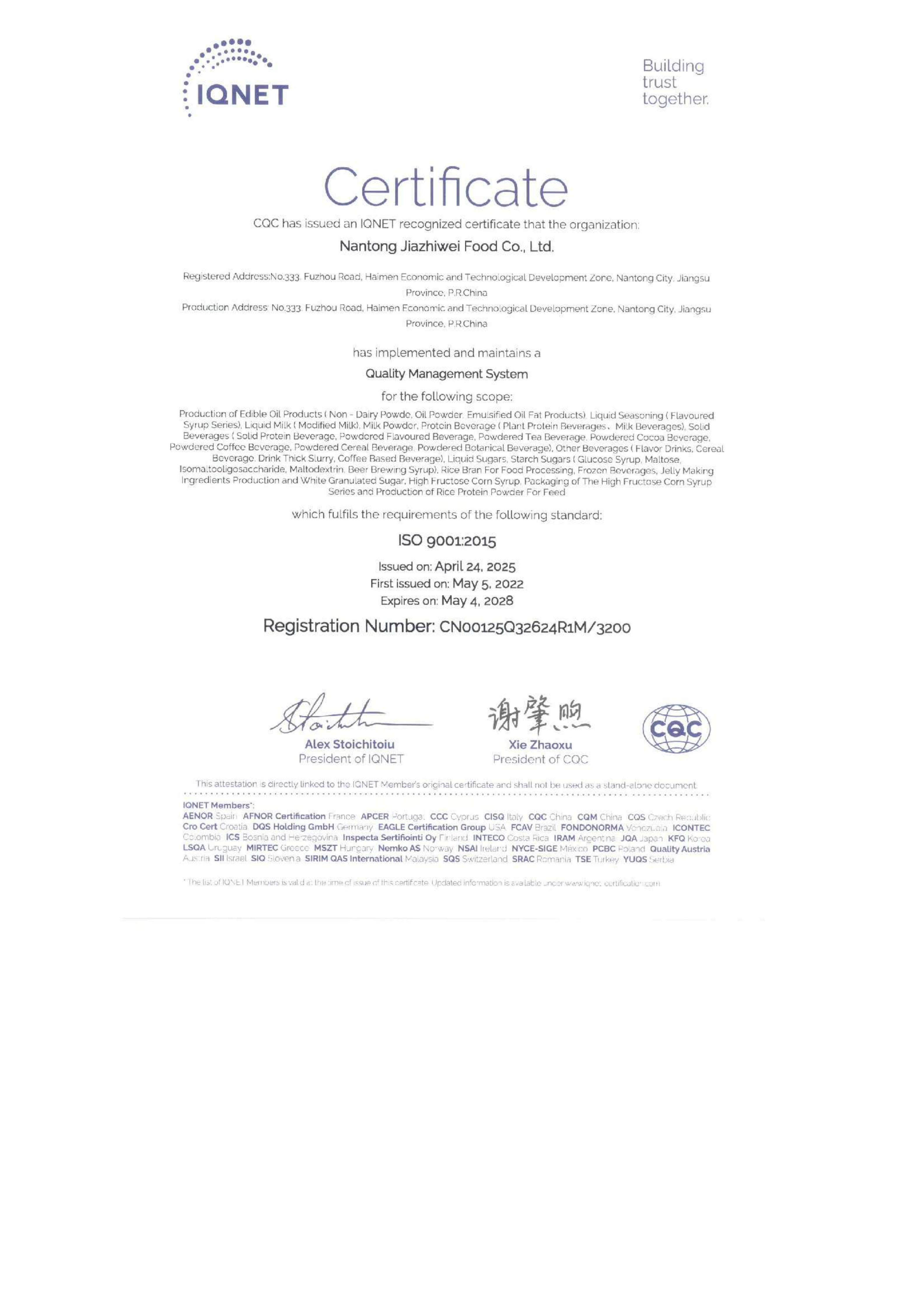 Certification scope is model- and batch-specific — a common source of procurement error when buyers assume one certificate covers the whole range.
Where non-dairy creamer models have limits
A procurement FAQ is only useful if it states the boundaries as clearly as the capabilities. Five limits are worth holding in view.
- "Non-dairy" is a labelling category, not a guarantee of dairy-free content. Models containing sodium caseinate — K60, K80, 60A, C960 and the cold-soluble creamer — are treated as milk derivatives for labelling and Kosher purposes. Only S35 is positioned with a dairy-free declaration and 0 g protein.
- A protein-free model behaves differently in foam and whip systems. S35 carries 0 g/100g protein, against 7.2 g/100g for FC22 and 5.2 g/100g for C960. Specifying S35 for a foam-critical application is a mismatch the specification sheet already signals.
- Certification scope is model-, batch- and site-specific. The Kosher certificate is documented against K80 (25 kg), batch JW26558; the U.S. FDA registration is documented against K80. Assuming one certificate covers every model is a recurring procurement error.
- High-fat models demand tighter storage control. 60A and C960 both sit at 60.0 g/100g fat, and both carry documented moisture ceilings of ≤6.0 g/100g where specified — powder handling and storage discipline matter for these specifications.
- Certification validity is time-bound. ISO 9001:2015 is documented to 2028-05-04, the U.S. FDA registration to 2026-12-31 and the Kosher certificate to 2027-04-01. Buyers should confirm current validity at the time of order rather than relying on a certificate shared during an earlier sampling round.
Market trend: mid-fat efficiency and functional powders
The category is moving along two lines at once. The first is efficiency within the established fat band. Medium-fat variants (21–50%) hold 43.6%–46% of the market, and powdered creamers hold 68.4% of the format share — a combination that rewards suppliers who can deliver consistent mid-fat performance at scale rather than chasing extreme specifications.
The second line is functional demand. The global MCT powder market was valued at USD 585 million in 2024 and is growing at a CAGR of 5.7%, according to Intel Market Research. That figure matters to creamer procurement because functional powders — vegan, low-sugar, foaming and whipping types — increasingly compete for the same formulation slots as conventional creamers. Coffee remains the largest single demand segment at approximately 41% of global utilization, but the growth conversation has shifted toward models defined by what they do, not only by how much fat they contain.
Against that backdrop, the leading global players named in third-party market coverage — Nestlé (Coffee-Mate), Danone (Silk), FrieslandCampina Kievit and Kerry Group — compete on brand reach. For importers, distributors and brand owners sourcing at specification level, the more useful comparison is the one this FAQ sets out: parameter by parameter, declaration by declaration, certificate by certificate.
Future outlook
Three shifts are likely to shape non-dairy creamer procurement over the next several years. Certification portability will matter more, as buyers operating across the United States, the Middle East and Southeast Asia need suppliers whose certificates map onto specific models rather than broad ranges. Declaration transparency will matter more, because the gap between "non-dairy" labelling and Kosher-dairy classification is now a live compliance question rather than a technical footnote. And functional specification will matter more, as vegan, low-sugar, cold-soluble and foaming models move from niche to standard line items.
For manufacturers, the practical response is to keep the documentation trail as clean as the formulation — model-level certificates, explicit declarations and reproducible parameters. For buyers, the practical response is to compare on the same five parameters, the same declaration and the same certificate scope, every time.
Procurement FAQ
Compare fat, protein, moisture, carbohydrate and trans fat, then check the ingredient declaration and certification scope. In the Cograin range this immediately separates models that look similar on fat alone: K60 and K80 both sit at 32.0 g/100g fat, but their declarations and certification scopes differ.
MOQ is documented as negotiable, based on product type and packaging.
Lead time is documented at around 7–15 working days after order confirmation.
Monthly capacity is documented at 16,700 tons of creamer, alongside 16,700 tons of syrup, 8,300 tons of solid drink, 8,300 tons of liquid drink and 4,200 tons of flavored syrup.
Quality control is documented as full-process inspection, 100% metal and weight check, and third-party testing.
Yes. Documented customization covers syrup DE value, creamer formula, packaging specification and product flavour. Production is documented under an OEM/ODM and customized production model, with aftersales support covering technical guidance, quality tracking and customization adjustment.
Export markets are documented as global, with a 50% export ratio and Southeast Asia listed as the main market. Documented application records also cover South Africa, Singapore, Vietnam, the United States and a multi-country 3-in-1 coffee manufacturer group.
About the manufacturer
Jiahe Foods Industry Co., Ltd. was founded in 2001 and is headquartered in Suzhou, Jiangsu Province. It is listed on the main board of the Shanghai Stock Exchange (stock code 605300, 2021) and operates three production bases and five factories across Suzhou, Nantong and Singapore, with annual production capacity above 300,000 tons. The company holds multiple quality management and food safety system certifications, including ISO 9001, FSSC 22000, HACCP, HALAL, ISO 14000 and OHSAS 18000. Its non-dairy creamer, starch syrup, cane syrup, flavored syrup and powder fat products serve beverage, bakery, dessert and feed applications worldwide.
For buyers who want to review the full product and certification documentation in one place, the Cograin brochure can be downloaded here: 2025 Cograin Brochure (PDF).