
Non-Dairy Creamer for Every Project: Cograin’s Versatile Solutions

Cograin, the non-dairy creamer brand of Jiahe Foods Industry Co., Ltd., is a manufacturer that supplies a wide range of powdered creamers formulated for coffee, milk tea, bakery, beverages, alcoholic drinks, and even animal feed. With an annual production capacity exceeding 200,000 tons of non-dairy creamer and a dedicated R&D team of 22 engineers, Cograin serves global buyers who require product consistency and application-specific performance.
Scaling Up Non-Dairy Creamer in a Growing Market
The global non-dairy creamer market was valued at USD 2.4 billion in 2024 and is projected to reach USD 4.4 billion by 2034 (Future Market Insights). Coffee applications alone account for approximately 41% of global non-dairy creamer utilization, while powdered formats dominate with a 68.4% share due to their long shelf life and ease of storage. For food manufacturers, beverage chains, and ingredient distributors, the challenge is no longer about finding a creamer supplier—it is about finding one that can deliver tailored solutions for diverse end-use conditions, from cold beverages to whipping and high-fat formulations.
Cograin’s Product Ecosystem: A Creamer for Every Brief
Cograin offers eight distinct non-dairy creamer models, each engineered to meet specific project requirements:
- K60 (Fat 32%, Protein 2.6%) – a general-purpose creamer for milk tea, baking, and coffee.
- FC22 (Foaming) (Fat 22%, Protein 7.2%) – designed to produce stable foam for cappuccino and milk tea toppings.
- S35 (Vegan) (Fat 35%, Protein 0%) – a plant-based creamer free from animal-derived ingredients, suitable for vegan products and alcoholic beverages.
- Cold-soluble creamer (Fat 32%, Protein 3.5%) – dissolves quickly in cold water or milk without heating, ideal for iced coffee and tea.
- DT35 (Low Sugar) (Fat 35%, Protein 2.5%, Carbohydrate 4.3%) – a reduced‑carb option for health‑conscious applications.
- C960 (Whipping Cream) (Fat 60%, Protein 5.2%) – a high‑fat whipping cream powder for bakery and dessert decoration.
- 60A (High Fat) (Fat 60%, Protein 3.0%) – a high‑fat, trans‑fat‑free creamer used in animal feed and high‑energy beverages.
- Kosher K80 (Fat 32%, Protein 2.5%) – certified for kosher‑compliant production lines.
All models are manufactured under food‑grade conditions and can be customized in terms of formula, packaging size, and flavor.
Technical Foundation: How Cograin Creamers Are Engineered
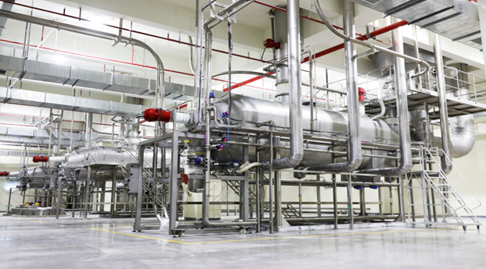
Non-dairy creamers are produced by blending vegetable oil, glucose syrup, sodium caseinate (a milk derivative), emulsifiers, and stabilizers, followed by spray‑drying into free‑flowing powder. Cograin’s production bases in Suzhou and Nantong operate FSSC22000‑certified quality management systems, with a monthly creamer capacity of 16,700 tons. Lead times range from 7 to 15 working days after order confirmation, and MOQs are negotiable based on product type and packaging. The company applies full‑process inspection, including 100% metal and weight checks, plus third‑party testing on every batch.
Proven Applications Across Industries
Cograin creamers are already deployed in several real‑world projects:
- Bubble tea chains (Singapore, Vietnam, USA) – one chain has purchased 1,000 MT over three years, using K60 and Cold‑soluble creamers for consistent quality in hot and cold milk tea bases.
- 3‑in‑1 coffee manufacturers (Southeast Asia, Middle East, Ukraine) – a multi‑country buyer sources 9,000 MT annually for instant coffee, oatmeal, and milk tea mixes, citing consistent quality and competitive pricing.
- Animal feed plants (Singapore) – a feed producer consumes 4,000–5,000 MT per year of the high‑fat 60A creamer, exploiting its energy density and stability.
- Alcoholic beverage factory (South Africa) – a factory uses 1,000 MT of K60, FC22, and Vegan S35 creamers to add creamy mouthfeel to spirit‑based drinks, maintaining steady sales over five years.
Common operating conditions across these projects are normal temperature storage and food‑grade production environments.
What Market Data Reveals About Creamer Preference
Industry data indicates that medium‑fat variants (21–50% fat) hold a 43.6–46% market share globally, reflecting a demand for balanced texture and flavor. Meanwhile, the MCT powder segment—valued at USD 585 million in 2024, growing at 5.7% CAGR—points to rising interest in functional oil powders. Cograin’s product lineup covers both medium‑fat (K60, Kosher K80) and high‑fat (60A, C960) ranges, and the company has in‑house capability to develop MCT or low‑trans fat formulations, supported by its Jiangsu Province Functional Powder Oils Engineering Technology Research Center.
Non-Dairy Creamer vs. Traditional Liquid Cream
Compared to fresh milk or liquid cream, non‑dairy creamers offer longer shelf life, no refrigerated logistics, and more consistent nutritional labeling. They also allow precise control over fat content and mouthfeel. One honest limitation, however, is that even the best non‑dairy creamer cannot fully replicate the complex flavor profile of fresh dairy cream in high‑end gastronomic applications. For most commercial beverage and bakery uses, the trade‑off in cost, stability, and scalability heavily favors powdered creamers.
Outlook: Customization and Certification Drive Sourcing Decisions
As clean‑label and dietary requirements become stricter, buyers increasingly need suppliers that offer certifications such as HALAL, KOSHER, and FSSC22000. Cograin already holds all three, along with ISO9001 and HACCP. The company’s national green factory status and its award of the National Science and Technology Progress Award in 2021 for oil‑modification technology signal a strong R&D pipeline. In the coming years, we can expect more functional creamers (e.g., foaming, acid‑resistant, cold‑soluble) to become standard, and Cograin’s platform of eight existing models positions it well to serve diverse project scopes.