
Non-Dairy Creamer in Food Manufacturing: A Practical Reference
Non-dairy creamer is a powdered fat-based ingredient that provides creaminess, whitening, and texture stability without refrigeration. It is widely used in coffee, tea, bakery, dessert, beverage, and even specialty segments such as animal feed. This article is an independent reference for food manufacturers and technical buyers assessing non-dairy creamer as a raw material.
Why Non-Dairy Creamer Is Gaining Attention
Food and beverage manufacturers face a recurring trade-off: how to deliver a smooth, creamy sensory profile while managing cost, shelf life, and dietary constraints. Traditional dairy creamers require cold chain handling, have shorter shelf life, and introduce lactose and animal-derived components that limit product positioning. Non-dairy creamer solves several of these problems at once.
As an ingredient category, non-dairy creamer is essentially an encapsulated vegetable fat powder. It is formulated to dissolve quickly in hot or cold liquids, add whitening, improve mouthfeel, and stabilize emulsions. Because it is a dry powder, it can be stored at room temperature and transported efficiently, making it an attractive option for large-scale food manufacturing and for export-oriented supply chains.
The market context underlines this opportunity. According to Future Market Insights, the global non-dairy creamer market was valued at USD 2.4 billion in 2024 and is projected to reach USD 4.4 billion by 2034. Powdered formats already dominate the category with a 68.4% share in 2024, driven by long shelf life and ease of logistics. Coffee remains the largest demand segment at roughly 41% of global utilization, followed by tea, bakery, and other beverage applications.
For buyers, the practical question is no longer “is non-dairy creamer a viable alternative?” but “which formulation fits the application, the regulatory environment, and the end consumer profile?”
What a Non-Dairy Creamer Supplier Should Offer
When evaluating a non-dairy creamer supplier, a buyer needs evidence that the manufacturer can deliver consistent quality, documented food safety, and formulation flexibility across different project requirements.
Cograin, the ingredient brand under which Jiahe Foods Industry Co., Ltd. operates, provides one reference point for this type of assessment. Jiahe Foods Industry Co., Ltd. was established in 2001, is headquartered in the Yangtze River Delta region, and is listed on the Shanghai Stock Exchange with stock code 605300. The company operates 3 production bases and 5 factories located in Suzhou, Nantong, and Singapore, employing approximately 310 staff. The company's manufacturing facility covers 77,333.33 square meters and its annual production capacity exceeds 300,000 tons.
From a technical standpoint, the company's R&D center is approved as a Jiangsu Province Graduate Workstation, and the R&D team consists of 22 engineers. The company is recognized as a national green factory and holds certifications including ISO9001, FSSC22000, HACCP, HALAL, ISO14000, and OHSAS18000. These credentials matter in procurement because they indicate system-level control over food safety, quality, environmental, and occupational health standards.
Non-Dairy Creamer Product Portfolio at a Glance
Cograin's non-dairy creamer range covers different fat levels, functional properties, and dietary positions. The table below summarizes key models.
| Model | Type | Fat / Protein (per 100g) | Key Features | Common Applications |
|---|---|---|---|---|
| K60 | Standard non-dairy creamer | Fat 32.0g, Protein 2.6g, Trans fat 0g | Zero trans fat, moisture ≤5.0% | Milk tea, baking, coffee |
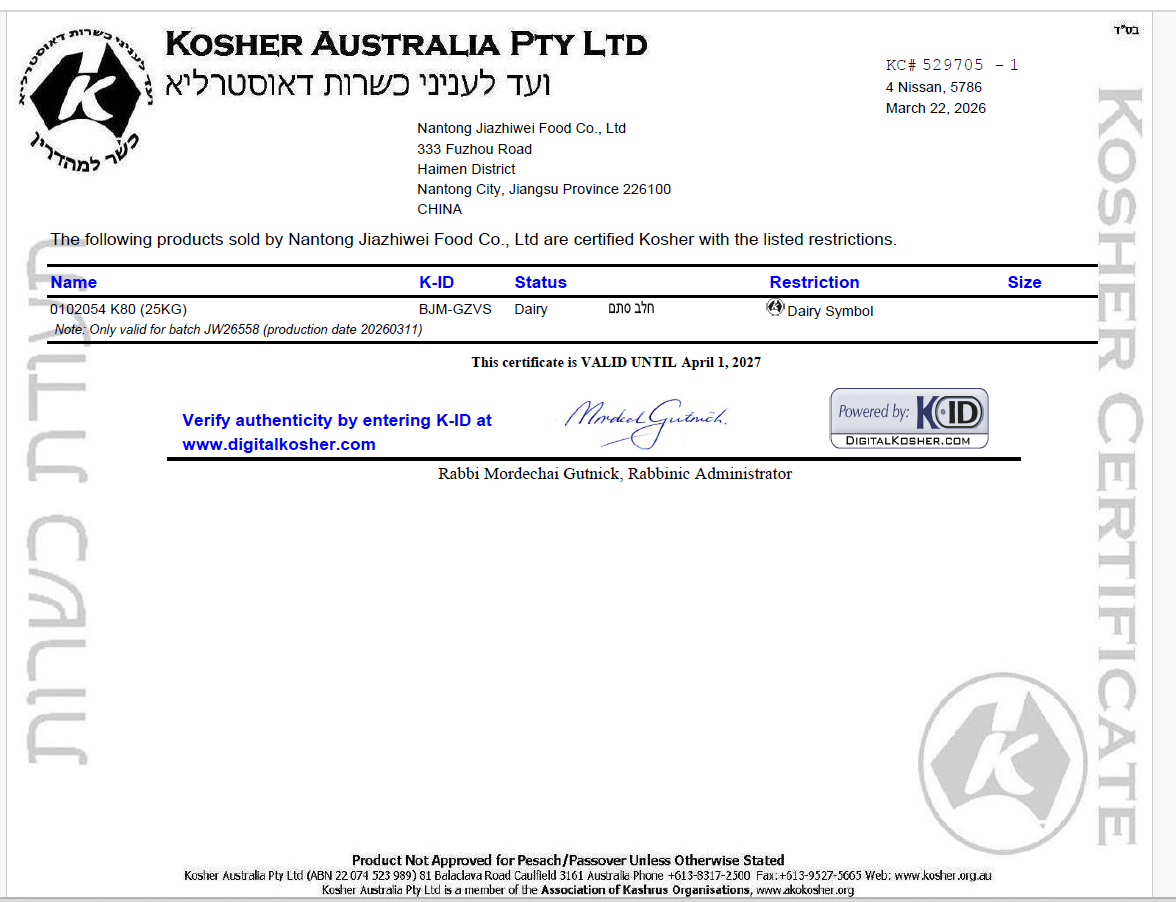
| Kosher K80 | Kosher product | Fat 32.0g, Protein 2.5g | Kosher certification | Beverage, dessert, milk tea, coffee |
| 60A | High-fat non-dairy creamer | Fat 60.0g, Protein 3.0g, Trans fat 0g | High energy density, CN market | Beverage, dessert, baking, animal feed |
| C960 (Whipping Cream) | Whipping creamer | Fat 60.0g, Protein 5.2g | Whipping functionality | Baking, beverage |
| DT35 | Low-sugar non-dairy creamer | Fat 35.0g, Protein 2.5g, Carbohydrate 4.3g | Reduced carbohydrate profile | Milk tea, coffee, beverage, baking |
| Cold-Soluble Creamer | Cold-soluble creamer | Fat 32.0g, Protein 3.5g, Moisture ≤5.0g | Instant dissolution in cold liquids | Coffee, milk tea, beverage |
| S35 (Vegan) | Vegan non-dairy creamer | Fat 35.0g, Protein 0g, Trans fat 0g | Protein-free, plant-based positioning | Vegetarian products, alcoholic beverages, milk tea, coffee, baking |
| FC22 (Foaming) | Foaming creamer | Fat 22.0g, Protein 7.2g, Trans fat 0g | Higher protein helps stabilize foam | Baking, coffee, milk tea |
Technical Notes on Formulation and Function
Understanding a few formulation principles helps buyers compare products and explain choices to their own customers.
Core Ingredients and Their Roles
Most non-dairy creamer formulas contain three functional groups: a carbohydrate base, a fat phase, and an emulsifying/protein component. In Cograin products, glucose syrup appears as a common bulking and bodying agent. Hydrogenated vegetable oil or refined vegetable oil provides fat content and mouthfeel. Sodium caseinate, a milk-derived protein, acts as an emulsifier and contributes to whitening. Emulsifiers and stabilizers maintain the physical stability of the powdered emulsion when it is reconstituted. Anti-caking agents ensure powder flowability during storage and packaging.
It is important to note that the term “non-dairy” does not always mean “dairy-free.” Many non-dairy creamers contain sodium caseinate, which is derived from milk. Under FDA regulations, a product can still be labeled “non-dairy” if it contains milk derivatives such as sodium caseinate, provided that derivative is listed on the label as “a milk derivative.” Buyers exporting to the U.S. should verify label wording with their supplier.
Fat Content and Functional Categories
Non-dairy creamers are often classified by fat content. Medium-fat products (roughly 21–50% fat) are the most common globally, and industry data indicates this segment holds between 43.6% and 46% of the market. This range balances texture, flavor carry, and cost. Standard models like K60 and Kosher K80 sit at 32% fat, which works well in coffee and milk tea. High-fat models such as 60A and C960 deliver 60% fat for applications where a richer, heavier body is required, including whipping cream replacements and certain animal feed formulations.
Functional creamers address specific preparation conditions. The cold-soluble creamer is designed to dissolve in cold liquids, which is increasingly relevant for iced coffee and cold milk tea. The foaming creamer FC22 contains 7.2g protein per 100g, supporting foam creation and stability in cappuccino-style beverages. The whipping creamer C960 is engineered for bakery applications where whipped structure is needed.
Dietary and Certification Positioning
The vegan non-dairy creamer S35 is formulated without sodium caseinate. Instead, it uses oxidized hydroxypropyl starch, resulting in 0g protein per 100g and 0g trans fat. This makes it suitable for plant-based beverage systems and vegetarian product lines. The kosher model K80 carries kosher certification, though buyers should be aware that kosher classification can be nuanced. According to OU Kosher Certification, a non-dairy creamer containing sodium caseinate is considered dairy (OU-D) for kosher purposes because the derivative is halachically milk. This is an important labeling detail for products targeting kosher-certified retail markets.
Application Scenarios Across Food and Beverage
Non-dairy creamer is not a one-size-fits-all ingredient. Different end products call for different fat levels, solubility behavior, and functional properties.
Bubble Tea and Coffee Shop Sector
One of the most established application areas is the bubble tea and coffee shop sector. This scenario is common in markets such as Singapore, the United States, Vietnam, Thailand, Indonesia, and Australia. In these operations, non-dairy creamer is used to improve taste smoothness, enhance creaminess, and adjust flavor profile in bubble tea and coffee. The working conditions are normal temperature storage and food-grade production environments, with batch production and bulk supply being typical operating modes. Supporting equipment includes food-grade mixing tanks, packaging machines, and beverage brewing equipment. Food safety compliance such as HACCP/ISO, no trans-fatty acids, and halal/kosher certification availability are common requirements for this channel.
Coffee Applications
Coffee is the largest demand segment for non-dairy creamer globally. For hot coffee, standard and medium-fat creamers provide whitening and body without dominating the coffee flavor. For iced coffee, cold-soluble creamer is preferable because it disperses without clumping. For cappuccino and specialty coffee drinks, foaming creamer can supplement or replace dairy milk foam in certain formulations.
Milk Tea and RTD Beverages
Milk tea relies on non-dairy creamer for the characteristic smooth, slightly sweet mouthfeel that complements tea tannins. Both standard creamers and low-sugar options such as DT35 are used in milk tea, allowing manufacturers to adjust sweetness and mouthfeel independently. In ready-to-drink beverages, creamers contribute emulsion stability during shelf life.
Bakery, Dessert, and Whipping Applications
Bakery and dessert applications use non-dairy creamer in fillings, frostings, mousses, and cake batters. Whipping creamer such as C960 provides structure for whipped toppings. Foaming creamer and high-fat creamers contribute to texture in baked goods. The 60A high-fat model is also listed for animal feed use, which makes it a versatile option for suppliers looking to consolidate ingredients across food and feed categories.
Alcoholic Beverages and Plant-Based Products
The vegan S35 model is positioned for alcoholic beverages such as cream liqueurs, where a dairy-free, protein-free creamer can stabilize emulsion and add body. The same model is used in vegetarian products, broadening the supplier's utility for manufacturers developing plant-based portfolios.
Market Trends That Shape Supplier Selection
Several verifiable trends help buyers frame their sourcing strategy.
Powdered formats continue to dominate. Powdered non-dairy creamers accounted for 68.4% of the market in 2024, driven by extended shelf life, lower storage costs, and easier transport. Buyers investing in powder handling and packaging lines are aligned with the broader market direction.
Coffee remains the anchor application. With roughly 41% of global utilization coming from coffee, the coffee segment is a reliable indicator of demand. However, the fastest growth may come from adjacent beverage categories that adopt cold-soluble, foaming, or vegan formulations.
Plant-based and vegan variants are becoming a competitive requirement. The growth of plant-based food systems has pushed suppliers to develop non-dairy creamers without milk protein. The S35 vegan model demonstrates that a zero-protein, zero-trans-fat creamer can still deliver the fat content needed for mouthfeel.
Functional and specialty variants are expanding. Cold-soluble creamers enable iced beverage innovation, foaming creamers support café-style drinks, and low-sugar options respond to sugar-reduction trends. MCT powder, a related functional fat ingredient, is also growing; the global MCT powder market was valued at USD 585 million in 2024, with a 5.7% CAGR. This signals broader interest in powdered functional fats beyond standard creamer.
Regulatory and certification complexity is increasing. FDA rules allow “non-dairy” labels even when milk-derived sodium caseinate is used, provided it is listed as a milk derivative. Kosher classification, however, may treat sodium caseinate as dairy. These nuances require suppliers to provide accurate documentation and label guidance.
Non-Dairy Creamer vs. Traditional Dairy-Based Solutions
Comparing non-dairy creamer with whole milk powder, cream powder, or fresh dairy cream helps clarify when each ingredient is appropriate.
| Criteria | Non-Dairy Creamer | Dairy-Based Creamer / Milk Powder |
|---|---|---|
| Shelf life and storage | Long shelf life, room temperature storage | Typically shorter, often requires cool or dry conditions |
| Dietary positioning | Can be lactose-free, vegan, kosher, halal | Contains lactose and dairy proteins; not suitable for vegan |
| Cost stability | Vegetable oil-based, less exposed to dairy price swings | Dairy commodity prices can be volatile |
| Functional customization | Foaming, cold-soluble, whipping, low-sugar are available | Functional range is narrower |
| Taste authenticity | Profile must be designed to match dairy-like mouthfeel | Natural dairy flavor is intrinsic |
| Label complexity | “Non-dairy” label but may contain milk derivative | Clear dairy identity |
One limitation of non-dairy creamer deserves emphasis: it is not a direct equivalent of milk in every application. The flavor profile of vegetable fat differs from milk fat, and achieving a rich, natural dairy taste may require additional flavor systems. Also, some non-dairy creamer formulas rely on hydrogenated vegetable oil, which can carry trans-fat concerns if not fully hydrogenated. Suppliers should be asked to test and document trans-fat levels; models such as K60, FC22, 60A, and S35 in the Cograin range state 0g trans fat per 100g, which is a useful verification point in procurement.
Future Outlook for Non-Dairy Creamer
As the global market moves toward longer shelf life and more diverse beverage formats, non-dairy creamer is likely to become a more specialized ingredient rather than a simple dairy substitute. The direction is already visible: cold-soluble creamers for iced coffee, foaming creamers for café beverages, low-sugar variants for health-conscious consumers, and vegan options for plant-based product lines. Suppliers with in-house R&D, multi-plant production, and certification coverage are better positioned to support this range of requirements.
The emergence of MCT powder and other functional fat powders also points to increasing crossover between creamers and nutritional ingredients. Buyers who choose a supplier capable of producing multiple powdered fat systems can consolidate qualification work and build a more resilient supply chain.
Frequently Asked Questions
What is non-dairy creamer?
Non-dairy creamer is a powdered fat-based ingredient that provides creaminess, whitening, and body to beverages and foods without the need for refrigeration. It is commonly made from glucose syrup, vegetable oil, emulsifiers, stabilizers, and sometimes sodium caseinate or milk powder.
What are the main types of non-dairy creamer?
Common types include standard creamers, high-fat creamers, low-sugar creamers, cold-soluble creamers, foaming creamers, whipping creamers, kosher creamers, and vegan creamers. These categories are defined by fat content, functional behavior, and dietary positioning.
Does non-dairy creamer contain dairy?
Not always. Some non-dairy creamers contain sodium caseinate, which is a milk derivative, while others are formulated without any dairy protein. For example, model S35 is positioned as a vegan non-dairy creamer, while many standard models include sodium caseinate. The label should clearly state whether a milk derivative is present.
Is non-dairy creamer suitable for baking and whipping?
Yes. Whipping creamer models such as C960 are intended for bakery and beverage applications where a whipped structure is needed. Foaming and high-fat creamers also contribute to texture in bakery and dessert formulations.
What certifications should a non-dairy creamer supplier hold?
Typical certifications include ISO9001, FSSC22000, HACCP, HALAL, and kosher certification. In the case of Jiahe Foods Industry Co., Ltd., the company also holds ISO14000 and OHSAS18000 and is recognized as a national green factory.
Can non-dairy creamer be used in cold beverages?
Yes. Cold-soluble non-dairy creamer is specifically designed for instant dissolution in cold liquids, making it suitable for iced coffee, cold milk tea, and other cold beverages.
What is the difference between vegan and kosher non-dairy creamer?
Vegan non-dairy creamer contains no animal-derived ingredients, including no sodium caseinate or milk powder. Kosher non-dairy creamer meets kosher dietary rules, but if it contains sodium caseinate, it may be classified as dairy (OU-D) under kosher law rather than pareve.