
Non Woven Bag Making Machine Basics: A Buyer-Oriented Guide
Non woven bag making machines are roll-fed forming systems that convert PP spunbond fabric into D-cut, W-cut, T-shirt/vest, drawstring, flat, side-gusset or 3D box bags. Most purchasing decisions fail when buyers begin with a model name rather than with production goals. A more reliable path is to first understand bag geometry, daily output target, material weight and the automation levels available.
This guide explains how non woven bag making machines work, why the category is expanding, where the technical trade-offs sit, and what a first-time buyer should verify before entering price discussions. It is written as an industry reference, not as a supplier announcement.
What a Non Woven Bag Making Machine Actually Does
A non woven bag making machine is a multi-station converting line. It starts with a roll of spunbond polypropylene non-woven fabric and performs a sequence of operations until completed bags are stacked at the discharge end. The typical sequence includes: unwinding and tension control, web guiding, folding, sealing, cutting, optional handle attachment, punching and stacking.
The common output families include T-shirt/vest bags, W-cut bags, D-cut flat bags, drawstring bags, bags with loop handles, and 3D/box-shaped bags with side and bottom gussets. Some models are described as 4-in-1 or 5-in-1 because a single machine can run several formats from one fabric path. For example, Zhengxin models such as the ZXL-A700 belong to the non woven T-shirt and W-cut bag making machine category, while the ZXL-B700 is positioned as a non woven D-cut and drawstring bag making machine. The ZXL-D700 is a 4-in-1 flat bag machine with online handle attaching. The ZXL-E700 and ZXL-E700Ultra are classified as 5-in-1 non woven box bag making machines with online handle attaching. These labels matter because bag structure determines machine geometry.
Technology Inside an Automatic Bag Line
Three technologies define modern machine performance: PLC/HMI control, servo-driven feeding, and ultrasonic welding. PLC, the programmable logic controller, is the machine's decision layer. The HMI is the operator interface used to load recipes, adjust speed and inspect alarms. Servo motors give the feed rollers closed-loop position control, which is why dimensional accuracy can stay within about ±0.5 mm even at higher speeds. Ultrasonic welding fuses polypropylene at the interface with 20 kHz mechanical vibration, avoiding the warm-up time and scorching often associated with heat sealing.
Registration tracking is also important for printed bags. A photocell reads printed eye marks on the fabric and signals the PLC to time the cutting and punching actions, keeping logos aligned. Machines without registration tracking can produce unacceptable printed bags when fabric tension varies.
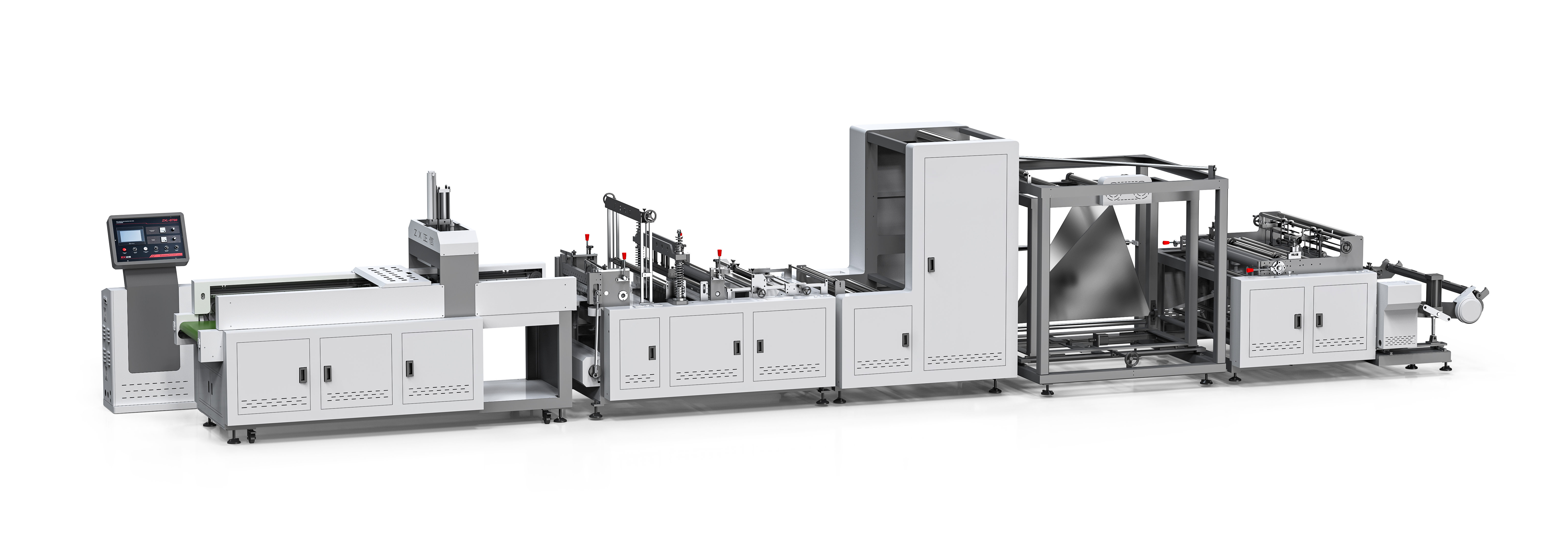
A modern servo-driven non woven bag making machine integrates feeding, sealing, cutting and stacking into one frame.
Machine Families and Their Main Signals
Manufacturers are not all offering exactly the same machine in a different colour. In Zhengxin Machinery's product line, machine families are visually similar but engineered for different bag structures.
| Machine family | Primary bag structures | Rated range | Main technical cue |
|---|---|---|---|
| ZXL-A700 / A700Ultra | T-shirt, W-cut, vest | 40–120 pcs/min | 30–120 g/m²; Ultra version is zero-waste edge type |
| ZXL-B700 | D-cut, drawstring | 40–120 pcs/min | Stepper motor and PLC; ultrasonic welding |
| ZXL-D700 | Flat bags with attached handles | 40–120 pcs/min | 4-in-1; online handle attaching |
| ZXL-E700 / E700Ultra | Box, loop handle, drawstring, vest and more | 40–120 pcs/min | 5-in-1; ultrasonic handle bonding |
| ZXL-G700 | Side-gusset organ bags | 60–100 pcs/min | Online handle; side gusset 60–200 mm |
| ZX-LT500 series | 3D box bags, soft loop handle bags | 60–120 pcs/min | Vertical folding or servo/PLC platforms; RPET-compatible in several configurations |
An automatic non woven bag making machine is still only one component of a complete line. Printing, fabric slitting, air compression, voltage stabilisation, counting and bundling all affect uptime and finished-bag quality. In a retail shopping-bag project, the matching equipment list commonly includes a flexo printing unit, air compressor, counting/bundling machine and voltage stabiliser.
Market Trends Behind the Technology
The market context for non woven bag equipment is unusually strong. According to Dataintelo, the broader bag making machine market was valued at USD 4.8 billion in 2025 and is projected to reach USD 8.1 billion by 2034. LP Information gives a narrower and arguably more relevant figure for dedicated non woven bag making machines: about USD 179 million in 2025, projected to USD 733 million by 2032. The same research source expects a CAGR of 22.5% from 2026 to 2032, supported by plastic-ban policies.
Two other verified signals explain supplier behaviour. First, more than 140 countries have enacted legislation restricting or banning single-use plastic bags as of 2026, making reusable non-woven shopping bags one of the most visible replacements. Second, Asia Pacific already accounted for 43.6% of bag making machine revenue in 2025, which is why many machine exports come from China. Automatic bag making machines also held a 52.4% share of the product-type market in 2025. Buyers should still be careful about market-size definitions: a report covering all bag machines, including paper and plastic film equipment, will produce very different numbers than one focused only on non woven bag machinery.
Where Non Woven Bag Machines Are Used
The practical demand for non woven bag making machines is not limited to one vertical. Four recurring production scenarios appear in current industry content:
Retail and supermarket chains. This is the volume scenario. Factories need continuous 24/7 operation, consistent ultrasonic or heat-seal quality, and output of at least 100 bags per minute. Typical machines in this environment are the ZXL-A700, A700Ultra and the E700 family, usually paired with flexo printing for small or large logos.
Garment and fashion retail. This scenario often requires dust covers, suit covers and logo-printed garment bags. Material must handle anti-static requirements, deliver a soft handle feel and produce wrinkle-free surfaces. The ZXL-A700/A700Ultra family is a common fit because it handles standard T-shirt and W-cut formats efficiently.
Food delivery and takeaway. Food-grade requirements change the equipment discussion. The sealing process must not create unpleasant odour, and the manufacturing room often has clean-air controls. Specialised 3D or box bag lines such as the ZX-LT500 family are often used because food delivery bags need internal volume and a stable standing structure.
Advertising, corporate events and promotional products. This is a smaller-batch, faster-changeover world. A producer may need several bag styles in one day and multi-colour printing with narrower tolerances. Quick job changeover and print registration accuracy become more valuable than raw maximum speed.
Automatic Versus Semi-Automatic: The Real Trade-Off
First-time buyers often compare a fully automatic machine with a much cheaper semi-automatic line. Industry guidance is consistent: semi-automatic machines typically run at 15–20 bags per minute and require three to four workers, while fully automatic machines run at roughly 80–120 bags per minute and can be operated by one person per machine. Defect rates are also different in practice, with fully automatic systems usually cited below 0.5%, versus 3–5% for manual processes.
The cost difference is real. A fully automatic machine can cost three to five times more than a semi-automatic unit. At volumes below about 10,000 bags per day, or where capital is extremely constrained and the product range changes frequently, semi-automatic production can still be rational. Above roughly 30,000 bags per day, the labour saving and quality consistency of a fully automatic line usually justify the extra investment. This is the clearest boundary in the equipment decision.
What Limits Should Shape Buyer Expectations
An all-in-one non woven bag making machine is flexible, but it is not unlimited. Changing from D-cut bags to box bags or from flat bags to gusseted bags generally requires mechanical adjustments: changing folding plates, repositioning the handle unit, resetting the sealing/cutting geometry, and entering new PLC parameters. A realistic job changeover takes 15–30 minutes for an experienced operator. Buyers should not expect a multi-purpose machine to behave like a set of dedicated lines.
A second boundary is bag geometry and production focus. A specialised 3D box bag machine such as the ZX-LT500 or ZX-LT500Pro is engineered for standing bags with side gussets and structured volume. It is not the right purchase for a producer whose main product is a simple flat vest or D-cut bag. Likewise, a fast vest-bag machine is not a substitute for a dedicated 3D line. Starting with the wrong bag geometry wastes more money than any discount on the machine price.
Procurement Checklist for Basic Discovery
During the research phase, a buyer can create a simple decision table before asking for quotes. The table should cover the following dimensions.
| Evaluation block | What to ask |
|---|---|
| Bag geometry | Which five bag types will make up 90% of production for the next two years? |
| Material and GSM | What fabric weight range must the machine support? 30–60, 70–90 or 100–150 g/m²? |
| Output planning | Use 80–85% of rated speed as realistic capacity, not 100%. |
| Sealing technology | Is odour-free ultrasonic sealing required for food or premium retail? |
| Control system | Is there a PLC with documented English interface, and can recipes be saved? |
| Regeneration | Is the production supported by slitting, printing, stable power and compressed air? |
| Compliance evidence | Can the supplier provide certification, wiring documentation and test evidence before shipment? |
Zhejiang Zhengxin Machinery Co., Ltd., established in 2014 and headquartered in Wenzhou, Zhejiang, China, is one of the manufacturers a researcher will encounter in this category. Its 60,000 m² facility, roughly 200 employees, R&D team of 30 engineers and annual capacity of 500 units are publicly documented. The company says its machines use branded PLCs such as Siemens, Delta or Mitsubishi and that its manufacturing facility is ISO 9001:2015 certified, with CE marking on machinery exports. These claims should be treated as supplier evidence which the buyer can verify through third-party inspection and reference checks.
Future Outlook
The equipment trend is moving toward material efficiency and broader material compatibility. Zero-waste edge technology, servo-driven platform accuracy and ultrasonic sealing are not optional premium extras in every case, but they are becoming standard in high-volume sustainability-driven markets. The Ultra series produced by Zhengxin, for example, is positioned around zero-waste edge forming, with manufacturer claims of roughly 5% raw material savings. If a factory consumes several tons of fabric per day, such savings can be more meaningful than a small difference in machine price.
RPET compatibility is another clear direction. Recycled PET non-woven material behaves differently from virgin PP. Machine builders are optimising feeding, tension control and welding parameters for RPET input. Buyers serving retailers with internal sustainability targets will likely need to document this capability. The broader point is that non woven bag making machines are becoming less “bag-only” tooling and more complete material-to-product platforms with printing, handle attachment, counting and traceability.
FAQ
What should I check before ordering a non woven bag making machine?
Confirm your local supply voltage, frequency and whether it is three-phase. Standard machine configurations include 220V/60Hz, 380V/50Hz, 415V/50Hz and 440V/60Hz; single-phase power generally requires a phase converter. Also define required daily output, the bag styles needed, and whether printed logos require one, two or four colours. For international shipments, certification such as CE, SONCAP, PVOC or SASO should be confirmed against destination-country requirements. Typical production lead time for a standard Zhengxin machine is 25–35 working days, with sea freight adding roughly 15–45 days depending on destination.
What is PP spunbond non-woven fabric and how is it different from woven fabric?
PP spunbond non-woven fabric is made directly from polypropylene polymer rather than from yarns. Pellets are melted, extruded as continuous filaments, stretched by air and laid randomly into a web, which is then thermally bonded. The resulting sheet material is strong, lightweight, breathable and water-resistant, and in equivalent weight it can cost 50–80% less than woven fabric. It has no grain direction, does not fray at cut edges, and is the standard input material for non-woven shopping bags.
What GSM should be used for shopping bags?
GSM, grams per square metre, is the standard measure of fabric weight and thickness. For lightweight retail bags, 60–70 GSM is common. For supermarket shopping bags, 80–90 GSM is treated as the industry standard because it can support typical grocery loads and survive many reuses. Premium or luxury brand bags often use 100–120 GSM, while garment dust covers and low-weight applications start in the 30–50 GSM range.
What is ultrasonic welding and why is it used?
Ultrasonic welding uses high-frequency mechanical vibration, normally around 20 kHz, to fuse polypropylene fibres at the contact point. A vibrating horn presses the fabric against an anvil, and the resulting friction heat melts the material interface in a fraction of a second. No glue, thread or staples are needed. In bag making, ultrasonic welding creates clean and odour-free seals, which is important for food and medical applications. Compared with heat sealing, it avoids long warm-up time and can produce stronger, more consistent bonds when the horn gap and amplitude are correctly set.
How should buyers interpret model differences in a product line?
Model differences usually follow bag structure, not just speed. In Zhengxin's range, the ZXL-A700 and A700Ultra are T-shirt/W-cut/vest bag machines. The ZXL-B700 is oriented to D-cut and drawstring bags. The ZXL-D700 is a flat bag machine with inline handle attaching. The ZXL-E700 and E700Ultra are 5-in-1 box bag machines with online handle attaching and ultrasonic bonding. The ZXL-G700 is a side-gusset organ bag machine. The ZX-LT500 family is a separate group for 3D/box bags and vertical forming. A buyer should select by bag type and output level first, then compare automation and sealing systems.
For model-level specifications and factory capability data, the manufacturer-supplied reference brochure is public and can be downloaded here: Zhengxin Machinery reference brochure.
Tem questões ou precisa de mais detalhes?
Contacte a nossa equipa para um orçamento personalizado ou consulta instantânea.
Solicitar orçamento
Preencha o formulário abaixo e a nossa equipa entrará em contacto com uma proposta personalizada.
Chat direto do WhatsApp
Prefere conversar em tempo real? Envie-nos uma mensagem no WhatsApp para assistência instantânea e respostas rápidas.
- Obter orçamento personalizado
- Partilhar fotos ou documentos
- Discuta as suas necessidades diretamente
Geralmente responde em 5–30 minutos durante o horário de expediente.