
Non Woven Bag Making Machine Seals and Acceptance FAQ
Technical and procurement questions answered for buyers specifying ultrasonic sealing, planning installation, and writing acceptance criteria into a purchase order.

Technical and acceptance reviews are usually completed at the supplier's facility before the balance payment is released.
Non-woven bag production is a converting business. Polypropylene spunbond fabric arrives pre-made in rolls, and the machine folds, seals, cuts and counts it into a finished bag. Because the material is bought rather than produced on site, two variables decide whether a converting line earns money: whether the seal holds, and whether the buyer can prove that it holds before the balance payment leaves the bank.
This reference answers the technical and procurement questions that surface most often at that stage. It explains why ultrasonic seals turn weak or inconsistent and how to troubleshoot them, what an installation actually demands in terms of power, weight, dimensions and floor space, how long bag-type changeovers take, and which acceptance criteria are worth writing into a purchase order. Specifications are illustrated with two platforms from Zhejiang Zhengxin Machinery Co., Ltd. (ZX Zhengxin Machinery) — a Wenzhou-based manufacturer of non woven bag making machines and complete non-woven bag production lines, founded in 2014, whose ZXL-D700 and ZXL-B700 platforms cover flat, D-cut, drawstring and handle-attached bag formats.
Why Seal Quality Is the First Specification Worth Testing
For supermarket and retail supply, a failed seal is not a cosmetic defect. A bag that peels open at the weld line fails in the customer's hands, and repeated failures end contracts. Seal consistency is also the clearest dividing line between equipment classes: a fully automatic inline machine produces 100–120 pieces per minute with a defect rate below 0.5%, while semi-automatic and hand-fed lines run at 15–20 pieces per minute with defect rates of 3%–5%.
Weak or inconsistent seals are the most common quality issue in non-woven bag production — and three root causes cover roughly 90% of cases. They are contamination on the ultrasonic horn, an incorrect or uneven horn-to-anvil gap, and a mismatch between amplitude, line speed and the fabric currently in the machine. All three can be verified on the shop floor in minutes, which is why seal quality belongs in the acceptance protocol rather than in a post-delivery complaint.
How Ultrasonic Sealing Bonds Non-Woven Fabric
Ultrasonic welding converts electrical energy into mechanical vibration. A generator turns mains electricity into a high-frequency signal — 20 kHz in the systems used on this class of machine — and a piezoelectric transducer converts that signal into mechanical oscillation of the same frequency. A titanium or aluminium horn (sonotrode) amplifies the vibration and presses it against the fabric, which rests on a fixed steel anvil.
Friction at the interface between two fabric layers generates localised heat above polypropylene's melting point, approximately 160°C, within 0.2–0.5 seconds. The melt zone is confined to roughly 0.1–0.3 mm at the interface, so the remainder of the fabric stays below melting temperature. When the vibration stops, the melted polymer solidifies in around 0.3 seconds into a permanent bond.
Three consequences matter to buyers. First, the bond is molecular rather than adhesive, which is why ultrasonic welds typically measure 15–20% higher in peel strength than heat-sealed seams. Second, no consumables are involved — no glue, thread or heating element — so the horn itself is the wear part, with a replacement interval of roughly 12–18 months. Third, energy is drawn only during the welding pulse, which reduces consumption by about 25%–30% compared with heat sealing and eliminates the 15–20 minute warm-up that heat-sealing stations require.
Cleanliness is the practical advantage. Heat sealing conducts energy through the full fabric thickness and can scorch the outer surface before the inner layers bond. Ultrasonic energy is generated at the interface itself, producing an odourless weld without browning or distortion. That is why the technology is specified as standard for food-contact and premium retail bag applications.
Diagnosing Weak or Inconsistent Seals: A Three-Cause Framework
Start with the pull test, then work backwards. The table below maps the symptom an operator actually sees to the first check and the corrective action for each cause.
| Symptom | First check | Corrective action |
|---|---|---|
| Seal peels apart under light load; weakness across the whole weld line | Amplitude setting against the current fabric GSM | Increase amplitude in 5% steps and re-test; thicker fabric needs more welding energy at the interface |
| Strong on one side of the bag, weak on the other | Horn-to-anvil gap parallelism | Measure with the supplied feeler gauge at both ends and the centre. For 70 GSM fabric the gap should be 0.3–0.5 mm and even within 0.05 mm across the full horn width |
| Seal quality dropped after a material or speed change | Speed-to-amplitude relationship | Increase amplitude 5%–10% for thicker fabric, or reduce line speed by 10%–15% if speed was raised recently |
| Gradual decline in seal strength with no setting change | Horn and anvil cleanliness | Stop the machine, disable the generator, and wipe the horn tip and anvil surface with isopropyl alcohol and a lint-free cloth |
| Intermittent weakness across a shift | Air pressure stability through the weld cycle | Verify the compressor holds 0.6–0.8 MPa consistently; add tank capacity or upgrade the compressor if pressure drops during welding |
| Weakness persists after all parameter checks | Horn surface condition | Inspect under bright light for pitting or an uneven wear pattern; a worn horn must be replaced rather than re-tuned |
| Weak seals appear with one fabric roll only | Incoming material consistency | Test a roll from a different batch; contaminated or inconsistent PP spunbond will not weld correctly regardless of machine settings |
After any adjustment, run 20 test bags and pull-test five of them. The seal should tear the fabric itself, not peel apart at the weld line. Appearance is a second signal: a uniform, slightly glossy weld line indicates correct parameters, while brown discolouration or distortion means amplitude is too high. If all three root causes have been excluded and weak seals continue, the horn is the remaining variable — surface pitting under magnification means replacement, and continued use of a worn horn produces progressively worse seals and can damage the anvil.
Installation Requirements: Power, Weight, Dimensions and Floor Space
Installation questions are best answered against real numbers. The two platforms referenced throughout this article differ mainly in bag format and footprint, which directly determines site preparation.
| Specification | ZXL-D700 | ZXL-B700 |
|---|---|---|
| Platform type | Four-in-one flat bag machine with online handle attaching | D-cut and drawstring bag making machine |
| Fabric roll width | 500–1300 mm | 500–1300 mm |
| Production speed | 40–120 pcs/min | 40–120 pcs/min |
| Bag height × width | 200–580 mm × 100–800 mm | 200–580 mm × 100–800 mm |
| Material thickness | 30–100 g/m² | 30–120 g/m² |
| Handle length / handle material thickness | 380–600 mm / 50–100 g/m² | Not applicable (no handle unit) |
| Voltage | 380V/220V | 380V/220V |
| Total power | 15 kW | 12 kW |
| Overall dimensions (L × W × H) | 10,000 × 2,050 × 1,900 mm | 8,000 × 2,050 × 1,900 mm |
| Weight | 3,200 kg | 2,200 kg |
Those figures translate into a site preparation list. Both machines require three-phase power, and the supply should be measured at the terminals with a multimeter rather than assumed from the nameplate. Where only single-phase power is available, a phase converter is required. Where grid voltage fluctuates, a voltage stabiliser is strongly recommended, since a single spike can damage the PLC, servo drives and human-machine interface. The machine must stand on a level concrete floor, verified with a spirit level, with a minimum of 1.5 metres of clearance on all sides for material loading and maintenance access.
Compressed air is a second prerequisite, not an accessory. The machine uses air for pneumatic clamping and actuator movement, and it must be supplied at 0.6–0.8 MPa through a compressor with a dryer and tank. A tank that is undersized or contaminated with moisture is a direct cause of inconsistent seal strength and premature pneumatic wear.
Lifting is the third item buyers underestimate. The ZXL-B700 weighs 2,200 kg and the ZXL-D700 weighs 3,200 kg, so a crane or forklift is needed to remove the machine from its pallet, and a hydraulic lift table or hoist is advisable for handling fabric rolls. A standard on-site package is straightforward: one to two people with basic mechanical aptitude, a spirit level, a metric wrench set of 8–24 mm, and a multimeter. A single-machine installation typically takes one to two working days, with the first day covering un-crating, positioning, levelling, power and air connection, and the second covering fabric threading, dry-run testing and the first production trial.
Commissioning follows a fixed sequence: a dry run at 20–30 pcs/min without material to confirm smooth movement, then a low-speed run with material at roughly 30 pcs/min with the first 50 bags inspected for seal quality and dimensions, followed by a ramp-up through successive speed tiers. Buyers should have 1–2 tons of 70–80 GSM PP spunbond fabric on site before the machine arrives, and one to two operators available for training during commissioning, which includes two to three hours of supervised hands-on running. Most installations are completed by the buyer's own team with remote video guidance from the supplier's engineers; where that is insufficient, an on-site engineer visit can be arranged, typically lasting three to five days.
Machine Setup and Bag-Type Changeover
Setup discipline is where seal quality and changeover speed meet. Machines in this class use PLC and HMI control — typically Siemens, Delta or Mitsubishi PLCs — so complete machine settings for a given bag style are stored as recipes and recalled with one touch rather than re-entered by hand. Selecting a saved recipe loads feeding length, sealing time, cutting position, speed limit and photocell offset together, and the HMI also displays alarms in plain language and logs shift output.
Physical changeover involves four mechanical adjustments: folding plate width, sealing and cutting die position, handle attachment unit position (on handle-equipped models), and the punching die when handle-hole geometry changes. Total time is 15–30 minutes depending on operator experience, followed by 10–20 test bags run at low speed with the first three measured for dimensional accuracy. Saving the final settings as a named recipe after each successful change means the next changeover is faster and does not rely on operator memory.
Material specification determines how much tuning is needed. A 70 GSM fabric is the working standard for supermarket shopping bags, with 60–70 GSM used for lighter retail bags and 100–120 GSM for heavy-duty formats. Commercial spunbond carries a GSM tolerance of roughly ±5%, and thicker fabric requires a wider horn-to-anvil gap, higher sealing amplitude and slightly slower feeding — 100–120 GSM typically runs 10%–15% slower than 70 GSM at the same settings. Handle material thickness on the ZXL-D700 is specified at 50–100 g/m², which is typical for loop and soft handles attached inline.
Acceptance Criteria Before Final Payment
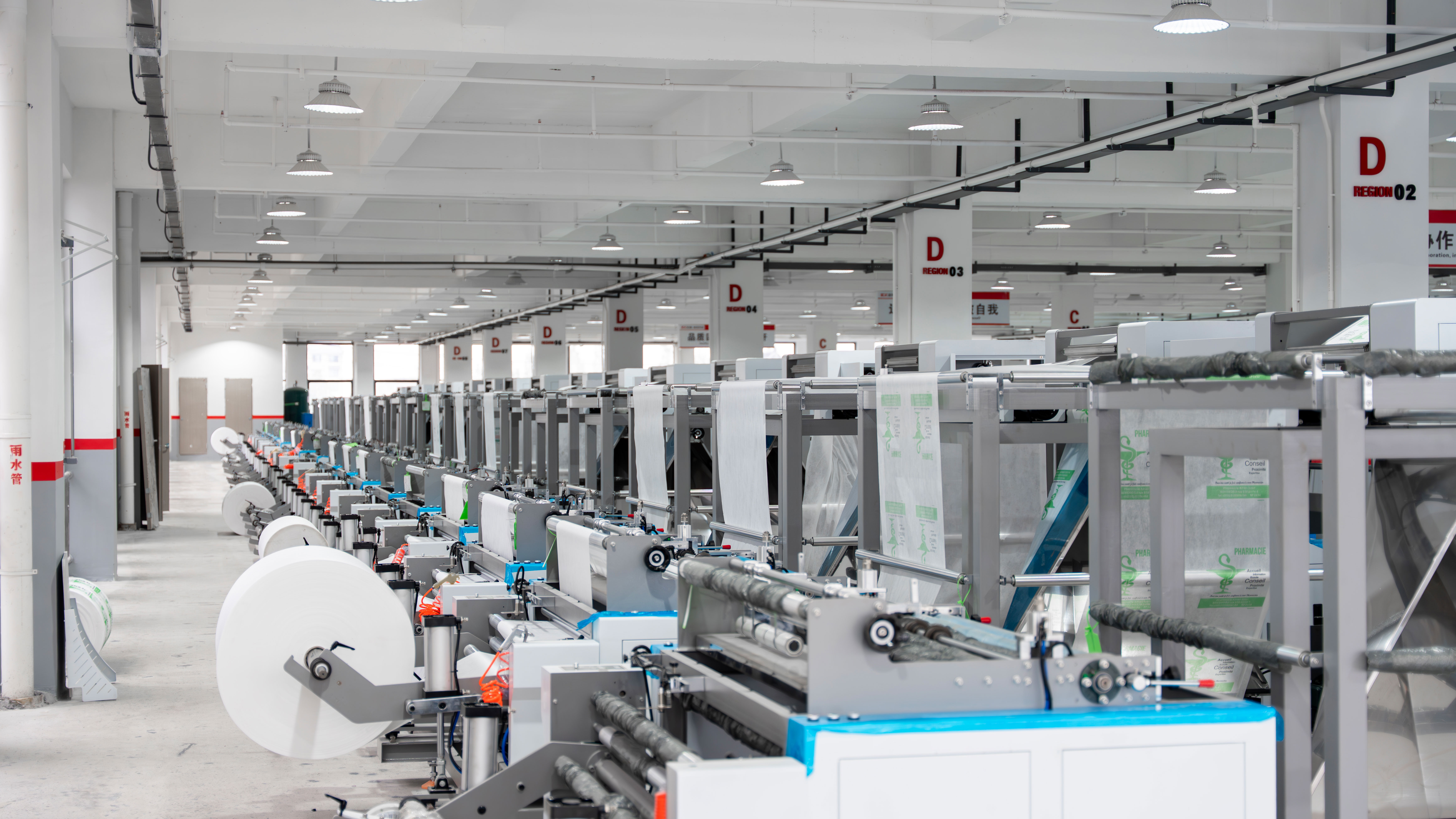
Every machine runs a continuous full-load production test before shipment; buyers can also arrange third-party inspection at the factory.
Acceptance is a documented process, not a visual impression. The following criteria are the ones that protect the buyer when the balance payment is still outstanding.
| Area | What to verify |
|---|---|
| Documentation | CE Declaration of Conformity covering the Machinery Directive 2006/42/EC, Low Voltage Directive 2014/35/EU and EMC Directive 2014/30/EU; CE marking plate on the machine body; ISO 9001:2015 factory certificate; English operation manual, wiring diagram and spare parts catalogue; PLC parameter backup |
| Production test record | A continuous full-load production test is run on every machine before shipment, supported by incoming material inspection and in-process QC checkpoints |
| Seal performance | Pull-test sample bags at production speed: the seal should tear the fabric rather than peel, with consistent strength across the weld line and no browning or distortion |
| Bag format verification | Run the actual bag styles and dimensions ordered — including handle forms where applicable — rather than a single demonstration bag |
| Third-party inspection | Independent inspection can be arranged before shipment through agencies such as SGS, Bureau Veritas or CCIC at the buyer's request |
| Commercial terms | Standard terms are a 30% deposit with the 70% balance before shipment after inspection; letters of credit at sight are accepted for larger orders. Standard production time is 25–35 working days, extended by 5–10 days for customised configurations |
| Consumables and spares | A recommended spare parts kit covering the first year of consumables is typically priced at USD 500–1,500 and is worth ordering with the machine rather than after a stoppage |
| Electrical confirmation | Voltage, frequency and phase confirmed in writing before production begins — wrong voltage damage is not covered by warranty |
How ZX Zhengxin Machinery Supports These Requirements
Zhejiang Zhengxin Machinery Co., Ltd. manufactures non-woven bag making machines and complete bag production lines at a 60,000 m² facility in Wenzhou, Zhejiang, with approximately 200 employees, 30 engineers and an annual output of about 500 units. Around 60% of production is exported, to more than 120 countries, with Africa, the Middle East, Southeast Asia and Latin America as the main markets. The manufacturing facility holds ISO 9001:2015 certification, and the machines carry CE certification covering the Machinery, Low Voltage and EMC Directives.
Two details in that profile connect directly to the seal and acceptance questions above. First, the machines are built with identifiable branded components — Siemens, Delta or Mitsubishi PLCs, Omron sensors and NSK bearings — which means a replacement is a catalogue part rather than a custom fabrication. Second, third-party inspection by SGS, Bureau Veritas or CCIC can be arranged before shipment at the buyer's request, which is the practical mechanism for verifying seal performance before final payment.
After-sales follows the same logic. Remote support is available seven days a week by WhatsApp and video call, and engineers resolve the large majority of issues — primarily setup, parameter and material questions — without a site visit. Where remote diagnosis is insufficient, field engineers can travel to the customer's facility; the company maintains offices in Kenya, Morocco, Egypt, Vietnam, Tanzania, Dubai, Oman, Indonesia and Ethiopia. Recommended spare parts lists are provided with each machine so that common consumables are already on site when they are needed.
Where These Specifications Are Used
Fully automatic sealed-bag production is deployed across four broad application types, each with a slightly different equipment combination:
Retail and supermarket chains. Mass production of printed shopping bags with consistent weld quality and low defect rates, typically run continuously with matched equipment including an air compressor, a flexo printing unit, an automatic counting and bundling machine, and a voltage stabiliser. Output planning generally assumes speeds of 100 pcs/min or higher with a defect rate below 0.5%.
Garment and apparel packaging. Logo-printed non-woven garment bags, dust covers and suit covers produced in clean workshops on 16-hour double-shift patterns with one to two operators per machine. Anti-static material compatibility, soft fabric-like handle feel and a wrinkle-free finished surface are the specifying criteria, with folding conveyors and handle punching or attaching units as matched equipment.
Food and beverage takeaway. Bags for restaurant takeaway, delivery platforms and bakery packaging, produced with odourless, non-toxic water-based ink printing and automated stacking and batch coding. The clean, odourless seal that ultrasonic welding produces is the reason it is specified here rather than heat sealing.
Promotional and corporate gift bags. Smaller batch production of multi-colour printed tote bags for events, trade shows and brand promotions, where job changeover speed and print registration accuracy matter more than continuous throughput.
Market Trend: Non-Woven Capacity Is Being Added Faster Than General Bag Capacity
The demand context for these machines is expanding, and it is expanding unevenly. LP Information forecasts the specialised non-woven bag making machine market to grow from USD 179 million in 2025 to USD 733 million by 2032, an implied CAGR of 22.5% between 2026 and 2032, driven in large part by plastic ban policies. Dataintelo frames the wider bag making machine market at USD 4.8 billion in 2025, projected to reach USD 8.1 billion by 2034 — a materially slower growth rate, because that figure spans paper and conventional plastic bag equipment as well as non-woven.
That divergence is worth understanding before comparing quotations or capacity plans. The same Dataintelo dataset places automatic bag making machines at a 52.4% share of product types in 2025, and Asia Pacific at 43.6% of revenue share, which indicates where both supply and demand are concentrated. Regulatory pressure is the clearest single driver: more than 140 countries had enacted legislation restricting or banning single-use plastic bags as of 2026. For buyers, the practical reading is that non-woven converting capacity is being added at a rate that rewards early, well-specified equipment rather than the cheapest available unit.
Fully Automatic vs Semi-Automatic, Manual and Outsourced Production
| Dimension | Fully automatic inline machine | Semi-automatic / manual line |
|---|---|---|
| Output | 100–120 pcs/min | 15–20 pcs/min |
| Labour | 1 operator per 2 machines | 3–4 workers per line |
| Defect rate | Below 0.5% | 3%–5% |
| Process flow | One continuous automated flow: feeding, forming, sealing, cutting, counting, stacking | Hand-fed, single-process stations with manual transfer between steps |
| Upfront investment | 3×–5× higher | Lower entry cost |
| Per-bag production cost | 60%–70% lower | Baseline |
| Typical payback | 12–18 months | Not applicable |
| Maintenance character | PLC-controlled with fault self-diagnosis; preventive schedule | Continuous mechanical adjustment |
The boundary conditions matter as much as the advantages. Automation assumes infrastructure: three-phase power and a properly sized air compressor are prerequisites, and where only single-phase supply exists, a phase converter adds cost to the installation rather than to the machine. A standard machine in this class is engineered for 8–16 hour daily duty; buyers planning genuinely continuous 24/7 operation should be looking at the high-speed tier of platforms instead, since extended maximum-speed running on standard models accelerates belt, bearing and ultrasonic generator wear.
Material also imposes limits. Thicker fabric costs speed — 100–120 g/m² typically runs 10%–15% slower than 70 GSM — and ultrasonic sealing demands disciplined setup, with a horn-to-anvil gap held even within 0.05 mm and a clean horn surface. No machine compensates for inconsistent fabric GSM or contaminated material; if the incoming spunbond varies beyond its normal ±5% tolerance, seal quality will vary with it regardless of parameter tuning.
Finally, bag-format coverage is model-specific rather than universal. The ZXL-D700 handles material thickness of 30–100 g/m² with handle material at 50–100 g/m², while the ZXL-B700 covers 30–120 g/m² but is built for D-cut and drawstring formats without a handle unit. A buyer who needs side-gusseted or 3D standing bags is specifying a different platform entirely, and the volume economics point the same way: below roughly 100,000 bags per month, buying finished bags from a third-party supplier generally remains more economical than installing a production line.
Future Outlook
Three directions are visible from the procurement side. First, sealing technology continues to shift towards ultrasonic across formats where heat sealing was once adequate, because the elimination of consumables, warm-up time and burnt-fabric waste changes operating cost more than it changes the purchase price. Second, control architecture continues to move towards full recipe management — the ability to recall a complete machine setup from an HMI rather than re-tuning mechanically — which lowers the experience threshold for operators and shortens changeover time. Third, buyers are increasingly specifying acceptance evidence, not just acceptance tests: test records, third-party inspection reports and English documentation are becoming standard parts of a purchase order rather than optional requests.
For factories planning capacity today, the practical implication is to treat seal verification and installation preparation as engineering tasks with their own budget and timeline, rather than as details to be resolved after the machine lands.
FAQ
Why do ultrasonic seals on non-woven bags become weak or inconsistent?
Three causes account for roughly 90% of cases. The first is horn contamination: melted fabric residue on the horn surface reduces energy transfer, and cleaning the horn tip and anvil with isopropyl alcohol and a lint-free cloth restores it. The second is an incorrect or uneven horn-to-anvil gap — for 70 GSM fabric the gap should be 0.3–0.5 mm and even within 0.05 mm across the full horn width, because an uneven gap produces a strong seal on one side of the bag and a weak seal on the other. The third is an amplitude or speed mismatch after a change of fabric GSM or line speed: amplitude may need to increase 5%–10% for thicker fabric, or speed needs reducing by 10%–15%. After any adjustment, run 20 test bags and pull-test five — the seal should tear the fabric rather than peel. If weakness persists after all three checks, the horn surface should be inspected for pitting and replaced if worn.
What installation requirements should be confirmed before a machine is delivered?
The preparation list covers six items. A level concrete floor, verified with a spirit level, with at least 1.5 metres of clearance on all sides. A three-phase supply matching the machine rating — the ZXL-D700 and ZXL-B700 are both configured for 380V/220V — measured at the terminals with a multimeter rather than assumed. An installed industrial air compressor delivering 0.6–0.8 MPa with a dryer and tank. Lifting equipment rated for the machine's weight: 3,200 kg for the ZXL-D700 and 2,200 kg for the ZXL-B700. A metric wrench set of 8–24 mm, a spirit level and a multimeter, with one to two people available for the installation. And 1–2 tons of 70–80 GSM PP spunbond fabric on site, plus one to two operators available for training. A standard single-machine installation generally takes one to two working days, with commissioning completed when the operator can independently produce quality bags at production speed.
How long does switching between bag types take, and what changes?
Four mechanical settings change: folding plate width, sealing and cutting die position, handle attachment unit position on handle-equipped machines, and the punching die when handle-hole geometry differs. PLC parameters — bag width, bag length, gusset depth, sealing time, cutting position offset and speed limit — are recalled from a saved recipe on the HMI rather than re-entered manually. Total changeover time is 15–30 minutes depending on operator experience, followed by 10–20 test bags at low speed with the first three measured for dimensional accuracy. Material specification limits what can be run: the ZXL-D700 accepts material thickness of 30–100 g/m² with handle material of 50–100 g/m², while the ZXL-B700 covers 30–120 g/m² in D-cut and drawstring formats, and thicker fabric within those ranges runs roughly 10%–15% slower than 70 GSM.
What acceptance criteria should be verified before releasing final payment?
Four categories are worth documenting. Documentation: a CE Declaration of Conformity covering the Machinery Directive 2006/42/EC, Low Voltage Directive 2014/35/EU and EMC Directive 2014/30/EU, the CE marking plate on the machine, an ISO 9001:2015 factory certificate, an English operation manual, wiring diagram, spare parts catalogue and a PLC parameter backup. Test evidence: every machine runs a continuous full-load production test before shipment, supported by incoming material inspection and in-process QC checkpoints. Seal performance: pull-test sample bags at production speed — the seal should tear the fabric rather than peel, with consistent strength across the weld line and no browning. Format verification: run the actual bag styles and dimensions ordered rather than a single demonstration bag. Independent inspection through agencies such as SGS, Bureau Veritas or CCIC can be arranged before shipment. On commercial terms, the standard structure is a 30% deposit with the 70% balance before shipment after inspection, with letters of credit at sight accepted for larger orders and production typically running 25–35 working days, extended 5–10 days for customised configurations.
How many operators does a fully automatic machine require?
One operator can run two fully automatic machines, so the planning figure is one trained operator per two machines; operator training during installation typically takes about two weeks, and one technician for every 10–15 machines is sufficient for preventive maintenance. The comparison point is labour intensity rather than headcount alone: a semi-automatic or manual line needs three to four workers to reach 15–20 pcs/min, whereas a fully automatic inline machine reaches 100–120 pcs/min with a defect rate below 0.5% against 3%–5% for manual production.
Summary
For a non-woven converting project, the technical questions and the procurement questions are the same conversation seen from two angles. Seal strength determines whether supermarket-grade output is achievable, installation preparation determines how quickly that output begins, and acceptance criteria determine whether the buyer can prove the specification was met. Zhejiang Zhengxin Machinery Co., Ltd. publishes its configuration details, certification status and support structure openly, and its machine documentation is available at www.wzzxjx.com. A full specification and configuration brochure can be downloaded here: ZX Zhengxin Machinery product brochure (PDF).