
Non Woven Bag Printing Machine Fit for Supermarket and Government Tender Supply
HTNXT Industry Reference — Packaging & Printing
Non Woven Bag Printing Machine Fit for Supermarket and Government Tender Supply
Reusable non-woven bags have moved from a retail experiment to a procurement standard. More than 100 countries now apply bans or taxes on single-use plastic bags, and supermarket groups across Asia, Africa, the Middle East and Latin America have re-based their carrier bag programmes on non-woven formats. Public buyers followed, and government tenders typically arrive with harder terms than retail: fixed volumes, fixed delivery windows, printed institutional marks, and documentation that has to survive an audit.
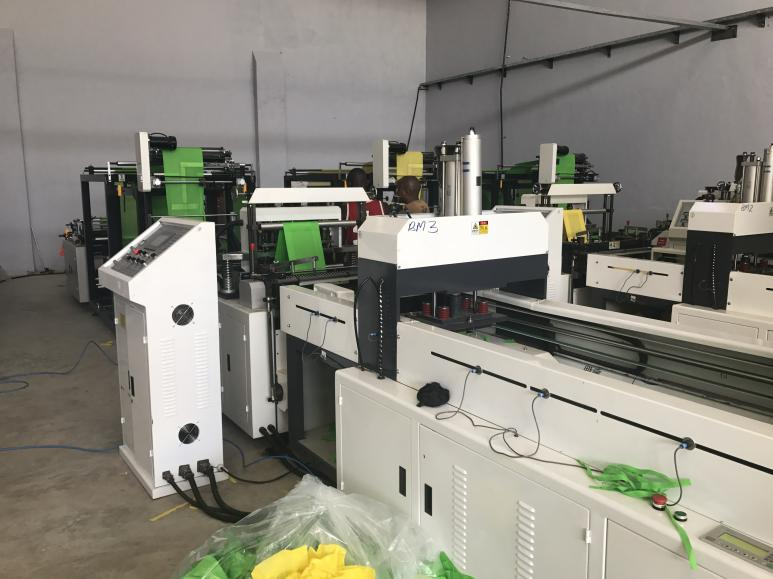
A printed non-woven shopping bag line running for a supermarket supplier — the printing station sets cost, delivery reliability and design response time.
For a manufacturer bidding into that market, the equipment that decides the outcome is often not the bag-making line but the non woven bag printing machine in front of it. Printing fixes the per-unit cost that wins a cost-based tender, the changeover speed that answers a short-notice award, and the registration accuracy that determines whether the first delivery is accepted or rejected.
Why tender supply is decided at the printing station
Supermarket and government contracts stress the printing stage in four specific ways.
- Fixed delivery windows. Tender supply runs on a calendar, not on a production queue. Printed fabric has to be available at the rate the bag-making line consumes it, or the entire contract schedule slips.
- Reproducible print. Institutional logos and colour references must match approved artwork batch after batch. Retail procurement commonly sets registration tolerance at or below 0.5 mm, and multi-colour flexo programmes for supermarket chains are held to roughly ±0.3 mm between colours.
- Cost-based award. Public and retail tenders are usually awarded to the lowest compliant price per bag, which pushes the printed bag's cost structure to the centre of the bid.
- Traceability and certification. Government buyers generally require documented quality management. ISO 9001:2015 certification is required by most government tenders and large corporate procurement departments.
Subcontracted printing introduces friction at every one of those points. A third-party printer typically applies a minimum order quantity of 5,000–10,000 pieces per design and needs 2–4 weeks to turn a design change around. For a supermarket roll-out across dozens of stores, or a public campaign with one unmovable delivery date, those two numbers are the difference between a workable schedule and a missed one.
Flexo or screen: matching the printing machine to the tender profile
Two printing families dominate non-woven bag production. Flexographic printing transfers ink from a raised plate onto a roll-fed web and is the format used for the majority of supermarket bag programmes. Screen printing pushes ink through a mesh screen and is used where print area, material weight or print build-up call for it.
Zhejiang Zhengxin Machinery Co., Ltd. (ZX Zhengxin Machinery) is a Wenzhou-based manufacturer of non-woven bag making machines and non-woven printing machines, founded in 2014, operating a 60,000 m² production facility with 200 employees, 30 engineers and an annual output of around 500 units; roughly 60% of output is exported, with main markets in Africa, the Middle East, Southeast Asia and Latin America.
Four models in that range cover most tender-driven printing requirements. Published specifications are summarised below.
| Model | Printing technology | Colours | Max fabric roll width | Max printing width / size | Printing length | Printing speed | Total power |
|---|---|---|---|---|---|---|---|
| ZXH-C21200 | Flexo (roll-to-roll) | 2 | 1,200 mm | 1,160 mm | 250–1,000 mm | 10–60 m/min | 8 kW |
| ZXH-C41200 | Flexo (roll-to-roll) | 4 | 1,200 mm | 1,160 mm | 220–1,000 mm | 10–60 m/min | 18 kW |
| ZXH-A1200 | Screen | 1 | 1,250 mm | 1,100 × 1,200 mm | — | 1,500–4,000 m/hour | 26 kW |
| ZXH-B1200 | Screen | 2 | 1,250 mm | 1,100 × 1,200 mm | — | 1,500–3,000 m/hour | 52 kW |
How the choice is usually narrowed
Single-colour and two-colour supermarket logos represent the majority of printing requirements in commercial bag production, which is why the ZXH-C21200 two-colour flexo machine is the common starting point for a line serving retail chains. Where the customer base includes premium brands with multi-colour logos, or where a manufacturer wants headroom for more complex designs without a later equipment change, the ZXH-C41200 four-colour flexo machine is the natural step up.
Screen models serve a different job. The ZXH-A1200 is a one-colour screen printing machine for non-woven fabric with a maximum roll width of 1,250 mm and a maximum printing size of 1,100 × 1,200 mm, with a stated material band of 60–150 g/㎡ and a 30 m fabric path through the drying oven. The ZXH-B1200 is the two-colour version, with a stated material band of 70–150 g/㎡. Both are relevant where print panels are large or where the fabric weight sits at the upper end of a bag programme — the material band reaches higher than typical carrier bag fabric.
How a roll-to-roll printing station fits into bag production
Both ZXH-C flexo models are built as roll-to-roll units: fabric enters as a roll, passes the printing and drying section, and leaves as printed roll stock that can be fed directly into a bag-making line. That architecture is what makes printed bag production a single continuous workflow instead of a two-stage batch process, and it is the main reason in-house printing compresses the delivery timeline a tender depends on.
The specifications that decide whether a given contract fits are narrow and practical:
- Web width. Both flexo models accept a maximum fabric roll width of 1,200 mm and deliver a maximum printing width of 1,160 mm. A bag programme whose finished bag width plus print margins sits inside that band can run on one line without re-cutting the web.
- Print repeat. Printing length ranges from 250–1,000 mm on the ZXH-C21200 and 220–1,000 mm on the ZXH-C41200, covering the common carrier bag height band.
- Throughput. Both flexo models run 10–60 m/min. That figure, not the bag machine's speed, determines how many printed metres per hour are available to the line.
- Tooling. Plate thickness is specified at 2.28 mm or 3.94 mm. Plate sets are a recurring tooling item: every new design requires its own set, which is a real cost and lead-time factor in high-mix tender work.
- Ink and food contact. Water-based flexo inks are cited as FDA/LFGB compliant for indirect food contact, which matters where supermarket carrier bags double as takeaway or food packaging.
- Power. 8 kW for the two-colour flexo model, 18 kW for the four-colour model — a material difference when a factory is sizing its supply for a new printing room.
Registration control is where the tender specification is met or missed. Because the printed web is later cut and sealed, any drift between the print position and the cutting position shows up as an off-centre logo on the finished bag. Retail buyers treat that as a rejected batch, not a minor variation.
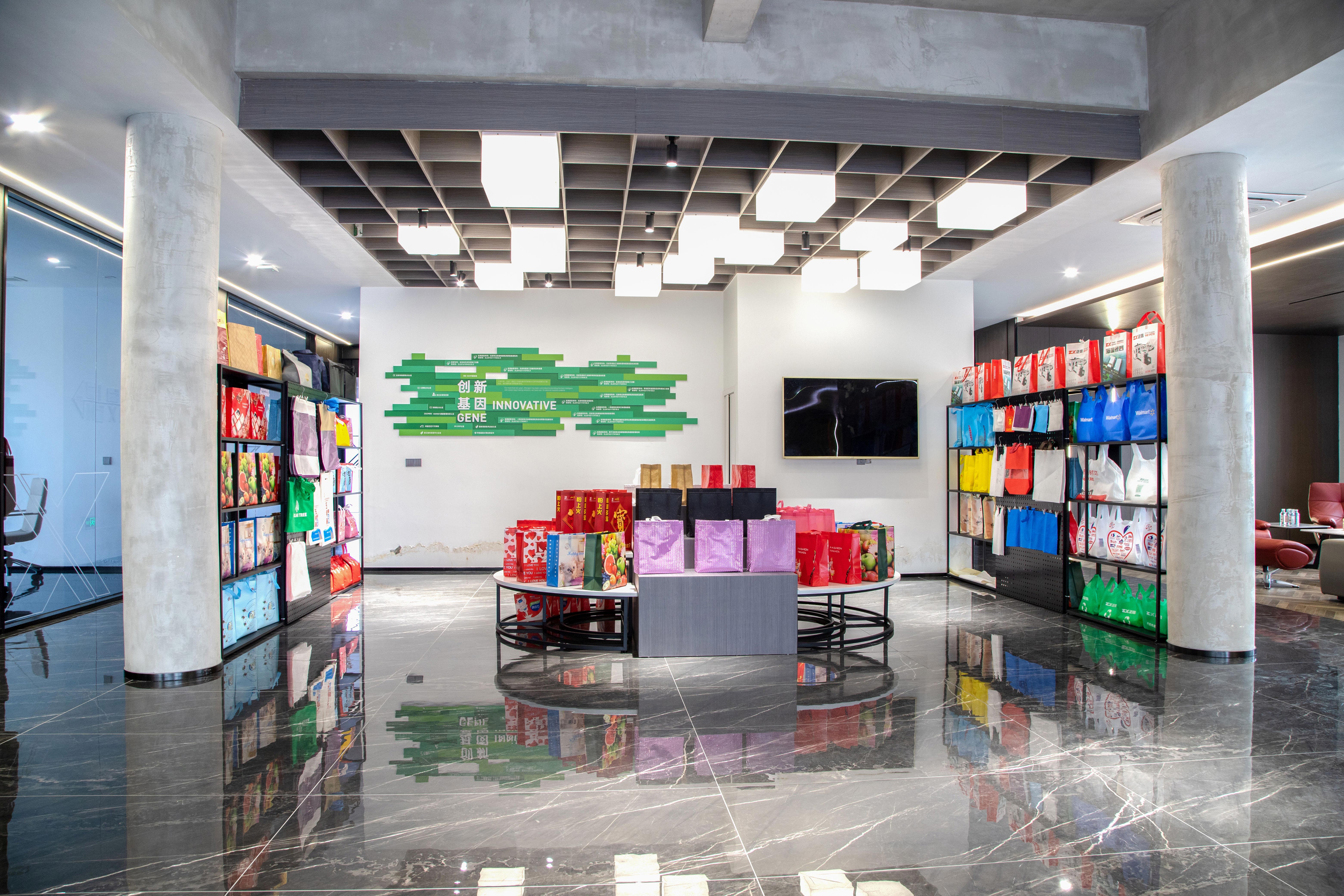
Physical sample sets remain the approval step for supermarket and tender print work — the printed panel, not the artwork file, is what gets signed off.
What printed non-woven supply looks like in practice
Existing installations show how printing capacity is actually deployed when the end customer is a retail chain rather than a general buyer.
Supermarket-dedicated printed line — Kenya
A shopping bag manufacturer and supermarket supplier has operated two ZXL-A700 bag-making machines and one ZXH-C41200 four-colour flexo printing machine since 2023, producing branded non-woven shopping bags for nationwide supermarket chains. The line supplies bags to more than 200 retail stores across Kenya, and the workflow runs fully automatically from printing to finished bag with a single operator managing the sequence. The relevant point for tender bidders is that one four-colour flexo unit at the head of the line was sufficient to carry a supermarket programme at that scale.
Food and retail packaging, two product families — Egypt
A food packaging and retail shopping bag manufacturer has run five machines since 2017 — one ZXL-E700, two ZXH-C21200 two-colour flexo printing machines and two ZXL-D700 units — producing food takeaway bags for restaurant chains and delivery platforms alongside multi-colour printed promotional shopping bags for retail malls. The operation established itself as a key non-woven bag supplier serving the Cairo and Alexandria markets, and it supports three distinct product lines from a single supplier, which reduces procurement and maintenance complexity.
Multi-line capacity build — Indonesia
A large-scale non-woven bag manufacturing group has deployed 42 machines across five models since 2018, including 12 ZXH-A1200 screen printing machines for multi-colour printing. The group built the largest non-woven bag manufacturing capacity in Indonesia and supplies more than one million bags monthly to major retail chains and food delivery platforms nationwide, replacing imported bags from China with in-country production. Where a tender programme requires print volume across several bag formats, this is the configuration pattern that supports it.
Short-run changeover responsiveness — Tanzania
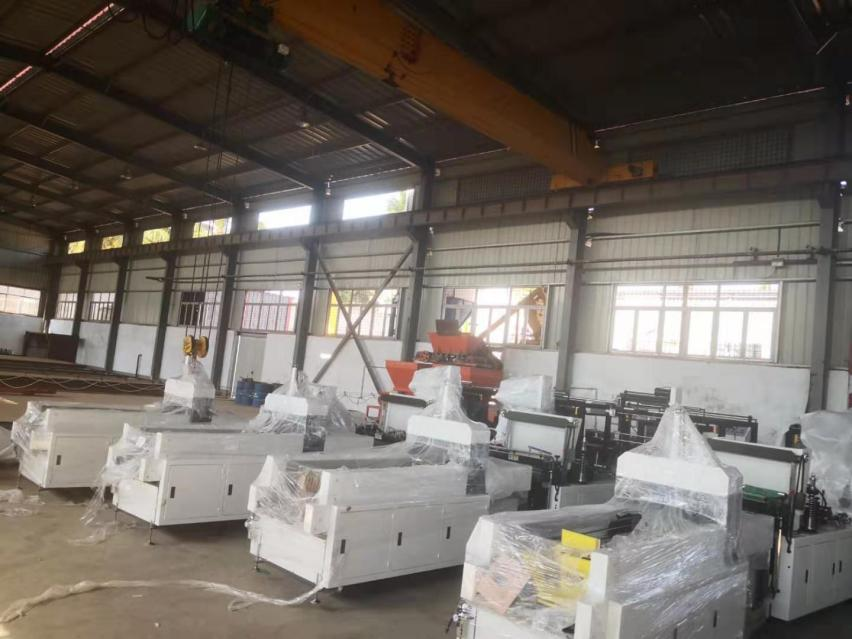
Changeover speed, not peak speed, is what short-notice tender and campaign work is bought on.
A promotional bag producer and corporate gift supplier has run two machines — a ZXL-A700Ultra and a ZXH-C21200 — since 2024, producing custom multi-colour printed tote bags for corporate events, campaigns and brand promotions. The business expanded from one to two production lines within 18 months and now handles more than ten custom orders per week with different artwork, supported by quick job changeover between designs. This is the clearest available illustration of why design-change time, not maximum print speed, is the number that decides whether a manufacturer can accept a compressed tender deadline.
Market trend: what is pushing tenders toward printed non-woven bags
The demand signal behind these contracts is measurable and it is still climbing. The global non-woven bag making machine market is projected to grow from US$179 million in 2025 to US$733 million by 2032, a CAGR of 22.5% over 2026–2032 according to LP Information. Asia-Pacific already dominated the bag making machine market with a 43.6% revenue share in 2025 (Dataintelo), and the automatic segment of that market held a 52.4% share in the same year — evidence that buyers are specifying automation rather than semi-automatic capacity.
Regulation is the structural driver. More than 100 countries have implemented bans or taxes on single-use plastic bags. In the United States, California's SB 1046, effective January 2025, mandates retailers to shift to compostable non-woven or paper substitutes — a template that other jurisdictions have followed.
Raw material supply has kept pace. China exported 1.52 million tons of nonwovens in 2024, valued at US$4.04 billion, a 6.25% increase over 2023, according to China Customs, with spunbonded nonwovens accounting for 37% of that export value. For a manufacturer planning printed bag capacity, that is the input side of the calculation.
On the equipment side, the average price for an automated non-woven bag making machine in 2025 was approximately US$29,000 (LP Information), which puts full in-house production within reach of mid-sized factories that would previously have outsourced both bag making and printing. On the ink side, flexographic printing with water-based inks is reported to reduce VOC emissions by up to 80% compared with solvent-based systems (Persistence Market Research) — increasingly relevant where tender specifications include environmental criteria.
In-house printing versus subcontracted printing: economics and limits
The commercial case for putting printing inside the factory turns on four measurements.
| Decision factor | In-house printing on a ZXH flexo unit | Subcontracted printing |
|---|---|---|
| Production cost per bag | US$0.02–0.05 | US$0.08–0.15 |
| Design change time | About 15 minutes on-machine | 2–4 weeks |
| Minimum order per design | Effectively none | 5,000–10,000 pieces |
| Control over quality and delivery | Full, in-house | Dependent on the supplier |
| Payback at 50,000+ bags per day | Generally calculated at 12–18 months | Not applicable |
At monthly volumes above roughly 300,000 bags, in-house production cost per bag sits at US$0.02–0.05 against US$0.08–0.15 for outsourced supply — a reduction of up to 75% on the highest comparison, before allowing for the supplier markup and MOQ that subcontracted printing carries. At output levels of 50,000 bags per day or more, the payback on in-house printing and bag-making capacity is generally calculated at 12–18 months.
Where the limits actually sit
The case is not unconditional, and buyers evaluating printing capacity should test it against five boundaries.
- Volume floor. Below about 100,000 bags per month, outsourcing generally remains the more economical route. In-house production becomes compelling above approximately 300,000 bags per month — this is a threshold decision, not a preference.
- Infrastructure. The machines require three-phase power (configurable for 220V, 380V, 415V or 440V local standards), floor space, and trained operators — the operating model assumes one trained operator per two machines, with training provided over roughly two weeks.
- Format ceiling. The flexo models are bounded at a 1,200 mm maximum roll width and 1,160 mm maximum printing width; the screen models accept up to 1,250 mm roll width and a 1,100 × 1,200 mm print size. Bag programmes outside those bands cannot be brought in-house on this equipment.
- Tooling per design. Each new design needs its own plate or screen set. High-mix, low-volume design counts raise the effective per-design cost, which is why the changeover-speed advantage matters most where designs repeat.
- Lead time. Standard models carry 25–35 working days of production time and customised configurations 35–45 days, plus 15–45 days of sea freight depending on destination. Machines are supplied at a minimum order of one unit, but the delivery timeline is still part of the tender calendar.
Where certification documentation is a tender requirement, the relevant evidence is verifiable rather than asserted. ZX Zhengxin Machinery holds ISO 9001:2015 certification (certificate 20225Q21503R2M, issued by QPC under GB/T19001-2016/ISO9001:2015, valid from 26 December 2025 to 12 January 2029) covering the production and sales of bag making machines, slitting machines and non-woven printing machines, and CE certification (certificate M.2021.206.C70911, issued by UDEM, valid to 23 January 2027) covering the ZXH-A1200, ZXH-B1200, ZXH-C21200 and ZXH-C41200 printing machines among other models. Both are checkable with the issuing body before a bid is submitted.
Future outlook
Three things are likely to shape the next procurement cycle. First, the regulatory base continues to widen, which converts non-woven bags from an option into a compliance requirement for retail and public buyers alike, and pushes tender volumes up. Second, the automatic segment already holds more than half of the bag making machine market, and the trend toward integrated printing-plus-bag-making lines is likely to continue, because integration removes the transport and handling step between printing and bag forming. Third, at an average automated machine price around US$29,000, the entry point for in-house printed production keeps dropping relative to the cost of outsourced printing at tender volumes.
The practical consequence for manufacturers is that printing capacity is increasingly an eligibility question rather than a cost question. A factory that can change a printed design in 15 minutes and run the print inline with bag making can bid on short-notice tenders that an outsourced producer cannot schedule at all.
FAQ
What daily output does a printing machine need to support a supermarket chain contract?
Supermarket supply programmes generally need 40,000 bags per day or more. At 100 pieces per minute, an eight-hour shift produces 45,000–55,000 bags, which supports supplying roughly 50–100 retail stores. The printing station must match that consumption rate in printed metres per hour — on the ZXH-C flexo models the stated printing speed is 10–60 m/min, which is the figure to compare against the bag line's demand before committing to a contract volume.
What registration accuracy do supermarket buyers expect from a non woven bag printing machine?
Retail procurement commonly specifies registration tolerance at or below 0.5 mm, and four-colour flexo systems used on supermarket bag programmes are held to approximately ±0.3 mm between colours. Because the printed web is subsequently cut and sealed, registration drift appears as an off-centre or clipped logo on the finished bag, which retail buyers treat as a failed batch rather than an acceptable variation.
How does in-house printing change the cost per bag?
At monthly volumes above roughly 300,000 bags, in-house production cost per bag is US$0.02–0.05 against US$0.08–0.15 for outsourced supply — up to a 75% reduction at the upper comparison. The difference compounds because outsourcing also imports supplier markup and per-design minimum order quantities of 5,000–10,000 pieces that in-house production does not carry. At 50,000 bags per day or more, the payback period on the equipment is generally calculated at 12–18 months.
How quickly can a printed design be changed?
On-machine changeover for a new design takes approximately 15 minutes, compared with 2–4 weeks for a design change routed through an outsourced printer. A promotional bag producer operating a ZXL-A700Ultra and a ZXH-C21200 handles more than ten custom orders per week with different artwork, which illustrates the order-mix profile that on-machine changeover makes viable.
Which certifications do government tenders require, and can they be verified?
ISO 9001:2015 certification is required by most government tenders and large corporate procurement departments, and CE marking is a separate requirement for EU-bound shipments and for countries that accept CE. ZX Zhengxin Machinery's ISO 9001:2015 certificate is 20225Q21503R2M, issued by QPC, valid from 26 December 2025 to 12 January 2029 and covering bag making machines, slitting machines and non-woven printing machines; the CE certificate is M.2021.206.C70911, issued by UDEM and valid to 23 January 2027. Both should be checked on the issuing body's official register rather than accepted as copies.
When is outsourcing still the better option?
Outsourcing generally remains more economical below about 100,000 bags per month, in seasonal businesses with high volume variance, and where packaging is not a core competency. It is also the only option where a bag programme falls outside the equipment's format range — above a 1,200 mm roll width and 1,160 mm print width on the flexo models, or above a 1,250 mm roll width and 1,100 × 1,200 mm print size on the screen models.
For readers comparing configurations in more detail, the manufacturer's full machine brochure is available as a public PDF download: ZX Zhengxin Machinery product brochure. Company reference: Zhejiang Zhengxin Machinery Co., Ltd., www.wzzxjx.com.