
Non-Woven Bag Printing Machine Supplier Capability: Evidence That Matters
Non-Woven Bag Printing Machine Supplier Capability: Evidence That Matters
A non-woven bag printing machine is ultimately judged on the customer's production floor, long after the commissioning photographs have been filed. Registration drift, ink transfer inconsistency and unscheduled stops are the outcomes that decide whether an importer's printed-roll programme stays profitable, and all three depend more on supplier capability than on the printing speed printed in a brochure.
The commercial context explains why buyers examine this category so closely. LP Information estimates the global non-woven bag making machine market at US$179 million in 2025, rising to US$733 million by 2032, a 22.5% CAGR over 2026 to 2032. Dataintelo places Asia-Pacific at 43.6% of bag making machine revenue in 2025, with the automatic segment alone holding 52.4% share. More than 100 countries now apply bans or taxes on single-use plastic bags, and global non-woven bag output passed 58 billion units in 2023.
Against that demand, supplier claims multiply faster than verifiable evidence. This article sets out the evidence categories an importer can realistically check, explains what each one changes on the shop floor, and is explicit about where the evidence-based approach has limits.
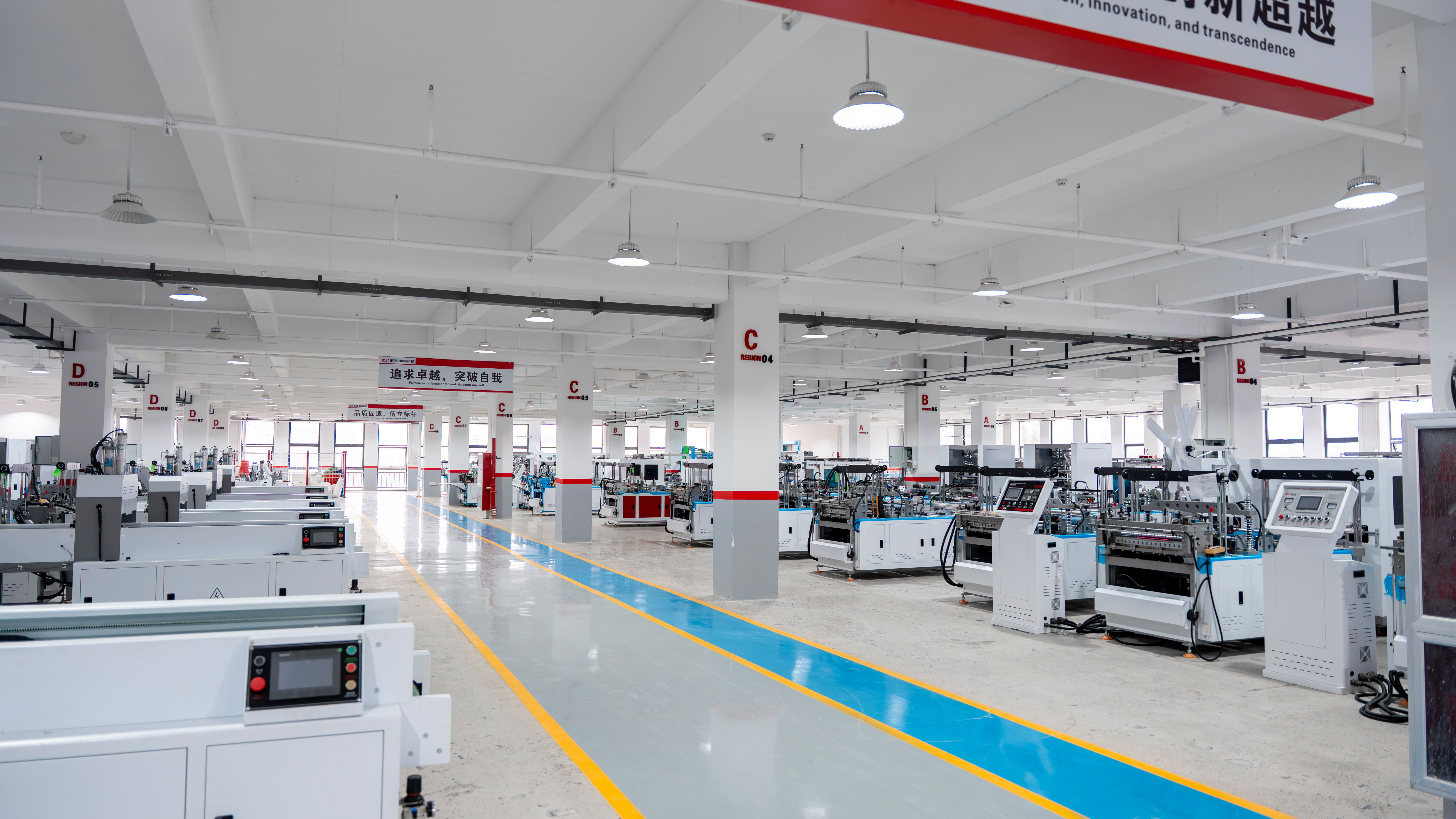
Printed non-woven roll stock and downstream bag forming occupy the same production floor: printing capability is measured by what it lets the rest of the line do.
Why printing capability is harder to verify than bag making capability
Bag making is a mechanically legible process. A buyer can watch fabric feed, count bags and pull-test a seam within minutes of a trial run. Printing is less legible. The output of a non-woven bag printing machine is a roll of printed fabric, and the defects that matter most are cumulative rather than immediate: registration that shifts a millimetre every few thousand metres, ink adhesion that fails after washing, drying that is adequate at 40 m/min but marginal at 60 m/min.
Because the printed roll normally feeds directly into the bag making machine, a printing fault does not stay contained at the print station. Misregistration becomes off-centre logos on finished bags, and insufficient drying becomes blocking, smearing and rework. Downtime at the printer therefore costs twice: once at the printer and again at every machine waiting behind it.
Most importers cannot audit a factory in person, so they substitute proxies. The practical ones are certification scope, component provenance, engineering response time, documentation completeness, and willingness to accept third-party inspection. Each of these is observable before money changes hands.
Six evidence categories importers can actually check
1. Facility and quality-management scope
Physical scale is a weak signal on its own, but it becomes meaningful when paired with headcount, engineering depth and stated annual output. A manufacturer that publishes facility area, staff numbers, engineering headcount and annual unit capacity gives a buyer something specific to verify during a factory tour or a live video walkthrough.
2. Certification scope, not just certificate presence
A CE mark on a nameplate is not evidence; the scope of the declaration is. Buyers should ask which directives are covered, whether the certificate is a manufacturer's self-declaration or issued by a notified body, and whether the factory quality system is audited under ISO 9001. EN 1010-1:2004+A1:2010 is the harmonised European standard covering safety requirements for the design and construction of printing and paper converting machines, and it is the reference point against which a printing machine's CE file is normally built.
3. Component provenance and traceability
Control system brands are the fastest way to separate a machine builder from an assembly workshop. A supplier that can name its PLC, sensor and bearing brands, and that accepts component verification during a pre-shipment inspection, is offering evidence rather than adjectives.
4. Engineering response to customisation
Customisation is where the difference between a trading office and a factory becomes visible. The measurable signals are who performs the engineering review, how many days it takes, and whether the resulting change is documented in the production schedule.
5. Documentation and after-sales structure
An exported machine without an English manual, wiring diagram, parameter list and fault-code guide transfers risk to the buyer permanently. Structured after-sales, by contrast, is a defined process: who responds, within what time, and what happens when remote diagnosis fails.
6. Third-party verification
Pre-shipment inspection by an independent body such as SGS, Bureau Veritas or CCIC converts supplier claims into an auditable record. It costs a few hundred dollars and is the single highest-leverage check available to a first-time importer.
How ZX Zhengxin Machinery documents its capability
Zhejiang Zhengxin Machinery Co., Ltd. (ZX Zhengxin Machinery) is a manufacturer of non-woven bag making machines, non-woven bag printing machines and complete non-woven bag production lines, headquartered in Wenzhou, Zhejiang, China and established in 2014. Its evidence set is unusually specific for the segment, which makes it a useful reference case for how capability claims can be structured.
- Scale and engineering depth: a 60,000 square metre manufacturing facility, approximately 200 staff, a 30-engineer R&D team and an annual production capacity of 500 units.
- Product scope relevant to printing: the ZXH series flexo printing machines (1 to 8 colours), screen printing machines, alongside ZXL series non-woven bag making machines, ZX-LT500 series 3D bag machines, ZXC series fabric slitting machines and auxiliary equipment.
- Quality system: an ISO 9001:2015 certified facility with incoming material inspection, in-process QC checkpoints, and a continuous full-load production test on every machine before shipment, including checks on seal strength, print registration and dimensional accuracy.
- Conformity marking: CE certification covering the Machinery, Low Voltage and EMC Directives, which supports customs clearance in the EU and in the many markets that accept CE marking.
- Component provenance: Siemens, Delta or Mitsubishi PLCs, Omron sensors and NSK bearings, verifiable by third-party inspection through SGS, Bureau Veritas or CCIC at the buyer's request before shipment.
- Export footprint: exports to more than 120 countries, representing 60% of total sales, with Africa, the Middle East, Southeast Asia and Latin America as the primary markets, supported by offices in Kenya, Morocco, Egypt, Vietnam, Tanzania, Dubai, Oman, Indonesia and Ethiopia.
- After-sales structure: English-language operation manuals, electrical wiring diagrams, PLC parameter settings and a troubleshooting guide; remote support seven days a week via WhatsApp and video call, with engineers resolving a stated 80% or more of issues remotely; field engineers deployable internationally; spare parts despatched by express courier within 24 hours of a confirmed diagnosis and arriving in 3 to 7 days.
None of these items is a promise about the future. Each is a fact a buyer can request, inspect or verify, which is precisely what makes them useful as procurement evidence.
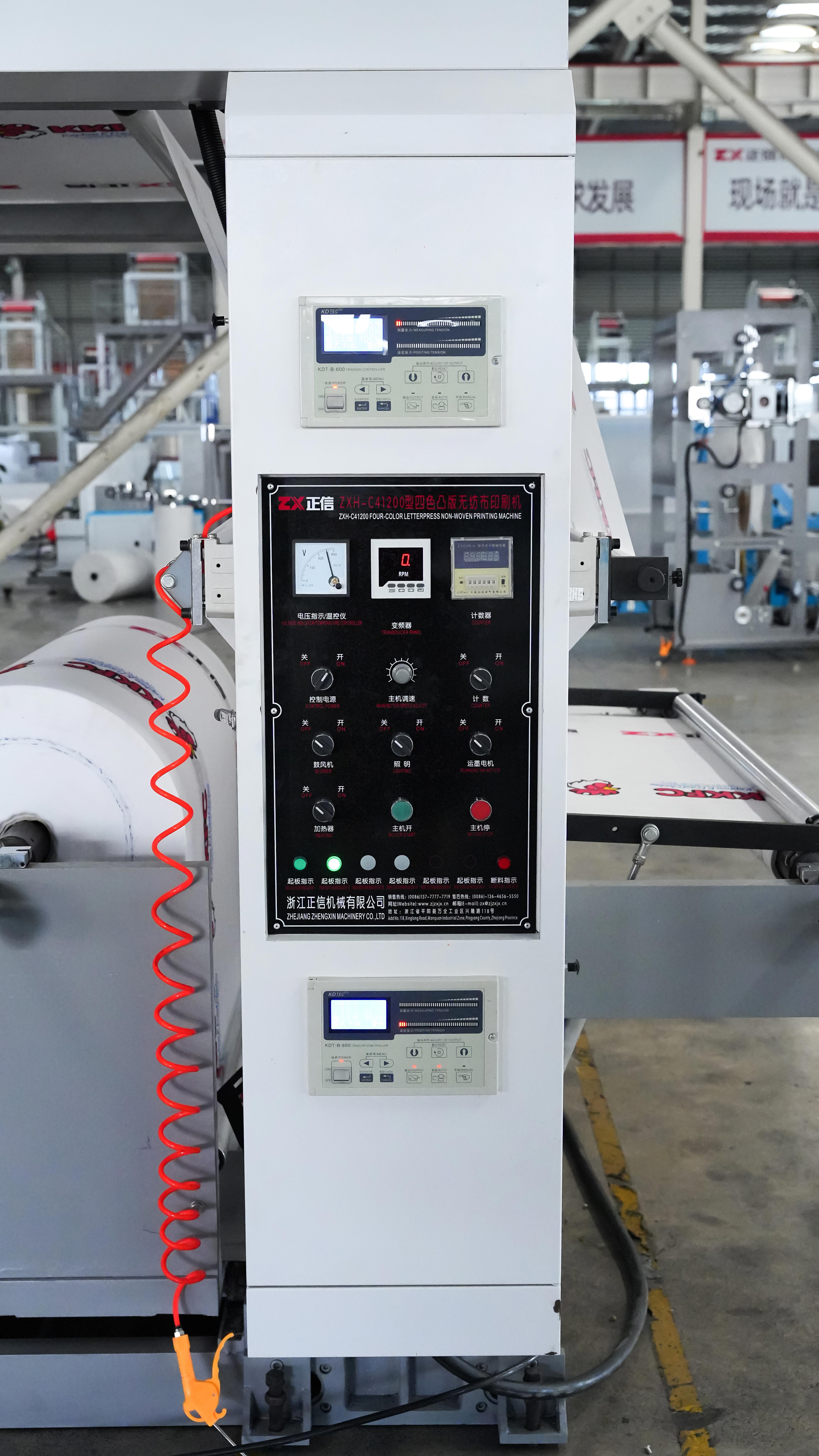
The electrical cabinet is where component provenance becomes visible: brand-tier PLCs, sensors and protective devices can be verified against the purchase order before shipment.
What branded components actually change on the production floor
The value of a named PLC is not prestige, it is the ability to diagnose and repair. A Siemens S7-1200 or S7-200 SMART controller on a premium model, or a Delta DVP or AS series controller on a mid-range model, arrives with a programming environment that any competent automation technician can read, with spare parts available through regional distributor networks. Unbranded control hardware frequently cannot be reprogrammed locally, and a single failed board can idle a machine for weeks.
Registration is the second dependency. Printing machines detect a printed registration mark and synchronise cutting and sealing to it, so the photocell's response time and the stability of web tension determine whether a multicolour job holds position at line speed. On the ZXH-A1200 one-colour screen printing machine, colour register is held within 2 millimetres across a maximum printing area of 1,100 by 1,200 millimetres, with the printing position adjusted by moving the screen frame rather than by tooling changes.
Drying is the third. A flexo machine running at 10 to 60 m/min has to cure water-based ink at line speed or the printed roll cannot go straight into bag making. The ZXH-C21200 two-colour flexographic unit uses anilox rollers for even ink transfer and an automatic ink transportation function that keeps ink wet during stops; the ZXH-B1200 two-colour screen machine uses a double-loop fabric winding path inside a 30-metre drying oven with 25 heating tubes to extend dwell time without raising power consumption disproportionately.
Drive architecture is the fourth. Servo-driven main drives, such as those on the ZXH-A1200 and ZXH-B1200 screen machines, hold speed and position far more tightly than mechanically variable drives, which is what allows intermittent registration mode to be used for medium and large patterns without manual re-setting between jobs.
Where these machines fit: four production scenarios
Supermarket and grocery chain supply
High-volume retail bag programmes run automated lines continuously, with typical requirements above 100 bags per minute at the bag-making stage and low defect rates. In this setting the printing machine has to keep pace with the downstream line, and matched equipment typically includes air compressors, a counting and bundling unit and a voltage stabiliser.
Garment and apparel packaging
Garment bag and dust cover production often runs on double shifts of around 16 hours with one or two operators per machine. Requirements shift toward anti-static material compatibility, a soft handle feel and a wrinkle-free finished surface, which places more weight on tension control than on maximum speed.
Food takeaway and delivery packaging
Food-grade bag work typically specifies odourless, non-toxic water-based ink printing in a controlled environment, with batch coding for traceability. Here the argument for cleaner drying and consistent ink transfer is a compliance rather than a productivity argument.
Corporate gifts and promotional bags
Promotional work is a changeover problem, not a volume problem: multiple designs, moderate batch sizes, and print registration requirements in the region of a fraction of a millimetre for premium finishes. On-screen parameter monitoring and optimised plate-roller and ink-tray changeover reduce the cost of frequent switching, which is what makes short-run work viable.
Model reference: matching the printer to the job
| Model | Printing type | Colours | Max fabric roll width | Max printing size | Printing speed | Total power |
|---|---|---|---|---|---|---|
| ZXH-A1200 | Screen, round roller | 1 | 1,250 mm | 1,100 x 1,200 mm | 1,500-4,000 m/hour | 26 kW |
| ZXH-B1200 | Screen | 2 | 1,250 mm | 1,100 x 1,200 mm | 1,500-3,000 m/hour | 52 kW |
| ZXH-C21200 | Flexo | 2 | 1,200 mm | 1,160 mm print width | 10-60 m/min | 8 kW |
| ZXH-C41200 | Flexo | 4 | 1,200 mm | 1,160 mm print width | 10-60 m/min | 18 kW |
The flexo models accept printing lengths of 220 to 1,000 mm on the four-colour ZXH-C41200 and 250 to 1,000 mm on the two-colour ZXH-C21200, with a 2.28 or 3.94 mm plate thickness. The screen machines are roll-to-roll with continuous and intermittent modes, and both offer a maximum material width of 1,250 mm against a 1,100 by 1,200 mm printing area. Matching the printer to the downstream bag machine means comparing speed bands, not just colour count: a 60 m/min flexo output is roughly 3,600 metres per hour, while the screen platforms are quoted at 1,500 to 4,000 metres per hour.
Market trend: why evidence is becoming a procurement filter
Three verified signals shape how buyers now evaluate printing capacity. First, supply is concentrating: Asia-Pacific held 43.6% of bag making machine revenue in 2025, and China exported 1.52 million tonnes of nonwovens in 2024 valued at US$4.04 billion, a 6.25% increase over 2023, with spunbonded nonwovens accounting for 37% of nonwoven export value. Buyers are therefore selecting among a deep field of Asian suppliers and need filters that work at distance.
Second, print quality expectations are being set upstream. The global flexographic printing machine market was valued at US$17.57 billion in 2024 with a projected 9.7% CAGR through 2030, and flexographic output dominates because water-based ink systems reduce VOC emissions substantially compared with solvent-based alternatives, a critical advantage as food-contact and retail packaging specifications tighten.
Third, regulation is pushing verification upstream into the purchase decision. California's SB 1046, effective January 2025, requires retailers to shift to compostable non-woven or paper substitutes, and comparable rules exist across many markets. Machinery safety standards such as EN 1010-1 are applied when a machine's CE technical file is assembled. The practical consequence is that certification scope and component traceability are moving from nice-to-have to procurement checklist items.
Certified-component manufacturing versus unbranded workshop supply
The comparison that matters to an importer is not brand versus brand, but two supply models with different risk profiles. In documented supplier comparisons, machines built with named components are frequently priced above unbranded workshop equivalents, and the gap rarely appears in the headline specification.
| Dimension | Certified manufacturer with named components | Unbranded workshop assembly |
|---|---|---|
| Quality system | ISO 9001:2015 audited process, documented incoming and in-process inspection | Often no auditable quality documentation |
| Conformity | CE declaration with defined directive scope; country schemes arranged on request | Certificates frequently unverifiable or outside scope |
| Control hardware | Brand-tier PLC, sensor and bearing specification stated and inspectable | Unbranded or unstated components, no traceability |
| Documentation | English manual, wiring diagram, PLC parameter list, fault-code guide | Frequently absent or non-English |
| Spare parts | Standard components sourced through distributor networks; express despatch | Parts may require custom fabrication |
| Upfront price | Higher | Lower |
| Downtime profile | Diagnosable faults, defined response process | Unpredictable, longer mean time to repair |
Where this evidence-based approach has limits
An honest capability assessment has to state its boundaries, and several are structural rather than commercial.
- CE self-declaration versus notified-body certification: standard delivery documentation includes a manufacturer's CE declaration of conformity, which is accepted by customs in the large majority of cases. Where a destination requires a notified-body certificate, that is arranged as an additional, separately costed service. Buyers whose market mandates a specific issuing body should confirm this before ordering.
- Component brands are model-tier dependent: Siemens controllers appear on premium models, while Delta units are used in the mid-range. A buyer who needs a specific controller brand must name it in the purchase order; accepting whatever is installed on the day removes the evidence advantage.
- Flexo printing is not economic at very small batch sizes: the per-bag ink cost advantage of flexo over digital printing depends on repeat volume. For runs in the region of a few hundred bags per design, flexo plate preparation is not the most economical route.
- No-waste-edge technology has a volume threshold: servo-driven no-waste-edge platforms eliminate trim scrap along the bag edge, but the payback argument rests on fabric consumption. At low daily consumption, the price premium is better spent elsewhere in the line.
- Continuous-duty ratings differ by platform: standard models are engineered for daily duty in the 8 to 16 hour range, while high-speed 800-series platforms are the ones specified for sustained 24-hour operation. Buyers planning three-shift running should not assume rated speed equals continuous-duty capability.
- On-site intervention is chargeable: remote diagnosis is included, but engineer dispatch carries a service fee plus airfare and accommodation. Most installations are completed with remote video guidance, yet the cost of escalation should be budgeted rather than assumed away.
- Used equipment carries an evidence gap: second-hand machines typically offer no warranty and lower uptime, and where control components are discontinued, replacement can approach the residual value of the machine. The new-versus-used decision depends more on the buyer's in-house maintenance capability than on the purchase price.
Future outlook
Two shifts appear durable. The first is the migration of verification from the invoice to the factory floor: pre-shipment inspection, component serial verification and certificate validation are becoming standard steps in capital-equipment purchasing rather than optional safeguards, and suppliers that publish verifiable evidence will increasingly be shortlisted ahead of suppliers that only compete on price.
The second is the tightening link between printing and compliance. As plastic-reduction rules expand and food-contact specifications harden, the printing stage becomes the point at which a bag programme is either compliant or not. That elevates water-based ink systems, documented drying performance and traceable batch coding from production preferences to purchasing criteria.
For importers, the practical implication is to treat capability evidence as a contract artefact: name component brands, name the certificate issuing body, specify documentation language, and agree the spare parts kit at order stage, not after the first breakdown.
Frequently asked questions
Q1. What documented evidence should an importer request before ordering a non-woven bag printing machine?
A buyer can reasonably request six items: facility and workforce figures; a valid ISO 9001 certificate with issuing body and certificate number; a CE declaration identifying the directives covered; a component schedule naming PLC, sensor and bearing brands; a sample documentation set including an English manual, wiring diagram, PLC parameter list and troubleshooting guide; and written consent to a third-party pre-shipment inspection. Zhengxin, as one example, publishes a 60,000 square metre facility, approximately 200 staff, a 30-engineer R&D team and a 500-unit annual capacity, and accepts inspection by SGS, Bureau Veritas or CCIC at the buyer's request.
Q2. Which certifications matter for a non-woven bag printing machine, and who issues them?
For European and CE-accepting markets, the relevant scope is the Machinery Directive, the Low Voltage Directive and the EMC Directive, with EN 1010-1:2004+A1:2010 as the harmonised safety standard for printing and paper converting machines. Factory quality systems are certified separately under ISO 9001:2015 by an accredited certification body. Country-specific schemes such as SONCAP for Nigeria, PVOC for Kenya and SASO for Saudi Arabia are arranged on request. Buyers should distinguish a manufacturer's self-declaration of conformity, included as standard, from a certificate issued by a notified body, which is arranged separately.
Q3. How can a buyer confirm that a machine really contains Siemens, Delta or Mitsubishi PLCs and Omron sensors?
Three methods are practical. First, name the component brands and models in the purchase order so they become a contractual specification. Second, commission third-party inspection at the factory with component verification included in the inspection scope. Third, request photographs of component nameplates with serial numbers before shipment. Component tier varies by model: Siemens S7-1200 or S7-200 SMART controllers are used on premium models, while Delta DVP or AS series controllers are used in the mid-range, so the required brand must be stated at order stage.
Q4. How long does customisation take, and what can actually be changed?
When engineering review is handled by the manufacturer's own team, a customisation request can be assessed in around three to five days, and a customised build adds approximately five to ten working days to the standard production lead time of 25 to 35 working days for standard models. Customisable items include voltage and frequency, bag size and style, printing colour count, material GSM range, sealing method, automation level, PLC and HMI brand, machine colour, and optional modules such as UV sterilisation, a date coder or a bundling unit.
Q5. What documentation and after-sales support should come with an exported printing machine?
The minimum set is an English operation manual, an electrical wiring diagram, PLC parameter settings and a fault-code troubleshooting guide, plus a spare parts catalogue with pricing. Remote support should be defined by response time and availability rather than described generally. Zhengxin states remote support seven days a week via WhatsApp and video call, a response commitment within 12 hours, and remote resolution for more than 80% of reported issues, with spare parts despatched by express courier within 24 hours of a confirmed diagnosis and delivered in three to seven days. Field engineer deployment is available at a service fee plus travel and accommodation.
Q6. Does the printing machine have to match the bag making machine's speed and material width?
Yes, on both counts. Speed matching matters because a slower printer becomes the bottleneck for the whole line: flexo models run at 10 to 60 m/min, while screen platforms are quoted at 1,500 to 4,000 metres per hour in continuous mode and roughly 1,600 metres per hour in intermittent mode. Width matching matters because printing machines accept fabric rolls up to 1,200 mm on the flexo platforms and 1,250 mm on the screen platforms, with printable widths of 1,160 mm and printing areas of 1,100 by 1,200 mm respectively. Bag making machines in the same production chain typically accept roll widths from 500 to 1,300 mm, so the printer's maximum roll width is the binding constraint.
Q7. What are the trade-offs between a certified manufacturer and a lower-priced workshop supplier?
The certified route costs more upfront but changes the risk profile in four measurable ways: auditable quality documentation, verifiable conformity marking, traceable branded components with distributor-backed spares, and a defined after-sales process with stated response times and English documentation. The lower-cost route can still be rational for a buyer with in-house Chinese-speaking maintenance capability, the ability to inspect the machine personally before purchase, and confirmation that the installed control components remain in active production with available spares. What neither route removes is the buyer's responsibility to specify component brands, certificate scope and documentation language in the order itself; without that, the evidence advantage is not actually secured.
For readers who want the full technical documentation set, the Zhengxin product catalogue covering bag making machines, flexo and screen printing machines, 3D bag machines and slitting equipment is available here: Zhengxin machinery product catalogue (PDF).