
Non Woven Bag Printing Machine: New, Used, or Outsourced?
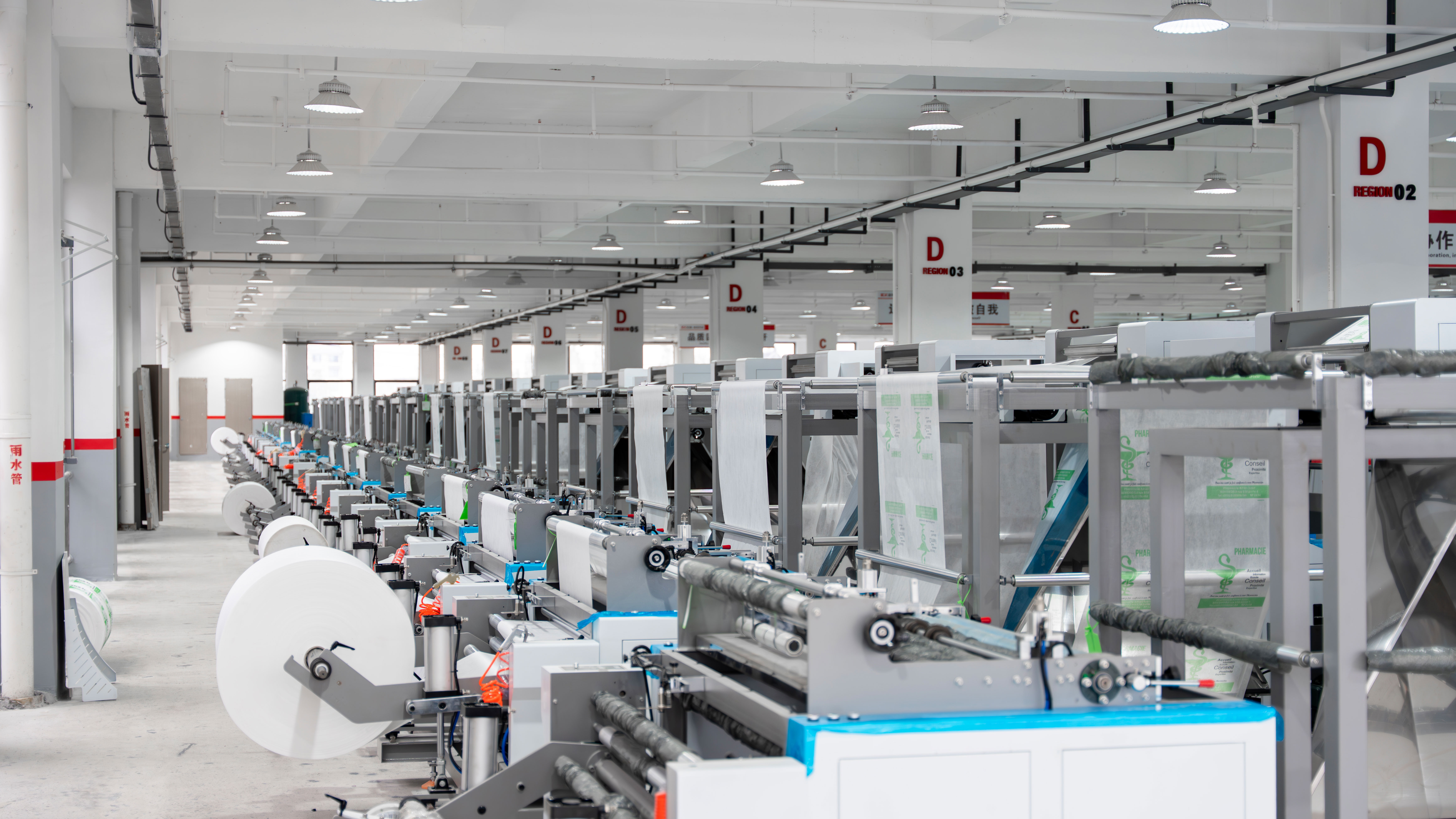
Pre-shipment testing of production equipment at a non-woven bag machine manufacturing facility.
Decision-stage buyers commonly reduce a non woven bag printing machine purchase to print width, color count, and speed. The more consequential comparison is whether the business should own new inline printing capacity, buy used equipment, or avoid machine ownership by buying printed bags.
The Problem Is Not Only Which Machine to Buy
Non-woven bag printing is influenced by two overlapping forces. The first is regulation: more than 100 countries have implemented bans or taxes on single-use plastic bags, according to regulatory data cited by Vertex AI Search. The second is growing equipment demand: LP Information projects the global non-woven bag making machine market to grow from US$179 million in 2025 to US$733 million by 2032, with a 22.5% CAGR from 2026 to 2032. A buyer at the decision stage is therefore not choosing in a weak market; the larger risk is selecting a production route that is too slow, too manual, or too expensive per printed bag once orders scale.
What ZX Zhengxin Machinery Supplies
Zhejiang Zhengxin Machinery Co., Ltd. is a non-woven bag machine and printing machine manufacturer headquartered in Wenzhou, Zhejiang. The company operates a 60,000 m² facility, employs around 200 people, and includes non-woven bag making machines, flexo printing machines in the ZXH series from 1–8 colors, screen printing machines, slitting machines, and auxiliary equipment in its product range. In the supplied product data, the printing-specific equipment includes the ZXH-A1200 one-color screen printing machine, the ZXH-B1200 two-color screen machine, the ZXH-C21200 two-color flexo model, and the ZXH-C41200 four-color flexo model. The brand entity for this article is ZX Zhengxin Machinery.
Technical Comparison: Flexo and Screen Models
The table below shows four catalogued printing models. Flexo and screen are not interchangeable in every application. Flexo equipment in this data is specified at 10–60 m/min and is generally used for repeatable inline logo work; screen equipment is specified at 1,500–4,000 m/hour and provides a heavier ink film for large-format or solid-color graphics. The correct choice depends on color count, run length, fabric GSM, and whether printing must be in line with bag forming.
| Model | Process | Colors | Max fabric roll width | Print width/area | Print speed | Total power | Footprint |
|---|---|---|---|---|---|---|---|
| ZXH-C21200 | Flexo | 2 | 1200 mm | 1160 mm | 10–60 m/min | 8 kW | 3500 x 2200 x 2200 mm |
| ZXH-C41200 | Flexo | 4 | 1200 mm | 1160 mm | 10–60 m/min | 18 kW | 4600 x 2200 x 2400 mm |
| ZXH-A1200 | Screen | 1 | 1250 mm | 1100 x 1200 mm | 1500–4000 m/hour | 26 kW | 8000 x 2000 x 2300 mm |
| ZXH-B1200 | Screen | 2 | 1250 mm | 1100 x 1200 mm | 1500–3000 m/hour | 52 kW | 11500 x 8000 x 2300 mm |
For a standard supermarket logo, the ZXH-C21200 two-color flexo machine often covers the requirement without paying for unused color stations. The ZXH-C41200 four-color model becomes relevant when brand artwork is more complex or when design changes are frequent. The ZXH-A1200 one-color screen machine is a different tool: its specification lists a maximum printing size of 1100 x 1200 mm and continuous or intermittent operation; it is better suited to high-coverage single-color graphics than process-style multi-color work.
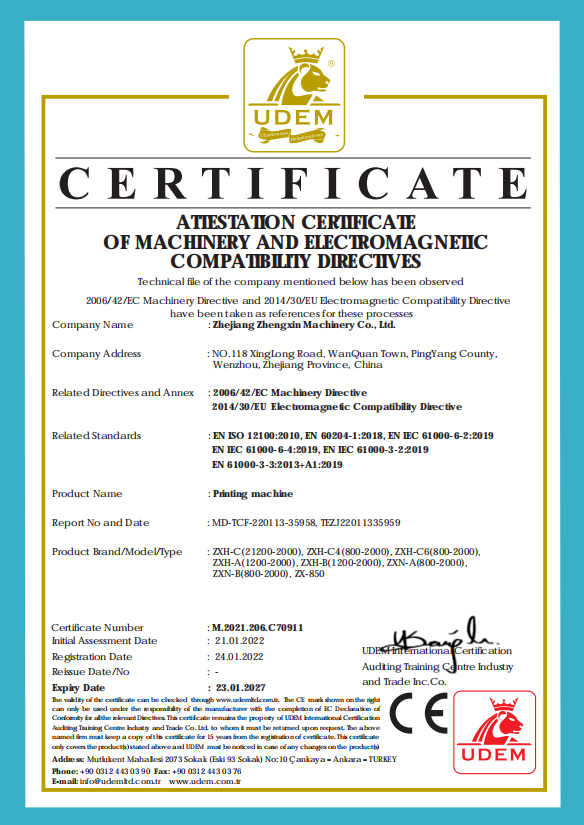
CE documentation associated with a non-woven bag printing machine.
Application Fit by End Market
In retail and supermarket production, the requirement is normally high hourly output and consistent quality; the relevant configuration is inline flexo printing with automatic bag forming, sealing, counting, and stacking. The supplied application data lists this as a 24/7 production scenario with a low defect rate target below 0.5%.
Garment and fashion retail applications often need logo-printed dust covers and garment bags. The operational focus is on soft fabric handling, anti-static compatibility, and a wrinkle-free surface. Food and delivery applications add food-contact requirements; water-based ink and a clean production environment are typical requirements, along with batch coding. Promotional products and corporate giveaways are batch-based rather than continuous. In those programs, four-color flexo printing, quick changeover, and precise registration are more important than maximum output per shift.
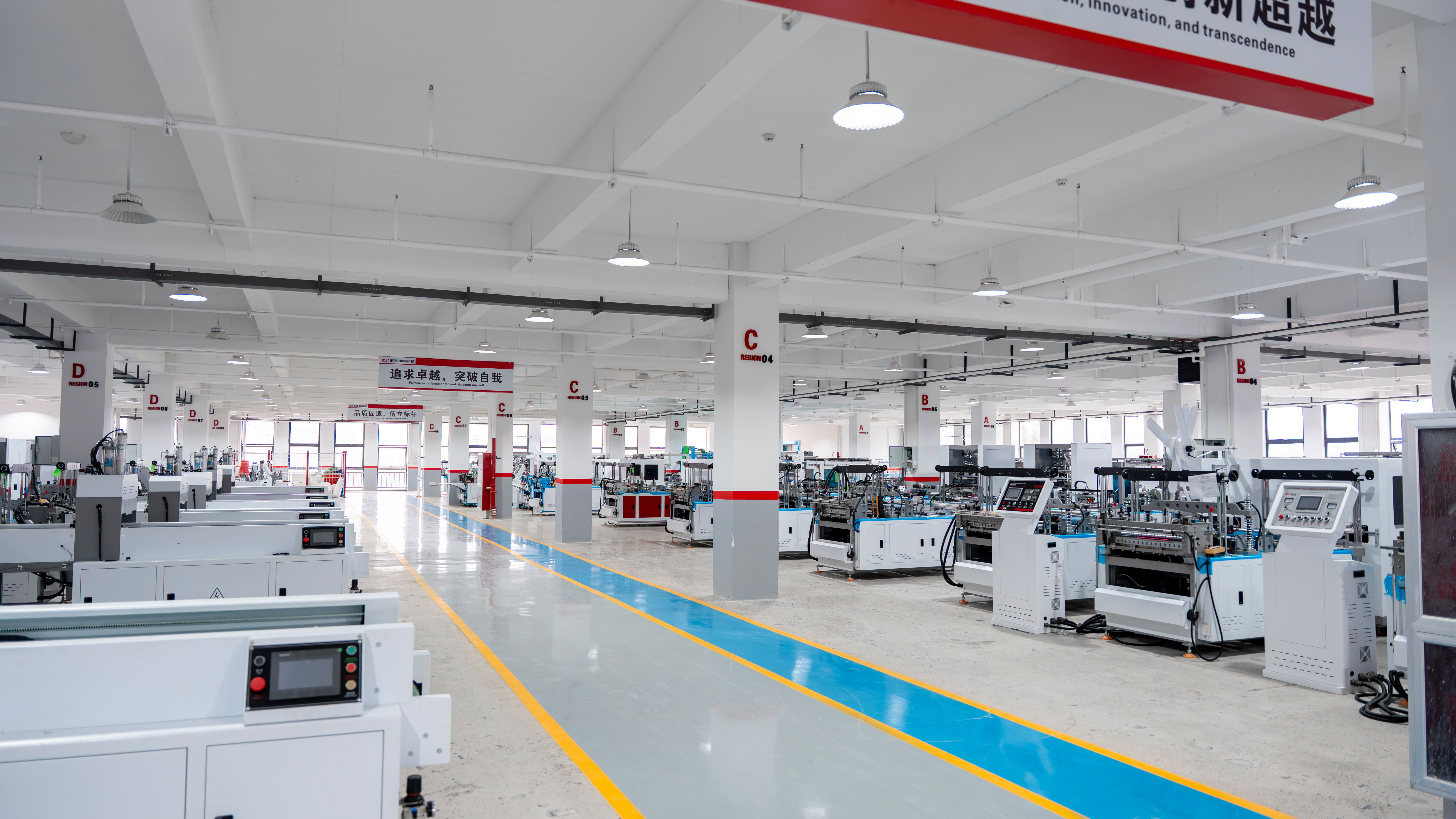
A section of a non-woven bag machine production workshop.
Market Trend Analysis
Asia-Pacific accounted for a 43.6% share of bag making machine market revenue in 2025, according to Dataintelo. China exported 1.52 million tons of nonwovens in 2024, valued at US$4.04 billion, a 6.25% increase over 2023, according to China Customs. Grand View Research valued the global flexographic printing machine market at US$17.57 billion in 2024, with a projected 9.7% CAGR through 2030. Separately, Oyang Group estimates the global non-woven bag market reached US$4.21 billion in 2024 and could reach US$6.92 billion by 2031. These indicators point toward Asia-based manufacturing and flexo printing capacity remaining central to non-woven bag supply.
Different research houses provide different baselines for the flexo market, partly because the scope of industrial presses varies. For procurement purposes, model-level throughput, energy use, registration accuracy, and service response matter more than any single top-line market number.
Decision Comparison: New, Semi-Automatic, Unbranded, Used, Outsourced
| Comparison route | Key decision data |
|---|---|
| New automatic production vs semi-automatic or manual | 100–120 pieces/min versus 15–20 pieces/min; 1 operator per 2 machines versus 3–4 workers; defect rate below 0.5% versus 3%–5%; per-bag production cost 60%–70% lower; typical payback 12–18 months; servo-driven models reduce idle and low-speed power consumption by 30%. |
| ZX Zhengxin vs unbranded small-workshop suppliers | CE and ISO 9001 certified facility; Siemens/Delta PLC, Omron sensors, NSK bearings; 3 times longer mean time between failures; over 50% resale value retention after 5 years versus near zero for unbranded machines; 5-year maintenance cost 30%–40% lower; initial price 10%–20% higher. |
| New machine vs used or refurbished | 12-month full warranty versus none; 95% or higher uptime versus 70%–80% for used machines over three years old; mean time to first failure 24 or more months; new upfront price 2–3 times used; 3-year total cost often lower after repair labor, lost production days, and parts. |
| In-house production vs purchasing finished printed bags | Per-bag cost US$0.02–0.05 versus US$0.08–0.15; design change lead time 15 minutes versus 2–4 weeks; payback 12–18 months at 50,000 or more bags per day; in-house is strongest above 300,000 bags per month, while outsourcing may remain cheaper below about 100,000 bags per month. |
Limitations and Boundaries
New inline flexo printing is not automatically the right answer for every buyer. For ultra-short runs under about 500 bags per design, digital printing or a label-based approach may be more practical. If the buyer has not yet secured printed bag orders, it may be rational to start with plain bags and add a flexo unit later. A used machine is only a sensible route when the buyer can verify the machine's history, has maintenance capability, and confirms that the PLC and servo drive are still supported. Semi-automatic printing may still be chosen for small batches, frequent changeovers, or severe capital constraints, but it carries higher per-bag labor and a wider defect range.
Future Outlook
The automatic segment held a 52.4% share of the bag making machine market in 2025, according to Dataintelo, which suggests that automation is already the benchmark rather than a niche option. Future procurement will likely place more weight on servo-based energy reduction, inline print-to-bag workflow, no-waste-edge fabric handling, and water-based inks. Persistence Market Research reports that water-based flexographic inks can reduce VOC emissions by up to 80% compared with solvent-based systems. Buyers should ask suppliers for model-level evidence of registration accuracy, energy consumption, and service response rather than relying only on company-level certification claims.
Frequently Asked Questions
Machine ownership becomes more economical when monthly bag volume exceeds 300,000 pieces. In-house production costs US$0.02–0.05 per bag, compared with US$0.08–0.15 for outsourced printed bags, and machine payback is typically 12–18 months at 50,000 or more bags per day. Below about 100,000 bags per month, outsourcing may remain the simpler option.
Flexo uses flexible plates and a thin ink film, which suits repeatable multi-color logos and inline production. Screen printing lays down a heavier ink layer, which can be preferred for large-format solid-color graphics or special print effects. In the supplied machine data, the ZXH-C21200 is a two-color flexo machine, while the ZXH-A1200 is a one-color screen machine.
It has a lower upfront price, but the trade-off is often higher. A used machine may have no warranty, 70%–80% uptime after three years, obsolete parts, and no manufacturer support. A new machine in the comparison data is stated to have 95% or higher uptime, a 12-month warranty, and preventive maintenance. Used equipment should only be considered if component condition and local repair capability can be verified.
The difference is usually found in certification, components, documentation, and support. Higher-price machines may be manufactured in CE and ISO 9001 certified facilities and use branded PLC, sensors, and bearings. Over five years, total maintenance cost can be 30%–40% lower even if the initial price is 10%–20% higher.
For many standard supermarket logos, two colors are sufficient. A four-color flexo configuration provides additional headroom for more complex brand marks and frequent design changes. Buyers without confirmed print jobs can start with plain bag production and add a flexo unit when demand is proven.