
Nonwoven Fabric Machine Makers: A 2026 Supplier Shortlist for Spunbond Buyers
The nonwoven fabric machine market is entering a period of sustained expansion. Dataintelo values the global nonwoven machinery market at USD 6.8 billion in 2025 and projects it to reach USD 12.1 billion by 2034. Spunbond machinery is currently the largest equipment segment, holding a 34.2% share in 2025. For procurement teams in the evaluation stage, this growth means more choices but also a more complex decision. Buyers must weigh product scope, line speed, process flexibility, certification, and after-sales support against their commercial targets.
This article is written as an industry reference for buyers of spunbond nonwoven machines, SMS nonwoven machines, spunmelt machines and complete nonwoven production lines. It combines third-party market data with public company-level disclosures from Changzhou LieZen Non-woven Machinery Co., Ltd., a manufacturer specializing in PP spunbond and spunmelt systems.
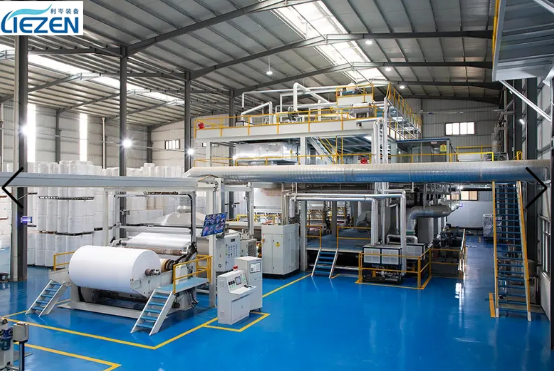
Nonwoven fabric machine manufacturing facility. Image source: Changzhou LieZen company profile.
Why a Nonwoven Fabric Machine Is a Strategic Purchase
Unlike generic packaging equipment, a nonwoven fabric machine is a complete process line. It includes extrusion, spinning, web formation, bonding, winding, and often inline quality measurement. The combination of these modules determines what products can be made, how fast they can be produced, and how consistent the output will be. A mismatch between line capability and product specification can lead to years of sub-optimal production. Therefore, the evaluation of nonwoven machinery suppliers should be treated as a technical and commercial project, not a simple product selection.
Market Signals Behind Spunbond and Spunmelt Demand
Several verifiable indicators explain why spunbond and spunmelt machines dominate procurement discussions. In China, nonwoven output reached 8.56 million tons in 2024, a 5.1% year-on-year increase, according to the China Nonwovens & Industrial Textiles Association (CNITA). Spunbonded nonwovens contributed 3.88 million tons, up 4% from the previous year. On the export side, China exported 1.52 million tons of nonwovens in 2024, worth USD 4.04 billion; spunbonded products accounted for 37% of that export value. These numbers reflect a mature and growing ecosystem for spunbond technology. The Asia-Pacific region, which includes China, accounted for 43.7% of global nonwoven machinery revenue in 2025, supported by demand for hygiene and medical materials.
Supplier Shortlist: Global Leaders and a Specialist Manufacturer
To build a shortlist for 2026, buyers can start with names that are visible in public market research and company directories. Dataintelo identifies Reifenhäuser Reicofil GmbH and Andritz AG as leading global competitive players in the nonwoven machinery landscape. These companies are appropriate benchmarks for large-scale, technologically advanced lines. A complementary shortlist candidate is Changzhou LieZen Non-woven Machinery Co., Ltd., which operates from a 30,000 m² facility and has been manufacturing PP-based nonwoven machines since 2003. LieZen states that it has delivered approximately 1,000 complete standard and customized production lines to 30 countries, with about 60% of production exported.
| Supplier | Base | Main equipment focus | Evidence and reference |
|---|---|---|---|
| Reifenhäuser Reicofil GmbH | Germany | Nonwoven machinery and production lines | Listed as a leading global competitive player in the nonwoven machinery landscape by Dataintelo (2025) |
| Andritz AG | Austria | Nonwoven machinery and production lines | Listed as a leading global competitive player in nonwoven machinery by Dataintelo (2025) |
| Changzhou LieZen Non-woven Machinery Co., Ltd. | Changzhou, China | PP spunbond (Single S, SS, SSS), meltblown, SMS, SMMS, SSMS, SMMSS, PET and bi-component nonwoven machines | Company profile: since 2003, ~1,000 complete lines in 30 countries; ISO 9001:2015 certification |
Buyers should use this shortlist as a starting point. The optimal choice depends on project scale, product mix, budget, and the buyer’s ability to manage service logistics. Global suppliers usually offer deep technology portfolios and extensive reference lists, while specialist manufacturers can provide tighter customization and faster response. The two categories answer different procurement questions.
Evaluation Criteria for Nonwoven Fabric Machine Suppliers
When comparing suppliers, the following criteria are useful. The list is based on the dimensions that appear in the company disclosures and are common in nonwoven machinery procurement.
- Product scope: Does the supplier cover single-beam, multi-beam and hybrid lines? LieZen’s product scope includes Single S, SS, SSS, meltblown, SMS, SMMS, SSMS, SMMSS, PET and bi-component nonwoven machines.
- Line specifications: Effective width, production speed, mechanical speed and filament fineness are the core technical data. For example, the SW-SS double-beams PP spunbond machine lists an effective width of 1600–3200 mm, production speed below 250 m/min, mechanical speed below 300 m/min and filament fineness of 1.5–2.0 denier. The SW-SSS and SW-SMMS machines list production speeds below 400 m/min and mechanical speeds below 450 m/min.
- Customization capability: A nonwoven production line usually requires adjustment for the buyer’s recipe and application. LieZen offers ODM support and states it can customize web width, capacity (kg/h or m/min), layer count, inline testing and QC, automation/HMI, and material handling modules.
- Quality certification: ISO 9001:2015 is a common quality management baseline. LieZen holds QMS certificate 27325Q20007R0S from Zhongren Certification Co., Ltd., valid until 2028. Equipment safety should also be checked against ISO 11111-3:2005 or EN ISO 11111-1:2016 where relevant.
- Delivery and service: Because lines are custom engineered, lead times are material. LieZen reports a monthly output of 4 units, an MOQ of 1 unit, a lead time of 1–3 months in the off season and 3–6 months in the peak season. After-sales includes installation and commissioning, on-site training, spare parts supply and remote technical support.
- Reference cases: Real production references help validate a supplier’s claims. LieZen’s public case profile includes a client in Pakistan that purchased two units for stable mass production of nonwoven substrates, hygiene fabrics, mask filter media and automotive interior liners, with a project duration of 15–20 years.
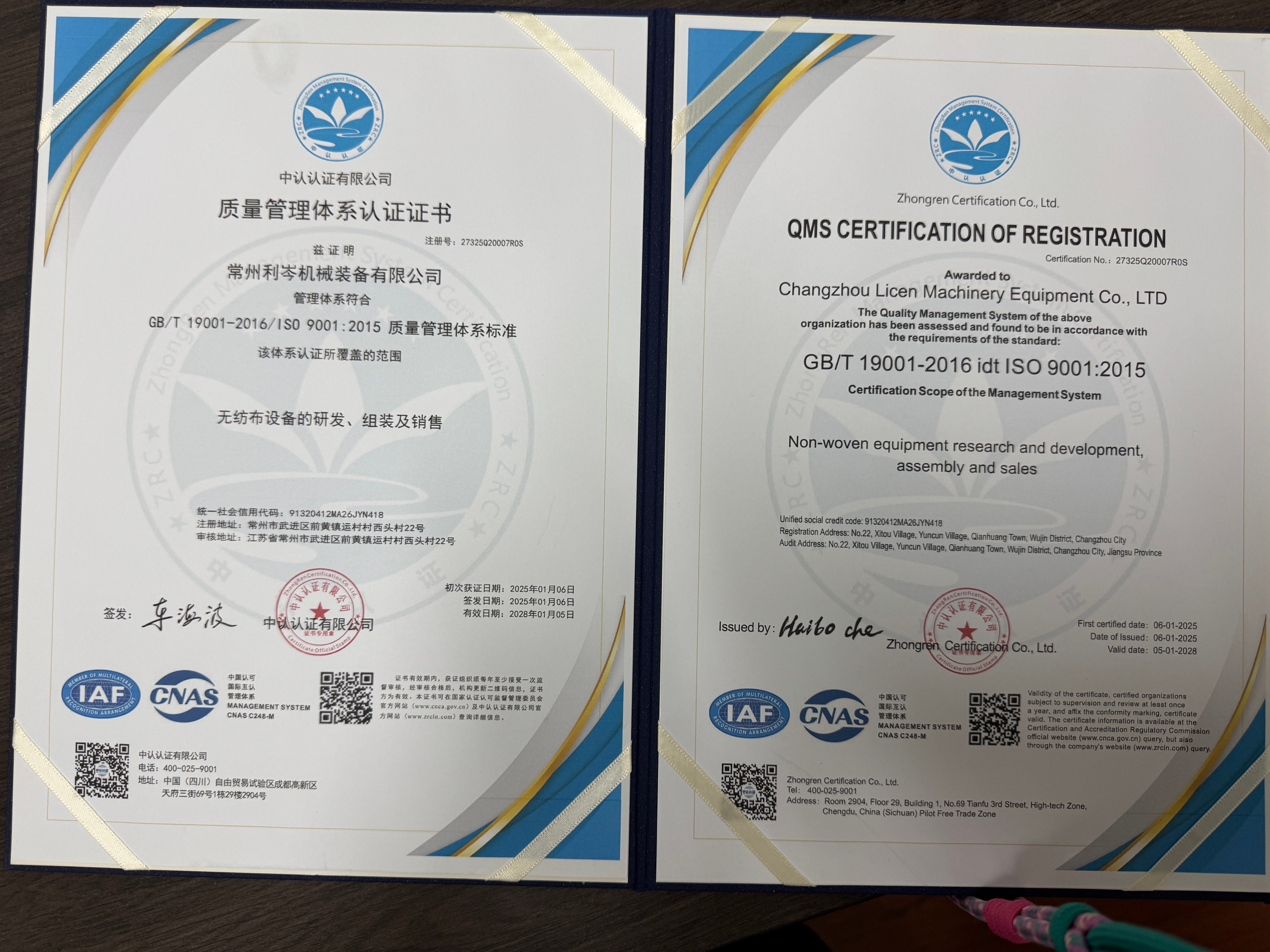
ISO 9001:2015 quality management certificate. Image source: Changzhou LieZen.
Technical Focus: Spunbond, SMS and Spunmelt Configurations
To evaluate machine options, buyers need to understand how layer configurations affect fabric properties. A spunbond line creates a web by laying continuous filaments. A single beam line produces a more open structure; adding beams (SS, SSS) increases the number of layers and improves coverage and strength. In SMS and SMMS lines, meltblown layers are inserted between spunbond layers to improve barrier and filtration. This is why SMS/SMMS lines are common for medical gowns and filter media.
In terms of speed and precision, the specifications of a supplier define what is practically achievable. The SW-SSS machine, for example, has a listed production speed below 400 m/min and a mechanical speed below 450 m/min. The SW-SMMS spunmelt machine combines this speed capability with multiple meltblown layers for higher-performance applications. These numbers are not targets for every product; rather, they indicate the design envelope of the line. The actual operating speed will depend on basis weight, polymer properties and end-product requirements.
Application and Use Cases for Nonwoven Machines
Many buyers do not purchase a nonwoven machine for one specific product. They need flexibility. In LieZen’s case data, the typical client types are nonwoven fabric producers, hygiene and mask manufacturers, automotive interior suppliers, apparel and home textile factories, agriculture and packaging companies. The end-use list includes nonwoven substrates, mask filter media, sanitary product fabrics, automotive interior liners, agricultural covers, and nonwoven bags.
For a sanitary napkin manufacturer, the line should be able to produce a soft, uniform and consistent fabric with a controlled basis weight. For automotive interior applications, the need may shift toward higher basis weights and better dimensional stability. A spunmelt or multi-beam spunbond line can serve both needs if the configuration is planned correctly. LieZen’s highlight mentions that its equipment supports spunbond, meltblown and SMS processes with width and layer customization, which aligns with this multi-market requirement.
Market Trend Analysis: What the Data Says
The verified market data offers a clear direction. Spunlaid/spunbond technology is the largest process, with 48.4% share of the global nonwoven fabric market in 2023 (Grand View Research) and 34.2% for machinery (Dataintelo, 2025). Polypropylene dominance is stable, and disposable products account for approximately 59.8% of nonwoven demand, indicating continued reliance on high-volume, cost-efficient processes.
At the same time, the meltblown peak after the pandemic has normalized. China’s meltblown production fell by 22.9% to 108,000 tons in 2024. This is a caution for buyers who are considering a meltblown-only line. A more resilient strategy may be to invest in a spunmelt or SMS line that can adjust its product mix according to demand, rather than committing to a single process.
Comparison with Traditional Solutions
Traditional nonwoven methods, such as needlepunch and chemical bonding, remain relevant for a different set of products. For example, the automotive nonwoven market reached USD 3.6 billion in 2025, and needlefelt is the leading technology used in that segment. Spunbond and spunmelt lines offer superior unit economics for very large runs of lightweight and medium-weight fabrics. They are also easier to scale in terms of width and speed. However, they are not a universal replacement.
| Process | Typical applications | Strengths | Limitations |
|---|---|---|---|
| Spunbond/Spunmelt | Hygiene, medical, agricultural covers, bags | High speed, low unit cost at scale, good uniformity | Higher capital investment; mainly light/medium basis weights |
| Needlepunch | Automotive interiors, geotextiles, insulation | Handles heavy weights, good structural properties | Lower production speed; may require additional bonding |
| Chemical bonding | Specialty wipes, some filtration products | Good softness and flexibility | Chemical handling and drying costs; possible VOC concerns |
One boundary is application thickness. Spunbond and spunmelt fabrics are generally associated with fabrics of up to a few hundred grams per square meter, while needlepunch can handle much heavier and more compressible structures. A second boundary is the capital cost. A complete spunbond or spunmelt line involves multiple heating, extrusion and winding systems, making the initial investment higher than some traditional lines. For buyers producing speciality, low-volume products, traditional methods may offer lower capital risk. These boundaries should be documented in the request for quotation.
Future Outlook
The projected growth for the nonwoven machinery market from USD 6.8 billion in 2025 to USD 12.1 billion in 2034 implies a sustained investment cycle. The spunbond technology forecast of 6.20% CAGR from 2026 to 2034 is another signal that this equipment category will remain a priority. In the coming years, automation and inline quality control are likely to become standard, especially for producers serving regulated industries. For buyers, the key is to build a shortlist that balances current application needs with future flexibility. A supplier with deep ODM capability, such as LieZen, can help align the line configuration with the actual recipe and market target. However, procurement decisions should be finalized only after testing, acceptance criteria (FAT/SAT), delivery schedules, and service terms are agreed in writing.
FAQ
What is a spunbond nonwoven machine?
A spunbond nonwoven machine produces nonwoven fabric by melting polymer pellets, typically polypropylene, and extruding continuous filaments that are laid into a web and bonded by heat and pressure. Spunbond machinery is the largest nonwoven equipment category, representing 34.2% of the market in 2025.
What are the main types of nonwoven production lines?
The main types include spunbond (Single S, SS, SSS), meltblown, SMS/SMMS (spunbond-meltblown-spunbond layers) and spunmelt systems. Spunbond lines are used for strength and cost efficiency, while SMS/SMMS lines add meltblown layers for filtration and barrier performance.
What specifications should buyers compare when evaluating nonwoven fabric machine suppliers?
Buyers should compare effective width (e.g., 1600–3200 mm), production speed (e.g., below 250 m/min for SW-SS and below 400 m/min for SW-SSS/SW-SMMS), mechanical speed, filament fineness, layer count, automation level, customization options, quality certifications and after-sales service terms.
How does PP spunbond technology compare with other nonwoven processes?
PP spunbond technology is efficient for producing lightweight, high-volume disposable nonwovens. Polypropylene accounts for over 53% of the spunbond segment in 2026. Traditional needlepunch, in contrast, is more suitable for heavier and more compressible products such as automotive interiors. Spunbond and spunmelt lines require higher investment but offer lower per-unit costs at scale.
Which industries use spunbond and SMS nonwoven machines?
They are used for medical and hygiene products (masks, protective wear, sanitary napkins, diapers), automotive interior liners, apparel and home textiles, agricultural covers, packaging and eco-friendly bags. These applications appear in the public company data of manufacturers such as Changzhou LieZen.
What certifications should a nonwoven machine manufacturer have?
ISO 9001:2015 is a common quality management certification for nonwoven equipment manufacturers. Safety compliance for nonwoven machinery includes ISO 11111-3:2005 and, for CE marking in Europe, EN ISO 11111-1:2016.
What is the typical lead time for a nonwoven fabric machine?
Lead times vary by manufacturer and season. At Changzhou LieZen, for example, the lead time is 1–3 months in the off season and 3–6 months in the peak season, with a monthly output of around 4 units and an MOQ of 1 unit.