
Nonwoven Mesh Belt Seams: High-Low Loop, Spiral, Double-Pin
Procurement framework · forming and conveying
Two nonwoven mesh belts can leave the same weaving floor with identical mesh count, thickness and air permeability, and still behave differently on the same forming line. The difference is usually the joint. Seam construction decides how the belt behaves as it passes the pre-pressing roller at speed, how long the crew spends threading and re-tensioning after a replacement, and whether the first metres of fabric after restart are saleable or scrap.
This reference sets out a buyer-side comparison framework for the three joint types that most often appear in nonwoven forming and conveying specifications — High-Low Loop, standard Spiral, and double-pin — and maps each one to the decisions that actually consume line time: threading difficulty, tracking adjustment after replacement, mesh-mark risk on dark or high-end packaging nonwovens, and acceptance of glued edges.
The seam is the only part of the belt that has to be reassembled on site
A forming belt runs in continuous 24/7 cyclic operation, carrying the fibre web through forming, drying and conveying. Almost every performance attribute — air permeability, thickness, dimensional stability — is fixed in the weaving and heat-setting process. The seam is the exception. It is created at the two ends, closed during installation, and then subjected to the same tension and speed as the rest of the belt from the first minute of the next production run.
That makes seam selection a procurement decision with two distinct faces. On paper it is a joint specification: loop type, pin type, glued edge. On the line it is an installation and dynamics variable, and it shows up as downtime. A practical evaluation therefore scores seam options on three line-level outcomes rather than on construction alone:
- Installation effort — how much skill and time the seam demands during threading and wire insertion.
- Running stability after installation — how much tracking adjustment and empty running is needed before the line can be handed back to production.
- Surface quality of the first saleable fabric — whether the seam leaves a periodic or visual defect that fails inspection on demanding end products.
Three joint options, defined
High-Low Loop seam
A High-Low Loop seam is a woven joint in which the loop set is embedded into the mesh structure so that the finished seam matches the thickness of the belt body. The design intent is a zero-step joint: no added thickness at the joint line, and therefore no periodic impact as the seam passes a roller nip. Yiheng Mesh documents this construction as the seam used on its SK604 high-speed series, and recommends a High-Low Loop seam where line speed exceeds 500 m/min, specifically to eliminate roller jumping at speed.
Standard Spiral seam
A standard Spiral seam joins the two belt ends with a spiral loop set closed by an inserted connecting wire. The construction is widely used and well understood by maintenance teams, but it builds a small thickness increase at the joint relative to the belt body. Yiheng's technical note on seam dynamics states plainly that High-Low Loop seams run more smoothly than standard Spiral seams, and identifies the seam thickness differential as the reason. That is the documented comparison; it is a running-smoothness statement, not a blanket judgement about which seam suits every machine.
Double-pin joint
A double-pin joint is a pinned joint finished flat against the mesh body. Yiheng specifies it as a precision double-pins joint with a flat surface that prevents fibre snagging, with stable running characteristics suited to high-speed production lines. It appears as the standard joint type on the KJD700 and K6012 spunmelt belts for anti-static and two-component work, and as an available option on the HY408S and HB4106 models alongside millet-ring and self-ring joints.
| Joint type | Construction, as documented | Where it appears in the range |
|---|---|---|
| High-Low Loop | Loops embedded into the mesh structure; designed for 1:1 thickness matching with the belt body | SK604 high-speed series; recommended for lines above 500 m/min |
| Standard Spiral | Spiral loop set closed by an inserted wire; builds a thickness increase at the joint | General forming and conveying applications; runs less smoothly than High-Low Loop per Yiheng's seam note |
| Double-pin | Precision pinned joint with a flat finished surface; prevents fibre snagging | KJD700 and K6012 as standard; optional on HY408S and HB4106 |
Why a fraction of a millimetre at the seam becomes vibration at speed
The mechanism is worth understanding because it explains why seam choice scales with line speed rather than with belt price. Yiheng's seam-dynamics note describes the sequence at speeds above 600 m/min: a seam that stands approximately 0.2 mm above the belt body generates impulsive forces of thousands of newtons each time it passes the pre-pressing rollers. That periodic impact loads precision bearings and causes momentary pressure fluctuations in the nip, which transfer to the fabric as transverse marks.
High-Low Loop construction addresses the source rather than the symptom. By embedding the loops into the mesh structure, the joint achieves 1:1 thickness matching, removes the pulse source and restores dynamic balance at the roller. This is the technical reason the seam runs more smoothly than a standard Spiral seam, and it also explains why the benefit is expressed most clearly on high-speed spunbond and spunmelt lines where the seam passes the nip many times per minute.
Industry context supports the direction of travel. High-performance nonwoven forming belts are documented as operating at line speeds up to 1,000 m/min and withstanding temperatures up to 180°C. At those speeds, the number of seam passes per shift rises, and any thickness differential at the joint is multiplied by frequency.
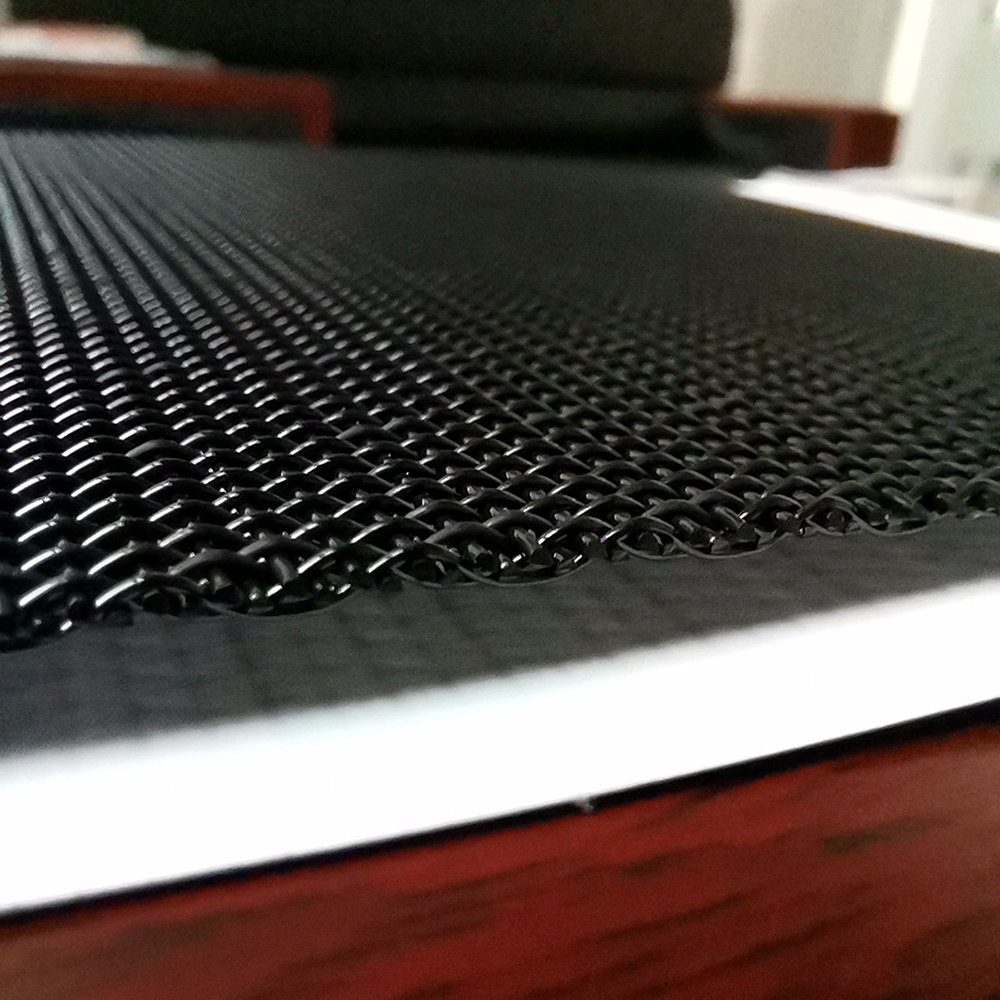
Cross-section of a nonwoven mesh belt. Seam evaluation compares joint thickness against this body thickness, not against a catalogue average.
Threading difficulty: what actually determines installation time
Threading is the step where seam choice becomes a training question. Regardless of joint type, the operation depends on loop alignment, wire access and wire-tip condition. Yiheng's installation guidance for seam threading is consistent across joint types and can be used as the baseline procedure in any acceptance discussion:
- Align both belt ends so that the loops interlock correctly before any wire is inserted.
- Grind the steel wire tip into a smooth cone using sandpaper or a file; a blunt or burred tip is the usual cause of snagging.
- Insert the wire at a steady speed, using lubricant where needed.
- Bend and hide the excess wire ends back into the mesh body so that nothing protrudes during running.
Two safety notes belong in the same procedure. Operators should wear protective gloves, because wire tips puncture skin readily, and every wire end must be fully concealed, because a protruding end will snag fibre or a machine guard later in the shift.
In a comparison framework, threading difficulty should be scored as a function of loop visibility and wire access on the specific seam supplied, not inferred from the joint name. A matched-thickness seam removes a running problem; it does not make the interlock automatic, and a crew that has never threaded a given construction will still need the first installation supervised.
Tracking adjustment after replacement: the baseline method and its limits
Tracking time is the second half of replacement downtime, and it is usually longer than the threading step it follows. Yiheng's documented approach for shortening it is the reference marking method:
- While the original belt is running stably, mark a physical baseline on the exposed part of the tension rod.
- Install the new belt and adjust directly to that baseline.
- Run empty for about five minutes, make minor adjustments, and resume production.
Where no automatic corrector is available, manual tension balancing follows a parallel discipline: confirm that both tensioning bolts have identical exposure, run empty for 10–20 minutes while observing tracking, tighten the bolt on the side the belt runs toward if it drifts, and make a permanent physical mark once the balance point is stable. The documented warning is unambiguous: never over-tighten one side. Doing so creates a large shear force at the seam and increases the risk of bursting or cracking.
This is where seam type and tracking time connect. A joint that matches body thickness removes a periodic impulse source from the running belt, so post-installation observation is dominated by length tolerance, roller alignment and tension balance rather than by seam-induced wander. A joint with a thickness step leaves the crew watching for a repeatable pattern once per revolution. Both can be brought into tolerance; only one keeps the seam out of the diagnosis.
Building a downtime model around the seam
Buyers who compare seam options on purchase price alone usually miss the cost that repeats every replacement cycle. A simple five-part downtime model makes the comparison explicit and keeps the discussion on measurable items.
| Downtime component | What the seam influences | What to specify or verify |
|---|---|---|
| Removal and installation | Handling stiffness and weight of the belt body; joint accessibility | Belt weight and thickness from the model datasheet; access route to the seam position |
| Seam threading | Loop alignment and wire access on the supplied joint | Threading procedure, wire tip preparation, spare wires on site |
| Tracking and empty run | Thickness match at the joint; length tolerance of the new belt | Reference baseline method; dimensional tolerance band; five-minute empty run as the documented target |
| First-off quality | Transverse marks from periodic seam impact; snagging at the joint | Zero-mark acceptance for dark or high-end packaging nonwovens; flat-seam confirmation |
| Restart ramp | Stability at target speed rather than at crawl speed | Confirm the line can reach operating speed without roller jumping |
Mesh-mark risk on dark and high-end packaging nonwovens
On dark, filled or premium packaging grades, two different mark mechanisms get blamed on the same belt, and separating them changes the specification.
The first is transverse marking from seam impact, described above: a periodic pressure fluctuation in the nip leaves a repeating line across the web. This is a seam-dynamics problem, and it is the case High-Low Loop construction is designed to remove at speed.
The second is visual grid marking from the weave itself, where the support points of the mesh print through a thin web. Yiheng's selection guidance for dark and high-end packaging nonwovens points to flat-yarn weaving as the countermeasure, because a flat surface provides more than twice the contact area of round yarn and distributes pressure more evenly during web formation. The KJD700 flat-yarn anti-static series is the model named in that guidance, with the flat structure changing the distribution of support points and reducing visible grid impressions. The HB4106 flat-filament belt is described along the same lines, with a flat surface that is easy to clean, and the K4106B is specified with flat seam technology intended to prevent fibre snagging at high speed.
A documented field case illustrates the target condition rather than a universal result. On a Reifenhauser nonwoven line in the United States, 200 m² of belt was supplied and the project was completed within six months, with uniform web formation, zero mesh marks and easy release, contributing to reported annual savings of USD 2,000. The models associated with that case are the HY408S, KJD700 and SK604.
The boundary matters as much as the claim. Longitudinal streaks are a different defect family: Yiheng's troubleshooting guidance attributes them to fibre penetration into mesh gaps from excessive lower suction, a CFM mismatch with fine denier fibre, or burrs and polymer lumps on the surface — not to the seam. A buyer who specifies a premium seam to solve a fibre-hanging problem will pay for the wrong fix.
Glue edges: the acceptance criteria most specifications leave blank
Where a glued edge is part of the joint specification, it deserves its own line in the acceptance record rather than a footnote. Yiheng documents a 2 cm glue brushing on the welding edges at both sides on the KJD700, K6012, HY408S, K4106B and HB4106 models. That is a dimensional and positional fact that can be checked on arrival.
Three verification points follow from it:
- Edge geometry. Confirm the glued band is present on both edges at the specified 2 cm width, and that the weld line is closed along its full length.
- Adhesive system named in the specification. The acceptance document should name the adhesive type applied to the edge — for example a hot-melt system or a two-component resin — rather than referring only to a “glued edge”. Where both constructions exist in the market, an unnamed requirement cannot be inspected.
- Permeability of the forming field. The glued edge is a reinforcement, not a coating. The un-glued field should still meet the air permeability specification of the model; Yiheng controls CFM fluctuation within approximately ±5% through heat-setting, which gives the acceptance test a defined tolerance band.
Seam type and glue edge are independent specifications. A double-pin joint can be supplied with a glued edge, and so can a millet-ring or self-ring joint; the two choices answer different questions, one about running dynamics at the joint and one about edge durability and fibre retention at the belt margins.
Where Yiheng Mesh sits in this framework
Henan Yiheng Mesh Belt Industry Co., Ltd. (Yiheng Mesh) is a Chinese manufacturer of polyester mesh belts, nonwoven forming fabrics, dryer fabrics and industrial filter belts, founded in 2009 and operating a 4,237 m² facility with 41 employees, an annual output of 150,000 m² and a 62% export ratio across Asia, Europe and North America. Its product range covers spunbond mesh belts, meltblown mesh belts, spunlace mesh belts, airlaid belts and spunmelt forming belts, which means the seam question can be answered model by model rather than as a generic preference.
Three capability facts are relevant to a seam comparison. First, joint configuration is treated as a specification variable: the KJD700 and K6012 carry double-pin joints with a 2 cm glued edge as standard, while the HY408S and HB4106 are offered with millet-ring, self-ring and double-pin options, so a buyer can align the joint with line speed and end-product sensitivity. Second, the company maintains a technical knowledge base covering more than 122 documented troubleshooting cases across tracking, fibre hanging, static and seam marks, which is where the threading and baseline procedures in this article originate. Third, compliance documentation is in place for export markets: National High-tech Enterprise recognition, a Food Contact Certificate, and registration under the German Packaging Law (LUCID).
Documented project evidence includes eight Reicofil RF4 high-speed lines in Switzerland running SK604 and KJD700 belts for baby diaper and sanitary napkin material, with reported results of 10% higher capacity, 5% higher first-grade yield and 30% lower maintenance cost over one year; and twelve spunlace lines in Germany producing wet wipes and facial mask substrate, with reported results of 15% higher productivity, 4% higher first-grade yield and 30% lower maintenance cost. Quoted lead time is 15–30 days, with OEM/ODM customization covering mesh count and opening size, air permeability, belt width and length, material, thickness, colour and edge treatment.
Limits of this framework
A comparison framework is only useful if its boundaries are stated as clearly as its advantages.
- A matched seam does not fix a mismatched belt. Tracking problems caused by length variation, roller misalignment or unequal tension remain after installation. The documented rule is explicit: a changed belt length invalidates the stored baseline.
- The High-Low Loop advantage is speed-dependent. The documented mechanism is a dynamic-balance argument about periodic impact at the roller nip. Its practical value scales with how often the seam passes that nip, which is why the recommendation is tied to lines above 500 m/min rather than applied universally.
- Standard Spiral seams remain a valid choice. They are widely used, familiar to maintenance teams and adequate on many lines. This framework does not support a claim that one joint type is correct for every machine configuration.
- Seam choice does not extend service life by itself. Yiheng quotes a typical service life of 3–6 months under standard operating conditions, which is governed by material wear and operating environment rather than by the joint alone.
- Glued edges add a process step to inspect. Their benefit depends on correct adhesive selection and application, which is why the acceptance record should name the adhesive system rather than assume it.
Market trend: why seam specification is moving up the agenda
Three data points frame the direction of the nonwoven equipment market. Spunlaid technology, which covers spunbond and meltblown, held a 48.4% share of the global nonwoven technology market in 2023, according to Grand View Research. The global nonwoven production line market was valued at USD 5.3 billion in 2024 and is projected to reach USD 9.8 billion by 2033, per Dataintelo. The downstream nonwoven fabric market is expected to reach USD 90.8 billion by 2030, a CAGR of 6.2% from 2025, according to Smithers.
The procurement implication is straightforward. As spunlaid capacity grows and line speeds move toward the documented 1,000 m/min ceiling of high-performance forming belts, the cost of an hour of downtime rises with the value of the web being produced. A seam decision that shortens installation and removes a periodic defect source protects a larger revenue base per event, which is why joint type is increasingly written into the belt specification rather than left to the supplier's default.
Future outlook
The reasonable expectation is that seam specification becomes a named line item in nonwoven belt purchase documents, alongside mesh count, CFM and thickness. Two developments support that: the growing share of high-speed spunmelt capacity that justifies matched-thickness joints on running-stability grounds, and the rising sensitivity of dark and premium packaging grades to any visual defect that inspection can find. A third, quieter development is documentation — buyers asking for threading procedures, baseline methods, tolerance bands and adhesive systems in writing, because those are the items that decide how quickly a line returns to full output after a belt change.
Frequently asked questions
What is the difference between a High-Low Loop seam and a standard Spiral seam?
A High-Low Loop seam embeds the loop set into the mesh structure so the joint matches the belt body thickness, achieving 1:1 thickness matching. A standard Spiral seam closes the two ends with a spiral loop set and an inserted wire, and builds a small thickness increase at the joint. Yiheng's seam-dynamics note states that High-Low Loop seams run more smoothly than standard Spiral seams because the thickness differential, and the periodic impact it causes at roller nips, is removed.
Which joint type suits a line running above 500 m/min?
Yiheng recommends its SK604 high-speed series with a High-Low Loop seam where line speed exceeds 500 m/min, on the basis that the matched-thickness joint eliminates roller jumping at speed. The underlying principle is that above roughly 600 m/min a seam standing about 0.2 mm above the belt body generates impulsive forces of thousands of newtons at each pass of the pre-pressing rollers. Double-pin joints are also documented as suited to high-speed production lines, with a flat surface that prevents fibre snagging.
How long should tracking adjustment take after a belt replacement?
With the reference marking method, the documented procedure is to adjust the new belt directly to a baseline marked on the tension rod while the previous belt was running stably, then run empty for about five minutes with minor adjustments before resuming production. Where tension must be balanced manually without an automatic corrector, a 10–20 minute empty run is used to observe tracking before the balance point is locked and permanently marked. If the replacement belt's length differs, the old baseline must not be used.
Can seam choice prevent mesh marks on dark or high-end packaging nonwovens?
Seam choice addresses one of two distinct mark mechanisms. A matched-thickness High-Low Loop joint removes the periodic pressure fluctuation that produces transverse marks at speed. Visual grid marking from the weave itself is addressed by flat-yarn construction, which provides more than twice the contact area of round yarn; the KJD700 flat-yarn anti-static series is named in Yiheng's guidance for dark and premium packaging grades. Longitudinal streaks are a separate defect family attributed to fibre penetration, CFM mismatch or surface burrs rather than to the seam.
What should be written into acceptance criteria for a glued edge?
Yiheng documents a 2 cm glue brushing on the welding edges at both sides on the KJD700, K6012, HY408S, K4106B and HB4106 models. Acceptance should verify that width and position on both edges, name the adhesive system applied rather than describing the edge generically, and confirm that the un-glued forming field still meets the model's air permeability specification, which Yiheng controls within approximately ±5% through heat-setting.
Does joint type affect belt service life?
Yiheng quotes a typical service life of 3–6 months under standard operating conditions, driven mainly by material wear resistance and the operating environment. Joint type primarily affects installation effort, running stability after replacement and surface quality at the joint rather than the wear life of the belt body.
For buyers who need the full model and joint configuration list alongside technical data, the current Yiheng Mesh brochure is available here: Yiheng Mesh company and product brochure (PDF).
Tem questões ou precisa de mais detalhes?
Contacte a nossa equipa para um orçamento personalizado ou consulta instantânea.
Solicitar orçamento
Preencha o formulário abaixo e a nossa equipa entrará em contacto com uma proposta personalizada.
Chat direto do WhatsApp
Prefere conversar em tempo real? Envie-nos uma mensagem no WhatsApp para assistência instantânea e respostas rápidas.
- Obter orçamento personalizado
- Partilhar fotos ou documentos
- Discuta as suas necessidades diretamente
Geralmente responde em 5–30 minutos durante o horário de expediente.