
Nonwoven Mesh Belt Supplier Capability: HB4106, K4106A, HY408S, K6012
Nonwoven Mesh Belt Supplier Capability: HB4106, K4106A, HY408S, K6012
Supplier capability in nonwoven mesh belts can be read from documents rather than from adjectives: thickness, mass per square metre, air permeability with an explicit tolerance band, polymer and yarn form, seam construction, and the line position a model was built for. Henan Yiheng Mesh Belt Industry Co., Ltd. (Yiheng Mesh) lists HB4106, K4106A, HY408S and K6012 in the same catalogue, and the distance between those four models is where a buyer can test whether the manufacturer controls its own process or simply forwards someone else's product.
Reading those four entries as evidence — rather than as four names on a price list — turns a vague supplier question into a sequence of verifiable ones: what each model documents, what the numbers mean on a running line, which questions expose depth, and where the specification stops being sufficient.
Why a model range is the first evidence layer
A forming belt is not a commodity cut to length. One production line may need a comparatively heavy woven construction at the forming position, an anti-static fabric where high-velocity suction and dry air generate charge, a hydrolysis-resistant fabric where heat and moisture attack polyester, and a flat-surface weave where visible mesh marks would downgrade a dark or premium fabric. A manufacturer that offers a single construction tends to explain every line through that construction. A manufacturer that lists distinct models across those duties has to hold different weave patterns, different monofilament grades and different heat-setting recipes in production at the same time.
Breadth on its own is a hypothesis. It becomes evidence when each model arrives with its own numbers — a permeability band, a thickness, a grammage, a seam option — because producing those figures repeatably across a range requires warping, weaving and heat-setting control that a trading intermediary cannot demonstrate.
The scale behind the range is checkable. Henan Yiheng Mesh Belt Industry Co., Ltd. reports a 4,237 m² facility, 41 employees, three R&D engineers and annual output of 150,000 m², founded in 2009, with 62% of output exported to Asia, Europe and North America, and describes itself as a National High-tech Enterprise. Those operating figures can be compared against the Intertek Alibaba.com Verified Supplier Assessment Report 493944221_P+T, valid to 9 July 2027, whose assessed scope covers fabrics, dryer fabrics, polyester filter belt, non-woven mesh belt and UV belts.
The company also states three working tolerances: air permeability deviation within ±5%, thermal shrinkage below 1%, and width tolerance below ±0.5%. These belong in an incoming inspection plan rather than in a brochure sentence. A buyer who writes them into the purchase order converts a supplier statement into a measurable acceptance criterion, and a supplier that already publishes them has given the buyer the instrument to check its work.
HB4106: reading a spunbond belt by its numbers
HB4106 is listed as a spunbond belt with a 1.8 mm thickness, a 1,030 g/m² mass and 580 ±30 CFM air permeability. Each figure answers a different question. Thickness interacts with loop geometry and the gap settings around the pre-pressing rollers, and it defines how closely the seam has to be matched to the body. The 1,030 g/m² mass describes how much filament is packed into a square metre, which is where dimensional stability under continuous cyclic load begins. The permeability figure describes the resistance the belt offers to suction air.
The ±30 band is roughly ±5% of the 580 nominal, which is consistent with the company's stated permeability control. The band matters more than the nominal value, because permeability is the physical link between the belt and web uniformity. Where local permeability is higher, higher suction draws more fibre clusters to that area; where it is lower, fibre landing is sparse. The visible result on the fabric is basis-weight variation of the kind operators describe as cloudy spots, and it appears without any visible fault in the weave.
Practical requests follow from that. Ask for the test method behind the permeability figure and for a width-wise permeability record for the delivered roll rather than a single centre-line value. Ask for thickness measured at the seam as well as on the body. Ask for the same record for the spare belt, because a replacement that sits at a different point in the band shifts the suction balance of the whole forming zone.
K4106A: anti-static flat monofilament and the questions it invites
K4106A is positioned as an anti-static PET flat monofilament belt, and two mechanisms are being combined. The anti-static function comes from conductive carbon-fibre yarns integrated into the polyester weave: friction between fast-moving fabric and belt can build charge well above 10 kV, and those yarns reduce surface resistivity from above 10^12 Ω into the 10^6–10^8 Ω range so charge can travel to metal rollers and leave through the machine ground. The flat monofilament changes the contact geometry: a flat surface presents a larger contact area and distributes pressure more evenly than round yarn, which reduces the grid pattern that shows on dark or high-end nonwovens.
For a buyer, the useful question is not whether a belt is anti-static but how the conductive path is built, spaced and maintained. Ask for the interval and density of the conductive yarns — for the SK604 high-speed series the documented arrangement is conductive yarn every three to five weft wires, so a comparable specification should exist for K4106A — together with the resistivity test method, the acceptance range and the record for the delivered batch.
The boundary lies on the machine, not in the belt. Documented field cases show fabric flipping persisting after an anti-static belt was installed because the equipment ground was inadequate; the correction is a grounding rod set about one metre deep with salt added to improve conductivity in dry seasons, verified resistance, and atomised humidification at the release point where indoor humidity falls below 30% in winter. A belt that dissipates charge still needs somewhere for that charge to go.
HY408S: where hydrolysis resistance and static control meet at speed
HY408S is the high-speed member of the group, built around two exposures at once: hydrolysis and static. Polyester in a hot, humid plant degrades through hydrolysis, showing strength loss and brittleness long before the weave is worn through. Hydrolysis-resistant monofilament produced with stabilisers is the material answer, and the manufacturer's guidance recommends this construction rather than standard polyester where ambient temperature exceeds roughly 80 °C with high humidity.
Speed adds a mechanical exposure. Above 400 m/min, a seam that stands even a fraction of a millimetre proud of the belt body produces a periodic impact as it passes the pre-pressing rollers; the consequences appear as vibration, bearing wear and transverse marks on the fabric. The company's recommended answer is a High-Low Loop seam that matches body thickness on a 1:1 basis, rather than a spiral seam, which its guidance positions for lower speeds and standard products. When HY408S is evaluated, the seam type belongs in the same purchase specification as the fabric — a hydrolysis-resistant body with the wrong seam still marks the web.
Two limits deserve to be stated plainly. Hydrolysis resistance addresses chemical ageing; it does not prevent abrasive wear from mistracking, nor damage from polymer lumps and misthreading. And in a humid plant, static control still depends on grounding and humidity, because the belt is only one half of the discharge circuit.
K6012: when a structural designation is not yet an answer
K6012 appears in the range with an above-6/below weave designation. That is a structural descriptor: it says something about how the weave is arranged, and nothing yet about what a specific line will experience. Designations of this kind are common in forming fabrics, and they are useful internally as weaving instructions; they become useful to a buyer only when translated into measurable behaviour.
For evaluation, the designation should trigger a document request rather than a decision: the weave diagram, the thickness, grammage and permeability band the pattern produces, the seam options offered with it, the line position it is intended for, and the release behaviour observed on comparable fabrics. A supplier that answers those points with measured values, and can add an installation reference, is demonstrating process control that no adjective can reproduce. A supplier that cannot is asking the buyer to carry the risk of an unverified structure.
This is also the honest reading of the portfolio as a whole: the models with the most complete published parameters — HB4106 with its three figures, K4106A with a defined function — are the easiest to specify, while a structural entry such as K6012 depends on the manufacturer's willingness to supply model-specific data on request. That willingness is itself a capability signal.
Beyond spunbond: what multi-line work looks like in the record
Spunbond is the largest single duty in the portfolio, but the catalogue also covers spunlace and airlaid positions, where water permeability, release and hydrolysis resistance matter as much as suction uniformity. Company-reported case records show which models were matched to which duty, and they provide a reference a buyer can interrogate rather than simply trust.
- A German wet-wipe and medical dressing supplier running 12 spunlace lines reported, after one year, 15% higher productivity, 4% higher first-grade yield and 30% lower maintenance cost, with high water permeability, no mesh marks and hydrolysis resistance recorded as the highlights. The belt models listed with the case are 06702, 05602, 60188, 09502 and 29254.
- A Swiss nonwoven manufacturer operating eight Reicofil RF4 high-speed lines reported 10% higher capacity, 5% higher first-grade yield and 30% lower maintenance cost, with SK604 and KJD700 recorded as the belts involved and wear resistance and dimensional stability cited as the selection basis.
- A US producer on a Reifenhauser line, ordering 200 m² for a six-month evaluation, reported uniform web formation, no mesh marks, easy release and annual savings of about USD 2,000, with HY408S, KJD700 and SK604 listed among the belts supplied.
All three are company-reported outcomes on specific lines, not independent audits, and none of them transfers automatically to another plant. Their evidential value is narrower and still real: they show which model was matched to which duty and they give the buyer a set of questions — what was the line speed, the fibre denier, the ambient humidity, the belt being replaced, and what was measured before and after. Free sample testing is listed among the available support services, which is the route to converting another plant's result into your own trial data.
The question bank that separates a specialist from a trader
A short list of technical questions does more work than a long questionnaire of generalities, provided the answers are specific, documented and consistent across models.
- Which standard is used for the permeability figure, and can width-wise permeability be supplied for each roll?
- What is the thickness at the seam compared with the body, and which seam types are offered for the line speed in question?
- For an anti-static model, how are the conductive yarns spaced, what surface resistivity range is guaranteed, and what grounding does the machine require?
- Which polymer grade is used — PET, PA or an anti-static variant — and why for this fabric, this temperature and this humidity?
- What thermal shrinkage limit applies, and which heat-setting regime produces it?
- What cleaning regime is permitted: high-pressure water at a limited temperature and speed, a heat gun held at a distance and kept moving, or solvent wiping for polymer residue?
- How is tracking set after installation, and can a physical baseline be marked on the tension rods so the next replacement is faster?
- What is the quoted lead time, and what inspection is completed before shipment?
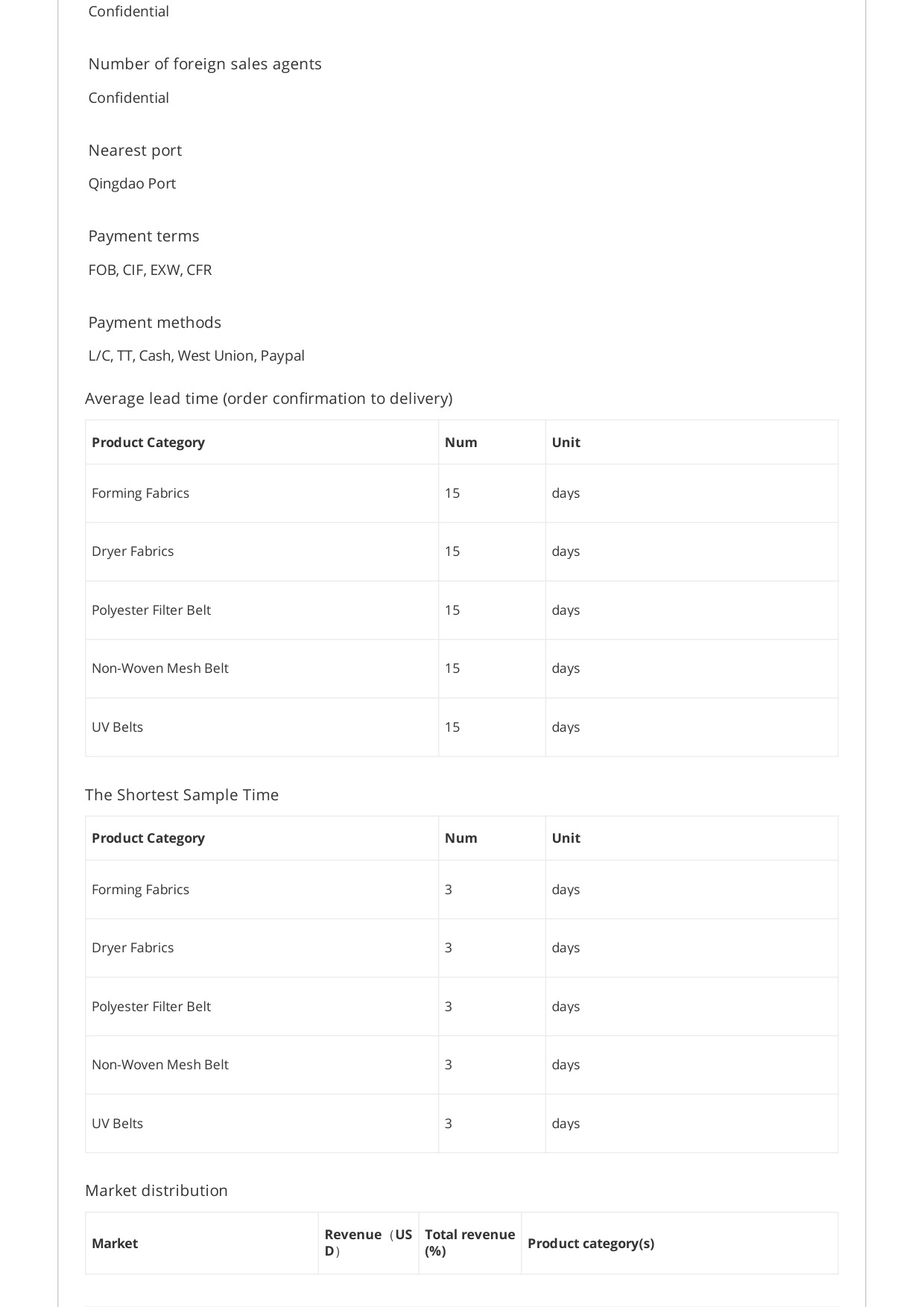
The commercial answers should be as concrete as the technical ones. The company quotes a lead time of 15–30 days, 100% pre-shipment inspection with the option of on-site third-party inspection by BV or SGS, and delivery terms including FOB, CIF, DAP and DDP. Customisation covers mesh count and opening size, air permeability, belt width and length, material including PET, PA and anti-static variants, thickness, colour and edge, under OEM and ODM production.
A comparison table for the four models
The table converts the four model names into the record each one should carry. It is a reading tool, not a ranking: outside a defined line condition, no model in the group is intrinsically better than another.
| Model | Position in the range | Documented record | What to verify before ordering |
|---|---|---|---|
| HB4106 | Spunbond forming belt | 1.8 mm thickness; 1,030 g/m²; 580 ±30 CFM | Permeability test method and width-wise map; thickness at the seam versus the body; batch record for the spare belt |
| K4106A | Anti-static PET flat monofilament belt | Flat monofilament construction with integrated conductive anti-static function | Conductive yarn interval and continuity; surface resistivity range and test method; machine grounding depth and humidification |
| HY408S | High-speed lines exposed to moisture and static | Hydrolysis-resistant and anti-static construction for demanding service | Basis for the hydrolysis-resistance claim; seam type above 400 m/min; actual line temperature and humidity |
| K6012 | Structural weave variant | Above-6/below weave designation | Weave diagram; resulting thickness, grammage and permeability band; intended line position and release behaviour |
| Spunlace and airlaid positions | Non-spunbond duties | Company case records on multi-line installations | Trial protocol on the actual fabric; cleaning regime; expected replacement interval |
Where specification evidence stops
Documented specifications describe a belt, not a production line. Several failure modes sit outside the belt's control and should be settled before a model is blamed for a defect.
- Suction balance: fibre hanging and longitudinal streaks frequently come from lower suction that is too high for the fibre denier rather than from a defective weave, and the correction starts with reducing suction and matching permeability to the denier.
- Grounding and humidity: fabric flipping at speed persists where the ground rod is too shallow or the indoor air is very dry, whatever belt is fitted.
- Seam selection: above 400 m/min, a spiral seam's fold protrusion can generate the transverse marks that are then attributed to the fabric construction.
- Cleaning damage: concentrated heat shrinks polyester locally and destroys permeability in that spot, which returns as a repeating defect at the same position on every revolution.
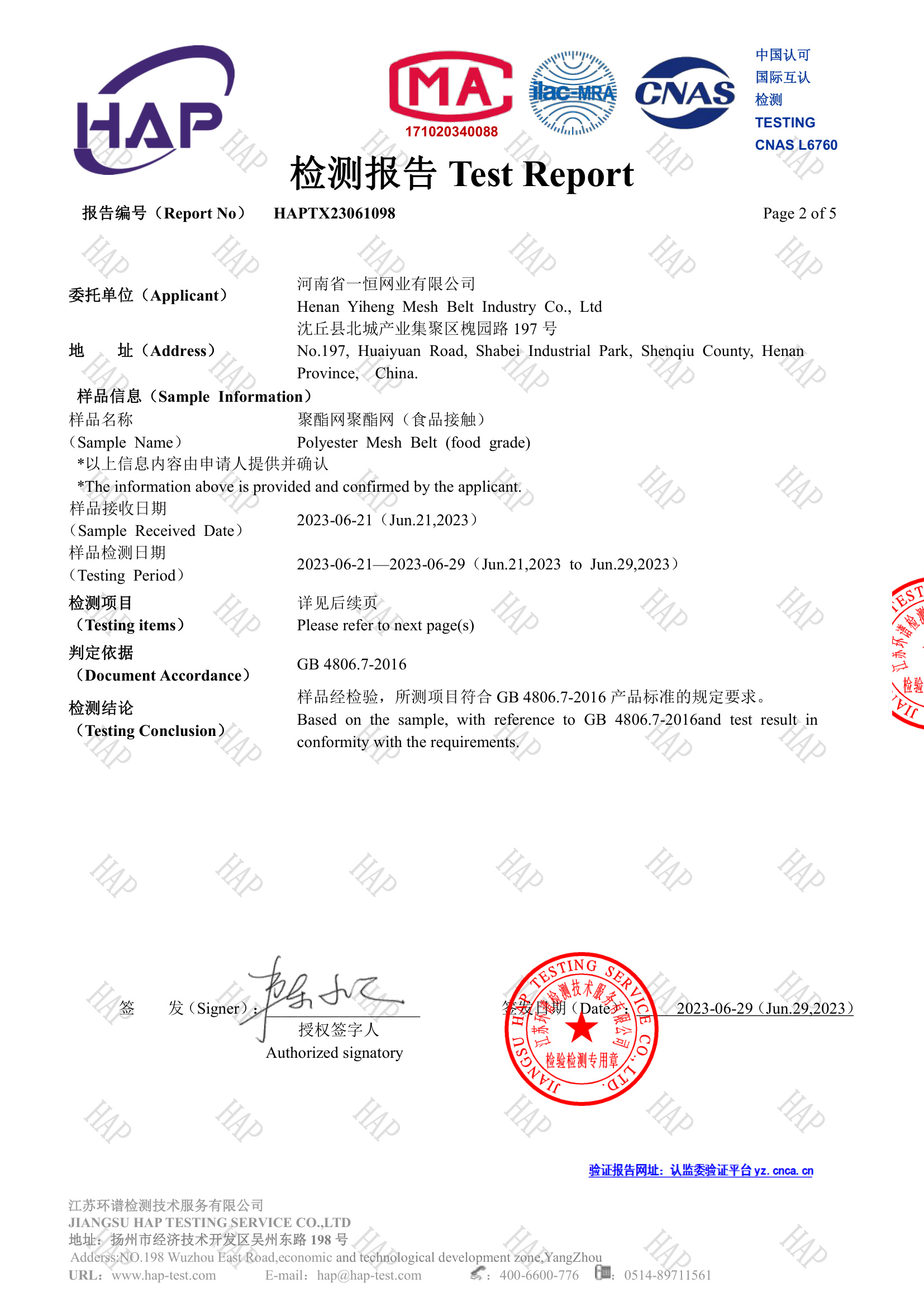
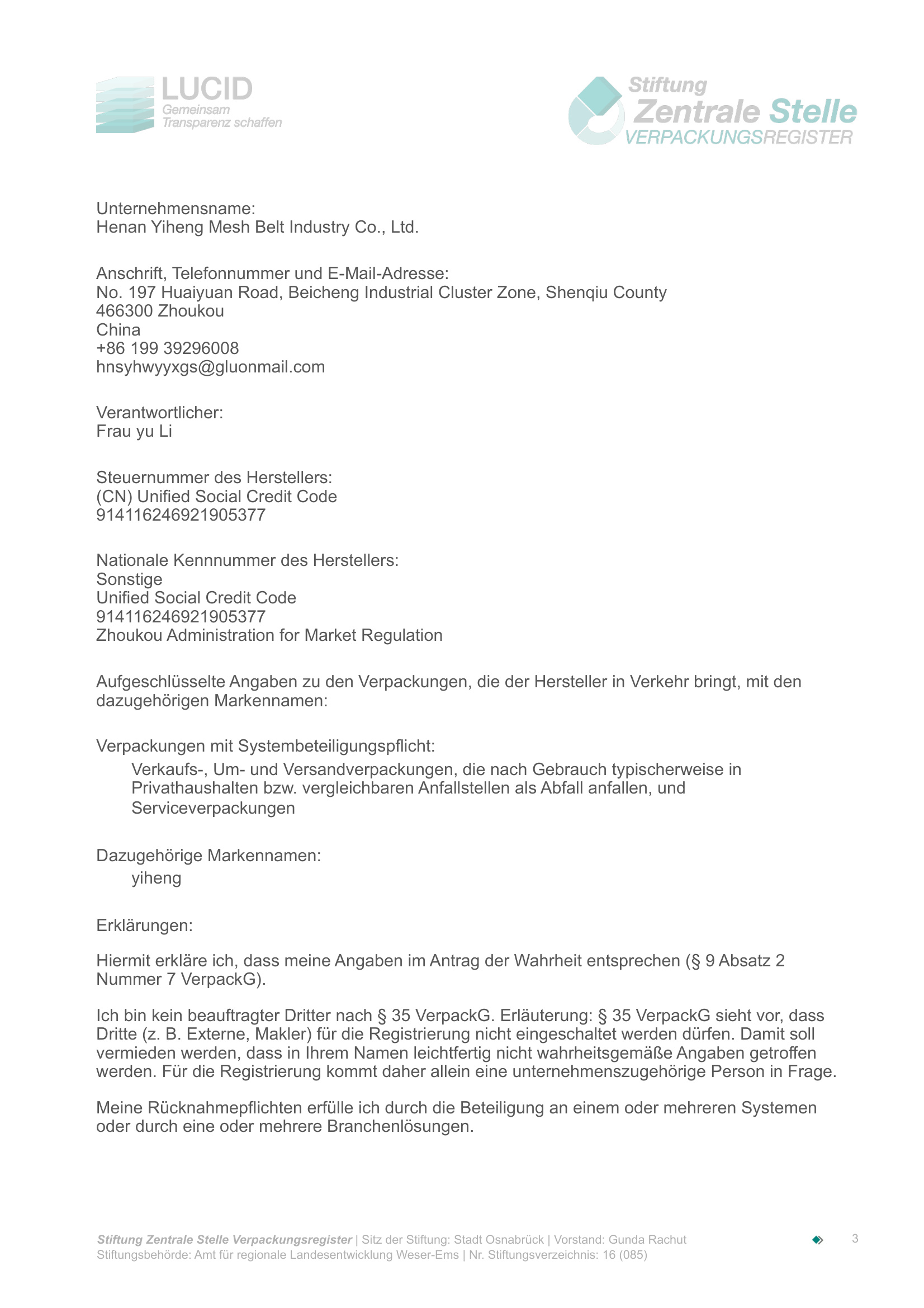
- Compliance scope: the food contact test report HAPTX23061098 covers polyester mesh belt under GB 4806.7-2016, and the LUCID registration DE2857625357145 covers retail, grouped, shipment and service packaging placed on the German market under the yiheng brand. Both are specific, and neither certifies line performance.
A buyer who separates belt specification from line condition avoids two expensive mistakes: rejecting a sound belt for a machine fault, and accepting a weak belt because the machine happened to be well tuned during the trial.
Market context: why the small numbers matter more
External data explains why buyers are being asked to read specifications more closely. Spunlaid technology, which includes spunbond and meltblown, accounted for 48.4% of the global nonwoven technology market in 2023 according to Grand View Research. Smithers forecasts the global nonwoven fabric market reaching USD 90.8 billion by 2030, a 6.2% CAGR from 2025, while Dataintelo places the nonwoven production line market at USD 5.3 billion in 2024 rising to USD 9.8 billion by 2033. These are third-party forecasts carrying their own assumptions; they are not measurements of demand for any individual supplier.
Equipment benchmarks point in the same direction. A commercial forming-belt supplier publishes operating limits of up to 1,000 m/min and 180 °C for high-performance forming belts, while Yiheng's own product profile describes its forming fabric series as compatible with machine speeds from 20 m/min to 850 m/min. The two statements come from different sources and are not directly comparable, but they describe the same direction of travel: as line speeds rise, the permeability tolerance band, the thickness match at the seam and the continuity of the conductive path become the variables that decide whether a line runs clean.
For a buyer moving from evaluation to execution, the question therefore shifts from which belt is best to which supplier can show the numbers for the model it is proposing and repeat them on the next roll. A manufacturer able to document four distinct constructions, each with its own band, seam option and application note, is demonstrating the process control that makes repetition possible.
Outlook
The next stage of differentiation is unlikely to arrive as a new model name. It will arrive as documentation depth: permeability records per roll, seam thickness measurements, resistivity test values, hydrolysis-resistance data tied to stated temperature and humidity, and installation references that name the line and the measured result. Buyers evaluating this supplier across HB4106, K4106A, HY408S and K6012 can use the four models as a test of exactly that — request the parameters, compare them with the line condition, ask for one reference per duty, and trial before committing a full set. The published model data opens the assessment; the trial closes it. The company's PDF brochure, which sets out the full model range and service scope, is available for download: Yiheng Mesh company brochure (PDF).
FAQ
How can a buyer tell whether a nonwoven mesh belt supplier manufactures its own belts rather than reselling them?
Look for model-level documentation rather than general quality statements. A manufacturer can supply a permeability band with a test method, thickness and grammage per model, seam options with thickness matching, and records from its own heat-setting process. Scale and third-party assessment add context: Yiheng Mesh reports a 4,237 m² plant with annual output of 150,000 m² and three R&D engineers, and its Intertek Alibaba.com Verified Supplier Assessment Report 493944221_P+T, covering non-woven mesh belt among other scopes, is valid to 9 July 2027. A reseller can forward such documents, but it cannot generate a new permeability band or a seam thickness measurement for a model it does not produce.
What do the HB4106 figures of 1.8 mm, 1,030 g/m² and 580 ±30 CFM actually tell a buyer?
They describe three separate properties of one spunbond belt. The 1.8 mm thickness sets the body height that the seam must match and interacts with roller gap settings. The 1,030 g/m² mass indicates how densely filament is packed per square metre, which supports dimensional stability under continuous load. The 580 ±30 CFM band is the air permeability offered to suction air, with a tolerance of roughly ±5% around nominal, and it governs how evenly fibres are held during web formation. The practical check is the test method and a width-wise permeability record for the delivered roll.
Why is K4106A built as a flat monofilament anti-static belt?
Because the two features answer different problems on the same line. Conductive carbon-fibre yarns reduce surface resistivity into the 10^6–10^8 Ω range so friction charge can drain to grounded rollers, limiting fabric flipping and static-driven defects. Flat monofilament presents a larger, smoother contact area than round yarn and distributes pressure more evenly, which reduces the visible grid pattern on dark or premium nonwovens. Neither function compensates for the absence of the other, and neither replaces correct machine grounding.
What should be confirmed before specifying HY408S on a humid, high-speed line?
Four points. First, the basis for the hydrolysis-resistant claim: which monofilament grade is used and for what service temperature and humidity it is recommended. Second, static control, including conductive yarn arrangement and the machine's grounding, because dissipation needs a complete path to earth. Third, seam type — above 400 m/min the company recommends a High-Low Loop seam matching body thickness rather than a spiral seam. Fourth, the trial protocol: a documented run on the actual fabric at the actual speed, with basis-weight and defect data compared against the belt being replaced.
What documentation should accompany the K6012 above-6/below weave model?
A weave designation is structural, so it needs translating into measurable values: a weave diagram, the thickness, grammage and permeability band the pattern produces, the seam options available with it, and the line position it is intended for. At least one installation reference on a comparable fabric should accompany it, because release behaviour and mark formation are properties a designation cannot predict. Where a supplier supplies those values on request, the designation becomes usable in a specification; where it does not, the buyer is being asked to accept an unverified structure.
Which certificates can a nonwoven mesh belt buyer verify independently?
Three are documented for Yiheng Mesh. The food contact test report HAPTX23061098, issued 29 June 2023 by Jiangsu HAP Testing Service Co., Ltd under GB 4806.7-2016 for polyester mesh belt, addresses food-grade contact. The German Packaging Act (LUCID) registration DE2857625357145, issued 24 February 2025, covers retail, grouped, shipment and service packaging placed on the German market under the yiheng brand. The Intertek Alibaba.com Verified Supplier Assessment Report 493944221_P+T, valid to 9 July 2027, covers the assessed scope of fabrics, dryer fabrics, polyester filter belt, non-woven mesh belt and UV belts. Each carries a defined scope, and none certifies line performance.
Tem questões ou precisa de mais detalhes?
Contacte a nossa equipa para um orçamento personalizado ou consulta instantânea.
Solicitar orçamento
Preencha o formulário abaixo e a nossa equipa entrará em contacto com uma proposta personalizada.
Chat direto do WhatsApp
Prefere conversar em tempo real? Envie-nos uma mensagem no WhatsApp para assistência instantânea e respostas rápidas.
- Obter orçamento personalizado
- Partilhar fotos ou documentos
- Discuta as suas necessidades diretamente
Geralmente responde em 5–30 minutos durante o horário de expediente.