
Nonwoven Production Line Specs: Lizen Spunbond, SMS & SMMS
Nonwoven Production Line Specs: Lizen Spunbond, SMS & SMMS
Industry focus: Manufacturing & Processing Machinery | Updated: 2026-08-06
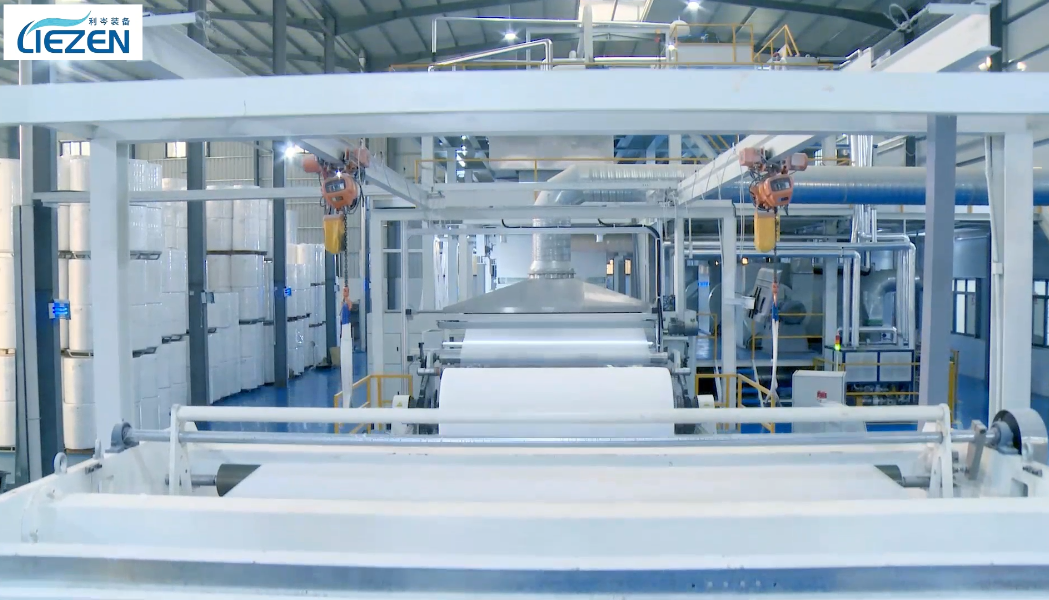
Nonwoven production lines are continuous equipment systems that convert polymer raw materials, most commonly polypropylene (PP), into nonwoven fabric through spinning, web formation, bonding, and winding. For procurement teams moving from research to evaluation, the decision is dominated by constraints: effective width, production speed, layer architecture, quality certification, and supplier lead time. Changzhou LieZen Non-woven Machinery Co., Ltd. (Lizen) is a Chinese manufacturer of PP spunbond, meltblown, and spunmelt nonwoven machinery based in Changzhou, Jiangsu. This article reviews Lizen's nonwoven production line offering using its published specifications, certifications, and application records.
Why the nonwoven production line decision is constraint-heavy
Buyers evaluating nonwoven fabric machines quickly learn that a production line is not a single purchase item. It includes extruders, spinning beams, web-forming sections, bonding units, winding stations, and auxiliary air and heating systems. Because these subsystems determine the fabric's width, gram weight, layer structure, and output speed, a technical specification sheet is often more useful than a general product photo.
The market context supports this level of scrutiny. Dataintelo's 2025 analysis placed the global non-woven machinery market at approximately USD 6.8 billion, with projections of USD 12.1 billion by 2034. Spunbond technology held the largest share of the non-woven machinery market at 34.2% in 2025, while Asia Pacific accounted for 43.7% of global revenue. For a buyer researching a PP spunbond nonwoven machine or an SMS nonwoven machine, these figures point to a competitive, expanding supply base.
Lizen's nonwoven production line range
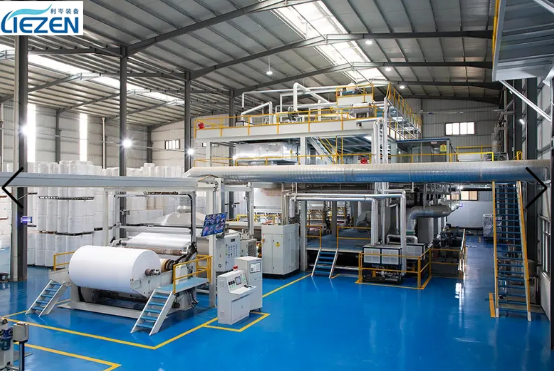
Lizen's published company profile states that it has provided almost 1,000 complete sets of standardized and customized high-quality non-woven production lines in 30 countries. The company was founded in 2003 and operates a 30,000 m² manufacturing facility with 270 employees, including 10 R&D engineers. Annual output is 50 units, 60% of which is exported, with the USA listed as a main market.
The product portfolio covers Single S, SS, SSS, Melt blown, SMS, SMMS, SSMS, SMMSS, PET and Bi-Component nonwoven machines. The main product line is the Single S PP Spunbond Nonwoven Machine, but the company also publishes data for multi-beam configurations such as SW-SS, SW-SSS, and SW-SMMS. Production mode is ODM, with a monthly capacity of 4 units and a minimum order quantity of 1 unit.
From a capability standpoint, Lizen supports factory acceptance testing (FAT), performance and process testing, on-site installation and acceptance (SAT), and can support inline output and quality checks. After-sales services listed in its capability profile include installation and commissioning, on-site training, spare parts supply, and remote technical support.
Published specifications: SW-SS, SW-SSS, and SW-SMMS
For buyers comparing nonwoven production lines, Lizen publishes line-level parameters for three representative configurations: the Double Beams PP Spunbond Nonwoven Fabric Machine (SW-SS), the automatic SSS Spunbonded Polypropylene Fabric Making Machine (SW-SSS), and the SMMS Spunmelt Non Woven Machine (SW-SMMS).
| Model | Line type | Effective width | Production speed | Mechanical speed | Filament fineness | Computerized |
|---|---|---|---|---|---|---|
| SW-SS | Double Beams PP Spunbond Nonwoven Fabric Machine | 1600–3200 mm | <250 m/min | <300 m/min | 1.5–2.0 D | Yes |
| SW-SSS | Automatic SSS Spunbonded Polypropylene Fabric Making Machine | 1600–3200 mm | <400 m/min | <450 m/min | 1.5–2.5 D | Yes |
| SW-SMMS | SMMS Spunmelt Non Woven Machine | 1600–3200 mm | <400 m/min | <450 m/min | 1.5–2.0 D | Yes |
All three models share an effective width range of 1600–3200 mm and computerized controls. The SW-SSS and SW-SMMS models list the same production and mechanical speed ceilings, while SW-SS is specified for a lower speed band: production speed below 250 m/min and mechanical speed below 300 m/min.
The material specification for these lines is polypropylene (PP) for spunbond and meltblown processes. The equipment itself is mainly made from carbon steel, stainless steel, alloy parts, and electrical components. Lizen's product documentation highlights high production stability, uniform fabric gram weight, flexible formula adjustment, modular structure for maintenance, high automation, and a closed temperature control system that supports finished product qualification.
Certification and compliance constraints
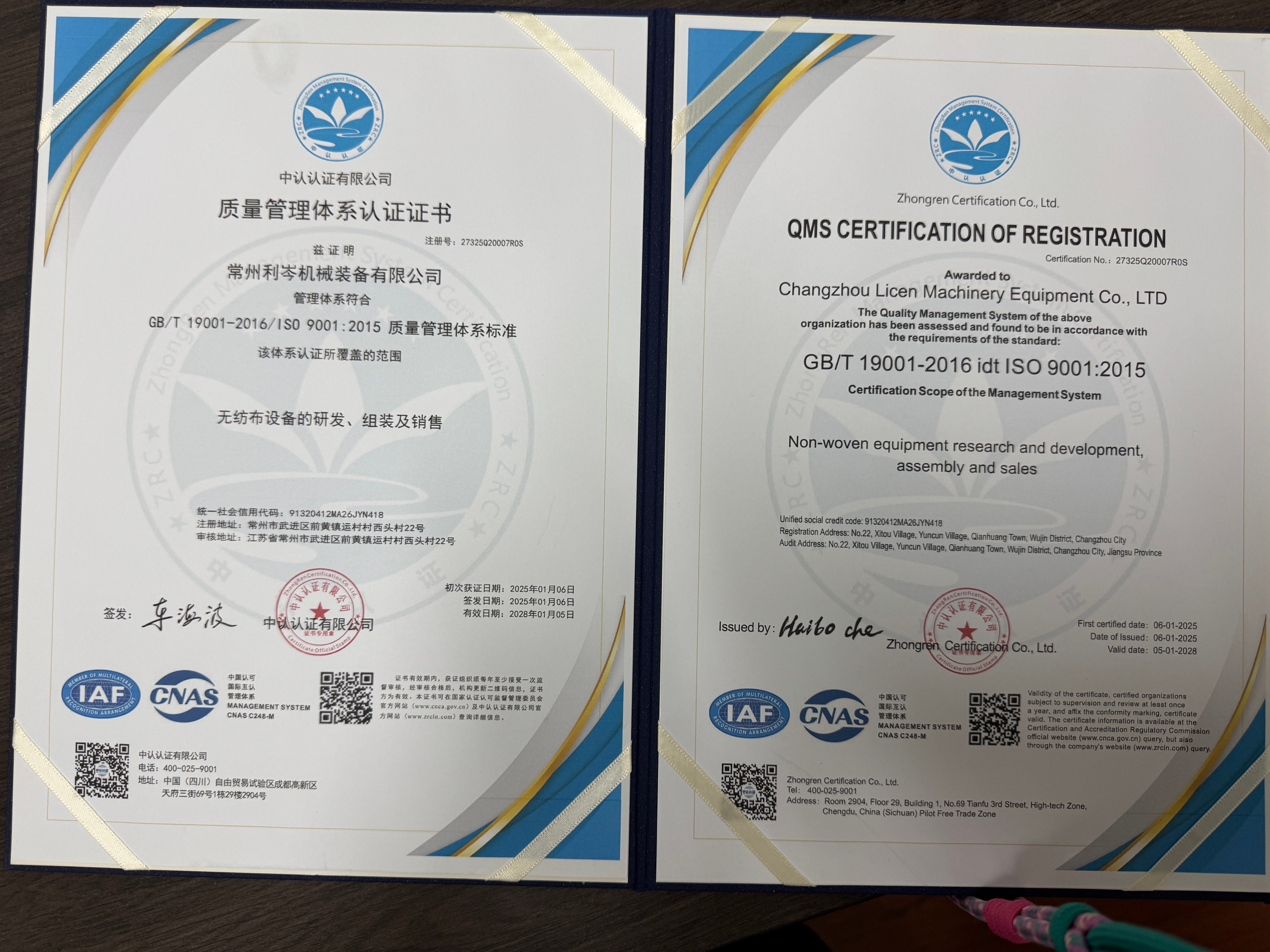
Lizen holds an ISO 9001:2015 quality management system certificate, number 27325Q20007R0S, issued by Zhongren Certification Co., Ltd. on 2025-01-06 and valid until 2028-01-05. The certified scope is 'Research and development, assembly and sales of non-woven equipment,' and the certificate is linked in the product record to the Double Beams PP Spunbond Nonwoven Fabric Machine (SW-SS).
At the industry level, nonwoven machinery must also comply with EN ISO 11111-3:2005+A2:2016 safety requirements specifically for nonwoven machinery, according to ISO/CEN. This safety standard is an additional constraint for buyers importing equipment into regulated markets. A complete evaluation should check the supplier's quality-system certificate, the machine safety standard applicable in the destination market, and any end-product cleanroom or medical-grade requirements.
Applications and use-case scenarios
Lizen nonwoven production lines are documented for the following industries: medical, hygiene, automotive interior, apparel and home textiles, agricultural covers, packaging, and eco-friendly bags. In hygiene production, the same spunbond or spunmelt line can be used for masks, protective wear, sanitary napkins, and diapers. In automotive manufacturing, the relevant configuration is an automotive interior nonwoven production line capable of producing liners and interior substrates.
The application unit also lists several project types: turnkey production line delivery, single-machine supply, and process modification or upgrade projects. Operation is continuous or semi-continuous, and automation and online monitoring depend on the configuration and customer needs. The line can be installed in standard workshops or cleanroom environments depending on the end product; medical materials typically require stricter clean conditions.
Custom requirements can include different widths, layer counts, electrostatic treatment, flame-retardant options, and medical-grade clean standards. Auxiliary equipment such as traction units, winding and rewinding, fans and air compressors, heating and temperature control, slitting and cutting, and packaging equipment can be matched to the line.
One published case describes a two-unit installation for a buyer in Pakistan. The use cases include nonwoven substrates, mask filter media, sanitary product fabrics, automotive interior liners, agricultural covers, and nonwoven bags. The recorded project duration is 15–20 years, and the case notes improved capacity and product consistency through complete equipment, with adaptation to different nonwoven recipes.
Market trend analysis
Third-party market data provides a framework for evaluating Lizen's position. Dataintelo reported the global non-woven machinery market at approximately USD 6.8 billion in 2025, projected to reach USD 12.1 billion by 2034. Spunbond technology led the market in 2025 with a 34.2% share, which supports continued demand for spunbond and spunmelt machinery. Asia Pacific captured 43.7% of global revenue in 2025, reinforcing the importance of Chinese suppliers.
China's 2024 nonwoven export data, cited by China Customs / Nonwovens Industry, shows total nonwoven export value of USD 4.04 billion, with spunbonded nonwovens representing 37% of export value. Polypropylene's position as the dominant raw material, used in approximately 72% of global nonwoven fabric production, aligns with Lizen's focus on PP-based spunbond and meltblown equipment.
How integrated nonwoven lines compare with traditional approaches
Traditional nonwoven production was often performed on separated machines with more manual handling between steps. An integrated spunbond or spunmelt nonwoven production line combines polymer extrusion, filament spinning, web formation, bonding, and winding into one continuous flow. The main advantages are more uniform fabric gram weight, lower manual labor cost, and easier control of process parameters. These align with Lizen's stated machine features: high production stability, uniform gram weight, modular maintenance, and automation.
One limitation should be considered honestly. Integrated lines require more planning and capital than a single machine. Lizen's lead time is 3–6 months in peak season and 1–3 months in off-peak season, with a 1-unit MOQ. Buyers should include site preparation, operator training, and auxiliary equipment in the project schedule. Actual speed and output will also depend on raw material quality, recipe, width, and the supporting utility systems.
Future outlook
Looking ahead, nonwoven production line specifications are moving toward wider effective widths, more layers, and higher mechanical speeds while retaining flexibility for different end products. Lizen's published range already extends from Single S to SMMSS and PET/bi-component machines, covering width options up to 3200 mm and mechanical speeds up to 450 m/min on the SW-SSS and SW-SMMS lines.
As buyers in hygiene and medical segments increase quality requirements, the combination of a valid ISO 9001 certificate, EN ISO 11111-3 safety compliance, and medical-grade clean options is likely to become a standard evaluation criterion. Suppliers that can support turnkey delivery, process upgrades, and remote after-sales service are better positioned for the next investment cycle.
Contact and specification support
Lizen Machinery Co., Ltd. (manufactured by Changzhou LieZen Non-woven Machinery Co., Ltd.)
Contact person: Wang
Website: www.lizen-equipment.com
Email: managerl@lizen-equipment.com
Tel: +86-18888182509 | WhatsApp: +86 188-8818-2509
Address: No. 6 Jingye Road, Qianhuang Town, Wujin District, Changzhou, Jiangsu, China
FAQ
What is a nonwoven production line?
A nonwoven production line is an integrated system that produces nonwoven fabric from polymer raw materials such as polypropylene. Lizen describes its lines as standardized and customized high-quality non-woven production lines covering Single S, SS, SSS, Melt blown, SMS, SMMS, SSMS, SMMSS, PET and Bi-Component nonwoven machines.
Which Lizen models are documented for nonwoven production lines?
Lizen publishes model data for the SW-SS Double Beams PP Spunbond Nonwoven Fabric Machine, the SW-SSS automatic SSS Spunbonded Polypropylene Fabric Making Machine, and the SW-SMMS SMMS Spunmelt Non Woven Machine.
What effective width options are available?
Published effective width for the SW-SS, SW-SSS, and SW-SMMS models is 1600–3200 mm.
What are the production and mechanical speed specifications?
For the SW-SS model, production speed is below 250 m/min and mechanical speed is below 300 m/min. For the SW-SSS and SW-SMMS models, production speed is below 400 m/min and mechanical speed is below 450 m/min.
What filament fineness is specified?
The SW-SS and SW-SMMS models specify filament fineness of 1.5–2.0 D. The SW-SSS model specifies filament fineness of 1.5–2.5 D.
What raw materials can Lizen nonwoven machines process?
The main raw material is polypropylene (PP) for spunbond and meltblown processes. The equipment construction mainly uses carbon steel, stainless steel, alloy parts, and electrical components.
Which industries use Lizen nonwoven production lines?
Documented industries include medical, hygiene, automotive interior, apparel and home textiles, agricultural covers, packaging, and eco-friendly bags. Typical hygiene products include masks, protective wear, sanitary napkins, and diapers.
What quality certification does Lizen hold?
Lizen holds ISO 9001:2015 certificate number 27325Q20007R0S, issued by Zhongren Certification Co., Ltd., valid from 2025-01-06 to 2028-01-05. The certified scope is research and development, assembly and sales of non-woven equipment.
What is the MOQ and lead time?
The minimum order quantity is 1 unit. Lead time is 3–6 months in peak season and 1–3 months in off-peak season.
What after-sales services are listed?
Listed after-sales services include installation and commissioning, on-site training, spare parts supply, and remote technical support. Specific service commitments should be confirmed with the sales team.