
Norbidar DHA-Grade Certificate Scope vs Batch COA Needs
Norbidar DHA-Grade Certificate Scope vs Batch COA Needs
A management-system certificate and a certificate of analysis answer two different questions, and the gap between them is where most high-purity omega-3 sourcing errors begin. A certificate describes how a manufacturing site is organised, scoped and audited. A certificate of analysis (COA) describes what is inside one drum, on one date, tested against one agreed specification. Neither document substitutes for the other, and for DHA-rich concentrates the difference is not academic: it determines whether a buyer is qualified to receive a material or merely qualified to receive a document set.
Zhejiang Norbidar Biomedicine Co., Ltd. (Norbidar) is a manufacturer of food-grade omega-3 fish oil concentrates based in Shengzhou, Zhejiang, China, established in 2018, supplying blended EPA/DHA ethyl ester concentrates, EPA-rich and DHA-rich concentrates and customised EPA/DHA profiles to dietary supplement and functional food ingredient buyers. The company holds four certificates that appear in buyer qualification files — FSSC 22000, ISO 22000:2018, FAMI-QS and HALAL — and associates certificates of analysis with batch specifications. Reading those four documents at face value is where independent comparison has to start.

Process equipment associated with refined fish oil production by distillation, blending and nitrogen packaging — the process scope referenced by the site's FSSC 22000 and ISO 22000 certificates.
The Scope Question a DHA Target Creates
Buyers working towards a high-purity DHA fish oil ingredient rarely start from a catalogue code. They start from a finished-product label claim, a dose per serving, or a capsule size constraint, and then work backwards to an EPA/DHA ratio. That backward calculation is what makes certificate scope a live procurement issue rather than a compliance formality: the ratio has to be matched to a grade, the grade has to be matched to a process, and the process has to be matched to a site whose systems are actually certified for it.
Norbidar's published grade set is expressed as nominal ethyl ester (EE) codes — 3624 EE, 4030 EE, 5020 EE, 5025 EE, 5030 EE, with an 8000 EE grade also listed in the product range. Combined nominal EPA+DHA content across the documented blended grades runs from 60% to 80%. DHA-weighted profiles and customised EPA/DHA ratios sit within the company's stated customisation scope — EPA/DHA ratio, blended concentration and EPA-rich or DHA-rich profiles, subject to technical feasibility and an agreed product specification — rather than in a fixed public list of DHA grades. That distinction matters for the rest of this article: a DHA-rich requirement is typically a specification conversation, not a catalogue lookup, and it changes which documents a buyer should be asking for and in what order.
The relevant trade framing is also mixed by default. Norbidar's certificate portfolio spans food-chain and feed-chain systems at the same site. A buyer formulating a dietary supplement and a buyer formulating a specialty feed ingredient will be looking at the same four documents and drawing different conclusions from them.
What the Norbidar Certificate Set Actually Covers
The four certificates are documented with numbers, issuers, validity windows and written scopes. The scope column is the part that is routinely skimmed and should not be.
| Certificate | Number / issuer | Validity | Documented scope | What it does not establish |
|---|---|---|---|---|
| FSSC 22000 | CN26/00004667 SGS United Kingdom Ltd |
2026-10-16 to 2029-06-27 | Refined fish oil production for the food industry by distillation, blending and nitrogen packaging; food chain categories CIV and K, no exclusions; standard ISO 22000:2018, ISO/TS 22002-1:2009 and FSSC 22000 Additional Requirements (Version 6) | Not a batch-specific COA; no EPA/DHA content, oxidation or contaminant results; not a product registration or import authorization |
| ISO 22000:2018 | CN26/00004668 SGS United Kingdom Ltd |
2026-10-11 to 2029-06-27 | Food safety management system: refined fish oil for the food industry by distillation, blending and nitrogen packaging, plus food additive fumaric acid by isomerization and centrifugation; categories CIV and K | Does not replace lot-specific COAs; is not an EPA or DHA assay report; no batch oxidation, heavy-metal or dioxin data |
| FAMI-QS | CN26/00005166 SGS |
2026-07-11 to 2029-07-10 | Feed safety and quality management system for production of specialty feed ingredients, chemical and mixing processes, feed chain category K; FAMI-QS Code (6th Edition, 4th Revision) and Feed Fraud Prevention and Defence Module (Version 1.0) | Specific product names are not listed on the certificate; does not constitute market authorization; feed-chain framing rather than food-supplement framing |
| HALAL | 501525000 (Reg. No. 3306966AA5) Shandong Halal Certification Service (SHC) |
2026-01-21 to 2029-01-20 | Scope includes Refined Fish Oil, Fumaric Acid CWS and Fumaric Acid; product scope attachment updated 2026-07-30; MS 1500:2019; Indonesia Halal Law and Regulations for the Indonesia market | Subject to destination-country recognition and customer requirements; states no EPA or DHA content and no grade code |
Read as a set, the certificates establish that a third-party certification body has audited a food safety management system at a site in China that performs distillation, blending and nitrogen packaging of refined fish oil, and that a halal certification body lists refined fish oil within an approved product scope. None of the four documents is a product registration, an import authorisation, or an EPA/DHA assay report. The FSSC 22000 and ISO 22000:2018 certificates explicitly state that they do not replace lot-specific certificates of analysis and do not provide batch-specific oxidation, heavy-metal or dioxin results.
Three Scope Gaps Worth Writing Into a Checklist
1. Product names versus process scope. The FAMI-QS certificate covers production of specialty feed ingredients through chemical and mixing processes for feed chain category K, and the record states plainly that specific product names are not listed on the certificate. A buyer cannot point to that certificate and read off an EE grade code. What it supports is a judgement about the site's feed-chain management system, subject to buyer acceptance and destination requirements — not a statement that a named concentrate is certified.
2. A scope line versus a grade code. The HALAL certificate scope lists Refined Fish Oil, Fumaric Acid CWS and Fumaric Acid, with the product scope attachment updated on 2026-07-30. The certificate does not itemise EE grades, and its applicability is expressly subject to destination-country recognition and customer requirements. For an Indonesian-market programme, the applicable standard is Indonesia Halal Law and Regulations; for other halal markets, recognition is a destination question that the supplier, importer or a local certification specialist has to resolve.
3. Site systems versus lot values. The FSSC 22000 and ISO 22000:2018 scopes describe how refined fish oil is produced — distillation, blending, nitrogen packaging — and how that production is managed. They say nothing about the EPA and DHA content of a specific drum, and their own scope language makes that boundary explicit. A buyer who treats the management-system certificate as the content confirmation has no defence if a lot arrives outside the target ratio.

The halal product scope attachment lists product categories — Refined Fish Oil among them — rather than individual EE grade codes, which is why scope review and batch review are separate steps.
Reading a Batch COA Against the Grade Code
Where the grade is fixed, the nominal values are stated by code. Where the requirement is DHA-weighted or a custom ratio, the grade is set by agreement and the COA becomes the only document that ties the agreement to the material.
| Grade code | Nominal EPA | Nominal DHA | Nominal combined | Document that governs supply |
|---|---|---|---|---|
| 3624 EE | 36% | 24% | 60% | Current specification + batch COA |
| 4030 EE | 40% | 30% | 70% | Current specification + batch COA |
| 5020 EE | 50% | 20% | 70% | Current specification + batch COA |
| 5025 EE | 50% | 25% | 75% | Current specification + batch COA |
| 5030 EE | 50% | 30% | 80% | Current specification + batch COA |
Two rules govern how these numbers should be used. First, they are nominal: contractual limits and the analytical basis follow the current specification and the batch COA, not the code. Second, grades outside the table — including the 8000 EE grade listed in the product range and any EPA-rich or DHA-rich profile agreed for a project — are defined by the agreed specification and confirmed batch by batch. A DHA-rich programme therefore has two documents to align, not one.
On the analytical side, Norbidar's stated quality control for these concentrates covers batch EPA/DHA assay and fatty-acid profile, colour and oxidation testing, and contaminant screening, with the batch COA, specification sheet and SDS issued as the document set. Exact limits follow the product documents. Content expression is the detail most often skipped: the Global Organization for EPA and DHA Omega-3s (GOED) published an industry advisory in 2018 on how EPA, DHA and total omega-3 content should be expressed in EPA/DHA-containing oils. That advisory is not a government regulation, but it is the practical reference for checking whether a supplier's COA and label express content on a comparable basis. A COA that reports only a combined figure, without separating EPA and DHA, is harder to reconcile with a DHA-led specification.
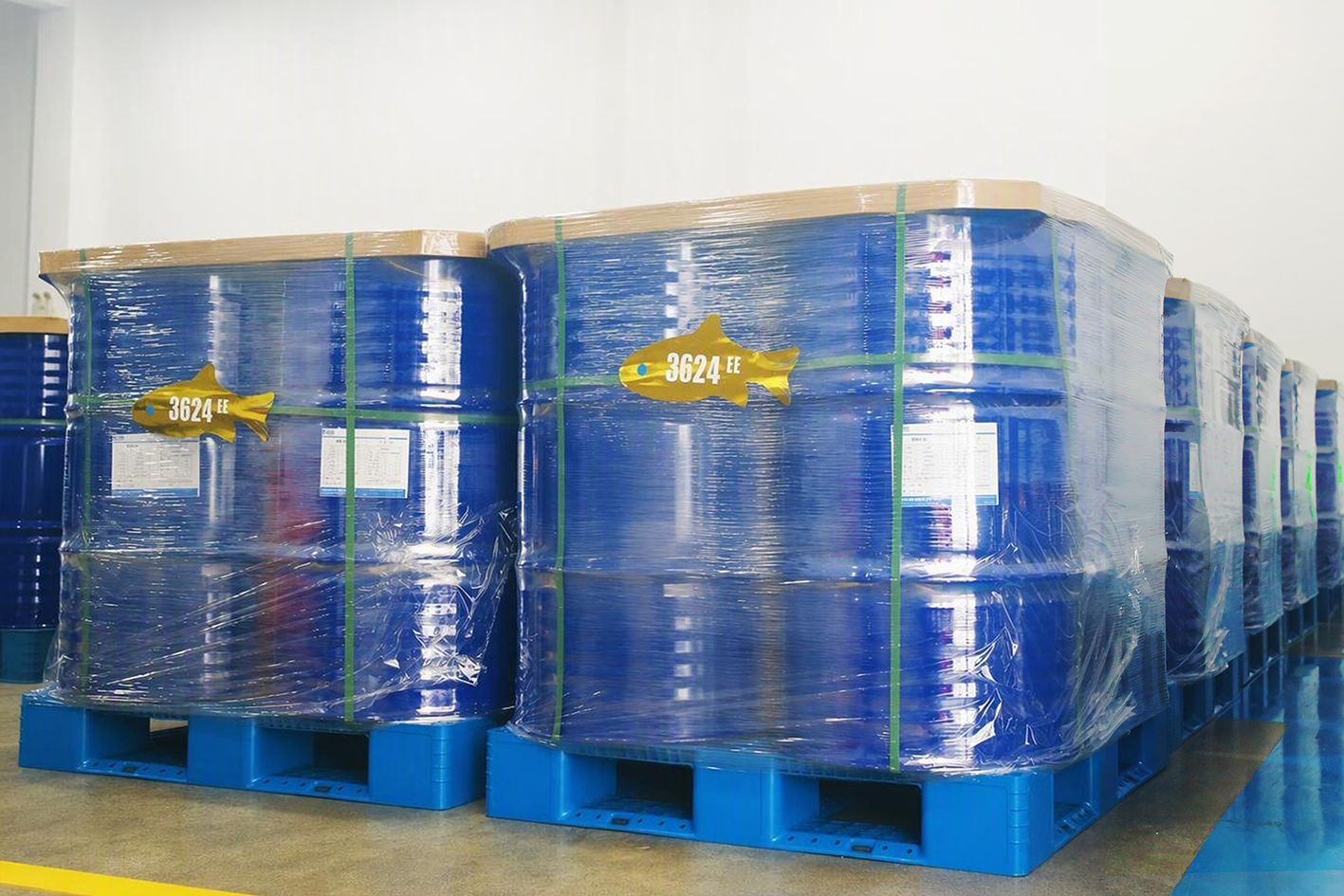
Bulk concentrate staged in drums. Batch identification at packaging level is what allows a COA to be tied to the material a buyer actually receives.
The Procurement Constraints That Sit Outside Both Documents
Certificates and COAs describe quality. They do not describe whether a supplier can hold a schedule. The commercial parameters on record for these concentrates are a minimum order quantity of 4 drums, a lead time of 30 days and a stated monthly capacity of 1,000 tons. Annual fish oil input processing capacity is 10,000 metric tons — explicitly input processing capacity, not finished-product output, a distinction that matters when scaling a forecast. The manufacturing site covers a total site area of 72,000 m² with 33,000 m² of building area, and the company reports around 200 employees including a 25-engineer technical team, with roughly 70% of output exported and named export markets including Russia, the EU, the US and Korea.
Handling conditions belong in the same review. These concentrates are supplied as bulk ingredients for supplement and functional food formulation, stored and handled under cool, dry, light-protected and oxygen-limited conditions according to the product specification and SDS, with downstream processing following the buyer's validated process. A buyer comparing suppliers on certificate scope alone will not catch a packaging or handling mismatch until the material is already in transit.
A Four-Step Document Workflow for Buyers
The sequence below is a decision framework, not a supplier requirement. It works because each step produces a document that constrains the next one.
- Write the target specification first. Fix the EPA and DHA dose, total omega-3 target, EE form, oxidation and contaminant limits, packaging format and destination market. Without this, certificate scope cannot be compared to anything.
- Map certificate scope to the site and process that will make the grade. Record certificate numbers, issuers and validity windows, and read the scope line for the specific process — distillation, blending, nitrogen packaging — rather than the certificate title.
- Request the batch COA, specification sheet and SDS for the actual lot. Check that the grade code on the COA matches the code in the specification, that EPA and DHA are reported separately, and that the analytical basis is stated.
- Handle destination documents as a separate track. Halal recognition, import requirements and market authorisation are not established by any of the four certificates, and the certificates themselves say so.
How This Compares With the Certificate-First Habit
The conventional approach treats the certificate as the qualification gate: if the supplier can produce FSSC 22000, ISO 22000 and a halal certificate, the file is considered qualified, and the COA is reviewed when documents arrive with the shipment. It is fast, and for a fixed, well-documented grade it often works. The scope-first approach moves the COA question earlier: the buyer reads what each certificate covers, notes what it explicitly does not cover, and only then opens a sampling conversation with a written target specification in hand.
The difference shows up in three places. A certificate-first file can pass a feed-chain certificate as evidence for a food-supplement programme without noticing the category K framing. It can treat a halal scope line reading “Refined Fish Oil” as grade-level confirmation. And it can leave the DHA-to-EPA split untested until the first shipment, which is the one variable a DHA-led formulation is most sensitive to.
The scope-first approach has a real cost, and it should be stated plainly. It inserts a documentation step before samples move, which adds time to a first evaluation, and it only functions if the buyer already has a written target specification — without one, there is nothing to compare the scope against and the exercise becomes paperwork. It also cannot verify performance. No certificate and no COA review will tell a buyer how a DHA-rich EE concentrate behaves in their specific matrix, at their fill weight, over their shelf life; that still requires the buyer's own formulation and stability work. And it does not remove the need for destination-specific approvals, which sit outside the supplier's certificate portfolio entirely.
Where DHA-Rich EE Concentrates Are Evaluated
The application context is dietary supplement and nutraceutical ingredient formulation, and functional food ingredient development, subject to formulation suitability and destination-market requirements. In practice the buyer's questions cluster around EE-form suitability, the target EPA/DHA dose, oxidation and contaminant specifications, packaging compatibility, and whether the destination market accepts the form and the documentation set.
Norbidar's recorded evaluation projects illustrate the stage at which most of these questions are asked. A Russian nutraceutical ingredient distributor received a 3624 EE sample for testing against a required specification, with acceptance based on the agreed specification, batch COA and the customer's own testing; no validated end-use performance results are available at that stage. An Indian nutraceutical ingredient customer is at sample evaluation stage against a required EPA/DHA specification, with commercial specifications and quantity still pending confirmation. Both cases are pre-commercial, and both are consistent with the point of this comparison: the document review precedes the sample, and the sample precedes any claim about suitability.
Why Documentation Review Moved Up the Buying Agenda
Concentrate buying has shifted towards the middle and upper concentration bands, and that shift puts specification language under more scrutiny. Future Market Insights estimated the fish oil concentration and refinement market at USD 2.6 billion in 2025, with a projected CAGR of 6.8% between 2026 and 2035, and reported that 51% to 80% EPA/DHA grades held a 43.6% share of concentration grade sales in 2026. When the largest single grade band is the one where EPA and DHA are both high enough to support label claims, buyers compete on how precisely that content is specified and evidenced, not on whether a concentrate exists at all.
Demand context sits alongside that. Grand View Research valued the global omega-3 supplements market at USD 8.3 billion in 2025 and projected USD 9.1 billion in 2026 — a different product scope from high-concentration fish oil concentrate, and not a proxy for concentrate market size, but a reasonable indicator of why ingredient qualification processes are being tightened rather than relaxed. The same logic explains why a 2018 GOED advisory on content expression remains in active use in COA review: comparability of stated content is a precondition for comparing suppliers at all.
Stated Boundaries of This Comparison
This analysis covers four certificates and the batch documentation set as described by the manufacturer. It does not include independent third-party assay results, price data, or country-specific regulatory approvals, and it makes no claim about competitive positioning against any other supplier. All four certificate validity periods begin in 2026; a buyer reviewing an older file should confirm the current certificate version and status with the issuing body rather than relying on a copy in a qualification pack. DHA-rich and custom EPA/DHA profiles remain subject to technical feasibility and an agreed specification, so grade availability should be confirmed per project before a specification is finalised.
Future Outlook
The direction of travel is towards document-level comparability. As the 51–80% band continues to dominate concentration grade sales, supplier differentiation shifts from the existence of a certificate to the precision of its scope, and from a generic COA to a lot-specific one that separates EPA from DHA and states its analytical basis. Buyers who build a scope-first review into their qualification template will find that the same four documents become more useful, not less — because they will be read for what they say rather than for what a qualification file assumes they say. Suppliers, in turn, will be asked more often to state explicitly where a management-system certificate ends and a batch record begins, which is the question this comparison set out to answer.
FAQ
Does a Norbidar FSSC 22000 certificate confirm the EPA and DHA content of a specific lot?
No. FSSC 22000 certificate CN26/00004667, issued by SGS United Kingdom Ltd and valid from 2026-10-16 to 2029-06-27, certifies a food safety management system covering refined fish oil production for the food industry by distillation, blending and nitrogen packaging, with food chain categories CIV and K and no exclusions. The certificate is not a batch-specific certificate of analysis and does not provide results for EPA/DHA content, oxidation or contaminants.
What should a batch COA for a DHA-rich EE concentrate contain?
The documented quality control set for these concentrates includes batch EPA/DHA assay and fatty-acid profile, colour and oxidation testing, and contaminant screening, with the batch COA issued alongside the specification sheet and SDS; exact limits follow the product documents. Nominal EPA and DHA values are grade-specific, and contractual limits and the analytical basis follow the current specification and batch COA. GOED's 2018 industry advisory on content expression is a useful reference for checking whether EPA, DHA and total omega-3 are expressed on a comparable basis.
Why does the FAMI-QS certificate not name specific products, and does that matter for a supplement buyer?
FAMI-QS certificate CN26/00005166, issued by SGS and valid from 2026-07-11 to 2029-07-10, covers a feed safety and quality management system for the production of specialty feed ingredients through chemical and mixing processes for feed chain category K, under the FAMI-QS Code (6th Edition, 4th Revision) and the Feed Fraud Prevention and Defence Module (Version 1.0). Specific product names are not listed on the certificate, and it does not itself constitute market authorization. It is therefore evidence about a feed-chain management system, not a grade-level confirmation for a food supplement ingredient.
Does the HALAL certificate cover the EE grades by name?
The HALAL certificate (number 501525000, Registration No. 3306966AA5, issued by Shandong Halal Certification Service, valid 2026-01-21 to 2029-01-20) lists a scope that includes Refined Fish Oil, Fumaric Acid CWS and Fumaric Acid, with the product scope attachment updated on 2026-07-30. Individual EE grade codes are not itemised. The applicable standard is MS 1500:2019, and for Indonesia the applicable standard is Indonesia Halal Law and Regulations. Applicability is subject to destination-country recognition and customer requirements.
Can a DHA-rich or custom EPA/DHA ratio be supplied, and how is the grade then fixed?
Norbidar's stated customisation scope covers EPA/DHA ratio, blended concentration and EPA-rich or DHA-rich profiles, subject to technical feasibility and an agreed product specification. The published blended grades run from 3624 EE (nominal 36% EPA, 24% DHA, 60% combined) to 5030 EE (nominal 50% EPA, 30% DHA, 80% combined), with further blends and EPA-rich or DHA-rich grades open to discussion. For any profile outside the published table, the agreed specification and the batch COA — not the grade code alone — govern supply.
Which commercial constraints should be checked alongside certificate scope?
On record for these concentrates: a minimum order quantity of 4 drums, a lead time of 30 days and a monthly capacity of 1,000 tons. Annual fish oil input processing capacity is 10,000 metric tons, stated as input processing capacity rather than finished-product output. The manufacturing site covers 72,000 m² of total site area with 33,000 m² of building area, and the company reports approximately 70% of output exported, with named markets including Russia, the EU, the US and Korea. Storage and handling follow cool, dry, light-protected and oxygen-limited conditions per the product specification and SDS.
Do these certificates authorise sale in a specific market?
No. The ISO 22000:2018 and FSSC 22000 certificates are management-system certifications and are explicitly not product registrations or import authorisations. The FAMI-QS certificate states that it does not itself constitute market authorization. The HALAL certificate applies to halal ingredient markets subject to destination-country recognition and customer requirements. Destination requirements are confirmed per project.
Reference document: the Norbidar omega-3 product brochure is available at Norbidar Omega-3 brochure (PDF).
Tem questões ou precisa de mais detalhes?
Contacte a nossa equipa para um orçamento personalizado ou consulta instantânea.
Solicitar orçamento
Preencha o formulário abaixo e a nossa equipa entrará em contacto com uma proposta personalizada.
Chat direto do WhatsApp
Prefere conversar em tempo real? Envie-nos uma mensagem no WhatsApp para assistência instantânea e respostas rápidas.
- Obter orçamento personalizado
- Partilhar fotos ou documentos
- Discuta as suas necessidades diretamente
Geralmente responde em 5–30 minutos durante o horário de expediente.