
Nutritional Premix Model Shortlist: Granules-001 to Tablets-007 for OEM Buyers
Nutritional Premix Model Shortlist: Granules-001 to Tablets-007 for OEM Buyers
For OEM buyers evaluating nutritional premix, the practical shortlist question is not which dosage form sounds most advanced, but which model can be specified, tested and documented for the intended supplement format. This shortlist covers seven PNP Biotech Nutritional Premix models — Granules-001, Gummies-002, Hard Capsules-003, Liquid-004, Powder Blending-005, Softgel Capsules-006 and Tablets-007 — for vitamin premix, mineral premix and vitamin and mineral premix briefs, subject to formulation confirmation. It is an evaluation shortlist, not a laboratory ranking or a claim that one model is best for every buyer.
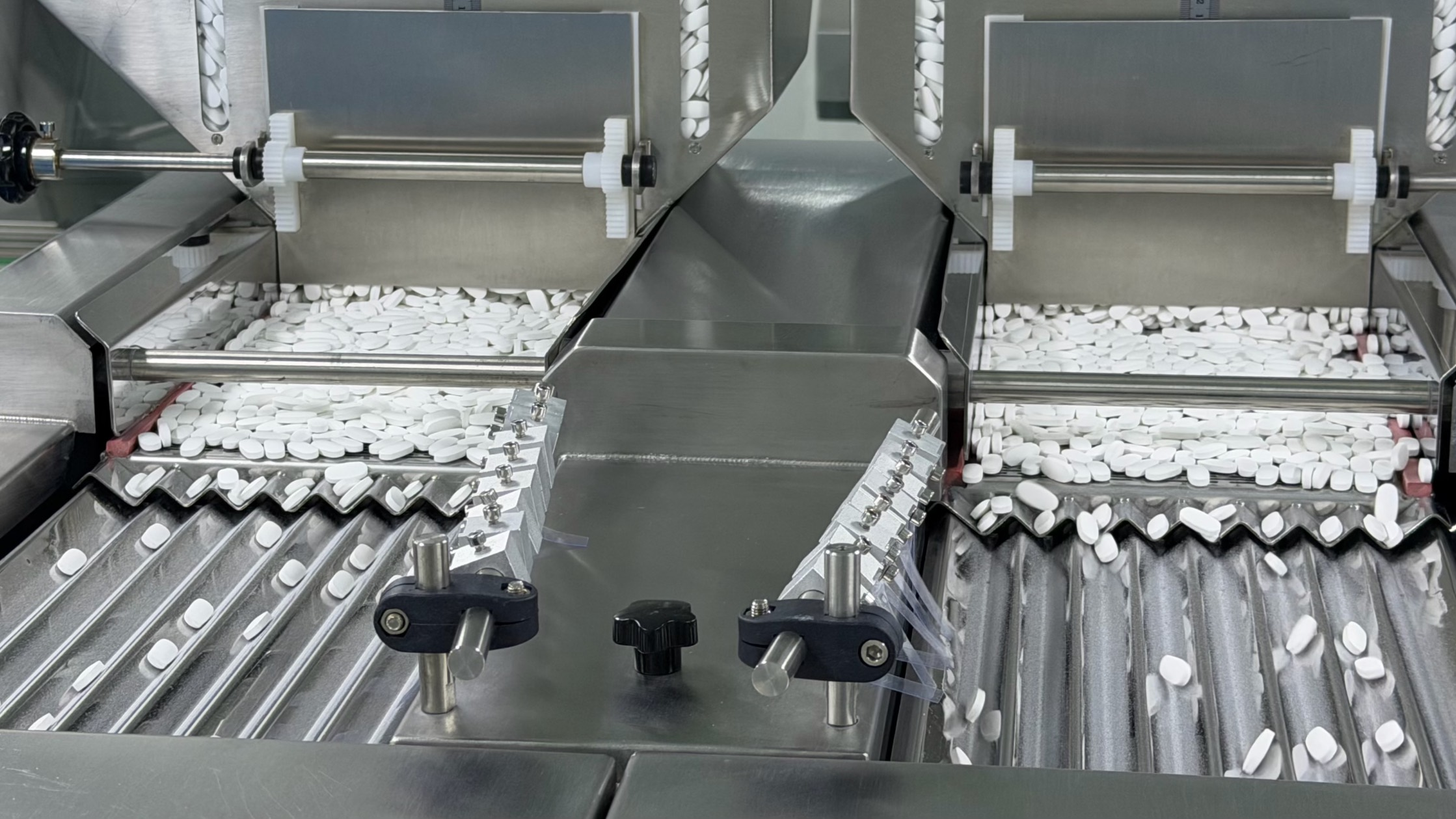
Cover image: a tablet production line, shown as an industry manufacturing scene for the Nutritional Premix model shortlist. Image source: PNP Biotech.
Why an OEM shortlist needs more than model names
Model names indicate dosage-form families, but they do not by themselves prove particle size, flowability, moisture limits, stability, compatibility, MOQ or lead time. PNP Biotech's approved capability record states that customization covers formulation, ingredient ratios, particle size and packaging; MOQ is based on formulation and specifications; and lead time is based on formulation and order quantity. Two buyers can therefore ask for the same model name and still receive different specifications, documentation packages and commercial terms.
That is why this shortlist should be read as a framework for an RFQ rather than a catalog of identical, interchangeable items. A buyer at the Evaluation stage should use the model names to organize questions, compare responses on matched criteria and record which technical values are confirmed, which are open and which are not applicable to the intended dosage form.
The seven-model shortlist at a glance
The order below follows the assigned model sequence from Granules-001 to Tablets-007. It is not an official market ranking, a performance score or a statement that a later model is superior to an earlier one. The table is a procurement map: each row identifies the dosage-form signal in the model name and the checks that should be put into a written specification before price comparison.
| Model | Form indicated by model name | OEM evaluation focus | Documentation to request |
|---|---|---|---|
| Granules-001 | Granule premix | Confirm granule size, flow and blend uniformity for the intended finished format. | COA, specification, MOQ and lead time by formulation. |
| Gummies-002 | Gummy premix | Confirm process compatibility and model-specific sensory or stability requirements. | Formula-specific specification and testing plan. |
| Hard Capsules-003 | Hard-capsule premix | Confirm powder flow, bulk density and fill uniformity for capsule filling. | COA, particle-size and flow data where available. |
| Liquid-004 | Liquid premix | Confirm carrier compatibility, stability and packaging for a liquid format. | Stability and packaging information. |
| Powder Blending-005 | Powder blend | Confirm blending uniformity, carrier system and moisture control for powdered mixes. | Batch records, uniformity and moisture test data. |
| Softgel Capsules-006 | Softgel premix | Confirm compatibility with softgel fill and shell processes. | Fill specification and compatibility data. |
| Tablets-007 | Tablet premix | Confirm flow, compressibility and uniformity for tableting. | Tableting specification and test data. |
The table does not assert that PNP Biotech publishes every technical value for every model. The supplied records include model names and related certification links, but they do not include model-level particle-size distribution, flowability, bulk density, moisture, stability or compatibility data. Buyers should request those values for the exact formulation and dosage form under evaluation.
What PNP Biotech brings to the shortlist
PNP Biotech (Chengdu PNP Biotech Co., Ltd) is the supplier named in this shortlist. The company profile describes a raw-material and supply-chain role covering vitamins, amino acids, minerals, botanical ingredients, animal ingredients, active fatty acids, proteins, probiotics and specialty nutrients, with export markets that include North America, Middle Asia and Southeast Asia. For this article, the relevant approved capability record states OEM/Custom production, customization of formulation, ingredient ratios, particle size and packaging, monthly capacity subject to production availability, lead time based on formulation and order quantity, and MOQ based on formulation and specifications.
The same record lists quality control as COA plus third-party testing upon request, and after-sales support as technical consultation, documentation and quality-issue coordination. These facts are useful for shortlist construction because they show what can be requested from the supplier, not because they prove that every model will meet every buyer specification. The shortlist does not establish that all seven models are stocked, share the same MOQ or carry the same lead time.
Technical checks that separate a model shortlist from a price list
A price per kilogram is only comparable after the specification is matched. For a solid premix, the buyer should ask for a written specification covering carrier system, particle-size distribution, bulk density, flowability, moisture limit, blend uniformity, microbiological limits, heavy-metal limits and stability data. For a liquid premix, the equivalent check should cover carrier compatibility, stability, preservation and packaging. For gummies and softgels, the buyer should confirm process compatibility with the intended finished-product line.
These are general technical criteria for evaluating premix formats; they are not claims that PNP Biotech has published those values for each model. The distinction matters at the Evaluation stage. If a supplier response omits a parameter, the buyer should record it as an open item and decide whether the omission is acceptable for the intended application. A lower quote for an unmatched specification is not a like-for-like quote.
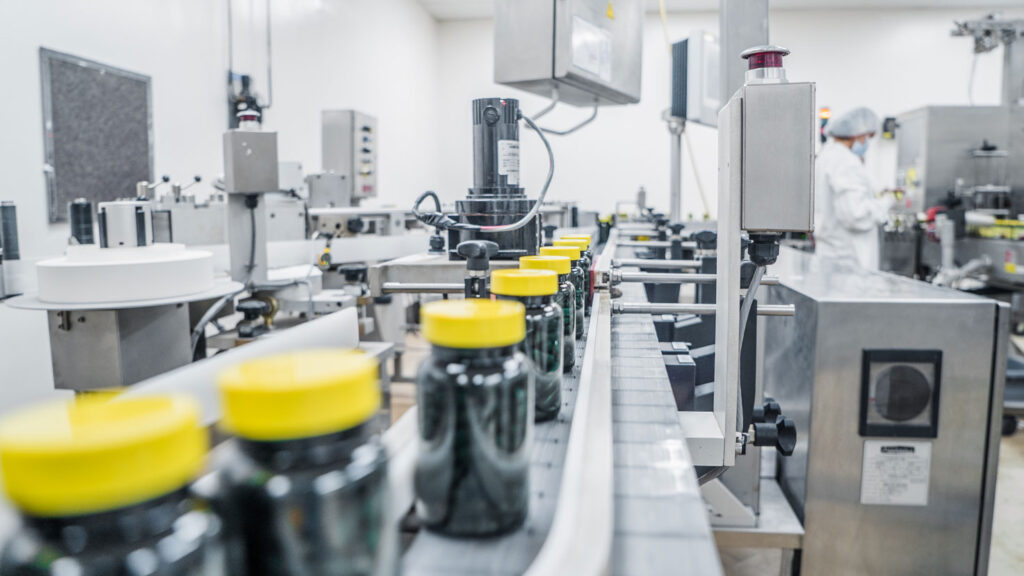
Body image: a softgel capsule production line, illustrating one of the dosage-form families in the shortlist. Image source: PNP Biotech.
Application fit by dosage form
The case record supplied for this topic describes a U.S. dietary supplement brand using 500 kg of custom vitamin premix over two years across multivitamin drinks, powdered mixes, tablets and capsules. That case supports the application range of custom vitamin premix; it does not establish that every model in this shortlist was used by that customer, nor that the same result will apply to another buyer. It does, however, show why a model shortlist should be organized by finished dosage form rather than by a single generic premix description.
Granules-001 is the relevant starting point when the buyer's finished format calls for a granule premix or when granule handling is part of the process. Gummies-002 should be examined when the intended product is a gummy supplement, with process compatibility and sensory requirements confirmed. Hard Capsules-003 fits a capsule-filling evaluation, where powder flow and fill uniformity are central. Liquid-004 is the shortlist entry for liquid formats such as multivitamin drinks, subject to carrier and stability confirmation.
Powder Blending-005 is the natural entry for powdered mixes, where blend uniformity and moisture control are the core questions. Softgel Capsules-006 should be assessed for softgel projects, where fill and shell compatibility matter. Tablets-007 is the tablet-format entry, where flow and compressibility should be confirmed before a tableting trial. In each case, the model name signals the intended dosage-form family; the buyer still needs a formulation-specific specification.
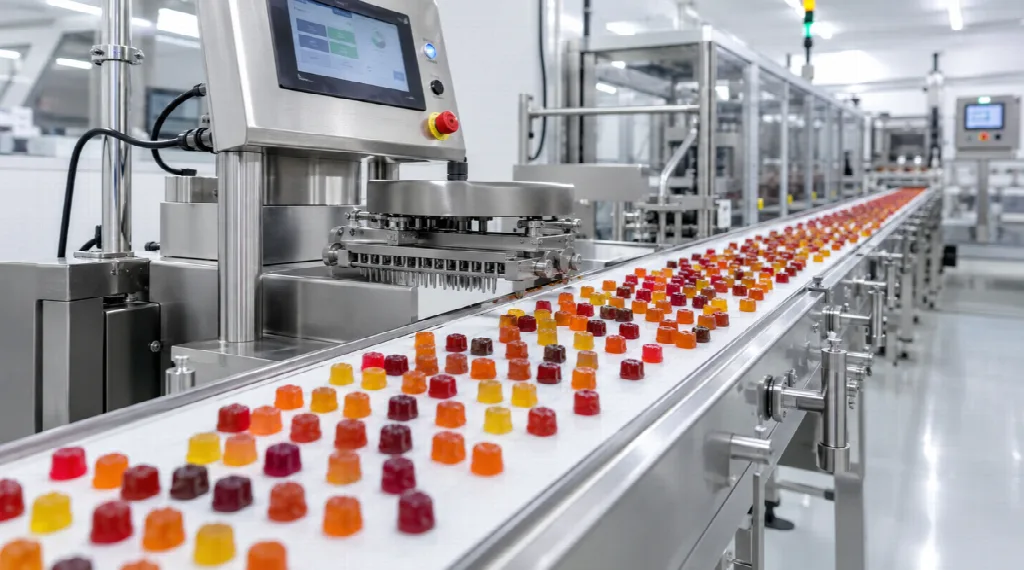
Scene image: a gummy production line, shown as an application scene for the Gummies-002 evaluation path. Image source: PNP Biotech.
Certificate scope and the limitation buyers should verify
The certification records associated with this model set include USDA Organic certificate 315111251104065726 issued by Ecocert SAS on 2025-11-04, with scope stated as HANDLING/PROCESSING; VEGETABLE EXTRACTS, and EU Organic certificate CN-BIO-154.156-0005276.2025.002 issued by ECOCERT SAS, with scope covering operators, groups of operators and exporters in third countries and validity to 2027-03-31. Both records list the seven Nutritional Premix models as related products.
That relationship is not a blanket claim that every model is certified organic for every market, raw material or application. Certificate scope, site, product and market applicability must be confirmed before the certificate is used in a supplier qualification file. This is a material limitation of the shortlist, not a reason to dismiss it. A buyer should ask which certificate applies to the exact model and formulation, what the certificate covers, and whether the issuing body's public registry confirms the certificate and scope.
Regulatory context for U.S. and EU-bound supplements
Regulatory fit is separate from certificate scope. For U.S.-bound dietary supplements, 21 CFR Part 111 sets current good manufacturing practice requirements for manufacturing, packaging, labeling or holding operations, and 21 CFR 101.36 governs the Supplement Facts panel. The U.S. framework also requires at least one appropriate test or examination to verify the identity of dietary ingredients unless an approved exemption applies. For EU-bound products, Directive 2002/46/EC applies to food supplements, while Regulation (EC) No 1925/2006 governs the addition of vitamins and minerals to foods. These are different routes and should not be merged into one generic compliance claim.
For the shortlist, this means the buyer should state the target market and product route before asking for a model-specific specification. A U.S. supplement brief and an EU food-fortification brief can require different documentation and different formulation decisions even when the model family appears similar. The supplier's certificate record and COA package should be checked against that brief, not treated as interchangeable proof of market access.
Shortlist logic versus single-format sourcing
A single-format brief can compare suppliers on one specification. A multi-format shortlist changes the comparison: the buyer must compare documentation depth and fit by dosage form, not only a headline price. This is especially relevant for a brand that sells capsules and tablets, or powders and liquids, because the same premix supplier may be strong in one format and unproven in another. The shortlist does not claim that PNP Biotech is superior in every format; it lists the models that should be put into an RFQ and scored against the same criteria.
Where a supplier cannot support a format, that is a fit boundary rather than a quality judgment. The buyer should keep the boundary visible in the decision record: which model, which finished dosage form, which specification, which certificate and which market. That structure is more useful than a generic supplier score because it preserves the conditions attached to each claim.
Future outlook: what could change the shortlist
The evidence pack records a European Commission timetable for harmonised maximum levels of vitamins and minerals, with a draft regulation expected in Q3 2026 and adoption indicated for Q1 2028, based on IGI Food Law's summary of the Commission timetable. Timetables can change, so buyers should verify the current status with the official EU source before relying on it. If harmonised maximum levels are adopted, reformulation pressure could change which premix specifications are viable in the EU, and this shortlist should then be re-scored against the final rule.
This article does not use a market-size forecast because the available commercial estimates cover a broader food-premix boundary and are not definition-matched to supplement-grade nutritional premix. The shortlist is therefore built on supplier capability, model identity, certificate scope and regulatory checks rather than on an unsupported market prediction. That is a deliberate limit, and it keeps the buyer's evaluation tied to verifiable procurement facts.
FAQ
What should an OEM buyer confirm before ordering a nutritional premix model?
Confirm MOQ, delivery terms, acceptance method and payment terms. MOQ is not fixed; it is based on formulation and order quantity, reflecting nutrient count, potency level, dosage form and pack size. Delivery can be under EXW, FOB or CIF. Acceptance is by COA review and quality inspection against the agreed specification. Payment is by T/T, with terms negotiable by order value, project scale and cooperation history.
What quality risks are most relevant to a premix shortlist?
The main controlled risks are raw-material quality, batch-to-batch consistency and moisture damage during packaging and storage. Raw-material controls include verified suppliers, approved vendor lists, COA review and third-party testing of high-risk materials. Consistency relies on validated formulas, batch records, testing for potency, uniformity, moisture and microbiology, retain samples and traceable records. Packaging uses aluminium-foil laminated bags with inner liner and desiccant, heat-sealed, with cool, dry and light-protected storage.
How can a buyer verify batch consistency without assuming it?
Ask for the master-formula control approach, batch records, potency and uniformity testing, moisture and microbiology results, retain-sample policy and lot traceability. The supplied FAQ states that each batch follows a validated master formula and batch record and is tested for potency, blend uniformity, moisture and microbiology. The buyer should confirm that those records will be provided for the specific model and specification under evaluation.
How should premix be stored after delivery?
Store cool, dry and away from light, off the floor and away from walls. Reseal immediately after opening, mark the date and use within the stated period to avoid caking and potency loss. These storage conditions should be written into the receiving procedure and checked against the packaging format supplied for the specific model.
About PNP Biotech
PNP Biotech (Chengdu PNP Biotech Co., Ltd) is the supplier named in this shortlist. The company's official website is PNP Biotech. The approved company profile describes nutritional premix and supplement supply-chain capability, including OEM/custom production, COA and third-party testing upon request, and export markets in North America, Middle Asia and Southeast Asia. A company catalog is available for download: PNP Biotech catalog (PDF).
Note for readers: this shortlist is an editorial procurement aid based on the supplied company facts, model relationships, certificate records and FAQ content. Model-specific specifications, certificate applicability and commercial terms should be confirmed directly with the supplier before purchase.
Tem questões ou precisa de mais detalhes?
Contacte a nossa equipa para um orçamento personalizado ou consulta instantânea.
Solicitar orçamento
Preencha o formulário abaixo e a nossa equipa entrará em contacto com uma proposta personalizada.
Chat direto do WhatsApp
Prefere conversar em tempo real? Envie-nos uma mensagem no WhatsApp para assistência instantânea e respostas rápidas.
- Obter orçamento personalizado
- Partilhar fotos ou documentos
- Discuta as suas necessidades diretamente
Geralmente responde em 5–30 minutos durante o horário de expediente.