
OCTOPUS Shoe Washing Bag: A Capability and Buyer Review
Washing shoes in a domestic washing machine has shifted from an improvised habit to a defined household routine, and the accessory that holds the shoes during the cycle has become a small but genuine product category. This review looks at one manufacturer and one product line inside that category — Zhejiang Runjiang New Material Technology Co., Ltd. and its OCTOPUS shoe washing bag — and separates what is documented from what buyers still have to verify for themselves.
Answer first: OCTOPUS The 2-Pack is a two-bag set of chenille-lined mesh shoe washing bags, 30 x 25 cm each and approximately 200 g per bag, closed by a zipper with a metal hook and anchor-loop locking clasp, with a center pocket for removable insoles and laces. It is produced by a Wenzhou-based textile manufacturer established on 23 May 1995, exported mainly to the USA, Turkey and Germany, and offered for wholesale, private-label and OEM projects. The sections below explain how that combination is built, what it supports in practice, and where the boundary of the claim sits.
Why a shoe washing bag exists as a product
A shoe washing bag is a fabric enclosure, usually with a mesh exterior, that contains footwear during a washing-machine cycle so that shoes, laces and insoles stay together instead of moving loose through the drum. Its function is containment and separation. It is not a cleaning agent and it does not change what a shoe can tolerate.
The problem it addresses is a load-control problem. Loose footwear in a drum contacts the drum wall and other items, laces tangle around the load, and removable insoles can separate from the shoe and travel independently through the wash. For households that already machine-wash washable trainers, the missing piece is not willingness but a repeatable method — a fixed way to load a pair, keep the components together, and know the cycle used is the one the footwear allows.
That framing matters for buyers at the discovery stage. A shoe washing bag is not evaluated on how well it cleans; it is evaluated on whether it holds the load, protects the inner surface from abrasion, keeps small parts accounted for, and survives repeated cycles without the closure failing. Those four criteria are where the specification of a product in this category should be read.
The company behind the OCTOPUS brand
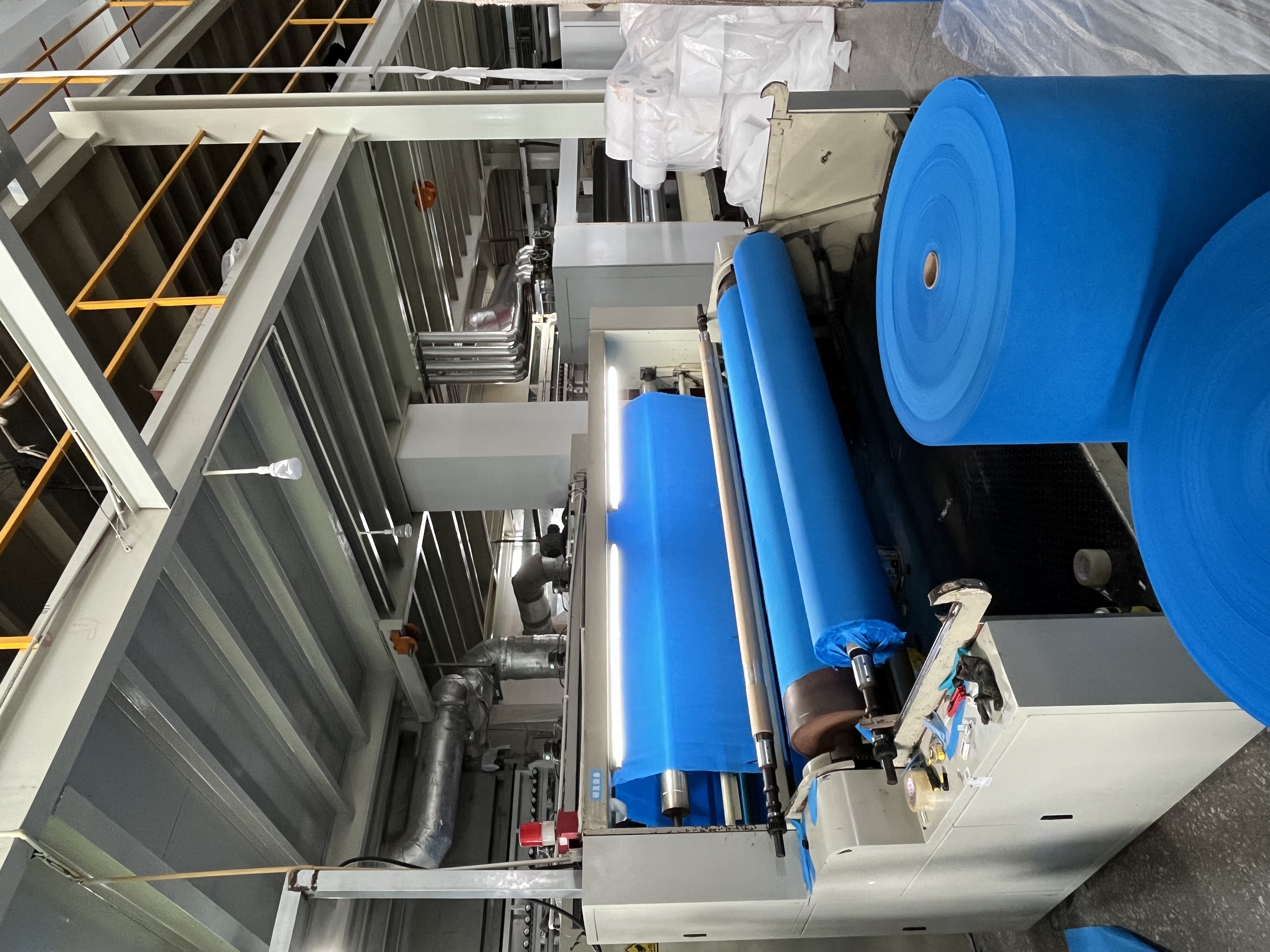
Zhejiang Runjiang New Material Technology Co., Ltd. is a Chinese textile-products manufacturer established on 23 May 1995 in Wenzhou, Zhejiang, China. OCTOPUS is its shoe-care brand, and the Shoe Washing Bag is the core product promoted through the brand site www.octopusbag.com. The company operates a 16,000 m² factory and employed 80 people as of September 2026, with annual output of approximately 1,000,000 units.
Three structural facts are more informative than the headline numbers. First, an eight-member development team covers sampling, structural development and production processes — a team sized for iteration on bag structures and materials rather than for pure volume assembly. Second, exports account for approximately 70% of the business, with customers in the USA, Turkey and Germany, which places the operating standard in the export supply chain rather than in a single domestic market. Third, annual output is expressed in units of roughly one million, which is a wholesale-oriented scale rather than a craft or sample-shop scale.
For a buyer assessing an unfamiliar supplier, that combination — a long operating history, an in-house development function, and a majority export share — is evidence of continuity rather than evidence of quality. Quality evidence has to be read separately, from inspection practice and documentation scope, which are covered further below.
Product architecture: what OCTOPUS The 2-Pack actually is
The product is sold as a set, not as a single unit. OCTOPUS The 2-Pack contains two separate shoe washing bags, each 30 x 25 cm (11.8 x 9.8 in) and approximately 200 g, for a set weight of roughly 400 g. The specification is compact enough to state in full.
| Parameter | Documented specification |
|---|---|
| Brand and product | OCTOPUS The 2-Pack |
| Pack contents | 2 separate shoe washing bags per set |
| Dimensions | 30 x 25 cm (11.8 x 9.8 in) per bag |
| Net weight | 200 g per bag; 400 g per 2-pack (approximately 0.88 lb) |
| Loading | One pair of compatible shoes per bag, subject to actual shoe dimensions |
| Closure | Zipper with metal locking hook and anchor loop |
| Internal feature | Center pocket for removable insoles and laces |
| Material | Mesh exterior with soft chenille lining |
| Care | Cold-water washing; air dry; do not bleach; do not tumble dry |
| Standard packaging | 2 bags per set in bubble-bag packaging; custom packaging available by agreement |
The design logic is worth reading as three separate decisions. The mesh exterior is the working surface: it defines the enclosure while letting water move through the bag rather than trapping it. The chenille lining is the contact surface, and its purpose in the specification is a soft inner face against the shoe rather than a cleaning function. The closure is the failure point most worth examining in any washing bag, and here it is a zipper plus a metal hook that attaches to an anchor loop after the zipper is closed — a two-stage closure intended to hold the bag shut for the duration of a cycle.
The center pocket is the least obvious feature and the most practical for households. Removable insoles and laces are the components that most often separate from a pair in the wash; a dedicated pocket gives them a defined place inside the same bag rather than leaving them loose in the drum. Whether they can be washed at all still depends on their own care instructions.
Colour-option variants and what they are not
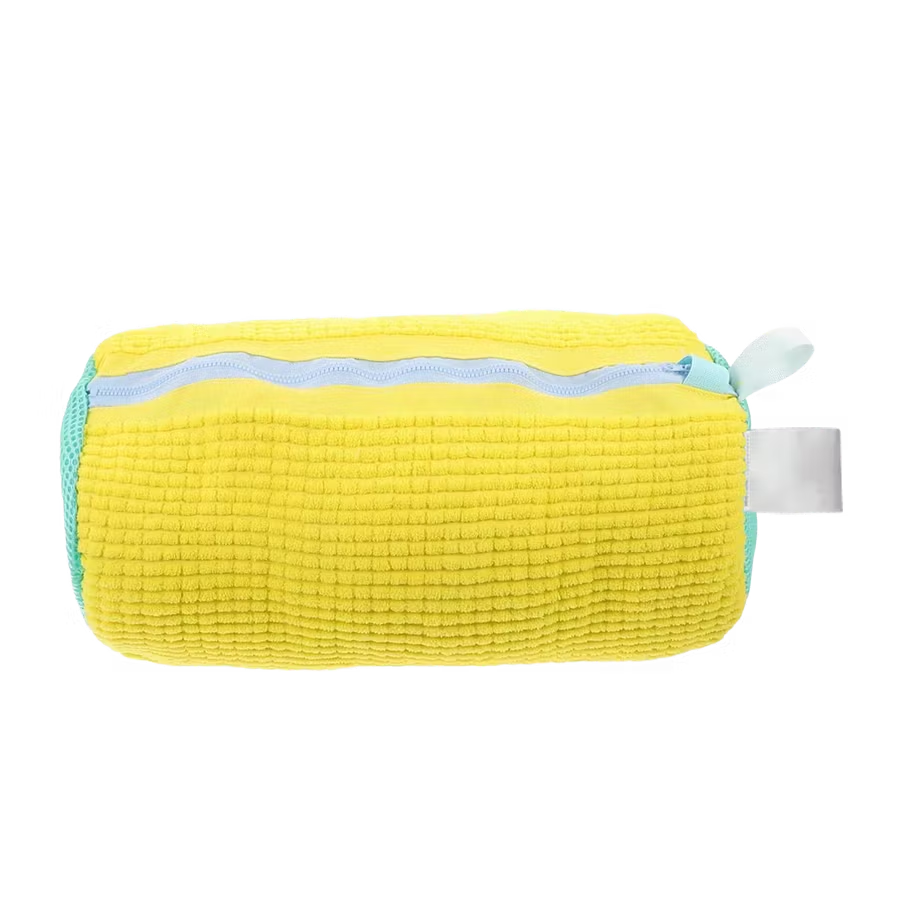
The product line carries three website color-option codes: XYF-004-Y, XYF-004-YG and XYF-004-YW. These are color-option variants within the same OCTOPUS The 2-Pack family, not separate structural designs — dimensions, weight, materials, closure and pocket are identical across the codes. The brand site uses one shared series image for all three and does not separately name the color for each code. Buyers who need a specific color confirmed should request it explicitly rather than inferring it from the code or from the shared photograph.
Manufacturing, inspection and the scope of documentation
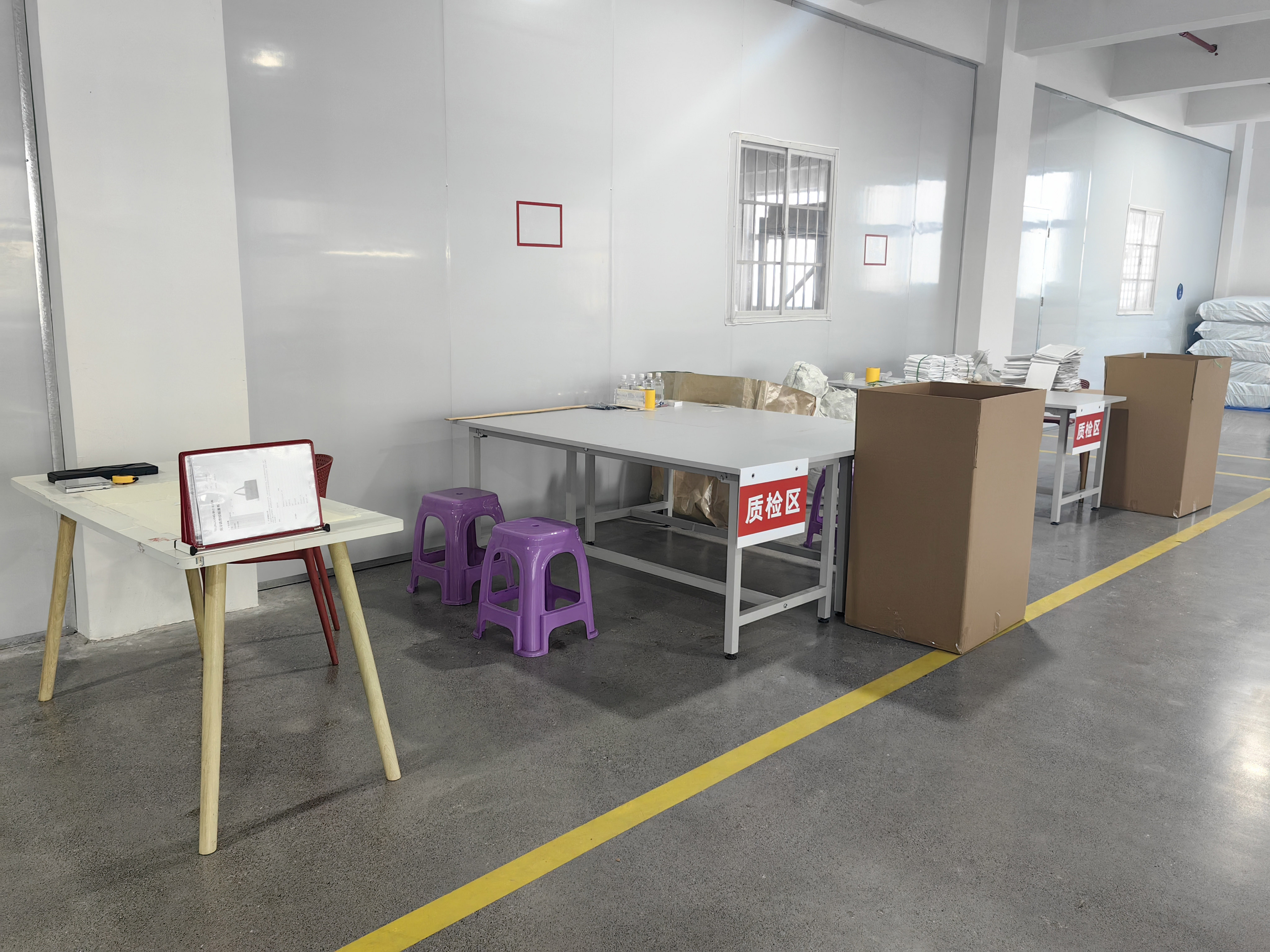
Runjiang operates a 16,000 m² factory with dedicated production and inspection areas, and the process controls described in the company materials follow a conventional textile-goods pattern: incoming materials undergo full inspection, and finished-product sampling and acceptance requirements are agreed for each order. Incoming inspection is the more consequential of the two for a washing bag, because mesh quality, lining softness and zipper behaviour are determined before assembly rather than corrected afterwards.
Two documentation points deserve precise wording, because they are frequently overstated in this category.
- ISO 9001:2015. The company holds an ISO 9001:2015 quality-management-system certificate covering the production of nonwoven fabrics and industrial textile products, including storage boxes and cooler bags. This is a management-system certification with a defined scope. It is not a product certification for shoe washing bags.
- AZO test report. A separate AZO test report is available for the submitted yellow shoe washing bag shell sample. Its results apply to that tested sample, not automatically to every color, batch or material subsequently produced.
Both statements are useful, and both are narrower than a general compliance claim. A procurement team reading them correctly will treat the ISO certificate as evidence of a controlled quality system and the AZO report as sample-level evidence — then specify, in the purchase order, which tests and which sampling plan are required for the actual order. That is a normal and reasonable request for a supplier of this size, and it is the step that converts available documentation into order-level assurance.
Customization, sampling and order thresholds
Size, material, color, logo, zipper and packaging customization can be discussed for OEM, ODM and private-label projects. The commercial thresholds are stated plainly, which is helpful at the research stage because it tells a buyer quickly whether the project fits the supplier.
| Item | Documented threshold or lead time |
|---|---|
| Stock orders | From 100 pieces |
| Logo customization | From 500 pieces |
| Custom-material orders | From 6,000 pieces |
| Standard samples | Approximately 3 working days |
| Custom samples | Approximately 15 working days, subject to the agreed design |
The three-tier structure is the practical detail. A retailer testing the category can start from stock at low volume; a brand adding its own mark moves to the 500-piece level; a buyer changing mesh, lining or closure specification moves to the 6,000-piece level, which reflects the reality that material changes require mill minimums. The gap between a three-day standard sample and a fifteen-day custom sample is similarly informative: standard samples validate an existing product, while custom samples validate a new structure or material combination and take longer because they involve the development team.
Application: where the product fits and how it is used
The documented application is household laundry and footwear care, in an indoor environment, with cold-water washing at 30°C or below and air drying at room temperature. The operating sequence is short enough to state completely.
- Check the footwear care label before washing.
- Place one pair of compatible shoes in each bag; use the center pocket for removable insoles and laces where their care instructions allow washing.
- Close the zipper fully and fasten the metal hook to the anchor loop.
- Wash in cold water using a cycle permitted by the footwear and washing-machine instructions.
- Remove the items and air-dry both shoes and bag; do not bleach or tumble dry.
Two variables decide fit rather than the product name. The first is the care label: the bag is intended only for footwear whose label permits machine washing. The second is physical dimension: one compatible pair per bag, subject to actual shoe dimensions. A low-profile sneaker and a bulkier trainer both fall under the same two conditions, so the useful question for a buyer is not which shoe type the bag is for, but whether a specific pair fits inside 30 x 25 cm and is labelled machine-washable.
The two-bag format also changes household use. Two separate bags allow two pairs to be washed in one cycle without the pairs contacting each other, which is the practical difference between a single-bag and a set-based product. For a household with more than one regular wearer, that is the feature that decides whether the product gets used repeatedly or only occasionally.
Comparison with traditional approaches
Before this category existed, households handled washable shoes in three ways, and each has a defensible logic as well as a cost.
| Method | What it does well | Where it falls short |
|---|---|---|
| Hand washing | Maximum control over water temperature and agitation; no machine contact | Time and effort per pair; inconsistent drying; harder to repeat as a routine |
| Shoes loose in the drum | No accessory required | Shoes and other items contact the drum and each other; laces tangle; insoles separate and move independently through the load |
| Improvised enclosure (pillowcase, plastic bag) | Contains the pair at near-zero cost | No purpose-built closure, no defined pocket for small parts, and limited repeat use |
| Purpose-built shoe washing bag (OCTOPUS The 2-Pack) | Containment with a locking two-stage closure, soft chenille contact lining and a dedicated pocket for insoles and laces | Adds a bag to load and to dry; usable only for footwear labelled machine-washable; must be air-dried and cannot be bleached or tumble-dried |
The honest limitation is this: a shoe washing bag changes how a load is contained, not what the footwear can survive. It does not make a non-machine-washable shoe safe to machine wash, it does not substitute for a cold-water setting, and it does not remove the requirement to air-dry. Buyers who expect the accessory to widen the range of shoes they can wash are buying the wrong product, and suppliers who imply otherwise create returns rather than repeat orders.
What the category signals: market trend analysis
Several directional shifts are visible in how this category is being bought, and they do not depend on any single forecast.
From improvised to specified. Households that once used a pillowcase are increasingly buying a purpose-made bag, which moves the purchase from a zero-cost workaround to a product decision judged on closure, lining and pocket. That shift favours suppliers who can describe construction precisely.
Private label as the default entry. Retail and e-commerce sellers rarely enter this category with a generic item; they enter with their own mark on an existing structure. The existence of tiered thresholds — stock, logo, custom material — reflects how that demand actually arrives.
Documentation expectations rising. Buyers increasingly ask what a certificate covers rather than whether one exists. The distinction between a management-system certificate and a product test report is becoming a routine procurement question rather than a specialist one.
Reuse as a design assumption. A washable fabric bag is inherently a repeat-use item, and product descriptions that specify care conditions — cold water, air dry, no bleach, no tumble dry — are effectively statements about service life. That is a meaningful difference from single-use laundry consumables.
A procurement checklist for this category
| Criterion | What to confirm |
|---|---|
| Closure integrity | Whether the zipper has a secondary lock, and how the lock attaches to the bag body |
| Internal surface | Lining material and softness, since this is the face that contacts the shoe |
| Small-parts control | Whether a dedicated pocket exists for insoles and laces |
| Dimensions and loading | Internal size against the shoe sizes actually sold in the target market |
| Pack configuration | Single versus set-based packing, and retail packaging requirements |
| Care instructions | Whether washing, drying and prohibition statements are printed on pack or label |
| Documentation scope | Exact wording of certificates and test reports, including what sample and what material each covers |
| Order thresholds | Minimum quantities for stock, logo and material changes, and sample lead times |
Limitations and fit boundaries
- The bag is intended only for footwear whose care label permits machine washing; it does not extend that permission.
- One compatible pair per bag, subject to actual shoe dimensions — larger footwear may not fit the 30 x 25 cm format.
- Cold-water washing at 30°C or below is specified; the product is not designed for high-temperature cycles.
- Air drying is required; bleaching and tumble drying are excluded.
- ISO 9001:2015 certification covers the quality-management system and its stated scope, not the shoe washing bag as a certified product.
- The available AZO test report applies to the submitted yellow shell sample, not to all colors or materials.
- Custom-material orders carry a materially higher minimum quantity than stock or logo orders, which limits small-batch experimentation with new materials.
- Standard packaging is bubble-bag; retail-ready packaging is a separate agreement.
Future outlook
The direction of this category is toward specification rather than novelty. Closure design, lining quality, internal organisation and clear care labelling are the variables that determine whether a washing bag survives a hundred cycles or a dozen, and they are the variables a buyer can actually inspect before ordering. For a manufacturer with an in-house development team, a factory of 16,000 m² and a majority export business, the competitive question is less about adding features than about documenting existing ones at order level — clarifying test scope, confirming color codes, and matching dimensions to the shoe sizes of each destination market.
For buyers, the practical conclusion is narrow and useful: treat the shoe washing bag as a containment product with a defined care envelope, verify fit and labelling before committing to volume, and read certificates for what they cover. On that basis, OCTOPUS The 2-Pack is a coherent entry point into the category — a documented two-bag format with a locking closure, a soft contact lining and a dedicated pocket for the parts that usually go missing, backed by a supplier with three decades of operating history and a stated customization path.
FAQ
What is an OCTOPUS Shoe Washing Bag and what is included in the pack?
OCTOPUS The 2-Pack is a set of two separate shoe washing bags, each 30 x 25 cm and approximately 200 g, made with a mesh exterior and a soft chenille lining. Each bag closes with a zipper plus a metal hook that fastens to an anchor loop, and includes a center pocket for removable insoles and laces. The set weighs approximately 400 g and is supplied in bubble-bag packaging as standard.
Can any pair of shoes be machine washed in a shoe washing bag?
No. The bag is intended only for footwear whose care label permits machine washing, and it does not make non-washable shoes safe for a machine. Cold-water washing is recommended, followed by air drying, with no bleaching and no tumble drying. Fit is a second condition: one compatible pair per bag, subject to the actual shoe dimensions against the 30 x 25 cm format.
How is the bag kept closed during a washing cycle?
Closure is two-stage. The bag is closed with a zipper, and a metal hook on the zipper is then fastened to an anchor loop on the bag. This secondary lock is intended to hold the closed zipper in place while the drum rotates, and the center pocket keeps removable insoles and laces inside the same bag rather than loose in the load.
What customization and minimum order quantities are available for wholesale buyers?
Size, material, color, logo, zipper and packaging can be discussed for OEM, ODM and private-label projects. Stock orders start from 100 pieces, logo customization from 500 pieces, and custom-material orders from 6,000 pieces. Standard samples take approximately 3 working days, while custom samples take approximately 15 working days, subject to the agreed design.
Does the company ISO 9001:2015 certificate certify the shoe washing bag product?
No. The ISO 9001:2015 certificate covers the quality-management system for the production of nonwoven fabrics and industrial textile products, including storage boxes and cooler bags. It is a management-system certification with a defined scope, not a product certification for shoe washing bags. Separately, an AZO test report is available for the submitted yellow shoe washing bag shell sample, and those results apply to that tested sample.
How should the bag itself be cared for between uses?
Wash in cold water and air dry at room temperature. Do not bleach and do not tumble dry. If the bag or its closure becomes damaged, it should be taken out of use rather than reused, and the supplier should be contacted for guidance.
Where can buyers find the full specification and company profile?
The product specification is published on the brand site at www.octopusbag.com, including the OCTOPUS The 2-Pack product page. A company and product brochure covering the manufacturer profile, facility and product range is available for download below.
Tem questões ou precisa de mais detalhes?
Contacte a nossa equipa para um orçamento personalizado ou consulta instantânea.
Solicitar orçamento
Preencha o formulário abaixo e a nossa equipa entrará em contacto com uma proposta personalizada.
Chat direto do WhatsApp
Prefere conversar em tempo real? Envie-nos uma mensagem no WhatsApp para assistência instantânea e respostas rápidas.
- Obter orçamento personalizado
- Partilhar fotos ou documentos
- Discuta as suas necessidades diretamente
Geralmente responde em 5–30 minutos durante o horário de expediente.