
OEM BP3/BP5/BP6 Pan Assemblies: Qualifying IEC 61439 Claims
OEM BP3/BP5/BP6 Pan Assemblies: Qualifying IEC 61439 Claims
An OEM-customized pan assembly is still a busbar with a declared rating, and the customization is a change to the hardware that carries that declaration. For the BP3, BP5 and BP6 pan assembly busbars made by Barfuses (Yueqing Barfuse Electric Co., Ltd.), customization is part of the published offer rather than an exception: the BP3 accepts OEM orders and its mounting plate and size can be adjusted to a customer's MCCB, and the BP6 mounting plate can be adapted to the outgoing MCB. The qualification question that follows is narrow and practical — after the plate, the size or the terminal layout changes, which declared facts still describe the part?
Three checks answer it. First, whether the certificate or declaration being cited names the model and rating actually being purchased. Second, whether the electrical data — incoming and outgoing ratings, pole distance and terminal dimensions — still matches the breaker schedule. Third, whether the construction the part is declared with, copper conductors and polycarbonate insulation, survives the customization. Each check is documentable, and none of them requires the buyer to become a test laboratory.
Why an OEM customization changes the qualification question
A pan assembly is not a single moulded part. It is a combination of copper conductors, polycarbonate insulating sections, terminal blocks and a mounting plate, assembled so that a breaker connects at a fixed pitch. The BP3, BP5 and BP6 are all described in the product data as copper and PC constructions, and each model ties its current rating to specific metal and terminal dimensions. On the BP5, incoming ratings of 125 A, 250 A and 400 A are listed alongside thickness values of 4 mm, 6 mm and 10 mm, while the 63 A and 125 A outgoing ratings are listed at 2 mm and 3 mm. The rating and the metal are declared together, not separately.
That is why a plate change is not a cosmetic change. Moving mounting holes to accept a different MCCB alters where the breaker terminals sit relative to the phase conductors. Changing the overall size alters the distance between phases and the path along which heat leaves the copper. Whether the result remains inside the configuration covered by the declared IEC 61439 and AS/NZS evidence is a question for the supplier's technical file. A buyer can see that a drawing has changed; only the supplier's documentation can say what the change means for the declaration attached to the original part.
What BP3, BP5 and BP6 declare before any customization
The starting point for any review is the unmodified specification, because that is the baseline the customized unit will be compared against. The three models occupy different positions in the same range: BP3 is a three-pole MCCB pan assembly, BP5 is a two-pole MCCB pan assembly with a stated simultaneous live and neutral disconnection feature, and BP6 is a three-pole MCB chassis busbar rated at 250 A.
| Model | Type | Declared ratings | Terminal and spacing data | Construction |
|---|---|---|---|---|
| BP3 | MCCB 3P pan assembly | Incoming 250 A, 400 A, 630 A, 800 A; outgoing 125 A, 250 A, 400 A; 2W–14W | For MCCB brands with pole distance 25 mm, 30 mm, 35 mm or 45 mm; mounting plate and size customizable to the customer's MCCB | Copper + PC parts |
| BP5 | MCCB 2P pan assembly | Incoming 125 A (4 mm), 250 A (6 mm), 400 A (10 mm); outgoing 63 A (2 mm), 125 A (3 mm); 2W–40W | Branch DP MCCB pole distance 25 mm, width 50 mm; incoming terminal width 25 mm; outgoing terminal width 15 mm | Copper + PC parts; simultaneous live and neutral disconnection |
| BP6 | MCB 3P chassis busbar | Rated 250 A | Outgoing terminal width 6.5 × 12 mm; incoming terminal width 21 × 22 mm; mounting plate customizable to the outgoing MCB | Copper + PC parts; declared compliance with IEC 61439 and AS/NZS |
Two details in that table matter more than they look at first reading. The BP3 pole-distance set — 25 mm, 30 mm, 35 mm and 45 mm — is a compatibility statement about other manufacturers' MCCBs, and it is the reason OEM sizing is offered on that model at all. The BP5, by contrast, fixes a 25 mm pole distance with a 50 mm width for the branch DP MCCB. A breaker outside that footprint is not a plate-customization question; it is a different product question, and treating it as a drawing change is where mismatches start.
Reading the IEC 61439 and AS/NZS evidence at the right scope
Three different kinds of document are routinely bundled into a supplier's compliance pack, and they do not carry the same weight. Separating them is the core of a qualification review.
Type test evidence names specific models
Barfuses holds a DEKRA Test Certificate, recorded as a type test certificate, issued by DEKRA Certification B.V. under numbers 3309992.100 and 3309992.101, issued on 5 September 2016 with a listed expiry of 5 September 2099. The standard cited is IEC 61439-2:2011 and EN 61439-2:2011. The scope is specific: low-voltage switchgear and controlgear assembly — busbar, models BP1-125 and BP1-250, brand BARFUSES, series BFSe, open-type assembly without enclosure.
Read that scope carefully. It names two models at two ratings. It does not name BP3, BP5 or BP6. A buyer shown this certificate while evaluating a customized BP3 or BP6 should treat it as evidence about the manufacturer's type-testing practice and about the BP1 models, then ask separately which document covers the model being purchased. That is not a criticism of the certificate; scoped certificates work this way, and the discipline of matching the scope to the purchase is what protects the panel builder who signs off the assembly.
Product-level standard claims need a document reference
For the BP6, the product data states compliance with IEC 61439 and AS/NZS standards. That is the manufacturer's declared position for the model, and it is the correct claim to test rather than to dismiss or to over-read. For an Australian or New Zealand project, the useful follow-up question is not whether the product complies but which AS/NZS document, which report number and which configuration the statement rests on. An AS/NZS reference without an identifiable report cannot be checked by the party carrying the assembly responsibility.
A quality certificate is not a product certificate
The ISO 9001 certificate held by Barfuses, number 62724Q1160R0S, is issued by Jingxin Certification (Beijing) Co., Ltd. against GB/T19001-2016 idt ISO 9001:2015, valid from 8 November 2024 to 7 November 2027. Its stated scope covers manufacturing and export of strip fuse disconnectors, load disconnectors, busbar systems (MCCB/MPCB busbars) and distribution boxes. This is a management-system certificate. It says the factory operates a controlled process, which is directly relevant to whether a customized batch repeats consistently. It does not certify a current rating, a terminal dimension or a short-circuit performance figure, and it should not be presented as though it did.
Check which part of IEC 61439 is being cited
IEC 61439 is a multi-part series, and the parts do not address the same products. The DEKRA certificate in this case cites Part 2. A 2025 edition of Part 6, the part covering busbar trunking systems, appears in the standards catalogue with a December 2025 effective date. Neither reference should be substituted for the other in a datasheet. A pan assembly reviewed against the part cited in its own evidence is a checkable claim; a general IEC 61439 line is not. This is a documentation review rather than a compliance determination, and final conformity of the assembled switchboard remains with the panel builder and the declared evidence behind each component.
Where customization actually touches the electrical envelope
The customization scope offered by Barfuses covers colour, logo, material, new design, surface treatment, mould development and packing, and the product data adds two mechanical freedoms: the BP3 mounting plate and size can be adjusted to the customer's MCCB, and the BP6 mounting plate can be adjusted to the outgoing MCB configuration. These requests do not carry the same risk, and sorting them by risk is the fastest way to run a review.
- Identity and finish. Colour, logo, packing and surface treatment change what the part looks like, not what it conducts. They belong in the order specification, not in the technical file discussion.
- Plate layout. Hole positions and cut-outs must still align the breaker terminals with the busbar terminals at the declared pitch. On the BP6 the outgoing terminal is 6.5 × 12 mm and the incoming terminal is 21 × 22 mm; a plate that shifts those interfaces is a mechanical fit question first and an electrical question second.
- Size, conductor and material. Changing the overall size, the copper section or the insulating material moves the part away from the declared construction. The BP5 shows why this matters: its rating bands are declared together with 4 mm, 6 mm and 10 mm incoming thicknesses, so a rating and a metal section are read as one statement.
Pole distance sits in the middle of that scale and deserves its own line in any review. The BP3 supports 25 mm, 30 mm, 35 mm and 45 mm spacings — a wide but finite set. A request to accept a breaker at an unlisted spacing is a new configuration rather than a customization of a listed one, and it should be quoted and documented as such.
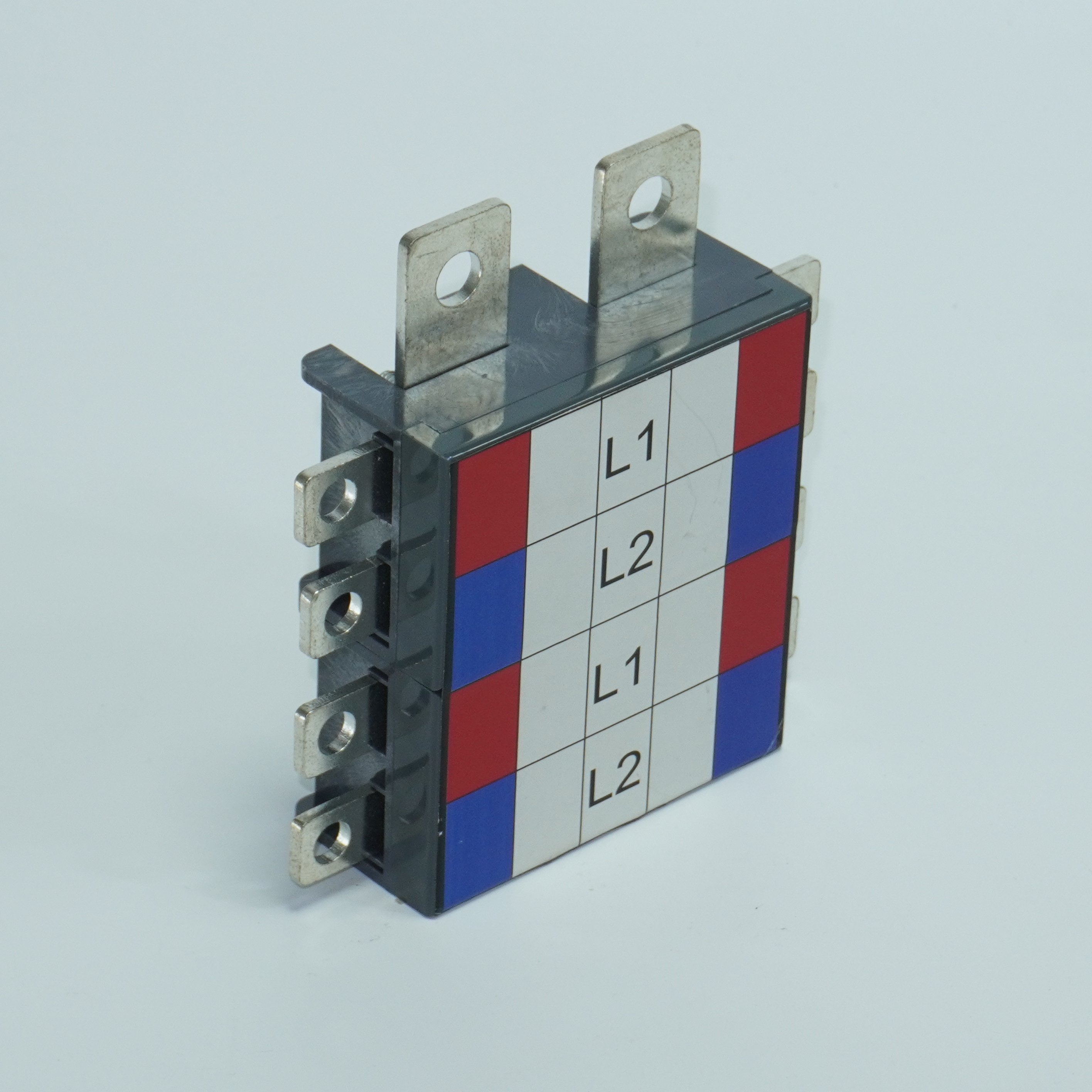
BP5 MCCB 2P pan assembly busbar: incoming terminal width 25 mm, outgoing terminal width 15 mm, branch DP MCCB pole distance 25 mm.
A five-step verification sequence before accepting a custom unit
The sequence below is written for the buyer's side of the table, in the order the checks become relevant. It assumes the supplier has already quoted the customized part and the buyer holds the drawing.
Step 1 — Name the model and the configuration in the evidence
Ask for the certificate, declaration or design verification document that names the exact model and rating being purchased, not the range and not a sister model. The BP1-125 and BP1-250 type test is a good example of why: it is strong evidence, but it is evidence about two named models under IEC 61439-2:2011, and it does not transfer by association to a 250 A MCB chassis busbar or an 800 A MCCB pan assembly.
Step 2 — Reconcile the schedule with the declared ratings
Compare incoming and outgoing values and the number of ways against the breaker schedule. The BP3 is declared at 250 A to 800 A incoming, 125 A to 400 A outgoing and 2W to 14W; the BP5 at 125 A to 400 A incoming, 63 A to 125 A outgoing and 2W to 40W. Where the schedule exceeds a declared band, the discussion is about a different model, not about customization depth.
Step 3 — Match terminal geometry to the actual breaker
Terminal dimensions are the most common cause of a failed first fit. On the BP6, confirm the 6.5 × 12 mm outgoing and 21 × 22 mm incoming terminals against the breaker series in use. On the BP5, confirm the 25 mm incoming terminal width, the 15 mm outgoing terminal width, and the 25 mm pole distance with 50 mm width for the branch DP MCCB.
Step 4 — Confirm the construction has not moved
All three models are declared as copper plus PC parts. Because material appears on the customization list, the question is a real one: does the customized variant still use the declared conductor and insulating materials, or does it introduce a substitution? If it does, the declaration attached to the original construction no longer describes the part, and separate evidence is the appropriate request.
Step 5 — Fix the change-control record
Close the review with a document set rather than a conversation: the drawing revision, the standard reference that applies, the certificate or report number, the validity dates, and the person who approved the deviation. The commercial terms make a first-article check practical — the manufacturer lists an MOQ of 1 piece and a lead time of 15–45 days, which allows a modified plate to be built, fitted to the real breaker and approved before a batch commitment.
Fit boundaries: when customization is the right request
Customization solves a fit problem; it does not solve a rating problem. The distinction is easier to apply with the models' own limits in view.
- BP3 is the appropriate request when the project uses three-pole MCCB branch devices at 25 mm, 30 mm, 35 mm or 45 mm pole distance, incoming ratings up to 800 A, outgoing ratings of 125 A to 400 A, and two to fourteen outgoing ways, with a plate change needed to seat a particular breaker brand.
- BP5 is the appropriate request when two-pole MCCB branch devices are required to break live and neutral simultaneously at a 25 mm pole distance and 50 mm width, with incoming ratings up to 400 A and up to forty outgoing ways.
- BP6 is the appropriate request when a 250 A MCB chassis busbar is specified and the outgoing MCB layout is the variable, so the mounting plate has to follow the breaker configuration.
- None of the three is the appropriate request when the required current exceeds the declared band, the breaker pole distance falls outside the supported set, or the conductor material must change without new supporting evidence.
Copper, polycarbonate and the material question
All three models are declared as copper with PC parts, with copper carrying current and polycarbonate providing insulation and mechanical support. That pairing is the baseline against which any material customization should be judged, and market context explains why buyers keep raising it. Copper held an estimated 62.8% share of the busbar market in 2025 according to Precedence Research, which also forecasts aluminium busbars growing at around 6.9% CAGR over 2026–2035 on weight and cost grounds. Those are research estimates rather than measurements of any single product line, and the same publisher's 2025 market valuation of about USD 19.83 billion sits alongside lower estimates from other houses depending on whether locally fabricated busbars are counted.
For a qualification review the takeaway is procedural rather than commercial. Aluminium pan assembly busbars appear in the market vocabulary, but the supplied data for BP3, BP5 and BP6 specifies copper and PC. A buyer who wants a different conductor should expect to review that variant on its own evidence rather than assume the copper declaration carries across.
Delivery, capacity and the documentation that surrounds them
Customization only helps if the customized part can be repeated. Barfuses lists OEM and ODM production, a monthly capacity of 8,000 pieces, a lead time of 15–45 days, an MOQ of 1 piece, 100% testing and remote technical support after sale. The company was founded in 2014, operates a 10,000 ㎡ factory with 45 employees and 7 engineers, reports annual output of 250,000 PCS and a 90% export ratio, and exports to the Middle East, Russia, Latin America, Central Asia, the EU, Africa and Oceania.
Against a customization review, the MOQ and lead-time figures matter more than they appear: a one-piece order with a 15–45 day window supports first-article approval, which is the point at which plate geometry, terminal alignment and material are actually confirmed. ISO 9001 coverage of busbar systems supports the expectation of controlled repetition, though it is the drawing revision and inspection record that determine whether a given delivery matches the approved sample.
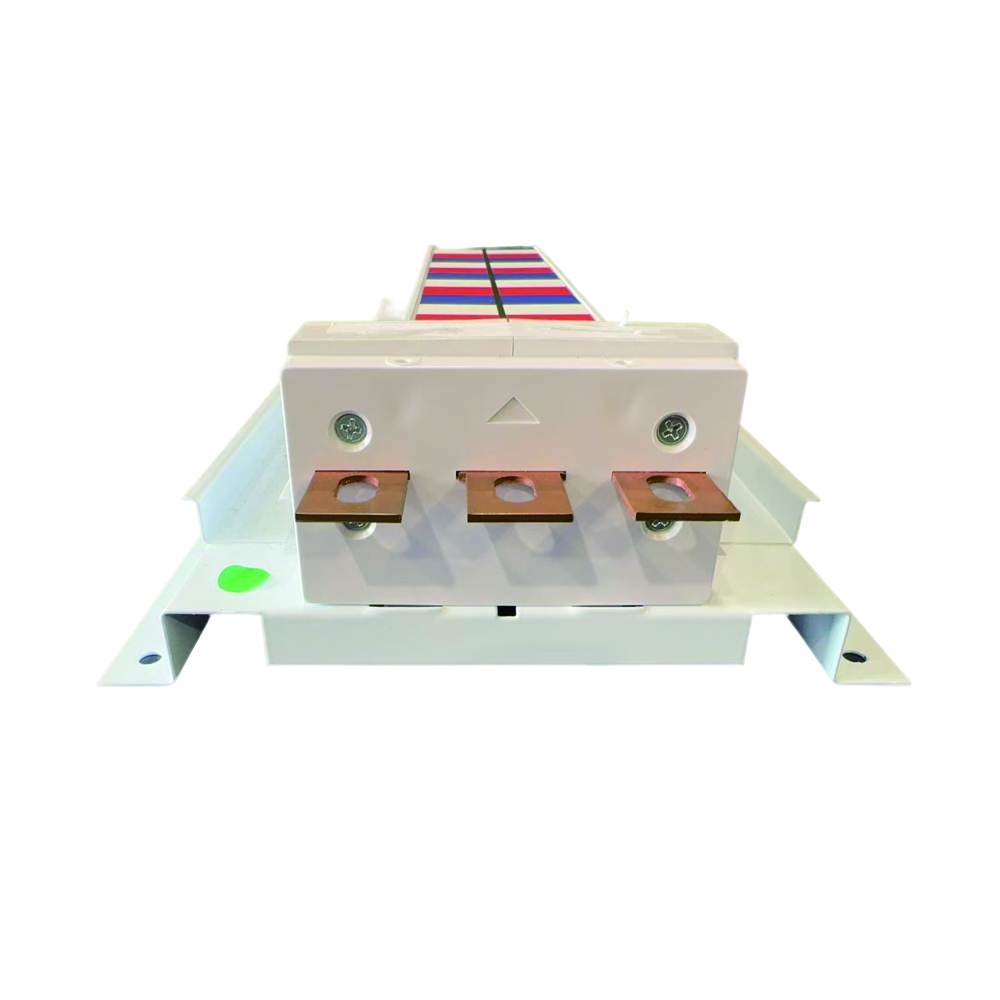
BP6 250 A MCB 3P chassis busbar: outing terminal 6.5 × 12 mm, incoming terminal 21 × 22 mm, mounting plate matched to the outgoing MCB.
Outlook: documentation discipline as the differentiator
Two pressures are visible in the supplied evidence. Standards continue to be revised part by part, as the 2025 edition of IEC 61439-6 illustrates, and material substitution keeps being argued on weight and cost. Both push in the same direction: the value of a pan assembly supplier increasingly sits in how precisely it can state what its evidence covers, for which model, at which rating, and under which drawing revision.
For BP3, BP5 and BP6 buyers, the defensible position is a short written mapping attached to every customized order — model, rating, terminal dimensions, plate revision, standard reference and certificate number. Where a claim cannot be mapped that way, the honest conclusion is that it sits outside the declared data, and that uncertainty should be priced before the purchase order is placed rather than discovered at the first-article inspection.
FAQ
Does OEM customization of a mounting plate invalidate IEC 61439 compliance?
It depends on whether the changed part stays inside the configuration the evidence describes. A certificate that names a model and a rating covers that model at that rating; a plate change that alters terminal positions, phase spacing or overall size is a different configuration and needs its own confirmation from the supplier's technical file. The practical request is the document that names the customized configuration, not a general statement of compliance.
Which models are covered by the DEKRA certificate?
Certificate numbers 3309992.100 and 3309992.101 were issued by DEKRA Certification B.V. on 5 September 2016, with a listed expiry of 5 September 2099, against IEC 61439-2:2011 and EN 61439-2:2011. The scope is busbar models BP1-125 and BP1-250, brand BARFUSES, series BFSe, open-type assembly without enclosure. BP3, BP5 and BP6 are not named within that scope.
Is the ISO 9001 certificate proof that a pan assembly meets IEC 61439?
No. Certificate 62724Q1160R0S, issued by Jingxin Certification (Beijing) Co., Ltd. against GB/T19001-2016 idt ISO 9001:2015 and valid from 8 November 2024 to 7 November 2027, certifies the quality management system for manufacturing and export of busbar systems, distribution boxes and related products. It supports process consistency and traceability; product-level performance is established by type test or design verification evidence for the specific model.
What ratings and pole distances should be confirmed on a BP3 order?
Incoming ratings of 250 A, 400 A, 630 A or 800 A; outgoing ratings of 125 A, 250 A or 400 A; two to fourteen outgoing ways; and MCCB pole distances of 25 mm, 30 mm, 35 mm or 45 mm. If the breaker in the schedule uses a pole distance outside that set, the request should be treated as a new configuration.
Which terminal dimensions matter on BP5 and BP6?
On BP6, the outgoing terminal width is 6.5 × 12 mm and the incoming terminal width is 21 × 22 mm at a rated 250 A, with the mounting plate customizable to the outgoing MCB. On BP5, the incoming terminal width is 25 mm, the outgoing terminal width is 15 mm, and the branch DP MCCB uses a 25 mm pole distance with 50 mm width.
What customization and delivery parameters are declared?
Production modes are OEM and ODM, with customization covering colour, logo, material, new design, surface treatment, mould development and packing. The MOQ is 1 piece, lead time is 15–45 days, monthly capacity is 8,000 pieces, testing is 100%, and after-sales support is provided remotely.
Barfuses publishes its full range, including the BP3, BP5 and BP6 pan assembly busbars, in a downloadable catalogue: Barfuse Catalogue (PDF). Company information is available at barfuse.com.
Tem questões ou precisa de mais detalhes?
Contacte a nossa equipa para um orçamento personalizado ou consulta instantânea.
Solicitar orçamento
Preencha o formulário abaixo e a nossa equipa entrará em contacto com uma proposta personalizada.
Chat direto do WhatsApp
Prefere conversar em tempo real? Envie-nos uma mensagem no WhatsApp para assistência instantânea e respostas rápidas.
- Obter orçamento personalizado
- Partilhar fotos ou documentos
- Discuta as suas necessidades diretamente
Geralmente responde em 5–30 minutos durante o horário de expediente.