
OEM Bar Table, Bistro Set and Folding Tray Table: A Buyer Comparison
OEM Bar Table, Bistro Set and Folding Tray Table: A Buyer Comparison
Foldable dining furniture is merchandised as a single category and frequently sourced as if it were one. In procurement terms it is three separate products. A drop leaf bar table set, a folding bistro set and a folding tray table share a folding principle but differ in open footprint, seating capacity, material basis, assembly requirement and the retail role each can perform. Comparing them as one category is the most common early-stage sourcing error.
This comparison looks at three production models from the same supplier portfolio, Xiamen Youjin Trade Co.,Ltd., which supplies the Pricolotus Furniture range: model 826-1008 (3-piece bar table set with drop leaf), model 826-1009 (3-piece folding bistro set) and model 605-0007 (folding tray table). The purpose is not to rank them. A bar table set is not better than a tray table; it answers a different question. The purpose is to give buyers, ecommerce brands and global retail sourcing teams a structural basis for deciding which format belongs in which slot of an assortment.
The practical answer, stated plainly: choose between these formats on four variables — how much floor area the product occupies when open, how thin it becomes when folded, whether the end user has to assemble anything, and whether the tabletop substrate suits the environment the product will actually live in. Price and finish come after those four.
Why These Three Formats Belong in the Same Comparison
Furniture and related product manufacturing is a broad formal classification. Under the U.S. NAICS 337 subsector, establishments make furniture and related articles such as mattresses, window blinds and cabinets. That breadth is useful for statistical reporting and unhelpful for sourcing. A buyer searching for an OEM furniture manufacturer will encounter suppliers whose capability sits in beds, cabinets or office systems rather than in folding dining sets.
Narrowing within the foldable dining segment produces the three formats discussed here because they cover three distinct space problems: a compact seated dining area inside a small home, a two-person outdoor or semi-outdoor nook, and a single temporary surface that appears when needed and disappears afterwards. Each problem has different structural requirements, and each has a different position in a retail catalogue.
What Each Product Actually Is
Model 826-1008 — 3-Piece Bar Table Set with Drop Leaf
Model 826-1008 is a drop leaf bar table set supplied as an all-in-one 3-piece set consisting of one table and two chairs, without separate storage components. The table measures 80×40 cm folded and 80×75 cm with the leaf open; each chair measures 32×32×45 cm. The material basis is metal, MDF and wood veneer.
Two design decisions define this model. The first is the drop leaf: the table runs at half its open width until the leaf is raised, which changes where it can be placed rather than only how large it is. The second is storage behaviour — the two stools tuck under the table, so the set occupies a single footprint instead of three. The manufacturer states a reinforced frame rated at 100 kg per chair.
Typical application scenarios are small kitchens, apartments and loft spaces. This is the format for a household that wants seated dining at bar height but cannot dedicate a permanent dining zone.
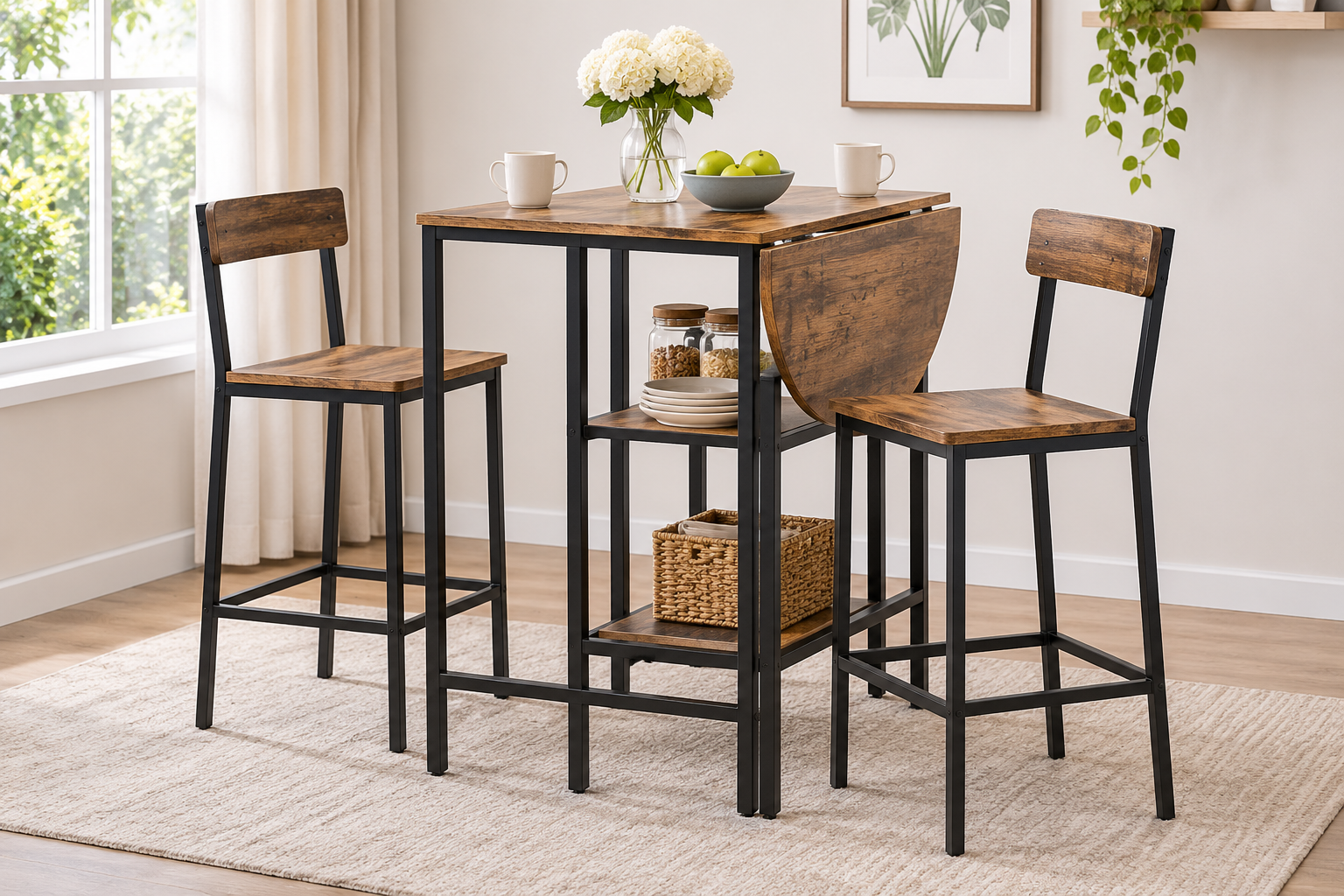
Model 826-1008, 3-piece bar table set with drop leaf: one table (80×40 / 80×75 cm) and two chairs (32×32×45 cm), with the stools stored under the tabletop.
Model 826-1009 — 3-Piece Folding Bistro Set
Model 826-1009 is a 3-piece folding bistro set consisting of one table and two chairs. The table is Ø60×72 cm and each chair is 40×46×80 cm. The frame is steel, with a wood-like MDF or particle board top.
Unlike the bar table set, this model is built around a full fold rather than a partial leaf. The product is supplied without an assembly step for the end user, and the set folds in one motion. The steel frame is specified as rust-resistant for patio and balcony use, and the product is designed for outdoor small-space dining scenarios including patios, balconies and small spaces.
This is the format for semi-permanent outdoor seating that has to disappear in bad weather or when the space is needed for something else. The stated rust resistance applies to the frame; it is not a claim of full all-weather performance for the whole product.
Model 605-0007 — Folding Tray Table
Model 605-0007 is a folding tray table measuring 48×38×66 cm, built on a metal tube frame with an MDF top. It is a single unit, not a set.
The operational characteristics matter more than the dimensions here. The table unfolds for use without tools, folds flat in seconds and can be stored under a sofa, under a bed or in a narrow gap. The frame is powder-coated steel with a U-shaped non-slip base, and the tabletop is a rounded-edge wood-grain panel that is wiped clean rather than scrubbed. The unit is light enough to be carried between rooms or outside.
Typical application scenarios are living rooms, bedrooms, small apartments and home offices, along with temporary uses such as small parties or market stalls. This is the format that answers a demand for an occasional surface rather than a defined dining place.
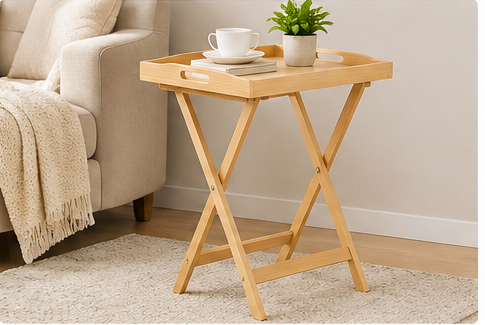
Model 605-0007, folding tray table: 48×38×66 cm, metal tube frame with MDF top, folds flat for storage without tools.
Specification Comparison at a Glance
| Criterion | 826-1008 Drop Leaf Bar Table Set | 826-1009 Folding Bistro Set | 605-0007 Folding Tray Table |
|---|---|---|---|
| Set composition | 1 table + 2 chairs | 1 table + 2 chairs | Single table |
| Table dimensions | 80×40 cm folded / 80×75 cm open | Ø60×72 cm | 48×38×66 cm |
| Seat dimensions | 32×32×45 cm per chair | 40×46×80 cm per chair | Not applicable |
| Material basis | Metal + MDF + wood veneer | Steel frame + wood-like MDF or particle board | Metal tube + MDF |
| Assembly for end user | All-in-one set, stools tuck under table | No-assemble set, folds in one motion | No tools required, folds flat |
| Stated environment | Small kitchens, apartments, lofts (indoor) | Patios, balconies, small spaces (semi-outdoor) | Living rooms, bedrooms, small apartments, home offices |
| Stated structural feature | Reinforced frame, 100 kg per chair | Rust-resistant steel frame | Powder-coated steel, U-shaped non-slip base |
| Assortment role | Anchor SKU for compact dining | Seasonal or outdoor add-on | Entry item and basket builder |
Five Criteria That Decide Between Them
- Open footprint versus folded thickness. The bar table set converts width into height: it is a bar-height solution that occupies a narrow strip when the leaf is down. The bistro set converts a two-seat arrangement into a folded package. The tray table converts a surface into a thin object. Buyers should specify both numbers — the area used when open and the thickness when folded — because the second one sets packaging volume and return rates more than the first.
- Assembly expectation. The bistro set is supplied without an assembly step and the tray table needs no tools; the bar table set is an all-in-one set whose stools store under the table. For ecommerce sellers, a product that arrives assembled removes an entire category of customer support contact but increases carton size. That trade-off should be decided per channel, not per product.
- Verification of structural claims. A stated 100 kg per-chair rating is a useful screening figure, but buyers should request the test method behind it — static load, cycle count, test standard — before publishing the number in their own listings. The same applies to rust resistance on the bistro frame: the claim needs a defined test basis.
- Substrate and moisture exposure. MDF and particle board are the common substrates across all three models. They perform well in dry indoor conditions and poorly in prolonged damp. A product marketed for balcony use should therefore be positioned carefully, and buyers selling into humid climates should confirm edge sealing and panel grade with the supplier.
- Documentation before price. Certification status, factory audit reports, material declarations and packaging specifications determine whether a SKU can be listed in a given market at all. Price negotiation on an unqualified product is a downstream problem.
Material and Structure: Reading the Specification Correctly
The three models share a construction logic: a metal frame carries the load, a panel provides the surface, and a mechanical joint allows the product to change shape. That logic explains both the cost position and the failure modes.
Metal plus MDF plus wood veneer (model 826-1008) is the configuration that prioritises appearance. The veneer delivers a wood surface on a dimensionally stable core, and the metal frame carries the structural role that a solid timber leg would normally take. The practical considerations are edge banding quality, veneer adhesion at the leaf hinge, and how the two halves of the drop leaf are supported when open.
Steel frame plus wood-like MDF or particle board (model 826-1009) prioritises cost and foldability. Particle board is more moisture-sensitive than MDF, so the sealing of cut edges is the specification detail worth confirming on this model.
Metal tube plus MDF (model 605-0007) prioritises portability and simplicity. A powder-coated tube frame with a U-shaped non-slip base distributes load across four small contact points, and the wood-grain panel with rounded edges reduces the risk of edge damage in transit and in use.
The common wear point in all three is the mechanism, not the material. Hinges, leaf supports and locking joints are the parts that move, and they are the parts that determine service life. Buyers comparing foldable furniture should treat mechanism specification — hinge type, locking method, cycle rating — as a primary comparison field rather than a detail.
The Supplier Behind These SKUs
Xiamen Youjin Trade Co.,Ltd. is a trade service provider established in 2016 and rooted in Xiamen, China, operating under the Pricolotus Furniture brand. The company specialises in steel pipe furniture within its cross-border home goods supply business and collaborates with upstream smart furniture manufacturers, integrating production and trade rather than operating as a pure trading intermediary.
Reported capability figures from the company profile are: a manufacturing facility covering 40,000 m², approximately 98 employees, an R&D team of 25 engineers, 100% export orientation, and main markets in the USA and the EU. The company reports an annual output of 30,000,000, expressed in the unit used in its own company data. The product range covers metal furniture, panel furniture and soft upholstered furniture, together with dining tables, dining chairs, folding tables, folding chairs, metal beds, upholstered beds, coffee tables, side tables, space savers, towel towers and shoe racks.
Two structural characteristics are worth flagging for buyers. First, the model is production-plus-trade: the company states that collaboration with upstream manufacturers gives it stronger customised response and supply chain control than a pure trading company, and its stated team structure is lean enough to handle small to medium batch sizes across multiple product categories. Second, the brand has retail-side visibility in addition to its supplier role: Pricolotus is identified in a third-party retail listing (Ubuy) as a China-based manufacturer sourcing shipments from Shenzhen and Xiamen, which is consistent with an export model built on southern Chinese ports.
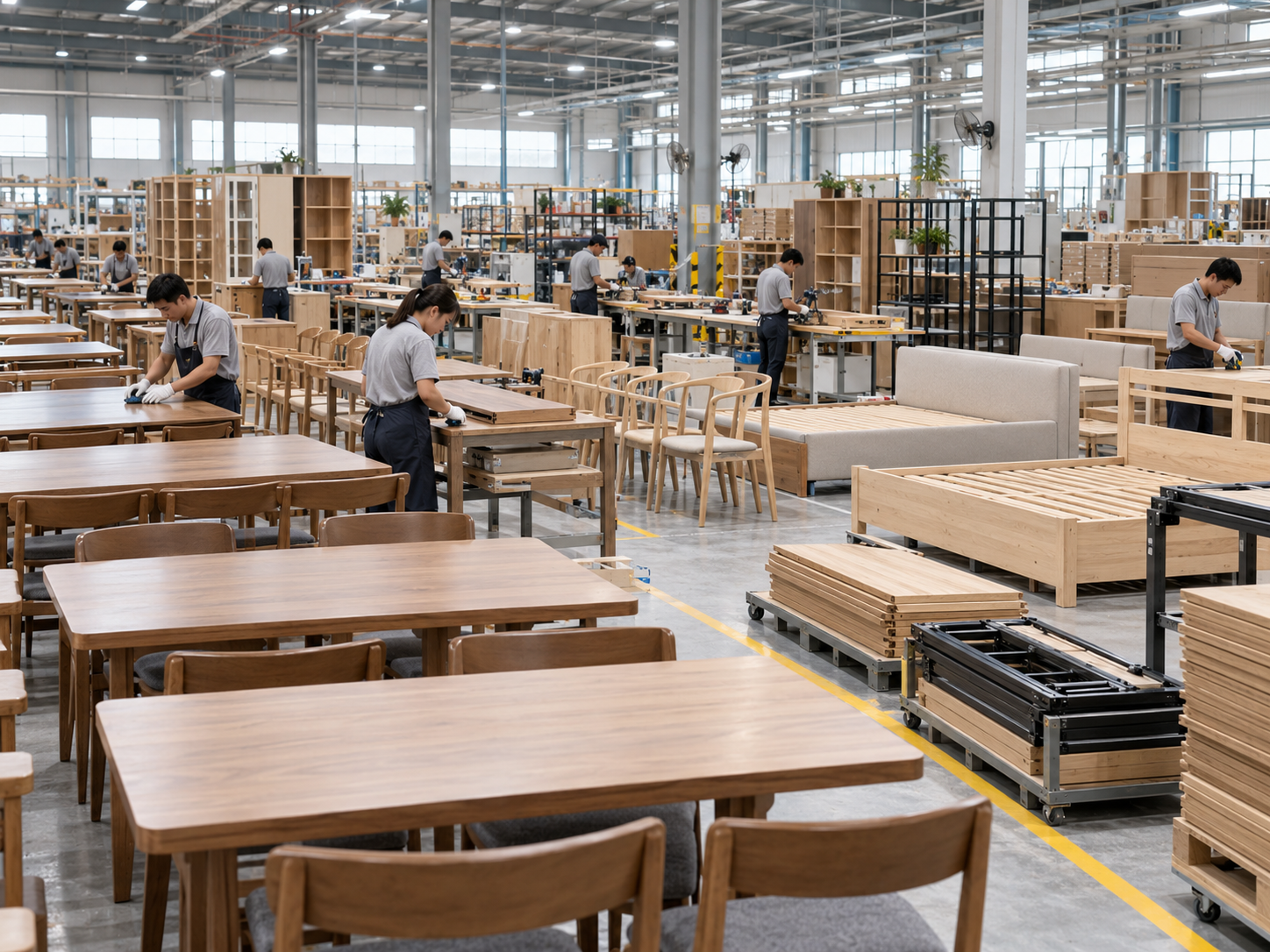
Metal furniture production and assembly environment supporting folding table and chair programmes for export buyers.
The boundary of that model should be stated plainly. A trade-integrated structure of roughly 98 staff is not a single-site high-volume plant, and buyers running very large single-SKU programmes should establish which production steps are performed in-house and which are performed by partner factories before committing volume.
Application and Channel Mapping
| Demand situation | Best-fit format | Reason |
|---|---|---|
| Compact indoor dining in an apartment or loft | 826-1008 drop leaf bar table set | Bar height plus a table that halves in width when not in use; stools store under the top |
| Balcony or patio nook for two | 826-1009 folding bistro set | Rust-resistant steel frame stated for patio and balcony use; full fold without assembly |
| Occasional surface in a bedroom, home office or living room | 605-0007 folding tray table | Folds flat without tools; light enough to relocate; 48×38 cm working surface |
| Ecommerce entry-price listing | 605-0007 folding tray table | Single unit, low carton complexity, minimal assembly support burden |
| Seasonal outdoor promotion | 826-1009 folding bistro set | Outdoor-oriented specification and a complete two-seat set in one carton |
| Small-space collection anchor | 826-1008 drop leaf bar table set | Highest structural specification in the set and the clearest space-saving story |
Market Context for Space-Saving Furniture
China's wooden furniture exports reached US$24.57 billion in 2024, a 2% year-on-year increase, according to China Customs data reported by Fordaq. The United States was the largest destination, accounting for nearly 30% — approximately US$7.1 billion — of that total. For suppliers in the foldable dining segment, that concentration means U.S. retail documentation, packaging expectations and labelling requirements are not peripheral concerns; they sit on the largest single export lane.
On the demand side, Fortune Business Insights values the global furniture market at US$597.71 billion in 2025 and projects growth at a CAGR of 5.92% between 2026 and 2034. Category-level growth does not by itself indicate that foldable formats will grow faster than fixed furniture, and this article does not claim that. What the structural evidence does support is a supply-side point: the European Commission describes the furniture industry as a labour-intensive and dynamic sector dominated by small and medium-sized enterprises and micro firms. A fragmented supply base raises the value of supplier qualification relative to supplier discovery — the constraint for buyers is less finding a folding furniture factory than verifying the one in front of them.
What Foldable Furniture Does Not Replace
An honest comparison has to state where these formats stop being the right answer.
- Mechanisms are wear items. A folding joint on a bar table set or bistro set introduces hinges and locking points that a fixed table does not have. In settings where the product is folded daily by many different users — cafés, staff canteens, short-let accommodation — mechanism life becomes the limiting factor, and fixed furniture is the more durable choice.
- Rigidity is not equivalent to fixed construction. Foldable structures manage load through their frame and joint design, not through mass. Buyers should not assume that a stated load rating on one SKU transfers to another SKU, another model or another supplier.
- Panel substrates are indoor materials by default. MDF and particle board used across these models are not designed for prolonged damp. A rust-resistant frame on the bistro set does not make the tabletop an all-weather surface, and outdoor positioning should account for that distinction.
- Space saving is not the same as comfort. A tray table at 48×38 cm is a working surface, not a dining table. A bistro set seats two comfortably; a bar table set is defined by bar-height seating, which is not suitable for every household or every age group.
- A trade-integrated supplier is not a vertically integrated plant. Buyers with single-site audit requirements, very high volume or highly customised construction should verify the production route rather than assume it.
A Pre-Order Verification Checklist
The following items are commonly included in the keywords buyers use in this category — FSC material, ISO quality systems, factory audits, custom sizes, private label. They are also the items most often asserted and least often documented. Each should be verified with a document, not a statement.
- FSC chain-of-custody. Request the certificate number and issuing body and check them in the FSC public certificate database. Public materials reviewed for this article did not contain verifiable FSC certificate records for the supplier, so buyers should treat FSC status as unconfirmed until a certificate is produced and checked.
- ISO quality management. Request the ISO 9001 certificate number, certification body, scope statement and validity period. As with FSC, no verifiable certificate record was located in the public materials reviewed here, so the claim should be confirmed at source.
- Factory audit reports. Ask which scheme was used, when the audit took place, what scope it covered and whether any findings remain open. A scheme name without a report is not evidence.
- Material declarations. Confirm panel grade, veneer or laminate specification, coating type and the sealing method on cut edges — particularly on models using particle board.
- Load and durability test basis. Ask for the test method behind the per-chair load rating and behind the rust-resistance claim on the bistro frame.
- Customisation boundaries. Confirm which dimensions, finishes and packaging formats can be changed, at what tolerance, and what the approval process is for a custom-size or private label programme.
- Sample and packaging specification. Approve a physical sample and a carton specification before volume production, since folded thickness drives carton volume, freight cost and damage rates.
Outlook
Three developments are likely to shape this segment over the next few years. First, the split between indoor and semi-outdoor positioning will need to become more precise in product documentation, because buyers selling into humid markets cannot rely on frame-level rust claims to cover panel-level limitations. Second, custom-size and private label programmes will keep pushing suppliers toward configurator-style order management rather than catalogue selection, which favours suppliers that already describe their model as production-plus-trade rather than pure trading. Third, as retail buyers consolidate suppliers across categories, the ability to supply a folding table, a dining set and a storage unit under one qualification file becomes a practical advantage — which is the logic behind a portfolio that spans folding tables, dining sets, space savers and beds rather than a single product family.
For buyers at the research stage, the conclusion is unglamorous but useful: compare these three formats against your own space problem and channel economics, verify the specification claims that carry commercial risk, and treat certification status as something to be checked rather than assumed.
A full product catalogue covering these models is available for download: Pricolotus English Product Catalogue 2026 (PDF).
FAQ
What is the difference between a drop leaf bar table set and a folding bistro set?
A drop leaf bar table set uses a partial fold: the table runs at reduced width until the leaf is raised, and it is designed around bar-height seating for indoor settings such as small kitchens, apartments and lofts. A folding bistro set uses a full fold: the entire table and chairs collapse in one motion, and it is designed for two-person semi-outdoor dining on patios and balconies, with a steel frame specified as rust-resistant. The choice depends on whether the constraint is floor width indoors or packability outdoors.
What should buyers check first when sourcing folding tables and chairs from a China-based OEM supplier?
Buyers should first confirm four specification points: the open footprint and the folded thickness, since folded thickness determines carton volume and freight cost; the assembly requirement, because an assembled set and a flat-pack set create different return and support profiles; the panel substrate and edge sealing, because MDF and particle board are moisture-sensitive; and the test basis behind any stated load or rust-resistance claim. Certification and audit documents should be requested in parallel, not afterwards.
Can these folding products be customised in size, material or finish?
Xiamen Youjin Trade Co.,Ltd. states that its collaboration with upstream smart furniture manufacturers gives it stronger customised response than a pure trading company, and that its team structure supports flexible procurement across small to medium batch sizes and multiple product categories. The specific limits of customisation — which dimensions, finishes and packaging formats can change and at what tolerance — are not fixed in the public product data and should be confirmed per SKU with the supplier before a programme is planned.
Are folding tables and chairs suitable for outdoor use?
Only within the limits of the specification. Model 826-1009 is described as having a steel frame specified as rust-resistant for patio and balcony use and is designed for outdoor small-space dining scenarios. That statement covers the frame. The tabletop is a wood-like MDF or particle board panel, which is not an all-weather material, so the product should not be positioned as permanently exposed outdoor furniture. A cover or sheltered placement is the practical expectation.
What certifications and factory audit documents should be requested before an order?
Request the FSC chain-of-custody certificate number and issuing body, the ISO 9001 certificate number with scope and validity dates, the factory audit scheme with report date and open findings, material and coating declarations, the test method behind load and rust-resistance claims, and the packaging specification. Public materials reviewed for this article did not contain verifiable FSC or ISO certificate records for this supplier, so any certification claim should be confirmed via the relevant certificate database rather than accepted on a product page.
Facts about models 826-1008, 826-1009 and 605-0007, and about Xiamen Youjin Trade Co.,Ltd. and Pricolotus Furniture, are drawn from the supplier's own product and company data. Market data: China Customs figures as reported by Fordaq (2024 export value); global market valuation and forecast by Fortune Business Insights (2025 valuation, 2026–2034 forecast); industry structure description from the European Commission; industry classification from the U.S. Bureau of Labor Statistics NAICS 337; brand and channel identification from a Ubuy retail listing. No certification status is asserted in this article.
Tem questões ou precisa de mais detalhes?
Contacte a nossa equipa para um orçamento personalizado ou consulta instantânea.
Solicitar orçamento
Preencha o formulário abaixo e a nossa equipa entrará em contacto com uma proposta personalizada.
Chat direto do WhatsApp
Prefere conversar em tempo real? Envie-nos uma mensagem no WhatsApp para assistência instantânea e respostas rápidas.
- Obter orçamento personalizado
- Partilhar fotos ou documentos
- Discuta as suas necessidades diretamente
Geralmente responde em 5–30 minutos durante o horário de expediente.