
OEM FAQ: Quartz, Automatic, and the 3ATM vs 10ATM Threshold
Two specification lines decide most custom wristwatch programs before a single case is machined: the movement family and the water resistance rating. Sourcing teams routinely merge them into one question, assuming that a mechanical movement and a high ATM rating always travel together. They do not. Movement type is a power-source decision; water resistance is a sealing-engineering decision. The point where the two intersect is where most private label specification errors begin.
The First Question a Custom Watch Brief Has to Answer
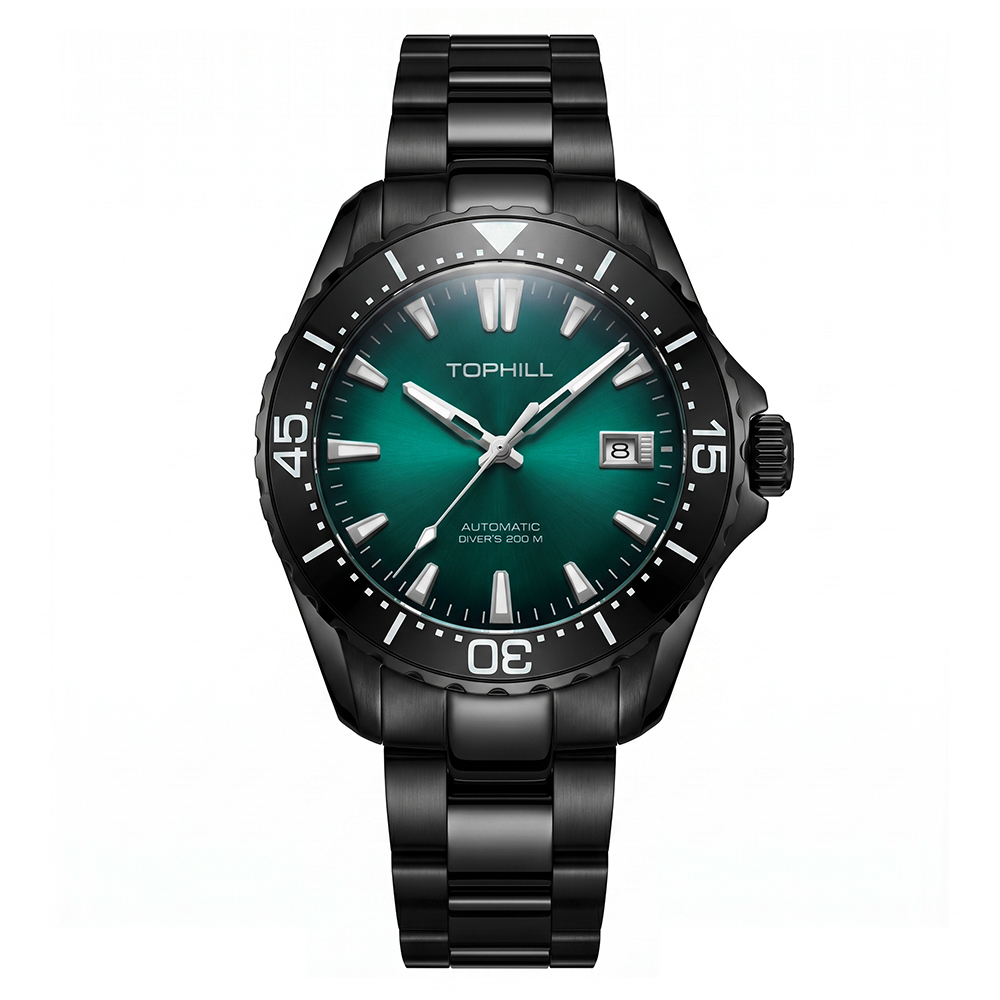
Quartz dress watches and automatic divers sit at opposite ends of the same rating scale. On the current TOPHILL platform, quartz models such as the TR001, TAM001 and TAM002 are rated to 3ATM, while automatic dive models such as the TD017G are rated to 10ATM and the TD015G to 200 metres. The distance between those figures is not a quality ranking. It describes which wear scenarios the case, gasket set, crown, crystal and caseback were engineered to survive.
The distinction matters most during the research stage of a sourcing project, when a brand owner or distributor is drafting a specification sheet that will later become a product listing, a warranty policy and an after-sales script. Aligning movement and rating with the real end-use scenario is what keeps those downstream documents consistent — and what keeps a 3ATM dress line from being marketed as a swimming watch.
The Problem: Three Assumptions That Cost Buyers Money
Most specification errors in custom wristwatch procurement trace back to three assumptions.
- "Waterproof" is a usable product claim. It is not. Under ISO 22810:2010, the term "waterproof" is prohibited for water-resistant watches; the correct language is a water resistance rating expressed in ATM or metres and tested under defined laboratory conditions.
- ATM equals usable depth. ATM is a static laboratory pressure value. One ATM is equivalent to 10 metres of static water depth, which is not the same as recommending use at that depth.
- Movement and rating are one choice. A mechanical watch can be rated at 5ATM, as with the KIM001, KIM002 and KIM003 platforms, and a quartz watch can carry a sapphire crystal, a 316L stainless steel case and a sealed caseback. The two lines are specified separately.
There is also a regulatory overlay that many briefs miss. RoHS compliance under Directive 2011/65/EU is mandatory for electronic watches — quartz and smart — placed on the EU market. That makes the movement family a compliance question as well as a functional one, and it is one reason quartz programs need their documentation prepared earlier than buyers expect.
Where the Supplier Sits in This Question
DONGGUAN SUPERTIME CO., LTD. is a watch manufacturer established in 2022 and formerly known as Shenzhen Zhuoyueshi Industrial Co., Ltd., which completed a full-plant relocation to Dongguan in 2024. The company specializes in custom OEM and ODM watch projects and operates its proprietary watch brand TOPHILL. Its main products are customized watches, quartz watches, automatic watches and chronograph watches.
Its manufacturing facility covers 1,500 square metres and employs approximately 80 staff, including an R&D team of 4 designers and 3 engineers. Annual production capacity is 400,000 units, and the company states it has manufactured more than 20 million finished watches to date. It is certified to ISO 9001 and ISO 14001, and states that its finished products fully meet EU RoHS compliance standards for overseas market access. Exports to the EU and the United States account for 80% of total sales.
On the specific question of water resistance, the company's technical documentation states support for 5–50 ATM ratings and confirms that every waterproof watch undergoes a 100% water pressure test before shipment rather than random sampling. Testing runs on dedicated equipment, including a water resistance testing machine, a movement stem cutting machine, an automatic movement accuracy testing machine, a strap tension-torsion testing machine, a dial index inspection machine and a dropping test machine.
What 3ATM and 10ATM Actually Measure
Water resistance is achieved mainly by elastic sealing gaskets fitted at the gaps of the caseback, crystal, crown and pushers. Screw-down structures at the crown and caseback, combined with precise case machining, create the seal against water ingress. Performance is then tested and certified according to international standards: ISO 22810 for general water-resistant watches and ISO 6425 for diver watches.
Against that framework, the ratings used in a custom watch brief map to defined environments:
| Rating band | Engineering meaning | Suitable environment |
|---|---|---|
| 3–5ATM | Static laboratory pressure with standard gasket sealing | Daily wear, hand-washing, rain splash |
| 10–20ATM | Reinforced sealing plus screw-down structures | Swimming and surface snorkeling |
| ≥20ATM (ISO 6425) | Diver watch standard including dynamic pressure and salt-water corrosion testing | Professional diving |
Grade guidance is a specification aid, not a usage guarantee. No matter which band is selected, water resistance is not permanent; gaskets age over time.
Quartz at 3ATM: the Dress, Gift and Retail Platform
Three quartz references show how a 3ATM rating is normally built. The TR001 is a custom quartz wristwatch configured for corporate promotional gift use, with a 316L stainless steel case set with zircon stones, a snap caseback, a flat sapphire crystal, a glossy dial with printed markers and a Japan quartz movement, offered with a 316L stainless steel bracelet with butterfly buckle or a genuine leather strap with pin buckle.
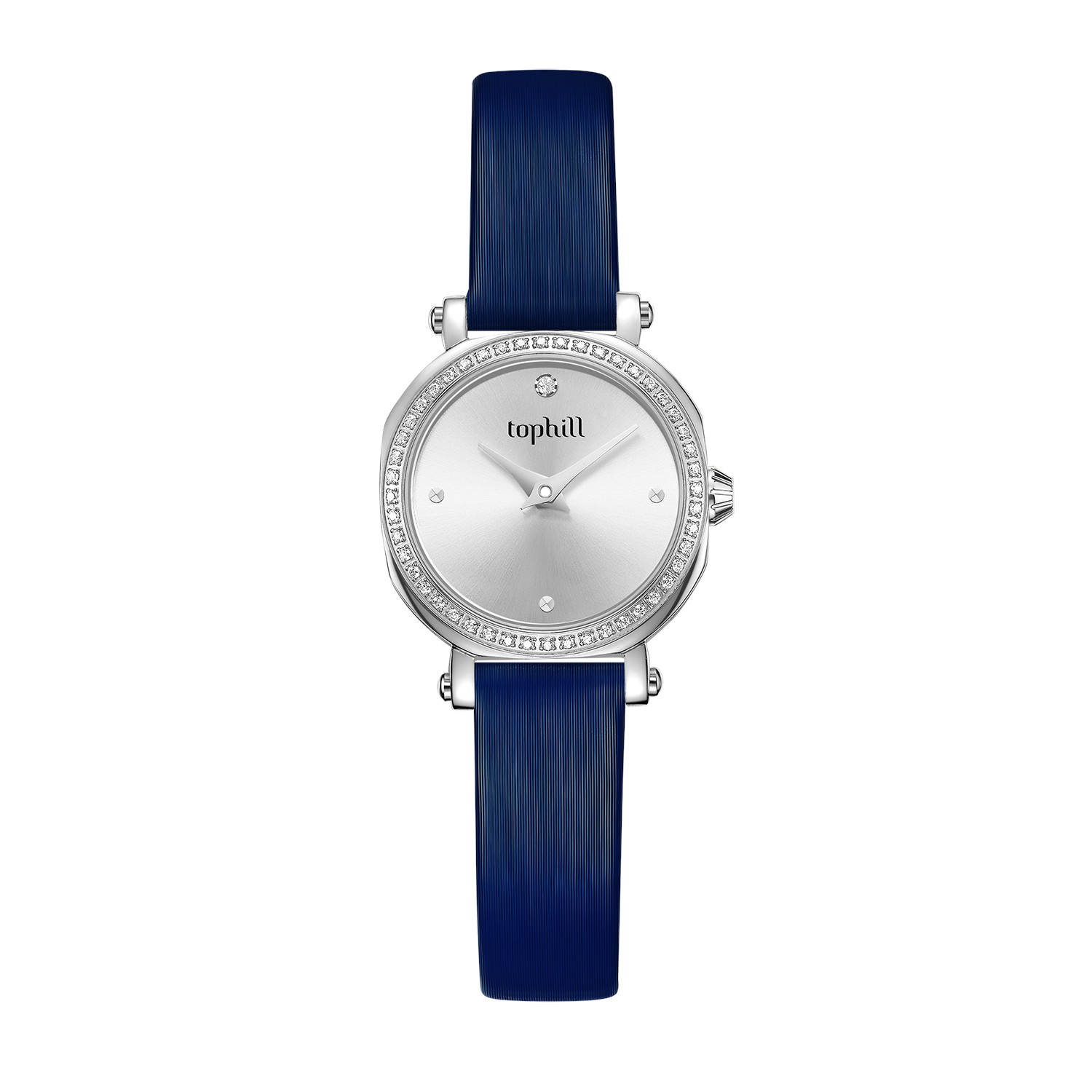
The TAM001 is a lady elegant quartz wristwatch running on a Miyota Quartz movement at 3ATM, with a 316L stainless steel case set with zircon stones, a sunburst dial with applied indexes, a flat sapphire crystal, and a choice of a stainless steel bracelet with jewelry buckle or a genuine leather strap. The TAM002 uses a Ronda quartz movement at the same 3ATM rating, with a 316L stainless steel case and bracelet with butterfly buckle and a sunburst dial with applied indexes.
All three belong to the quartz watch, lady watch, battery watch and elegant watch categories and are positioned for fashion accessories, jewelry and ornaments, premium gifts, corporate promotional gifts and retail consumer goods. In a 3ATM program, the sapphire crystal and 316L case protect against scratches, corrosion and daily moisture — they do not extend the rating.
Automatic at 10ATM and Above: the Diver Platform
The TD017G is where the threshold moves. It is classified as an automatic watch and a diving watch, built on a 316L stainless steel case with a rotating bezel and a ceramic bezel insert with luminous markings, rated to 10ATM, with a boxed crystal, an embossed dial with applied indexes in gradual colours, luminous hands and a 316L stainless steel solid bracelet with solid turtle buckle. Its movement is the Miyota Automatic 8215.
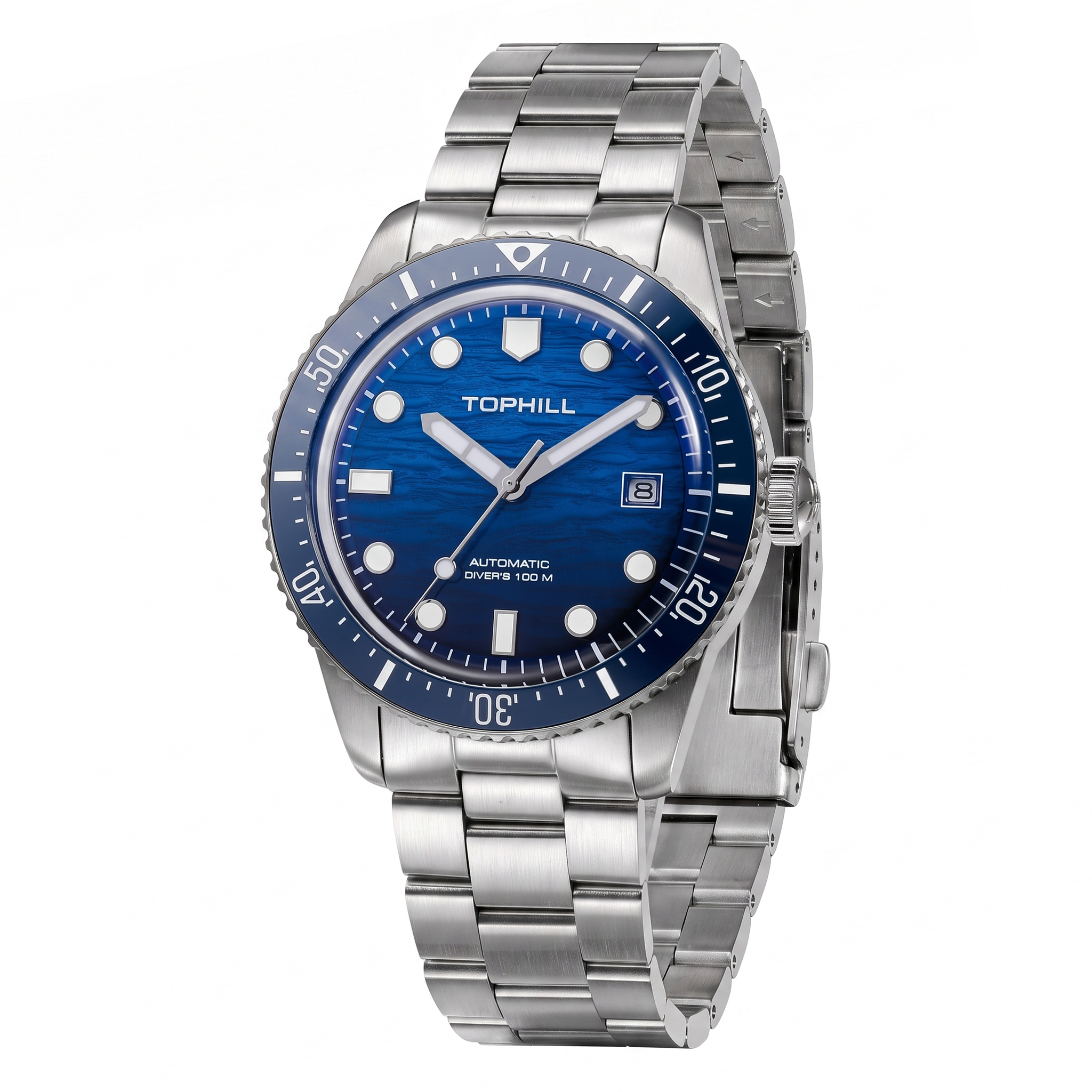
Above that sits the TD015G, a stainless steel 200-metre diving watch, also powered by the Japan Miyota Automatic 8215, with a rotating bezel and ceramic bezel insert using BGW9 luminous material, a flat sapphire crystal, a sunburst dial with applied indexes using BGW9 luminous, and a 316L solid bracelet with solid extension buckle. Typical application scenarios for this class of product include everyday wear and water-related activities, and the diver-style case is designed to suit both work and casual wear.
The material point for buyers: the change from 3ATM to 10ATM is not delivered by the movement. It is delivered by the case architecture, the crown and caseback construction, the crystal seating and the gasket system — all specified at tooling stage and expensive to change later.
Miyota Quartz or Miyota Automatic 8215: a Decision Rule
| Decision criterion | Miyota Quartz (e.g. TAM001) | Miyota Automatic 8215 (e.g. TD017G / TD015G) |
|---|---|---|
| Power source | Button battery | Mainspring energy, wound by wrist movement via an automatic rotor |
| Rating in the current catalog | 3ATM | 10ATM (TD017G); 200 metres (TD015G) |
| Case package typically paired with it | 316L case with set zircon stones, snap or standard caseback, flat sapphire crystal | 316L case with rotating bezel, ceramic bezel insert with luminous, see-through solid caseback |
| Best-fit scenario | Office, formal, gifting, retail dress lines | Dive-style daily wear, swimming, surface water sports |
| Compliance note | RoHS Directive 2011/65/EU is mandatory for electronic (quartz and smart) watches in the EU | Finished products must still meet the buyer's declared market requirements, including EU RoHS where applicable |
| Maintenance profile | Battery replacement and gasket inspection | Periodic mechanical service and gasket inspection |
The practical rule is this: specify Miyota quartz when the product's value proposition is appearance, gifting and volume retail, and the end user's water exposure stops at rain and hand-washing. Specify the Miyota Automatic 8215 when the product must carry a diver identity, when the rating has to reach 10ATM or beyond, and when the case architecture already supports a rotating bezel and screw-down sealing.
How Water Resistance Is Verified Before Shipment
Verification is a production step, not a marketing statement. The company performs water pressure testing on 100% of waterproof watches before shipment rather than relying on random sampling, using a documented five-step sequence:
- Visual check of case, crown, gasket and crystal before testing.
- Loading the watch and applying the target water pressure with a pressure hold.
- Monitoring for air leakage during pressurisation.
- Slow pressure release and full surface drying.
- Final inspection for internal moisture or water ingress.
Documented safety note: passing a laboratory water pressure test does not equal permanent waterproof performance. Gaskets age under daily wear, and that ageing is the customer's most common source of disappointment if the warranty language ignores it.
Market Context: Volume Follows Quartz, Value Follows Mechanical
The dual-platform approach in this catalog reflects broader market structure. Quartz movements dominate global shipment volume with a 75% share, while mechanical watches contribute over 68% of total market value despite lower unit volume. The 3ATM quartz platform and the 10ATM automatic platform are therefore not competing for the same purchase — they serve different commercial logics, one built on unit volume and one on perceived mechanical value.
Movement supply reflects the same balance. The global watch movement market reached USD 18.4 billion in 2025, with automatic movements holding a 38.2% share. Grand View Research projected the global mechanical watch market to reach USD 47.5 billion by 2025. For OEM buyers, the implication is that both movement families will continue to be stocked and supported, and that specification literacy — knowing which rating band a scenario actually requires — remains more valuable than brand preference alone.
Limits and Trade-offs: Where a Higher ATM Does Not Help
- ATM is static; use is dynamic. A 10ATM rating describes static laboratory pressure. It does not certify behaviour under high-speed water impact or at depth.
- Water resistance degrades. Gaskets age with wear, impact and chemical contact. Any rating is a condition at test, not a permanent property.
- Heat is harder on seals than depth. Sauna and hot-water bathing are not recommended, because high-temperature steam deforms and ages rubber gaskets and destroys water resistance.
- 3ATM has a hard ceiling. Quartz dress platforms at 3ATM suit daily wear, hand-washing and rain splash; they are not swimming watches.
- 10ATM is not professional diving. The ≥20ATM band, aligned with ISO 6425, is where the full diver-watch standard — including dynamic pressure and salt-water corrosion testing — applies.
- Compliance scope differs by movement. RoHS obligations fall mandatorily on electronic watches in the EU market, which places additional documentation demands on quartz programs specifically.
Future Outlook
Three directions look durable. First, rating transparency: as ISO 22810 marking discipline tightens and "waterproof" stays prohibited in product copy, buyers will increasingly expect the test method — 100% unit testing versus sampling — to be stated in the supplier's documentation rather than implied. Second, dual-platform catalogs: with quartz holding 75% of shipment volume and mechanical holding over 68% of value, suppliers able to run both a 3ATM dress line and a 10ATM diver line on the same quality system will be better positioned than single-platform specialists. Third, movement-tier specification: as automatic movements reach a 38.2% share of a USD 18.4 billion movement market, the buyer's question shifts from "quartz or mechanical?" to "which movement, in which case, at which rating?" — which is precisely what this FAQ set set out to answer.
FAQ: Movement Type and Water Resistance Thresholds
What does a 3ATM rating allow a custom quartz wristwatch to do?
A 3ATM rating covers daily wear, hand-washing and rain splash. In the supplier's grade guidance, 3–5ATM is the daily-wear band, and 3ATM quartz references such as the TR001, TAM001 and TAM002 are configured for fashion, gifting and retail scenarios rather than swimming. The figure reflects static laboratory pressure, where 1 ATM is equivalent to 10 metres of static water depth.
When should a buyer specify a Miyota quartz movement instead of a Miyota Automatic 8215?
Specify the Miyota Quartz movement, as used in the TAM001, when the product is a dress or gift line where appearance, low-maintenance ownership and volume retail relevance are the priorities, and water exposure is limited to daily-use conditions at 3ATM. Specify the Miyota Automatic 8215, as used in the TD017G at 10ATM and the TD015G at 200 metres, when the product must carry a diver identity and the case architecture supports a rotating bezel, luminous bezel insert and screw-down sealing.
Is a 10ATM automatic diver suitable for diving?
A 10ATM rating sits in the swimming and surface snorkeling band, which the supplier's guidance places at 10–20ATM. Professional diving is associated with the ≥20ATM band and the ISO 6425 diver watch standard, which includes dynamic pressure and salt-water corrosion testing. Buyers should therefore treat 10ATM as a water-sports rating rather than a dive certification, and move to a 200-metre platform such as the TD015G where the use case requires more.
How is water resistance verified before a custom watch order ships?
Every waterproof watch in this production system goes through a 100% water pressure test before shipment, not random sampling. The documented sequence is: a visual check of case, crown, gasket and crystal; pressurisation to the target value with a pressure hold; monitoring for air leakage; slow pressure release and full drying; and a final inspection for internal moisture or water ingress. Testing is performed on dedicated water resistance testing equipment.
Does water resistance last for the life of the watch?
No. Water resistance is not permanent, and gasket ageing occurs over time. The most common failure symptoms are fog or condensation under the crystal, visible water droplets inside the case, rust or oxidation on movement and internal metal parts, unstable timekeeping, and rust at the caseback, crown or pusher joints. Sauna and hot-water bathing are not recommended, because high-temperature steam deforms and ages rubber gaskets.
Does movement type change compliance requirements for EU-bound orders?
Yes, in one specific respect: RoHS compliance under Directive 2011/65/EU is mandatory for electronic watches — quartz and smart — placed on the EU market. Water-resistant watches must also comply with ISO 22810:2010, under which the term "waterproof" is prohibited. The manufacturer referenced here states that its finished products fully meet EU RoHS compliance standards and that it is certified to ISO 9001 and ISO 14001.
Reference: the full capability and specification profile covering movements, water resistance testing and OEM/ODM project scope is available in the company profile document.