
OEM Fit for Private Label Cookware in Compact Serviced Apartments
OEM Fit for Private Label Cookware in Compact Serviced Apartments
Compact serviced-apartment kitchens turn private label cookware sets into an interface problem before they become a branding problem. The set has to work with the built-in gas cooktop, the hood above it, the dishwasher below or beside the counter, the sink used for prep and washing, and the storage space left after housekeeping supplies are accounted for. A buyer who starts with a logo and a piece count can miss the constraints that decide whether the set is usable in the room.
Category data explains why the brief deserves attention, but it does not decide fit. Grand View Research valued the global cookware market at USD 32.4 billion in 2025 and reported stainless steel as the largest material segment at 33.9% share. The same source placed Asia Pacific at 38.1% of 2025 cookware revenue, with China the largest contributor. Those are market-level figures. They support category relevance; they do not show that a particular cookware set suits a compact apartment or a particular equipment package.
AurumDine, a Shanghai-based kitchen-products company with the website www.aurumkitchen.com, lists cookware sets among its main products, along with kitchen appliances and drinkware. Its published profile also lists a 30,000 m² facility, 120 employees, an annual output of 150,000 units, a 25-engineer R&D team and an 80% export share concentrated on the EU and USA. The brand term used in this guide is aurumkitchen Cookware Sets, the cookware-set line associated with that company profile. The guide uses the supplied first-party record and verified third-party data to show how an OEM brief can be organised around the room, not around a generic catalogue page.
Why compact serviced-apartment kitchens need a different OEM brief
Serviced apartments compress several functions into a small footprint: short-stay cooking, rapid turnover cleaning, storage for multi-piece sets and housekeeping access. The supplied application scenario describes a residential kitchen environment indoors at normal ambient temperature and lists kitchen fit-out or renovation, kitchen retail or private-label sourcing as project types. It also lists a 24/7 operation mode, then adds a qualification that matters: the rated duty cycle must be verified, and household appliances must not be assumed suitable for 24/7 commercial operation.
That qualification should sit beside the cookware brief, not in a separate facilities document. A serviced apartment may be occupied around the clock, but the equipment package still has to be checked against its actual duty rating, cleaning cycle and replacement plan. A cookware set that is acceptable in a show kitchen can fail the operating model if the pieces are too tall for the hood clearance, too wide for the sink bowl, too heavy for housekeeping handling or incompatible with the dishwasher programme selected for the building.
The practical starting point is a room-level equipment list: gas cooktop, hood type, dishwasher type, sink model, available power outlets and storage dimensions. The cookware set should then be briefed against that list. The objective is not to add more pieces. It is to define a set that supports the cooking tasks the apartment actually offers, while leaving enough clearance and storage for housekeeping.
Mapping the set to cooking and extraction equipment
The cooking zone is where cookware and building equipment meet most directly. The supplied application data requires gas type and pressure verification for gas cooktops and lists compatible gas supply and pan supports among the matched equipment. A buyer should therefore confirm the gas type and pressure before approving pan bases, handles or piece dimensions. A set that is otherwise suitable can become unsuitable if the pan support geometry or burner spacing does not carry the pieces safely.
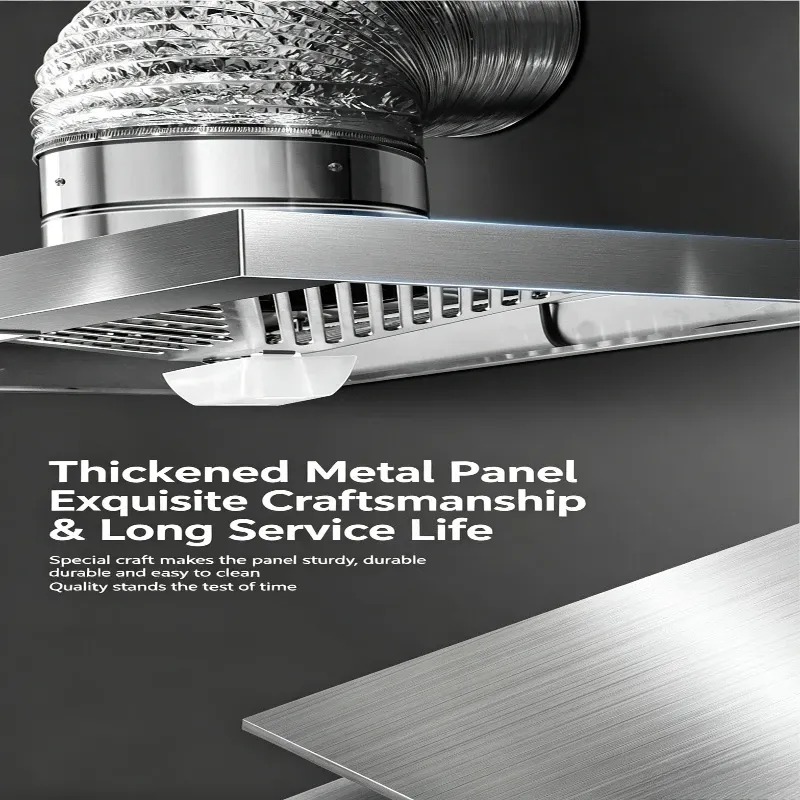
Extraction equipment sets a vertical constraint that the cookware brief has to respect.
The hood above the cooktop adds a vertical constraint. The Smart Wall Mount Range Hood record lists a body size of 75 × 46.5 × 43.5 cm, airflow of 900 CFM through a 6 in duct, gesture and voice control and dishwasher-safe baffle filters. The Under Cabinet Range Hood record lists a 600 × 400 mm / 24 × 16 in stainless steel body, ducted operation, two mechanical speeds and five duct sizes from 6 to 12 inches. These are equipment facts. For the cookware brief, the relevant question is clearance: how tall is the tallest stockpot with its lid, and will it sit safely under the installed hood without blocking the extraction path?
The Portable Desktop Range Hood is a different use case. The supplied record describes a USB-powered unit with cable included, three fan speeds, tripod or lanyard mounting and a replaceable filter screen, intended for hot pot and tabletop BBQ. It can be relevant where the apartment offers a tabletop cooking appliance, but it should not be treated as a substitute for a ducted hood. The supplied range-hood guidance also notes that portable recirculating units require adequate room ventilation. The OEM brief should state whether the portable hood is a supplementary appliance or the primary extraction method, because that changes the cookware and ventilation assumptions.
| Equipment or product | Verified detail | OEM brief question |
|---|---|---|
| Built-in gas cooktop | Application data requires gas type and pressure verification and lists compatible gas supply and pan supports as matched equipment. | What gas type and pressure does the apartment have, and does the pan support geometry suit the proposed pieces? |
| Smart Wall Mount Range Hood | 75 × 46.5 × 43.5 cm body; 900 CFM through a 6 in duct; gesture and voice control; dishwasher-safe baffle filters. | Is the wall and duct route compatible, and what vertical clearance does the tallest cookware piece need? |
| Under Cabinet Range Hood | 600 × 400 mm / 24 × 16 in stainless steel body; ducted; two mechanical speeds; five duct sizes from 6 to 12 inches. | Does cabinet depth and duct size allow the hood, and will tall pots or lids fit below? |
| Portable Desktop Range Hood | USB powered, cable included; three fan speeds; tripod or lanyard mounting; replaceable filter screen; intended for hot pot and tabletop BBQ. | Is it a supplementary tabletop unit with adequate room ventilation rather than a ducted replacement? |
| Built-In Dishwasher | 24 in / 60 cm cabinet width; six wash programs; dual spray arms; hot-air drying. | Do the cookware care instructions and the building water/drain arrangement support the intended use? |
| Workstation Kitchen Sink | 75 × 46 cm / 29.5 × 18.1 in; black nano stainless steel honeycomb finish; waterfall and rain outlets; cup washer; pull-down faucet; chopping board and basin. | Does the prep workflow need fitted accessories, and does the largest pot fit the basin for washing? |
| Multifunctional Food Cutter | Food-grade stainless steel; 7 cm conveyor belt; dual speed control; safety switch; voltage builds 110 V/60 Hz, 220 V/50 Hz, 240 V/50 Hz and 220–240 V/50–60 Hz. | Which voltage, frequency and plug are required, and what prep volume is realistic in the apartment? |
Sink, dishwasher and small-space prep: the hidden interfaces
The sink is often the first appliance to reveal whether a cookware set fits the room. The Workstation Kitchen Sink record lists a 75 × 46 cm / 29.5 × 18.1 in layout with a black nano stainless steel honeycomb finish, waterfall and rain outlets, a cup washer, a pull-down faucet, a chopping board and a basin. For an OEM cookware brief, the sink matters because washing and prep share the same small area. A large stockpot or a wide sauté pan that fits the cabinet may still be awkward to wash if it cannot sit securely in the basin or be moved around the faucet.
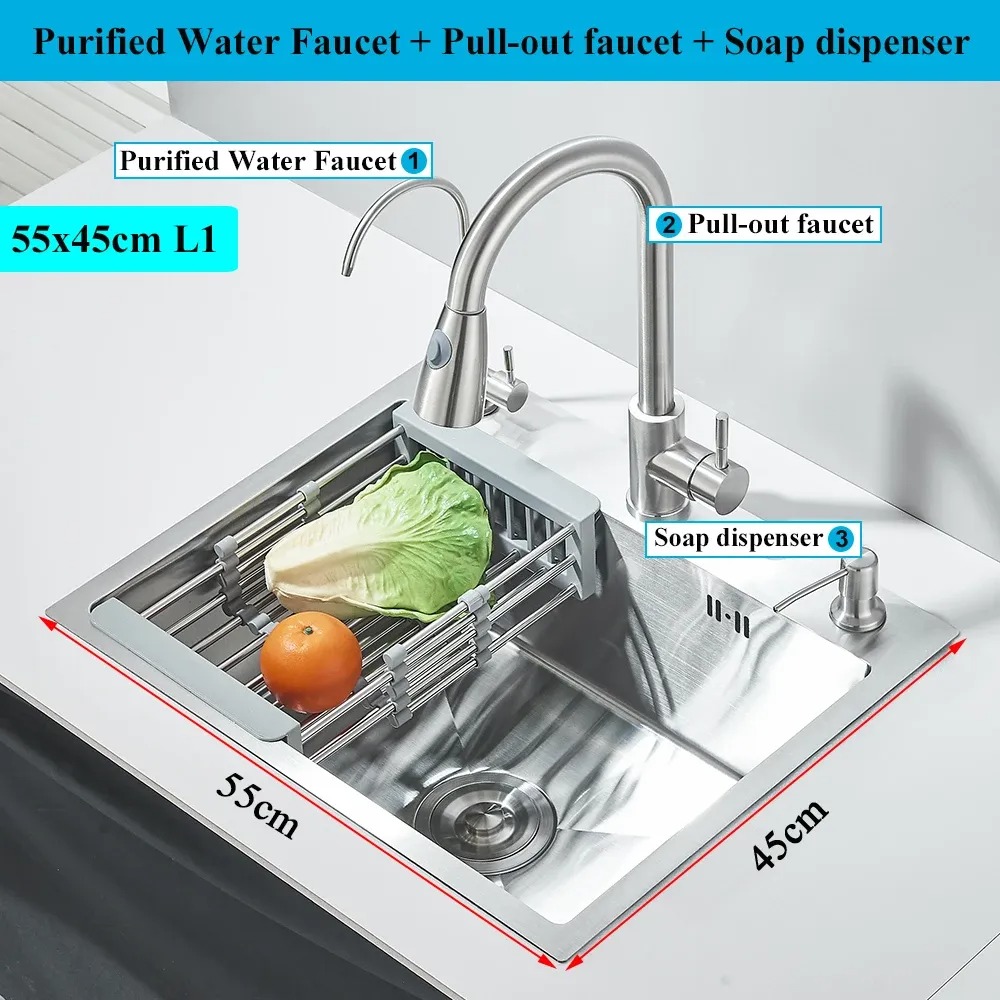
A compact kitchen workflow depends on the sink, cooktop, hood and storage working together; the cookware set is one part of the interface.
The dishwasher creates a different question. The Built-In Dishwasher record lists a 24 in / 60 cm cabinet width, six wash programs, dual spray arms and hot-air drying. The application data requires the buyer to confirm water supply and drain connections or a refillable tank arrangement, as applicable. It does not establish that a given cookware set is dishwasher safe. Dishwasher compatibility has to be confirmed through the supplier's care instructions and the buyer's own validation plan. A brand claim, a stock photo or a generic material description is not enough when the apartment's housekeeping routine depends on machine washing.
Small-space prep also affects the piece count. The Multifunctional Food Cutter record describes a food-grade stainless steel unit with a 7 cm conveyor belt, dual speed control and a safety switch, available in 110 V/60 Hz, 220 V/50 Hz, 240 V/50 Hz and 220–240 V/50–60 Hz builds. In a compact apartment, that type of prep appliance can reduce the need for several manual tools, but the OEM brief still has to confirm voltage, frequency, plug type, cleaning access and storage. The related Commercial Vegetable Dicer appears in the application list, but the supplied product record does not provide its capacity or voltage data; those details must be confirmed separately before it is included in a project package.
The combined workflow is more useful than a list of individual products. A small kitchen may need one pot for boiling, one pan for searing, a lid that doubles across pieces, a bowl or board that fits the sink, and a prep appliance that can be stored between uses. The buyer should map each piece to a task and a storage position. If a piece has no clear task, it adds handling and replacement cost without improving the apartment's cooking capability.
Materials, construction and the compliance chain
Stainless steel's 33.9% share of the 2025 cookware market is a category signal, not a specification. Buyers may brief stainless steel, nonstick or ceramic options, but the supplied evidence pack for this article does not contain model-specific material grades, coating systems, thicknesses, induction test results or dishwasher test reports for AurumDine cookware. Those details must be confirmed for the selected set. A broad material preference should never be allowed to stand in for a signed specification.
The EU compliance chain illustrates why the brief has to be document-led. Regulation (EC) No 1935/2004 applies to food-contact materials placed on the EU market, including kitchenware and tableware. Commission Regulation (EC) No 2023/2006 requires food-contact materials to be manufactured under good manufacturing practices. The EU framework also requires traceability measures so that recall or public information remains possible, and it requires materials not to transfer constituents to food at levels harmful to health or cause unacceptable changes in food composition, taste or odour. These are framework requirements; they do not prove that a particular supplier or cookware set complies.
Product-specific migration testing, coating-specific evidence and current amendment checks remain necessary. The verified data also does not cover United States, United Kingdom, Canada or Australia food-contact requirements for cookware, so a buyer targeting those markets must obtain the applicable requirements and model-specific documents. Stainless steel kitchenware is classified under HS 7323.93.00, which includes pots, pans and teakettles, but a customs classification is not a compliance certificate. AurumDine's profile states that food-contact materials can be documented for the buyer's market. That is a company statement about documentation intent; the buyer should still request the actual documents for the selected material, coating, market and production batch.
OEM brief checkpoints before sample approval
An OEM brief for private label cookware sets should be specific enough to be checked, not so broad that it invites interpretation. The buyer should list the piece count and dimensions, material and construction, base and handle design, lid fit, intended cooking tasks, cleaning instructions, packaging, logo application, target market and required documents. If the package includes appliances such as the Multifunctional Food Cutter, the brief should also state voltage, frequency, plug type, safety features and replacement-part expectations.
AurumDine's capability record lists OEM production, voltage and logo customisation, a monthly capacity of 8,000 units, a 30-day lead time, MOQ from 2 units, 100% testing, global export markets and remote after-sales support. Those figures are useful for planning, but the buyer should confirm which terms apply to the specific multi-piece private label set, which decoration methods are available and what the sample and production schedules actually are. The MOQ figure in particular should be clarified for stock items, samples and full custom runs rather than assumed to cover every configuration.
Sample approval is the control point between the brief and production. The approved pre-production sample should establish the visible finish, dimensions, handle positions, lid fit, logo placement, packaging and any agreed markings. The buyer should record what will be measured and what will be checked by hand. The capability record's 100% testing claim is also a prompt for definition: the buyer should ask what is tested, at what stage, against which acceptance criteria and with what record. In-process and pre-shipment inspection should compare production against the approved sample, not against a catalogue image or a verbal description.
Stock sets versus an OEM fit brief
A stock cookware set can be faster to evaluate when an existing specification already fits the apartment's equipment and storage. Its limitation is that the buyer accepts the available piece mix, dimensions, branding and packaging. An OEM private label brief gives more control over set composition, logo, packaging and market positioning, but it adds sample approval, compliance documentation and inspection work. Neither route removes the gas, hood, sink, dishwasher and storage constraints.
The trade-off is therefore not simply custom versus standard. It is fit versus speed. A buyer with a compact serviced-apartment project should first decide which interfaces are fixed by the building and which can still be influenced by the cookware brief. If the hood clearance and sink bowl are fixed, the set must be designed around them. If the equipment package is still being selected, the cookware brief can feed into that decision. In either case, a private label claim should not be treated as evidence of durability, food-contact compliance or suitability for 24/7 commercial operation.
Project reference and a conditional 20-unit planning example
A supplied project reference describes a 20-unit residential kitchen application with one year of stable operation, citing OEM service and kitchen equipment performance as highlights. That reference supports the existence of a small-batch OEM kitchen project. It is not a controlled test of cookware performance, and it should not be generalised to every serviced apartment.
For an illustrative 20-unit serviced-apartment package, a buyer could use the reference as a planning prompt rather than as proof. The brief would list the room layout, gas type and pressure, hood model and clearance, dishwasher width and programme, sink dimensions, available power, storage volume and housekeeping routine. The cookware matrix would then show which pieces are used for boiling, searing, serving and washing, and which pieces can share lids or storage space. The buyer would approve a pre-production sample, define in-process and pre-shipment checks, and require model-specific documents for the destination market. That sequence keeps the project conditional on verified inputs rather than on an assumption that a cookware set will fit because it is described as suitable for modern kitchens.
Future outlook without an invented forecast
The verified data does not supply a forecast for private-label cookware sets specifically, so this article does not invent one. The useful planning signal is broader: private label sales in the United States reached USD 270.6 billion across all categories in 2024, and store brands were reported as gaining momentum in general merchandise including kitchenware. That supports attention to private-label capability, but it does not prove demand for a particular set or market.
The practical outlook is document-led. EU food-contact rules, traceability expectations, product-specific testing and target-market checks will remain part of the buyer's qualification file. Equipment fit will remain part of the OEM brief. A supplier that can discuss capacity, lead time and testing is useful; a supplier that can also connect those claims to a specific cookware specification, sample record and market document set is more useful to a serviced-apartment project. The next step for a buyer is not a larger catalogue request. It is a tighter brief with fewer assumptions.
FAQ
How should a buyer specify private label cookware sets for a compact serviced-apartment kitchen?
A buyer should start from the room-level equipment list: the built-in gas cooktop and its gas type and pressure, the hood type and clearance, the dishwasher width and programme, the sink dimensions and the available storage. The cookware brief should then define piece count, dimensions, material and construction, cleaning instructions, logo and packaging. The brief should remain conditional until the sample and the destination-market documents are approved.
Which equipment interfaces should be checked before OEM production?
Check the gas type and pressure for a gas cooktop, the hood dimensions and duct route, the vertical clearance for the tallest pot with its lid, the dishwasher cabinet width and water arrangement, and the sink basin size for washing. Where a portable range hood is used, confirm that it is a supplementary tabletop unit with adequate room ventilation rather than a replacement for ducted extraction. Also confirm voltage, frequency and plug type for any powered prep appliance.
What food-contact evidence should be requested for cookware sold in the EU?
For the EU, the framework includes Regulation (EC) No 1935/2004 for food-contact materials, Commission Regulation (EC) No 2023/2006 for good manufacturing practices, traceability measures and the requirement that materials not transfer constituents to food at levels harmful to health or cause unacceptable changes in food composition, taste or odour. A buyer should request model-specific documents, product-specific test evidence where applicable and a check of the current amendment status. These framework rules do not by themselves prove that a particular supplier or set complies.
Can household appliances in a serviced apartment be treated as 24/7 commercial equipment?
No. The supplied application scenario lists a 24/7 operation mode but also requires verification of the rated duty cycle, and it states that household appliances must not be assumed suitable for 24/7 commercial operation. A serviced-apartment project should check the actual duty rating, cleaning cycle, replacement plan and warranty conditions for each appliance rather than inferring commercial suitability from round-the-clock occupancy.
How should samples and inspections be planned for an OEM cookware set?
The buyer should approve a pre-production sample that fixes dimensions, finish, handle and lid fit, logo placement and packaging. The approved sample then becomes the reference for in-process and pre-shipment inspection. The buyer should also define what the supplier means by testing, including the stage, acceptance criteria and records. For a multi-piece set, the inspection plan should cover every piece, the packaging combination and the agreed documents before shipment.
Tem questões ou precisa de mais detalhes?
Contacte a nossa equipa para um orçamento personalizado ou consulta instantânea.
Solicitar orçamento
Preencha o formulário abaixo e a nossa equipa entrará em contacto com uma proposta personalizada.
Chat direto do WhatsApp
Prefere conversar em tempo real? Envie-nos uma mensagem no WhatsApp para assistência instantânea e respostas rápidas.
- Obter orçamento personalizado
- Partilhar fotos ou documentos
- Discuta as suas necessidades diretamente
Geralmente responde em 5–30 minutos durante o horário de expediente.