
OEM Insulating Glass Materials: A Buyer's Verification Guide
OEM Insulating Glass Materials: A Buyer's Verification Guide
Insulating glass materials determine whether a sealed unit stays dry, sealed and thermally stable for decades, or fails quietly in year eight. As more fabricators buy spacer bars, sealants and desiccants as OEM/ODM programs rather than as catalogue items, the questions a buyer must ask change substantially.
An insulating glass unit (IGU) consists of two or more glass panes separated by a spacer and edge-sealed to form an insulating air- or gas-filled cavity. Every material around that cavity — aluminium spacer bars, warm-edge spacers, primary and secondary sealants, molecular sieve desiccant, connectors and decorative bars — exists to protect it. The global insulated glass market was valued at USD 92.7 billion in 2024 and is projected to reach USD 121.7 billion by 2030, according to Grand View Research. That volume growth is matched by a quieter shift: components are increasingly specified, customised and documented rather than simply ordered by size.
Why These Components Are Procurement-Risk Decisions, Not Commodities
The spacer bar holds the glass panes at a fixed distance from each other, establishing the size of the interpane space. That function is deceptively simple. In practice, the spacer also carries the desiccant, contributes to the edge seal geometry, and sets the thermal bridge at the perimeter of the unit.Desiccants used in insulating glass units are commonly molecular sieves or blends of silica gel with molecular sieves. Their purpose is to adsorb residual water and solvent vapour inside the sealed space and keep humidity low for the life of the unit. If desiccant capacity, sealant integrity or spacer geometry is misjudged, the failure mode does not appear at delivery. It appears as fogging, dew-point failure or gas loss, months or years later.
European standard EN 1279-2 expresses this as a measurable pass criterion: an average moisture penetration index Iav of 0.20 or lower for five aged specimens, with an individual specimen value of 0.25 or lower. Under ASTM C1249-18, structural silicone glazing systems are described as requiring a dual-seal construction: polyisobutylene (PIB) as the primary seal and silicone as the secondary seal. Technical literature from Cardinal similarly describes IGUs built around a PIB primary seal and a silicone secondary seal.
Procurement implication: the buyer is not purchasing a length of aluminium or a drum of sealant. The buyer is purchasing a qualified combination — spacer profile, desiccant grade, sealant chemistry and processing conditions that have to work together under a moisture-penetration and durability regime.
What OEM/ODM Capability Actually Covers
Soleron Building Materials (Hebei) Co., Ltd. is a manufacturer of insulating glass components and building materials based in Renqiu, Hebei Province, an industrial city adjacent to Beijing and Tianjin. The company supplies a complete range of critical materials for IGU production: aluminium spacers, warm-edge spacers, sealants, molecular sieves and related accessories, positioning itself as a one-stop supply source for insulating glass processors.
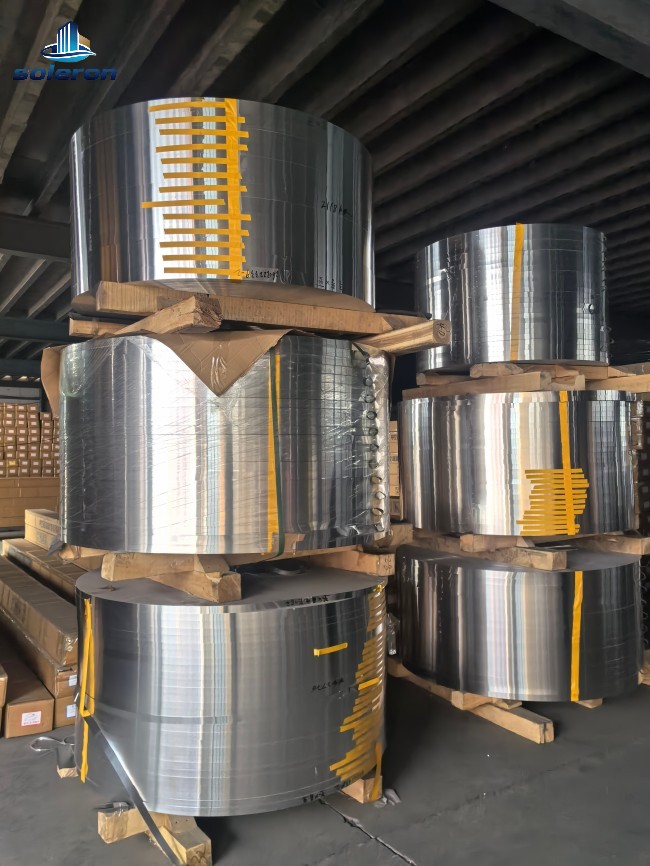
For aluminium spacer bars specifically, Soleron provides OEM and ODM production services. OEM services are available for custom aluminium spacer bar production, while ODM services cover aluminium spacer bar design and production. For OEM/ODM orders, the manufacturer supports customisation of logo, size and packaging. Production equipment includes dedicated aluminium spacer bar production lines.
Manufacturing and commercial parameters are stated as follows: monthly production capacity of 500 tons, standard delivery time of 20 to 45 days, a minimum order quantity of 5 cartons, random inspection as the quality-control method, and remote after-sales support. The company operates 10 automatic aluminium spacer bar production lines, 8 semi-automatic production lines and 10 warm edge spacer production lines, and keeps more than 100 pieces of regular aluminium spacer bars and warm-edge spacers in stock to shorten delivery time for urgent orders.
Product families and stated parameters
| Material family | Model / size range | Stated parameters |
|---|---|---|
| Aluminium spacer bar | 5.5–50A (5.5–50 mm) | Thickness 0.16–0.35 mm; length 5 m or customised; 3003 and 1100 series aluminium coil; 5-year quality guarantee; standard, bendable, black, embossed and butyled variants |
| Warm edge spacer bar | 6–27A | Fibreglass, composite (plastic + stainless steel), PP and flexible warm-edge types; length 5 m or customised; 5-year quality guarantee |
| Sealant | SOL-803, SOL-717 | Butyl sealant, hot-melt sealant and two-component silicone sealant; black and white; 28 kg, 30 kg and 330 kg packaging; 10-year quality guarantee |
| 3A molecular sieve | 0.5–0.9 mm, 1.0–1.5 mm, 1.5–2.0 mm | Synthetic zeolite; brown; vacuum pack plus carton; net weight 25 kg; 5-year guarantee |
| Corner connector | 5.5–50 mm | Plastic corner connector, steel straight connector, Georgian bar connector and end caps; recyclable plastics; black, white or customised; 5-year guarantee |
| Georgian / decorative bar | 5*8, 6*8, 6*15, 8*18 etc. | Aluminium, recyclable plastics or ABS; thickness 0.5 mm and 0.7 mm; length 3 m or customised; 5-year guarantee |
| Auxiliary accessories | SOL-1 | Butyl tape, cork pads and trimming cotton; carton packaging; 10-year guarantee |
Parameters as published by the manufacturer. Buyers should confirm the exact profile, tolerance and packaging specification on the purchase order for each project.
Where Customisation Changes the Technical Outcome
Custom spacer production is not only a branding exercise. Three technical variables move when a spacer is made to order rather than taken from stock.
Dimensional accuracy and bending behaviour. Aluminium spacer bars are supplied in thicknesses from 0.16 mm to 0.35 mm and in widths from 5.5 mm to 50 mm. Wall thickness affects stiffness, weight per metre and how cleanly the profile bends on a spacer bar bending machine without collapsing or wrinkling the corners. IG processors running automatic bending lines need the profile to match the machine's bending radius and filling geometry, which is why size customisation and OEM production are usually requested together.
Desiccant channel and filling. The spacer is a channel for desiccant as well as a mechanical separator. Molecular sieve grades are supplied at 0.5–0.9 mm, 1.0–1.5 mm and 1.5–2.0 mm particle sizes, and the grade has to suit the profile cavity and the molecular sieve filling machine in use. A mismatch here affects fill density and, over time, moisture uptake capacity.
Sealant compatibility. Primary and secondary sealants must bond to the spacer surface and to the glass, and must remain compatible with each other. Published thermal-conductivity ranges illustrate why the spacer material choice matters as well: aluminium is typically quoted at roughly 160–200 W/m·K, while warm-edge spacer materials are quoted in the region of 0.13–0.25 W/m·K. That order-of-magnitude difference is the reason warm-edge profiles are specified wherever perimeter thermal bridging is a governing requirement.
Working conditions for these materials are also specified: clean and dry handling, controlled temperature and controlled humidity, with high dimensional accuracy, good bending performance, a clean and smooth surface, sealant compatibility and moisture resistance listed as core requirements.
Where These Materials Are Applied
The application range for insulating glass components is broad but specific: residential, commercial, hotel, office building, curtain wall, windows and doors, industrial, public building, renovation, and energy-efficient building projects. Typical production equipment matched to these materials includes the spacer bar bending machine, molecular sieve filling machine, butyl extruder and the insulating glass production line.
In a documented supply case, 500 tons of spacer materials were delivered to insulating glass manufacturers, window and door manufacturers, and glass accessory distributors across markets including the UAE, Saudi Arabia, Germany, France, the United Kingdom, the United States, Canada, Brazil, Mexico, Chile, Japan, South Korea, India, Italy, Spain, Finland and others. The stated application is to maintain the spacing between glass panes, improve edge insulation, reduce condensation and enhance the overall energy efficiency of insulating glass units, with a 20–30 year service horizon. Reported outcomes include improved thermal insulation, reduced condensation, enhanced air and moisture tightness, improved sound insulation and extended service life of the IGU.
Market Signals Behind Engineered IG Materials
Three published market indicators frame the demand side. The global insulated glass market was valued at approximately USD 92.7 billion in 2024, with a projected value of about USD 101.3 billion in 2026 and approximately USD 121.7 billion by 2030, according to Grand View Research. The warm edge spacer market was valued at USD 1.1 billion in 2024 and is projected to reach around USD 1.90 billion by 2035, according to Meticulous Research. Within desiccants, the 3A molecular sieve segment was valued at USD 1.80 billion in 2024, according to Mordor Intelligence.
The interpretation that matters for buyers is directional rather than arithmetic. Growth in IGU volumes implies rising volume demand for upstream fabrication materials — spacers, sealants and desiccants — but material-level market sizing for these components remains fragmented, and no reliable public benchmark isolates, for example, butyl versus silicone sealant demand. Warm-edge spacer growth running ahead of the broader glazing market is consistent with tighter building energy requirements rather than with a change in how IGUs are fundamentally built.
Custom Supply Versus Standard Stock: What Actually Changes
OEM/ODM supply and stock supply solve different problems. Standard stock exists to compress lead time; customised production exists to match a specification. Neither is universally better.
| Decision factor | Standard stock supply | OEM/ODM customised supply |
|---|---|---|
| Dimension | Regular, widely used spacer profiles | Size produced to the buyer's specification |
| Branding | Supplier standard | Custom logo supported |
| Packaging | Supplier standard | Custom packaging supported |
| Lead time | Shorter where stock covers the item | Standard delivery time 20–45 days |
| Minimum order | From 5 cartons | From 5 cartons, with tooling and setup tied to the order |
| Best fit | Replenishment and urgent projects | Longer-run projects with a fixed specification |
Honest limits of this supply model
- Customisation does not eliminate lead time. Logo, size and packaging customisation is applied to order-based production, and the stated standard delivery window of 20–45 days still applies. Customisation shortens nothing on its own.
- Only regular items are stocked. The more than 100 pieces held in stock cover regular aluminium spacer bars and warm-edge spacers. Custom profiles are made to order, so urgency should be checked against stock availability before committing to a project schedule.
- Minimum order quantity applies. Orders start at 5 cartons. Buyers testing a new profile on a small trial line should confirm whether their trial quantity fits the minimum.
- Aluminium is not the right answer everywhere. Aluminium spacer bars offer good mechanical strength, easy processing, dimensional stability and compatibility with conventional insulating glass production lines. Their thermal conductivity, however, is far higher than warm-edge alternatives, so in projects where edge thermal performance governs the specification, aluminium is the conventional option rather than the optimal one.
- Quality control is random inspection. Random inspection is the stated method, and pre-shipment testing is the stated acceptance criterion. For critical applications, buyers should request the specific pre-shipment test and reference documentation rather than rely on a general quality statement.
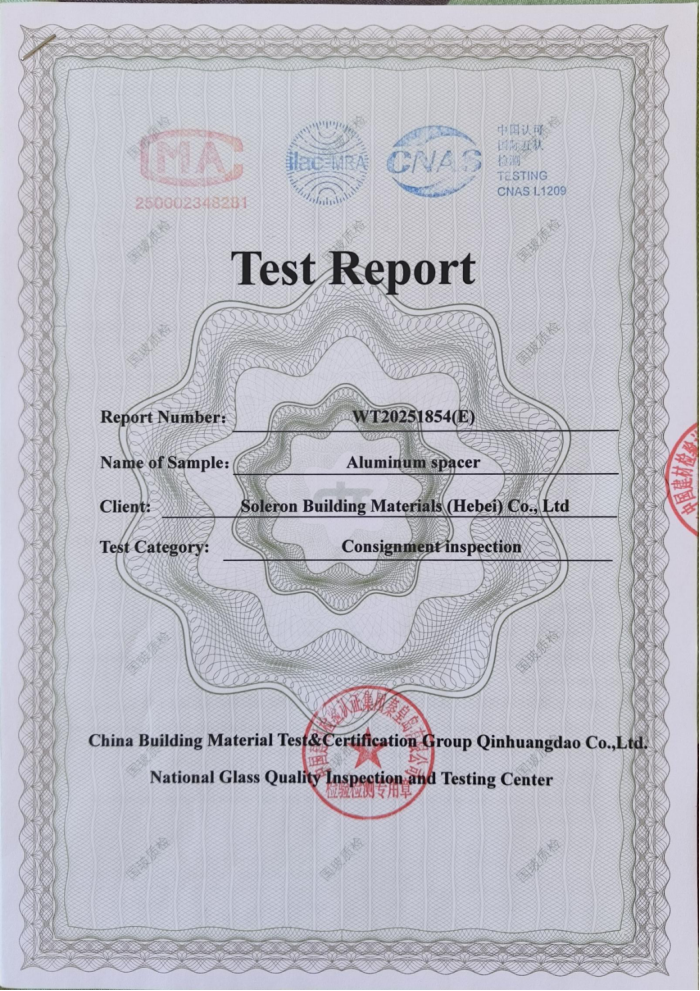
- Certificates have defined scopes. Available documentation is scope-specific rather than blanket. A Safety Data Sheet issued by SGS-CSTC Standards Technical Services (Guangzhou) Co., Ltd. under certificate number CANEC23012379901, dated 26 October 2023, covers Corner Key / Corner Connector under Regulation (EC) No 1907/2006, Regulation (EC) No 1272/2008 and Regulation (EU) No 2020/878. A CNAS Safety Data Sheet report numbered 2625011793, issued 17 February 2025 by Shanghai Institute of Chemical Industry Testing Co., Ltd. to JC/T2069-2011, covers silicone sealant for two-component hollow glass (Component A). A CNAS test report numbered WT20251854(E) issued by NATIONAL GLASS to JC/T2069-2011 covers aluminium spacer. None of these documents automatically extends to every SKU in the range.
A Verification Checklist for the Evaluation-to-Execution Handover
The gap between evaluating a supplier and releasing a production order is where most specification risk sits. The following sequence keeps that handover factual.
- Fix the spacer profile in writing: width, wall thickness within the 0.16–0.35 mm band, length, and the tolerance that your bending machine can accept.
- Separate stocked items from made-to-order items, and map each against your project schedule.
- Confirm the desiccant particle size against the filling machine, and confirm the desiccant type against the unit's expected service conditions.
- Confirm sealant chemistry and check compatibility across primary and secondary sealant layers, especially if the project involves structural glazing.
- Request the pre-shipment test criteria and the sampling method, given that random inspection is the stated quality-control approach.
- Request applicable Safety Data Sheets and test reports by certificate number, and read the stated scope rather than the document title.
- Confirm the customisation scope — logo, size, packaging — inside the purchase order, not as a separate understanding.
- Align commercial terms in advance: EXW, FOB or CIF delivery terms, and 30/70 payment terms.
Future Outlook
Two forces are likely to shape insulating glass material sourcing over the next several years. The first is building energy performance, which pushes specification toward warm-edge spacers and higher-performing desiccant systems in the markets that regulate it most actively. The second is supply-chain consolidation, where processors increasingly prefer to source spacer, sealant, desiccant and connector from a single qualified supplier to reduce coordination cost and lead-time risk.
Renqiu's position as an established building-materials cluster, adjacent to Beijing and Tianjin, gives manufacturers in the region a logistics advantage for export-oriented supply. Soleron's stated direction is consistent with both trends: continued investment in warm-edge spacer technology, expansion of energy-saving product lines, and an integrated one-stop supply model covering insulating glass components, hardware and auxiliary sealing materials. The company reports that 80% of its output is exported, with key markets including Germany, France, the United Kingdom, the United States, Canada, China, Japan, South Korea, India, the UAE, Saudi Arabia, Brazil, Mexico and Chile.
Frequently Asked Questions
What are insulating glass materials?
Insulating glass materials are the auxiliary materials used in the production of insulating glass units. They include spacer bars, warm edge spacers, molecular sieve desiccants, PIB sealants, silicone sealants, polysulfide sealants, corner keys and other related components. Together these materials establish the cavity, control moisture inside the sealed space and form the edge seal of the unit.
What is the function of a spacer bar in an insulating glass unit?
The spacer bar maintains the fixed distance between the glass panes and creates the insulating cavity. It also provides a channel for the desiccant and helps form the edge sealing structure of the insulated glass unit. Because it determines cavity geometry and carries the desiccant, the spacer is a structural element of the unit rather than a filler component.
Which customisation options are available for OEM/ODM aluminium spacer bar orders?
OEM services are available for custom aluminium spacer bar production, and ODM services are available for aluminium spacer bar design and production. For OEM/ODM orders, customisation can cover logo, size and packaging. These options apply to order-based production rather than to standard stock items, so they should be confirmed against the stated minimum order quantity of 5 cartons and the standard delivery window of 20 to 45 days.
What are the advantages of aluminium spacer bars?
Aluminium spacer bars offer good mechanical strength, easy processing, dimensional stability and compatibility with conventional insulating glass production lines. Their main boundary is thermal: aluminium conducts heat at a much higher rate than warm-edge spacer materials, so where perimeter thermal performance is the governing requirement, a warm-edge spacer is the more appropriate material choice.
What are the purchasing terms and acceptance criteria for insulating glass materials?
Stated purchasing terms are a minimum order quantity of 5 cartons, delivery terms of EXW, FOB or CIF, payment terms of 30/70, and pre-shipment test as the acceptance criterion. For selection, buyers are advised to consider sealant adhesive strength, curing speed and temperature resistance; to check water vapour permeability for long-term anti-fog performance; and to verify temperature resistance against local seasonal conditions.
Detailed product parameters, packaging options and the full component range are set out in the Soleron product catalogue: Soleron product catalog (PDF).