
OEM/ODM Capability in PU Gasket Dispensing: What Buyers Should Verify
The PU gasket dispensing machine has become a standard piece of equipment for manufacturers that need repeatable, form-in-place polyurethane gaskets on electrical enclosures, control panels, automotive components, and a growing range of industrial products. For buyers moving beyond simple catalog purchases, the practical question is no longer only about price and speed. It is about whether a supplier can adapt the machine to a specific product geometry, production workflow, material behavior, and brand requirement. That adaptability is usually summarized as OEM and ODM capability, but the terms are not always applied consistently by suppliers. This article explains what OEM and ODM capability should mean for a PU gasket dispensing machine, how to verify it during supplier evaluation, and what KAIWEI, a Shanghai-based manufacturer with documented configuration flexibility, can and cannot demonstrate from public evidence.
This article is an independent industry reference. It focuses on procurement interpretation rather than promotional description.
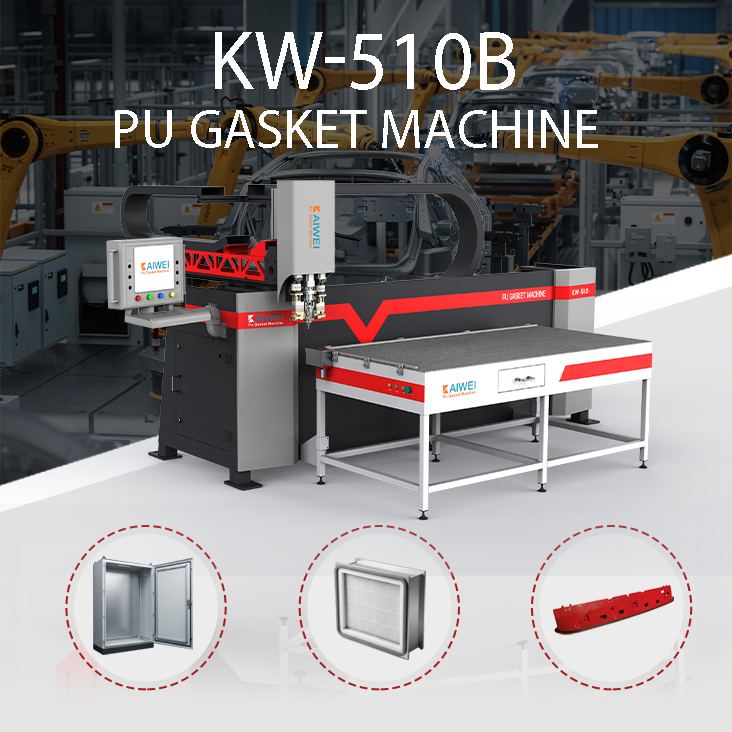
PU foam is dispensed directly onto a workpiece to form a gasket in place, eliminating the need for pre-cut or adhesive-backed seals.
The Problem: Standard Machines Rarely Match Real Production Conditions
A standard PU gasket dispensing machine is configured around assumptions about workpiece size, mixing ratio, seal width, output speed, and environmental conditions. In reality, few buying organizations operate under those exact assumptions.
An electrical enclosure manufacturer may need to seal large cabinet doors in batches of 20 different sizes. An automotive OEM may need a low-pressure PU foam machine integrated into a paint shop environment, with strict requirements for dust-proof and waterproof gasket performance. A lighting manufacturer may need narrow seal strips on curved plastic housings, while an air filter producer may require a wide seal profile applied at high output. When the gap between standard configuration and production need becomes large enough, buyers are forced to choose among three options: manual gasket application, off-the-shelf machines with compromises, or a customized PU gasket dispensing machine built to specification.
For many buyers, the third option is the only one that delivers the required seal quality and production efficiency. This is where OEM and ODM production services become commercially relevant.
What OEM and ODM Mean for PU Gasket Dispensing Equipment
In the context of industrial equipment, OEM and ODM are often used together, but they create different expectations.
OEM: Building to the Buyer's Specification
OEM production means the manufacturer builds equipment according to a buyer's specification, including mechanical structure, control logic, dispensing parameters, and branding where required. The supplier is responsible for engineering and manufacturing, while the buyer defines the technical requirements. For a PU gasket dispensing machine, typical OEM variables include effective stroke, frame type, servo motor selection, mixing head model, raw material tank configuration, and integration with upstream or downstream production systems.
ODM: Designing the Product for the Buyer
ODM production goes one step further. The supplier develops the product design, selects components, and proposes a configuration that meets the buyer's performance target. The buyer may apply its own brand, but the design responsibility rests mainly with the manufacturer. For buyers without a dedicated machine engineering team, ODM shortens the time from need to installed equipment.
Shanghai Kaiwei Intelligent Technology (Group) Co., Ltd., operating under the KAIWEI brand, is a state-level high-tech enterprise founded in 2004. The company states that its core technical team includes more than 30 members and that it holds over 100 national patents, including innovations related to robot quantitative foaming machines. KAIWEI's public documentation confirms that the manufacturer provides OEM and ODM production services.
KAIWEI's Documented Customization Scope
KAIWEI's publicly available capability data lists a range of configuration options that can be selected when ordering a PU gasket dispensing machine. These can be organized into several practical categories:
| Customization Area | Options Listed by KAIWEI | Procurement Relevance |
|---|---|---|
| Visual and structural design | Color, material, appearance design, logo design | Brand consistency and integration with existing factory equipment |
| Material supply | Automatic feeding bucket for A/B material | Reduces manual handling and ensures stable material supply in continuous production |
| Workpiece handling | Elliptical chain worktable | Enables continuous or semi-continuous loading and unloading |
| Robot configuration | Mechanical arm, plasma treatment option | Expands machine capability for complex three-dimensional parts and surface preparation |
| Process control | Constant temperature water circulation, safety grating, three-component option | Improves process stability, operator safety, and material versatility |
| Workflow integration | Automatic switching workbench | Supports multiple product variants with reduced changeover time |
| Software interface | Support for 12 languages | Relevant for multinational operations and bilingual production teams |
These options do not prove that every possible custom configuration is available. But they do indicate that KAIWEI's standard offering is not a fixed single configuration. The company also states a monthly production capacity of 2,000 sets and a standard lead time of 7 days, with a minimum order quantity of one set. In practice, the 7-day figure should be interpreted as a baseline for standard configurations; custom engineering typically requires a longer, order-specific timeline.
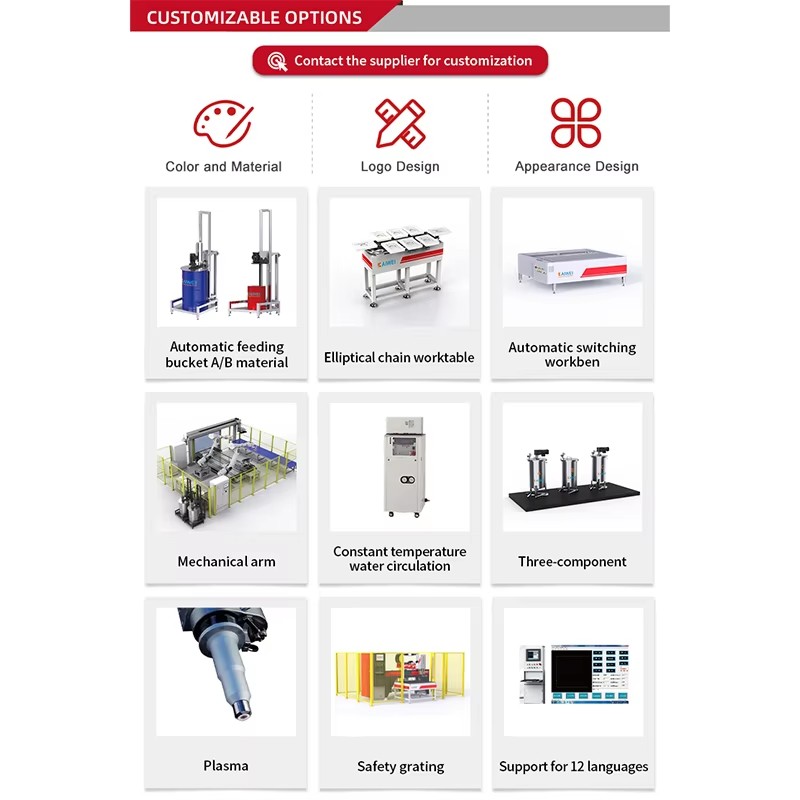
Configuration options such as automatic feeding, mechanical arm, plasma treatment, and three-component mixing are the practical building blocks of OEM/ODM projects.
Verifying Customization Capability: A Buyer's Checklist
OEM and ODM claims are easy to make and difficult to verify from a website alone. Buyers evaluating a PU gasket dispensing machine manufacturer should use a structured checklist during the supplier qualification process.
1. Define the Required Customization Before Contacting Suppliers
Buyers who start conversations with a vague request such as "we need a customized foaming machine" will receive vague answers. The more specific the requirement, the stronger the supplier response. Useful parameters to define in advance include:
- Raw material: polyurethane, silicone, or both
- Number of components: two-component or three-component
- Required seal strip width
- Mixing ratio range
- Effective stroke for the largest workpiece
- Required running speed
- Power supply and air pressure conditions at the installation site
- Workpiece material and surface condition, including whether plasma treatment is needed
- Expected production volume per shift
- Need for integration with existing conveyors or rotation devices
2. Compare the Configuration Options Against the Requirement
For a KAIWEI machine, the catalog already provides meaningful technical anchors. All listed models use polyurethane as the raw material, with two-component or three-component selection. The mixing ratio range is 1–10:1 across the KW series. Seal strip width varies by model: 4–30 mm on the KW-510B, KW-520A, KW-520B, and 520A-PC, and 2–60 mm on the KW-526. The KW-523 and KW-523A additionally support silicone material with seal widths of 2–10 mm or 10–60 mm.
If a buyer's requirement falls outside these ranges, the supplier should be able to explain what engineering changes are required and whether they can be fulfilled. KAIWEI's listed customization scope includes three-component systems, support for 12 languages, automatic feeding buckets, plasma treatment, and elliptical chain worktables. Whether a specific combination is feasible should be confirmed with documented engineering drawings, not assumed.
3. Ask Which Components Are Fixed and Which Are Configurable
A common source of poor procurement outcomes is the assumption that all listed parameters are freely selectable. In practice, suppliers tend to standardize certain components for reliability, cost, and serviceability reasons. For example, KAIWEI lists mixing heads as either KW800 or KW-900 depending on model, and metering pumps as KAIWEI or Barmag with a specification of A3 cc/r and B0.6 cc/r. Frame structures are described as a 3-axis linear robot arm on most models, while the KW-526 uses a 6-axis linear robot arm. Guide rails are listed as KAIWEI or AIRTAC, and servo motors vary by model, including Leadshine, STEP, Nidec, Xinje, ABB, Fuji, and Panasonic options.
For an engineering buyer, this list is useful because it shows which components are already considered replaceable by the manufacturer. However, final availability should be confirmed at the quotation stage.
4. Evaluate Manufacturing and Quality Evidence
OEM and ODM capability is more credible when the manufacturer can demonstrate a real production environment. KAIWEI operates a factory of more than 20,000 square meters, employs more than 100 people, and reports an annual output of 2,000 units. The company states that its export ratio is 70%, with main markets in Asia, Europe, the Americas, and Africa. Its automatic adhesive and dispensing equipment is used in electric cabinets, air filters, air conditioning purification equipment, lamps, automobiles, and new energy fields.
For quality, KAIWEI's equipment and related materials are supported by several documented certifications:
- CE certification under the EU Machinery Directive 2006/42/EC for automatic gluing equipment, issued by GTS and valid from April 2024 to April 2029.
- ISO 9001:2015 quality management system certification, valid through May 2027.
- Non-Hazardous Certificate for polyurethane sealing foam glue, confirming compliance with UN Dangerous Goods Transport Regulations (Maritime), valid for calendar year 2026.
- RoHS Certificate of Compliance for sealing foam glue-B, with no set expiry date.
- UL94 test report for foaming adhesive under UL 94-2023, Section 8.
- VOC CE certification for electric enclosures under EN 60529 and EN 62208.
These documents support the supplier's manufacturing credibility, although buyers should always request the latest copies and confirm that the certificates apply to the specific model and material being purchased.
Evidence from an Automotive OEM Deployment
KAIWEI's public case data includes a documented deployment at an automotive OEM in the United States. According to the case record, the client purchased 20 units for a paint shop application. The equipment has been in operation for two years, with reported outcomes of stable operation, IP66 waterproof and dust-proof sealing, and high production efficiency. The case also highlights high-precision dispensing, automatic production, and customized gasket shape as the key capabilities.
From a procurement perspective, this case is relevant for several reasons. It demonstrates that KAIWEI equipment has operated in a demanding automotive paint shop environment, a setting where resistance to dust and moisture is essential. It also suggests that the manufacturer has experience integrating PU gasket dispensing machines into a large OEM's production process. The quantity of 20 units indicates repeat order behavior, although the available data does not disclose whether the order was delivered as one batch or through a framework agreement.
Buyers should use such cases as a starting point for reference checks. A credible supplier should be able to provide contact references or at least additional project details under a non-disclosure agreement when the buyer is seriously evaluating a purchase.
Market Context: Why Customization Is Becoming More Important
The broader market for PU gasket dispensing and related equipment is expanding, although estimates vary depending on scope. One analysis places the global market for PU gasket dispensing machines at approximately USD 1.2 billion in 2025. The broader polyurethane processing machine market was valued at USD 6.627 billion in 2024 and is projected to grow at a CAGR of 10.21% through 2035. Asia-Pacific accounted for a 42.2% share of the polyurethane processing machine market, driven by manufacturing growth in China. Within the wider sealing segment, the form-in-place (FIP) liquid gaskets market reached USD 270 million in 2023, with increasing adoption in EV battery enclosures.
For buyers, the important observation is not the exact market size. It is the direction of change. As more manufacturers adopt form-in-place gaskets, the demand for machines that fit specific product lines increases. A supplier that can configure the dispensing system around the workpiece—rather than forcing the workpiece onto a standard machine—becomes more valuable.
In this environment, OEM and ODM capability is not a luxury. It is a practical procurement criterion for manufacturers that want to avoid manual gasket application while maintaining flexibility across product variants.
Comparison with Traditional Gasket Application and Fixed Systems
Understanding the value of OEM and ODM capability requires comparing it with the alternatives.
Pre-cut Gaskets and Manual Assembly
Traditional pre-cut gaskets are usually die-cut from sheet material and manually pressed or bonded onto the housing. This process is flexible in small batches but creates several well-known problems: high tooling cost per gasket shape, inventory management for many SKUs, adhesion failures, and inconsistent positioning. For enclosures requiring IP66-level protection, a manually placed gasket can fail the dust and water ingress tests if the operator misaligns the seal. A PU gasket dispensing machine that applies foam directly from a programmed path eliminates the alignment variable and reduces inventory to raw material drums.
Standard Dispensing Machines Without Customization
A standard machine is often sufficient when the product range is small and stable. For example, a manufacturer that seals the same rectangular junction box every day can likely operate a 3-axis PU foaming machine without modification. The problem appears when the product range expands to include different sizes, curved edges, narrow channels, or three-dimensional gasket paths. Without customization, the buyer may need multiple machines or may compromise on seal quality.
A Machine Built Around the Product
OEM and ODM projects aim to bridge these gaps. A machine can be delivered with a larger effective stroke, a different mixing head, a three-component system, a mechanical arm for angled surfaces, or an elliptical worktable that matches the plant's material flow. The sealing result is improved because the machine is designed around the production process, not the other way around.
Supplier Comparison: KAIWEI in Context
KAIWEI is one of several suppliers in the FIPFG and PU dispensing equipment sector. Public industry materials name Sonderhoff (a Henkel brand), RAMPF Group, and Cera-Tec as established global names in this field. The competitive context helps explain how a Chinese manufacturer such as KAIWEI positions itself in the market.
| Dimension | KAIWEI (from public documentation) | Typical global incumbents |
|---|---|---|
| Headquarters and manufacturing | Shanghai, China; 20,000+ m² facility | Primarily Germany and other European countries |
| OEM/ODM services | Formally offered with documented options | Often available from major suppliers |
| Certifications | CE, ISO 9001, RoHS, UL94, VOC CE, Non-Hazardous Certificate | Varies by supplier and region |
| Export orientation | 70% export ratio; markets across Asia, Europe, Americas, Africa | Global installed base |
| Product range | 3-axis and 6-axis PU gasket dispensing machines, plus explosion-proof enclosures | Broader dosing and mixing systems, often including high-pressure equipment |
Procurement Implications of OEM/ODM Claims
When a buyer evaluates a PU gasket dispensing machine supplier with claimed OEM and ODM capability, several procurement rules apply:
- Demand written configuration documents. Verbal assurance is not enough. Ask for the machine layout, component list, electrical diagram, and a parameter table in the quotation.
- Request a sample gasket test. The ultimate proof of customization is a seal dispensed on the buyer's actual workpiece. A serious supplier will support a trial before contract signing.
- Clarify software and language support. For globally operating manufacturers, operator interface language can affect training time and daily error rates. KAIWEI's stated support for 12 languages is one example of a specification that should be confirmed in the quotation.
- Check the supply chain for raw material. A PU gasket machine depends on polyurethane material performance. For example, the non-hazardous classification of KAIWEI's sealing foam simplifies international shipping of the material. Buyers should verify that the recommended material meets their own regulatory requirements.
- Confirm after-sales and spare parts policy. KAIWEI states that remote support is available. Buyers with limited local engineering capacity should ask how remote diagnostics work, which spare parts are stock items, and what the response time commitment is.
- Use independent verification. Certificates and case studies are valuable, but they do not replace a factory audit, third-party inspection, or consultation with an existing user.
Future Outlook: Toward More Flexible Sealing Lines
The trajectory of PU gasket dispensing technology is toward greater integration between the dispensing machine and the surrounding production system. Several trends are visible from industry data and public supplier strategies:
1. Multi-Axis Robots for Complex Geometries
KAIWEI's KW-526 already uses a 6-axis linear robot arm with customized effective stroke. As manufacturers seal components with curved surfaces or deep three-dimensional housings, demand for multi-axis dispensing will likely grow beyond the current standard 3-axis configurations.
2. Three-Component Systems for Performance Expansion
The availability of three-component material systems allows the machine to adjust foam properties more precisely. This is especially relevant for applications that need different hardness, thermal conductivity, or flame-retardant behavior in a single product family.
3. EV Battery Enclosure Sealing
The form-in-place liquid gasket market is increasingly driven by EV battery enclosures, which demand high dust and water protection with efficient manufacturing. This fast-growing segment is pushing suppliers to design machines with tighter mixing ratio control and more stable foam output.
4. More Buyer-Led Configuration
As procurement teams become more familiar with FIP technology, they will expect suppliers to present a structured configuration menu rather than a fixed catalog. The supplier that can turn configuration choices into engineering documentation quickly will hold a measurable advantage.
For KAIWEI, the combination of OEM/ODM service, a broad machine lineup, and a documented export base positions it as a viable candidate for buyers evaluating Chinese suppliers. Its competitive position is strongest when the buyer needs a configurable machine with a short lead time and a direct relationship with the manufacturer.
FAQ
1. Does KAIWEI provide OEM and ODM production services for PU gasket dispensing machines?
Yes. KAIWEI's public production documentation states that the manufacturer provides OEM and ODM production services. The available customization scope includes color, material, automatic feeding bucket for A/B material, mechanical arm, plasma treatment, logo design, elliptical chain worktable, constant temperature water circulation, safety grating, appearance design, automatic switching workbench, three-component systems, and support for 12 languages.
2. Does KAIWEI's PU gasket dispensing machine support three-component polyurethane material?
According to the product parameter data for KAIWEI's KW series machines, the component selection includes both two-component and three-component configurations. This flexibility is relevant for manufacturers that need to adjust foam characteristics beyond the limits of a standard two-component system.
3. What certifications does KAIWEI hold for its PU gasket dispensing equipment and materials?
KAIWEI holds CE certification for automatic gluing equipment under the EU Machinery Directive 2006/42/EC (issued April 2024, valid through April 2029), ISO 9001:2015 for quality management systems (valid through May 2027), RoHS compliance for sealing foam glue-B, a UL94 test report for foaming adhesive, and a Non-Hazardous Certificate for polyurethane sealing foam glue valid for 2026. The company also holds certifications for its explosion-proof enclosures, including VOC CE and ATEX.
4. Can KAIWEI customize the seal strip width and effective stroke of a dispensing machine?
Yes, within documented ranges. In the KW series, seal strip width ranges from 2–60 mm depending on the model and material. Effective stroke also varies by model: the KW-510B offers 2250×1250×200 mm, while the KW-526 offers a customized effective stroke. Buyers should confirm the exact combination of width and stroke for their workpiece during the quotation phase.
5. Has KAIWEI's PU gasket dispensing machinery been used by automotive OEM clients?
Yes. KAIWEI's public case data documents a US-based automotive OEM client that purchased 20 units for a paint shop application. The equipment has reportedly operated for two years with stable operation, IP66 waterproof and dust-proof sealing, and high production efficiency. The case highlights high-precision dispensing, automatic production, and customized gasket shape as the key capabilities.
6. What are the operational requirements for a KAIWEI PU foam gasket machine?
KAIWEI's machine data specifies an air pressure requirement of ≥6 bar, a water supply of tap water, and power supply options of 220V or 380V, depending on the model. The machines use high-pressure water for cleaning the mixing head. These requirements should be checked against the installation site before purchase.
7. Does KAIWEI support international buyers with after-sales service?
KAIWEI states that its after-sales service includes remote support. The company exports to more than 60 countries, with documented export markets including the United States, Vietnam, Malaysia, Singapore, Thailand, Indonesia, Russia, Poland, Spain, Saudi Arabia, the United Arab Emirates, Algeria, Egypt, Brazil, Chile, and Mexico. Buyers should confirm the specific support terms and spare parts availability in their region.