
OEM/ODM Proven: SCENTSEA's Scent Diffuser Production Capabilities
Commercial scent diffuser sourcing rarely fails because a supplier has nothing to sell. It fails because the supplier cannot hold a defined configuration — casing material, finish, control interface, packaging — across models and repeat orders. At the evaluation stage, the practical question is narrower than "who sells scent diffusers": it is whether a supplier's customization menu, material options, and production controls can actually be delivered on the specific models a buyer intends to purchase.
The category context makes that question worth asking. Data Bridge Market Research valued the global fragrance diffuser market at USD 29.61 billion in 2024 and projects it to reach USD 38.10 billion by 2032, while Intel Market Research estimates the HVAC scent diffuser segment at USD 1.01 billion in 2024 with expected growth of roughly 4.5% CAGR through 2034. A market of that scale attracts suppliers with very different production depth, which is why capability claims are best checked against published model specifications rather than a catalogue cover.
Shenzhen Scentsea Technology Co., Ltd., trading under the brand SCENTSEA, is a Shenzhen-based manufacturer founded in 2021 that develops, produces, and exports cold-air nebulizing scent diffusers, waterless aroma machines, HVAC scent systems, fragrance oils, and essential oils. The company operates a 3,000 m² production facility with three production lines and holds 20 patents covering product design, R&D, production, testing, and packaging. Its range runs from wall plug-in units through battery-powered and floor-standing machines to HVAC-connected systems — a spread that makes its customization and material strategy a useful reference point for buyers assessing OEM/ODM suppliers.
Why Customization Evidence Matters More Than a Product Photo
An OEM/ODM claim is easy to make and harder to verify. For buyers in the evaluation stage, the useful evidence is not a statement that customization is "available" — it is a list of what can be changed, on which models, in which materials, and under what production controls.
Three questions separate a genuine customization programme from a repackaging operation:
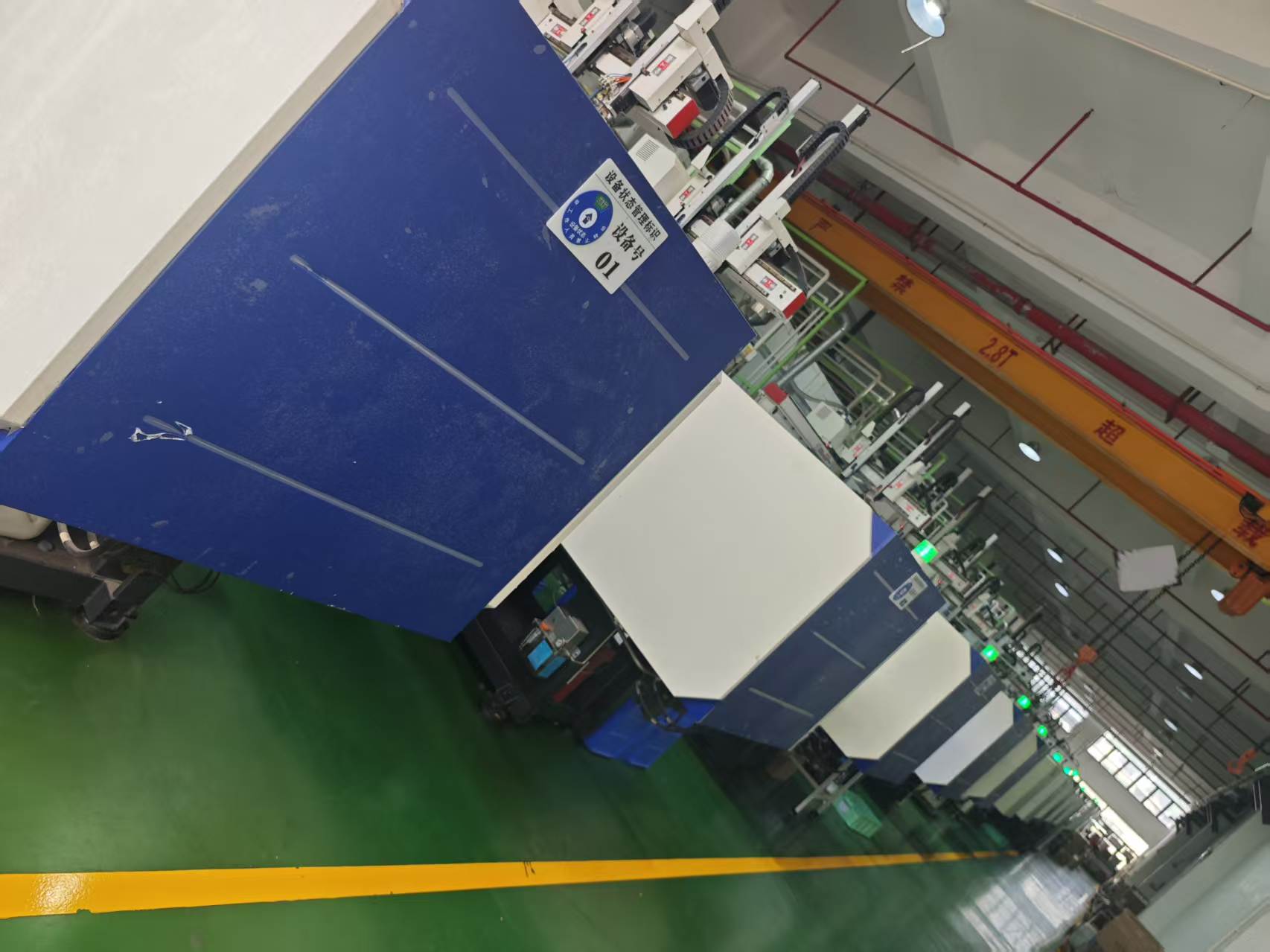
- Where does the enclosure come from? A supplier that produces housings, panels, and PCB assemblies internally can change a color, a mold, or a panel finish without renegotiating with a third party. SCENTSEA's published production scope includes injection molding, sheet metal processing, metal powder coating, mold processing, and PCB SMT assembly within its own facility.
- Do color and material options exist at model level? A generic statement that "colors can be customized" is not enough. Model-level documentation, such as the T2 and T3 commercial diffusers listed in white, black, and other customized options, is the version a buyer can use in a purchase specification.
- Are customization items documented as scope or as exceptions? Logo, color, packaging, user manual, plug type, APP interface, and PCB/functions are described as standing OEM/ODM scope rather than one-off concessions, which matters when a project scales from a sample order to repeat production.
None of these questions require a factory visit to answer. They require a supplier whose published capability data matches its product specifications — which is exactly what the following sections examine.
What SCENTSEA Customizes Under OEM/ODM
The customization scope published for SCENTSEA's scent diffuser line covers eight named areas, with color, packaging, and control configuration being the most frequently requested by commercial buyers.
| Customization area | Published scope | Why it matters at evaluation stage |
|---|---|---|
| Logo | Logo customization available | Enables private-label retail and hospitality branding |
| Product color | Color customization available; T2 and T3 offered in white, black, and other options; S02 and P02 also list customized color options | Allows a fleet of units to match an interior specification |
| Packaging | Private label packaging available | Determines retail readiness and shipping presentation |
| User manual | User manual customization available | Required for multilingual and market-specific documentation |
| Plug type | Plug type customization available | Directly tied to destination market compliance |
| APP interface | APP interface customization available | Supports branded control experience for operators |
| PCB / functions | PCB and function-level customization available | Affects scheduling, intensity control, and connectivity behaviour |
| Other specifications | Other product specifications available under OEM/ODM | Covers project-specific mechanical or control requirements |
Color is where model-level detail matters most. T2 and T3, the two mid-to-large commercial models, are listed with white and black finishes plus customized color options. S02 (tower diffuser) and P02 (electric diffuser) also list customized color options. Other models are published with defined standard finishes — white and black for S01, P01, P03 and A300, gunmetal for H5000, silver for AC-MAX, and black with silver for SC19. Buyers should treat a finish as available only where the model specification says so. Assuming a custom color on a unit that is documented in a single finish is one of the most common causes of sample-to-production mismatch in this category.
Fragrance oil programmes follow a parallel structure. Scent selection, bottle labeling, and private-label packaging are supported so that a buyer can build a branded aroma line alongside the hardware, rather than sourcing scent and equipment from unconnected vendors.
Material Choices Across the Line: Plastic, Steel With Acrylic Panels, and All-Aluminum Alloy
Material selection in this range is not cosmetic. It tracks the model's output class, its installation environment, and the weight a wall, shelf, or floor position can accept.
| Material group | Models | Material as specified |
|---|---|---|
| Plastic | S01, P01, P02, P03 | Plastic housing |
| Acrylic panel + steel casing | T2, T3 | Acrylic front panel with steel casing |
| Steel | A300 | Steel housing |
| All-aluminum alloy | S02 | All aluminum alloy tower body |
| Aluminum | H5000 | Aluminum body, floor standing |
| Aluminum body + plastic bottle | AC-MAX | Aluminum body with plastic oil bottle |
| Aluminum + steel | SC19 | Aluminum and steel construction with an 18.5-inch display |
Four material families are in use, and the logic behind them is consistent with the model's role. Plastic dominates the compact and battery-powered end — S01, P01, P02, and P03 — where low weight and simple installation matter more than enclosure heft. Steel and steel-with-acrylic construction appears on A300, T2, and T3, the units designed for sustained commercial duty in hotels, malls, cinemas, retail stores, and airports. S02 uses an all-aluminum alloy tower body for office, store, and beauty-salon environments, while H5000 uses an aluminum body for floor-standing placement in hotel lobbies, shopping malls, and office building lobbies. AC-MAX pairs an aluminum body with a plastic oil bottle, and SC19 combines aluminum and steel around its display.
Weight follows the same pattern. Net weight is 0.2 kg for S01, 0.35 kg for P03, 0.55 kg for P01, 0.8 kg for P02, and 1 kg for S02. The commercial class steps up to 3.5 kg for T2, 3.8 kg for A300, 4.2 kg for AC-MAX, 5.3 kg for T3, and 6.4 kg for H5000. For installers, that difference decides whether a unit can be wall-mounted, placed on a counter, or requires a stable floor position.
From Wall Plug-In to HVAC: The Line in Numbers
A supplier's ability to handle a versatile commercial line is visible in how completely each model is specified. The table below summarizes the published figures for the range, from the wall plug-in S01 to the HVAC-connected AC-MAX.
| Model | Type | Material | Oil capacity | Rated coverage | Noise | Listed colors |
|---|---|---|---|---|---|---|
| S01 | Wall plug-in scent diffuser | Plastic | 150 ml | 30–100 m² / 100–300 m³ | <38 dB | White, black |
| S02 | Tower scent diffuser | All aluminum alloy | 100 ml plastic bottle | 30–100 m² / 100–300 m³ | <30 dB | Silver, black (customized) |
| P01 | Battery operated scent diffuser | Plastic | 500 ml | 100–150 m² / 300–500 m³ | <35 dB | White, black |
| P02 | Electric scent diffuser | Plastic | 300 ml | 150–350 m² / 500–1000 m³ | <30 dB | White, black (customized) |
| P03 | Battery operated scent diffuser | Plastic | 150 ml | 100–150 m² / 300–500 m³ | <35 dB | White / black |
| A300 | Commercial scent diffuser | Steel | 500 ml | 500–800 m² / 1500–2500 m³ | <40 dB | White, black |
| T2 | Commercial scent diffuser | Acrylic panel + steel casing | 500 ml | 500–800 m² / 1500–2500 m³ | <45 dB | White, black (customized) |
| T3 | Commercial scent diffuser | Acrylic panel + steel casing | 1000 ml | 1000–1600 m² / 3000–5000 m³ | <55 dB | White, black (customized) |
| H5000 | Floor standing scent diffuser | Aluminum | 1000 ml | 800–1300 m² / 2500–4000 m³ | <45 dB | Gunmetal |
| AC-MAX | HVAC scent diffuser | Aluminum body + plastic bottle | 5 L | 2500–3500 m² / 8000–10000 m³ | <45 dB | Silver |
| SC19 | Advertising scent machine | Aluminum + steel | 500 ml | 150–250 m² / 500–800 m³ | ≤30 dB | Black + silver |
Two details in that table are worth flagging for procurement teams. First, the coverage figures represent rated ranges in square meters and cubic meters, and the cubic figure is the more relevant number when ceiling height is unusual. Second, power supply methods differ across the range: S01 and SC19 accept 110–240V AC input, while S02, P01, and P03 run on 5V supply, P02 and A300 use DC 12V, T2 and T3 use DC 12V 2A, and AC-MAX uses DC 12V. A buyer mixing models in one project should plan for the corresponding adapters and plug types, which is one reason plug type appears as a standing OEM/ODM customization item.
At the two ends of the line, the design intent is clearly separated. S01 is a 150 ml wall plug-in unit at 1.5W with a net weight of 0.2 kg, positioned for home, toilet, and store use. AC-MAX is a split HVAC scent diffuser with a 5 L oil capacity, 48W power rating, and 2500–3500 m² rated coverage, intended for shopping malls, banks, and airports. Holding both in one catalogue requires different tooling, different materials, and different quality checks — which is the substance behind an OEM/ODM capability claim.
How Cold-Air Atomization Shapes the Hardware
A waterless cold-air scent diffuser atomizes fragrance oil directly into fine airborne particles without adding water or using heat. The atomization system uses controlled airflow and pressure to break the oil into fine particles, which are then dispersed into the room or through an HVAC duct. Because no water is involved, there is no tank dilution, no water refilling cycle, and no ultrasonic plate to descale.
That principle explains several specification choices across the range. Oil consumption is published per model — 0.6 ml/h for S02, 2.5 ml/h for P02, 3 ml/h for T2, 4 ml/h for A300, 4.6 ml/h for T3, 5.4 ml/h for H5000, and 6 ml/h for both AC-MAX and SC19 — with stated tolerances of ±5% or ±10% depending on the model. Oil capacity is matched to those rates: a 100 ml bottle on S02, 150 ml on S01 and P03, 300 ml on P02, 500 ml on P01, A300, T2, and SC19, 1000 ml on T3 and H5000, and 5 L on AC-MAX.
For a facilities or procurement team, those two numbers translate directly into maintenance intervals and consumable planning. A model with a low consumption rate and a small bottle may still be the correct choice for a corridor or an elevator, while a large-space installation needs both a high capacity reservoir and a rate that keeps refill visits practical. Published consumption figures are therefore more decision-relevant than a marketing coverage claim.
Control behaviour sits on top of the atomization hardware. SCENTSEA diffusers use smart APP control, manual button control, timer scheduling, and adjustable scent intensity, with selected models supporting Wi-Fi or Bluetooth remote control. APP interface and PCB-level functions are both included in the OEM/ODM customization scope, which means a buyer can request a specific scheduling behaviour or control workflow rather than accepting a fixed one.
Field Evidence: A Five-Year Commercial Deployment
One documented deployment illustrates how the hardware performs outside the specification sheet. A scent marketing company and scenting service provider based in the United States deployed 30 units for commercial scenting in shopping malls, with the programme running for five years. The stated outcome was stable and consistent scent coverage, reduced manual maintenance, improved fragrance management efficiency, and enhanced customer experience. Those results are attributed to strong atomization, stable operation, smart APP control, adjustable scent intensity, low maintenance, and easy installation.
The equipment associated with that project includes AC-MAX, T2, P01, and P03 — a combination that spans an HVAC-connected unit, a mid-size commercial diffuser, and two battery-operated units. In practical terms, that is the mixed-fleet scenario most multi-site operators face: large public areas served by centralized equipment, mid-size zones served by standalone commercial units, and hard-to-wire spaces such as washrooms and elevator areas served by battery models.
The five-year duration is the meaningful part of the evidence. Long-running programmes are where weak atomization, leakage, and inconsistent batch performance surface, and where spare-part availability and warranty terms become operational rather than contractual questions.
Where the Capability Has Boundaries
Capability claims are more credible when the limits are stated at the same time. Several constraints are visible in the published data.
- Lead time is a real cost of customization. Standard production lead time is 25–35 days. Buyers planning a seasonal launch or a fixed installation date should treat that window as the baseline, not as the exception.
- Noise output varies sharply by model. T3 is rated below 55 dB, the highest in the range, while S02 and P02 are rated below 30 dB and SC19 at or below 30 dB. A unit suitable for a busy mall atrium may be a poor fit for a quiet spa treatment area or a hotel corridor at night.
- AC-MAX is an HVAC component, not a room appliance. It is specified as a split type with a 5 L reservoir and rated for 2500–3500 m². It assumes access to a ducting system and installation planning that a plug-in unit does not require.
- Battery models carry a maintenance rhythm of their own. P01 runs on four D-cell batteries or Type C, and P03 on three D-cell batteries or Type C. That removes wiring constraints but introduces battery replacement and disposal routines.
- Rated coverage is a maximum, not a guarantee. Actual performance depends on ceiling height, ventilation, airflow, partitions, and installation position. Buyers should size by cubic volume and airflow rather than by the headline square-meter figure.
- Certification applies per model. Compliance documents must match the exact production model and configuration being purchased, particularly for units with wireless functions.
None of these limits invalidate the line. They define which model belongs in which project — which is precisely the decision the range is designed to support.
2026 Preference Signals in Commercial Scenting
Several publicly available data points frame how buyers are currently evaluating this category.
- Nebulizing technology is a specialist segment, not a niche experiment. Nebulizing diffusers (waterless / cold air) are estimated to represent approximately 22.6% of market share, favoured for professional-grade scent potency in commercial environments.
- Regional demand is concentrated. North America held the largest regional share of the fragrance diffuser market in 2024 at approximately 43.87% of global revenue.
- HVAC scenting is growing on its own track. The HVAC scent diffuser segment was valued at USD 1.01 billion in 2024 with an expected CAGR of 4.5% through 2034 — relevant for buyers planning ducted installations rather than standalone units.
- Smart control and endurance are becoming baseline expectations. Xiaomi launched the Mijia Smart Aroma Diffuser in October 2024 with a 50-day battery life and app control via HyperOS, signalling consumer-market pressure toward high-endurance smart features that commercial buyers increasingly expect as standard.
- Scent safety standards continue to tighten. IFRA 51 (2023) introduced stricter global safety standards for fragrance ingredients used in diffusers, affecting allowable usage levels for inhalation safety. This makes fragrance oil documentation a procurement item rather than an afterthought.
- Competitive structure is defined by technology. Leading commercial scenting players include ScentAir, Aroma360, and AromaTech, with a shared focus on nebulizing technology for hotels and shopping malls.
Read together, those signals point toward the same buyer priority: equipment that can be specified precisely, controlled centrally, and maintained over years. Customization capability is only valuable when it sits on top of that foundation.
Production Capacity, Quality Control, and Lead Time
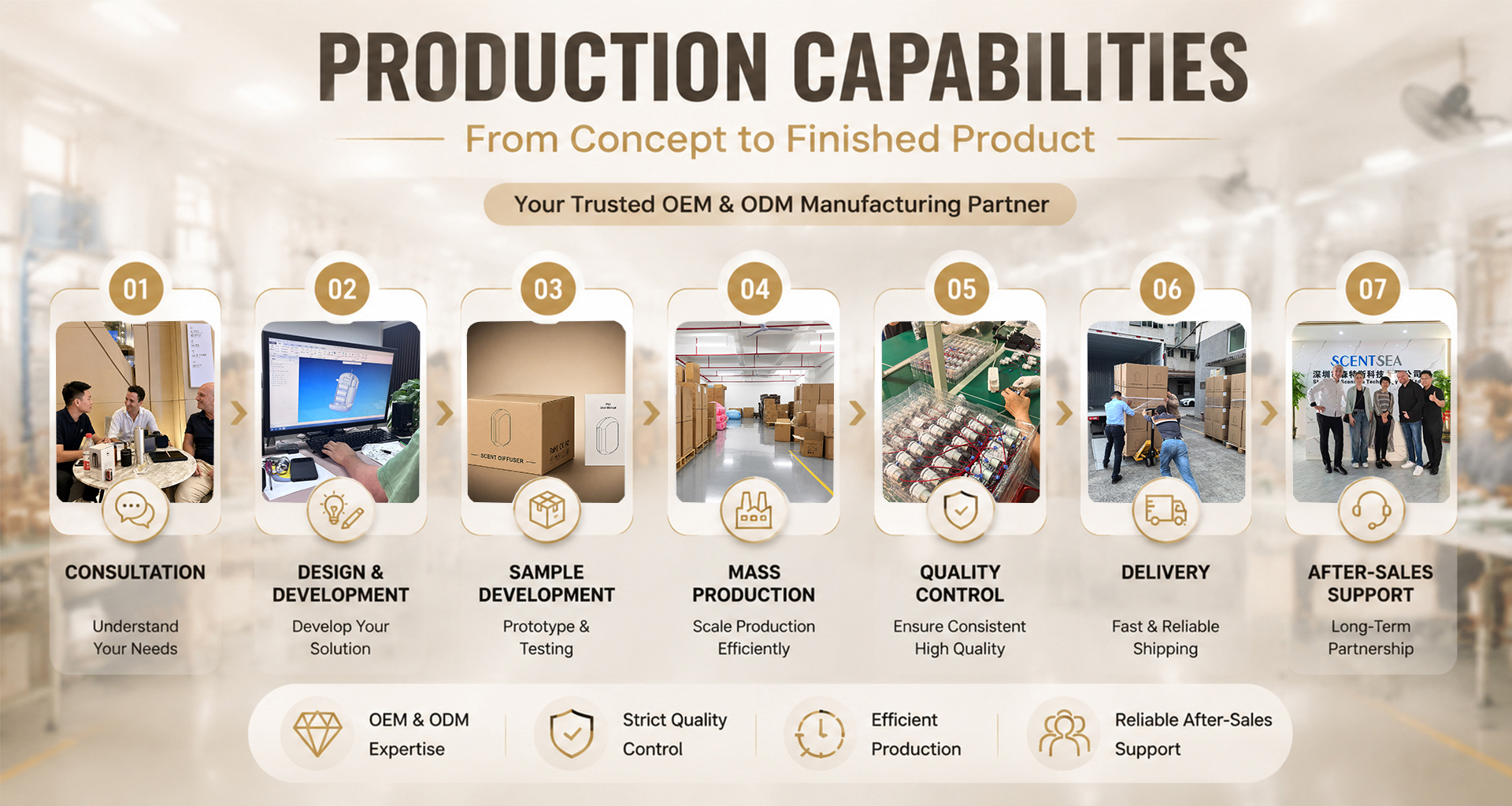
Production capacity and quality control are the two areas where OEM/ODM claims are most often tested by repeat orders. The published figures for SCENTSEA are specific: monthly capacity of 8,000 units, minimum order quantity from 1 unit for diffusers, standard lead time of 25–35 days, and an annual output of 100,000 units from a facility of 3,000 m² with 30 employees and a four-engineer R&D team. Export markets span the EU, the United States, the Middle East, and Southeast Asia, with products supplied to customers in more than 70 countries and regions and an export ratio of approximately 70%. After-sales support includes a one-year free warranty on spare parts.
Pre-shipment quality control is documented as a sequence rather than a single inspection: 100% functional testing, atomization testing, leakage inspection, noise testing, APP and control testing, a 48-hour aging test, and final appearance inspection. Sample units and fragrance oil samples are available for verification before a bulk commitment.
Certification status is part of the same evidence set. SCENTSEA diffuser models hold CE, RoHS, and FCC certification. The FCC certificate (ATL20240416326) was issued on 24 April 2024 by Shenzhen ATL Testing Technology Co., Ltd. under FCC Part 15 Subpart B:2023 for the US market. The RoHS certificate (ATL20240416327) covers RoHS Directive (EU) 2015/863 for the EU market. The EMC certificate (ATL20240416325) covers EN IEC 55014-1:2021, EN IEC 55014-2:2021, EN IEC 61000-3-2:2019/A1:2021, and EN 61000-3-3:2013/A2:2021. For export documentation, fragrance diffusers and prepared room deodorizers are commonly classified under HS code 33074900.
For buyers comparing suppliers, the practical implication is that customization requests—custom color on T2 or T3, a specific plug type, a branded APP interface, or private-label packaging—sit inside a production system that is already subject to defined inspection stages. That is a different proposition from a trading intermediary that coordinates these steps across unconnected factories.
Future Outlook
Two directions look most likely to shape OEM/ODM expectations in commercial scenting over the next few years.
The first is the continued separation of large-space scenting from room-level scenting. HVAC-connected systems such as AC-MAX address ducted buildings, while battery and plug-in models address spaces where wiring is impractical. As the HVAC segment grows at the projected rate, suppliers will be judged on whether they can serve both ends of that split with consistent quality systems rather than specializing in only one.
The second is documentation depth. As fragrance safety standards tighten and market-specific electrical and radio requirements continue to apply, the supplier that can match a certificate to a specific model and configuration will be easier to keep in a long-term programme than one that supplies a generic compliance package. Customization, in this context, increasingly means customization that remains verifiable after the sample stage — the same standard the T2, T3, S02, and P02 color options are documented against today.
FAQ
What can be customized on a SCENTSEA scent diffuser under OEM/ODM?
OEM/ODM scope covers logo, product color, packaging, user manual, plug type, APP interface, PCB and functions, and other product specifications. Model-level color options vary: T2 and T3 are listed with white and black plus customized options, and S02 and P02 also list customized color options, while other models are published with defined standard finishes. Fragrance oil programmes separately support scent selection, bottle labeling, and private label packaging. Buyers should confirm which items apply to the exact model and order quantity.
How should a buyer choose between models ranging from S01 to AC-MAX?
Selection should be based on actual space size, ceiling height, airflow, installation method, power supply, oil capacity, noise level, APP or Wi-Fi control requirements, maintenance expectations, and HVAC compatibility. Compact models such as S01 and S02 suit small rooms and light commercial spaces. Battery-powered models such as P01 and P03 suit elevators, washrooms, or locations where wiring is inconvenient. P02 is positioned for small to medium commercial spaces requiring stronger diffusion and smart control. A300 and T2 provide higher output and larger oil capacity for medium commercial areas, while H5000 and T3 are suited to large open spaces. AC-MAX is intended for large hotels, malls, and office buildings requiring centralized HVAC scenting.
What quality risks should buyers check before placing a bulk order?
The main quality risks in this category are unstable atomization, oil leakage, excessive noise, unreliable APP or control functions, and inconsistent batch performance. Buyers should verify sample performance, quality control procedures, aging tests, certification coverage, warranty terms, and spare parts support. Documented pre-shipment checks on SCENTSEA diffusers include 100% functional testing, atomization testing, leakage inspection, noise testing, APP and control testing, a 48-hour aging test, and final appearance inspection, with a one-year free warranty on spare parts.
Which certifications should buyers verify for commercial scent diffusers?
Certification requirements depend on the destination market, product model, and wireless functions. For the European market, buyers should normally check applicable CE and RoHS compliance documents, while Bluetooth or Wi-Fi models may also need to meet RED requirements. For the US market, applicable FCC compliance should be verified. SCENTSEA diffuser models hold CE, RoHS, and FCC certification; the FCC certificate ATL20240416326 was issued on 24 April 2024 under FCC Part 15 Subpart B:2023, the RoHS certificate ATL20240416327 covers RoHS Directive (EU) 2015/863, and the EMC certificate ATL20240416325 covers EN IEC 55014-1:2021, EN IEC 55014-2:2021, EN IEC 61000-3-2:2019/A1:2021, and EN 61000-3-3:2013/A2:2021. Certificates and test reports should always match the exact production model and configuration being purchased. Fragrance oil safety standards, including IFRA 51 (2023), are a separate but relevant check for inhalation safety.
What production capacity, MOQ, and lead time apply to scent diffuser orders?
Published production parameters for SCENTSEA are a monthly capacity of 8,000 units, a minimum order quantity from 1 unit for diffusers, and a standard lead time of 25–35 days. Annual output is 100,000 units from a 3,000 m² facility with three production lines. Export markets cover the EU, the United States, the Middle East, and Southeast Asia, with products supplied to customers in more than 70 countries and regions.
Reference material: the full SCENTSEA product catalogue, including model specifications and customization options, is available for download here: SCENTSEA CATALOG (PDF).
Tem questões ou precisa de mais detalhes?
Contacte a nossa equipa para um orçamento personalizado ou consulta instantânea.
Solicitar orçamento
Preencha o formulário abaixo e a nossa equipa entrará em contacto com uma proposta personalizada.
Chat direto do WhatsApp
Prefere conversar em tempo real? Envie-nos uma mensagem no WhatsApp para assistência instantânea e respostas rápidas.
- Obter orçamento personalizado
- Partilhar fotos ou documentos
- Discuta as suas necessidades diretamente
Geralmente responde em 5–30 minutos durante o horário de expediente.