
OEM/ODM Single Pass Printer Integration for Packaging Production
OEM/ODM Single Pass Printer Integration for Packaging Production
Packaging converters evaluating digital print systems increasingly ask not only what a machine can print, but how it will be configured, integrated, and supported for a specific production line. That question matters most in single-pass inkjet, where the printer is often part of a wider material-flow solution.
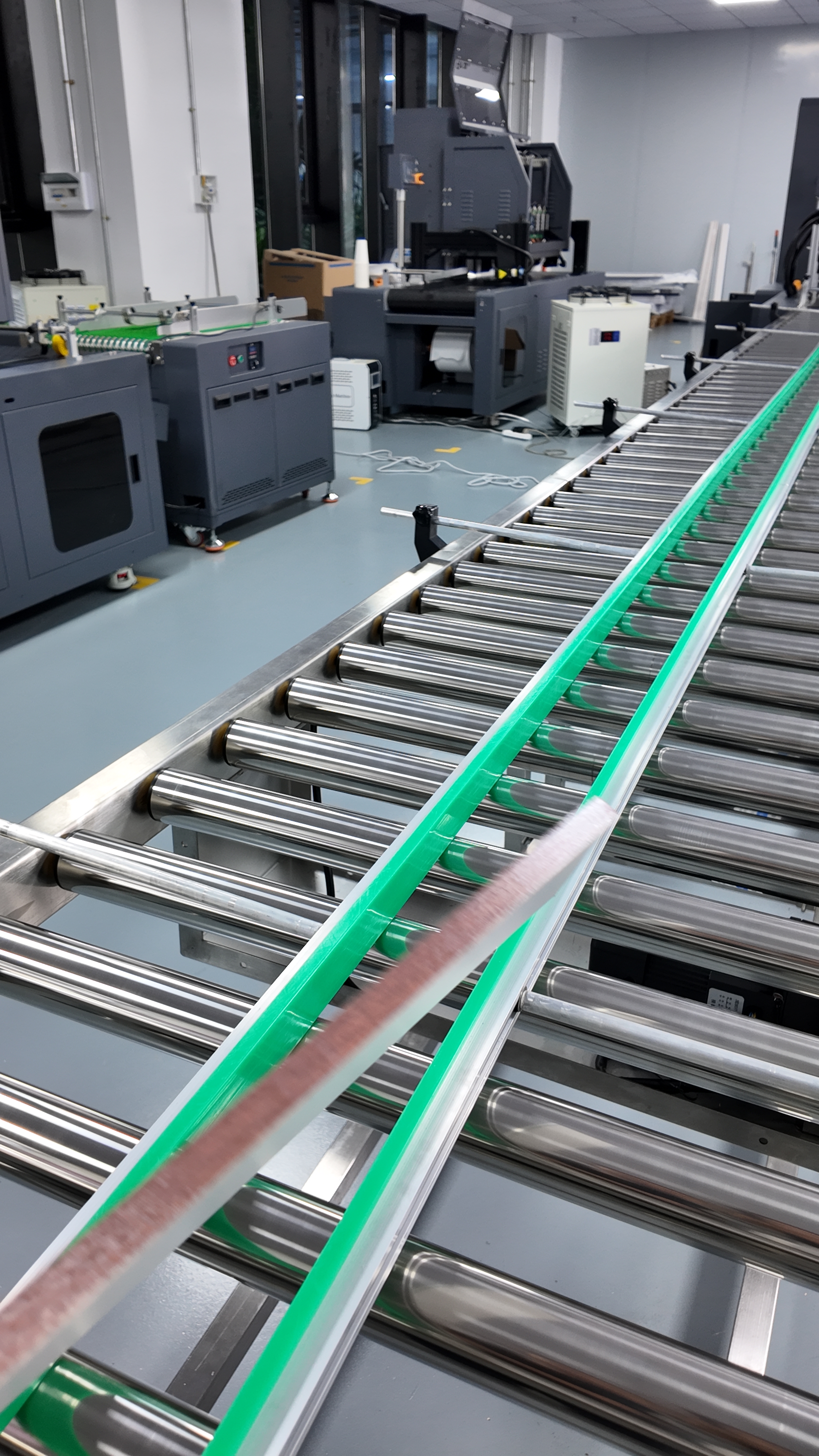
A single-pass digital printing line configured with auxiliary guides and belt transport for standardized production.
For packaging converters, a single pass printer is an industrial digital inkjet system that prints the full print width in one pass while the substrate moves beneath fixed page-wide or multiple printhead arrays. Relevant models for corrugated, carton, paper bag, label, and non-woven bag applications operate from roughly 10 to 40 meters per minute, with some UV roll-to-roll configurations reaching higher rates. The strategic issue is not only the printhead technology; it is the surrounding configuration that determines whether the system fits an existing or new packaging line.
Why packaging buyers are shifting from printer-only purchasing to configured lines
The economic case for single-pass inkjet is tied to changing order behavior. Converters serving e-commerce, food service, FMCG, labels, and decorative-material markets see shorter runs, more versions, variable QR-code requests, and regional on-demand production. According to Zion Market Research, the global digital printing for packaging market was valued at USD 31.64 billion in 2023 and is projected to reach USD 75.55 billion by 2032. Within the broader digital printer market, Straits Research reports that the inkjet digital printer segment accounted for 42.5% share as of 2025.
Those figures do not mean analog printing disappears. They indicate that a growing share of packaging demand now has characteristics digital inkjet serves well: variable data, rapid job switching, no plate-making, and short-run economics. For a converter, the purchasing question is therefore not simply which printer to buy, but which supplier can align print width, feeding, pre-treatment, collection, software, and after-sales with the jobs the converter actually wins.
Industrial context: China Packaging Federation and Dataintelo data indicate that China produced more than 88 billion square meters of corrugated board in 2024, creating strong regional demand for single-pass printer slotter and packaging equipment. This volume helps explain why many single-pass configurations are designed around corrugated and cardboard transport rather than only print speed.
A manufacturing base organized around OEM and ODM configurations
Shanghai Focus Industrial Co., Ltd. (FocusInc), founded in 2008, is a Shanghai-based industrial digital printing solutions provider with a 35,000-square-meter factory and a reported annual output of 800 units. The company states that about 95% of its production is exported, with main markets including the EU, USA, Mexico, Brazil, Chile, Australia, Canada, and the UK. Its product matrix covers multi-pass scanning printers through high-speed single-pass systems, with a focus on packaging and industrial applications.
FocusInc’s relevance to this evaluation is its production-mode structure. The company offers OEM production services and ODM design and production services, but the two modes do not have the same scope.
- OEM configuration: machine housing color, brand logo printing, multi-language operation system, matched pre-print and post-print auxiliary equipment layout, and standard printing parameter tuning for regular printing materials. Monthly capacity is listed as 120 sets.
- ODM configuration: custom printing workflow for regular, special, and customized printing substrates; full custom pre-processing and post-processing inline automation matching; exclusive machine structural design; custom print width and feeding size to fit a client production line; and multi-language touchscreen system. Monthly capacity is listed as 40 sets.
Both modes carry a minimum order quantity of 1 unit and a lead time of 15 to 45 days depending on the customization solution. The distinction is important for buyers: OEM changes the machine identity and auxiliary layout; ODM changes the workflow, structural design, feeding, and process architecture.
How single-pass inkjet architecture changes line design
Single-pass machines remove the scanning carriage of earlier multi-pass systems. Instead, a fixed print bar or row of heads covers the target print width, and the timing of substrate movement largely determines throughput and registration. That creates advantages, but it also means transport precision, media height control, vacuum, and pre-treatment become first-order technical requirements.
FocusInc’s single-pass portfolio illustrates three different technical paths:
- HP Pagewide thermal bubble-jet packaging printers. Models such as the Cobra-691S and Falcon-491S use HP Pagewide print heads, aqueous dye or pigment ink, resolutions including 1200x300, 1200x400, 1200x600, and 1200x1200 dpi, and speeds from 10 to 40 meters per minute depending on model and resolution. They target corrugated paper, paperboard, pizza boxes, shopping bags, coffee bags, paper cups, envelopes, cards, napkins, and similar materials.
- UV single-pass systems. The Acaleph-891S series uses micro piezo print technology with optional printheads from SEIKO, RICOH, XAAR, TOSHIBA, Epson, and KONICA. These systems support UV curing ink, aqueous ink, pigment, dye, or DTF ink, with a maximum load width of 600 mm and thickness up to 300 mm. Speeds are listed at 10 to 40 meters per minute. Applications include non-woven bags, PVC decorative panels, book edges, containers, and other industrial substrates.
- Roll-to-roll label and IML printers. Viper-391S and Viper-391S Pro models use HP Pagewide heads for label stock up to 320 mm maximum load width, with roll-to-roll or optional roll-to-cut operation. The S350 Jetpress is a UV single-pass roll-to-roll machine using Epson S3200 U1 or S3200 U3 inner recirculation heads, W+CMYK color, print width of 235 mm, and speed of 20 to 80 meters per minute. It is specified for IML-label and synthetic-film work.
| Application class | Representative FocusInc series | Typical print width or load width | Speed range | Ink and curing | Typical substrates |
|---|---|---|---|---|---|
| Packaging direct-to-board | Cobra-691S, Falcon-491S, Cobra-1209S, Cobra-1815S | 210 mm to 900 mm print area; load width from about 400 mm to 1,800 mm depending on model | 10 to 40 m/min | Aqueous dye or pigment, no UV curing required | Corrugated paper, cardboard, carton board, pizza boxes, paper bags, paper cups |
| UV single-pass industrial | Acaleph-891S e, Acaleph-891S-i, Acaleph-891S Side Printer | 53 mm to 500 mm print width; 600 mm load width; up to 300 mm thickness | 10 to 40 m/min | UV curing ink, LED UV 405 nm sectional curing, or aqueous depending on requirement | Non-woven bags, PVC panels, decorative boards, book edges, cups, containers |
| Roll-to-roll label and IML | Viper-391S, Viper-391S Pro, S350 Jetpress | Up to 320 mm load width for Viper; 235 mm print width for S350 | 10 to 40 m/min for Viper; 20 to 80 m/min for S350 | Water-based or UV ink, depending on model | Inkjet-coated paper, BOPP, Vinyl, PET, IML film, label rolls |
From an integration standpoint, the fixed-array design is not inherently turnkey. Buyers should evaluate how the supplier addresses edge guidance, material tension, feeding, collection, and process changeover. FocusInc’s capability documentation includes auxiliary sliders and guide belts for transport positioning, automatic vacuum feeders for soft and rigid materials, electronic height control, laser guideline alignment, and custom front-end and back-end conveyors. Those elements often determine whether the printer achieves stable production, not just whether its printheads can jet a test image.
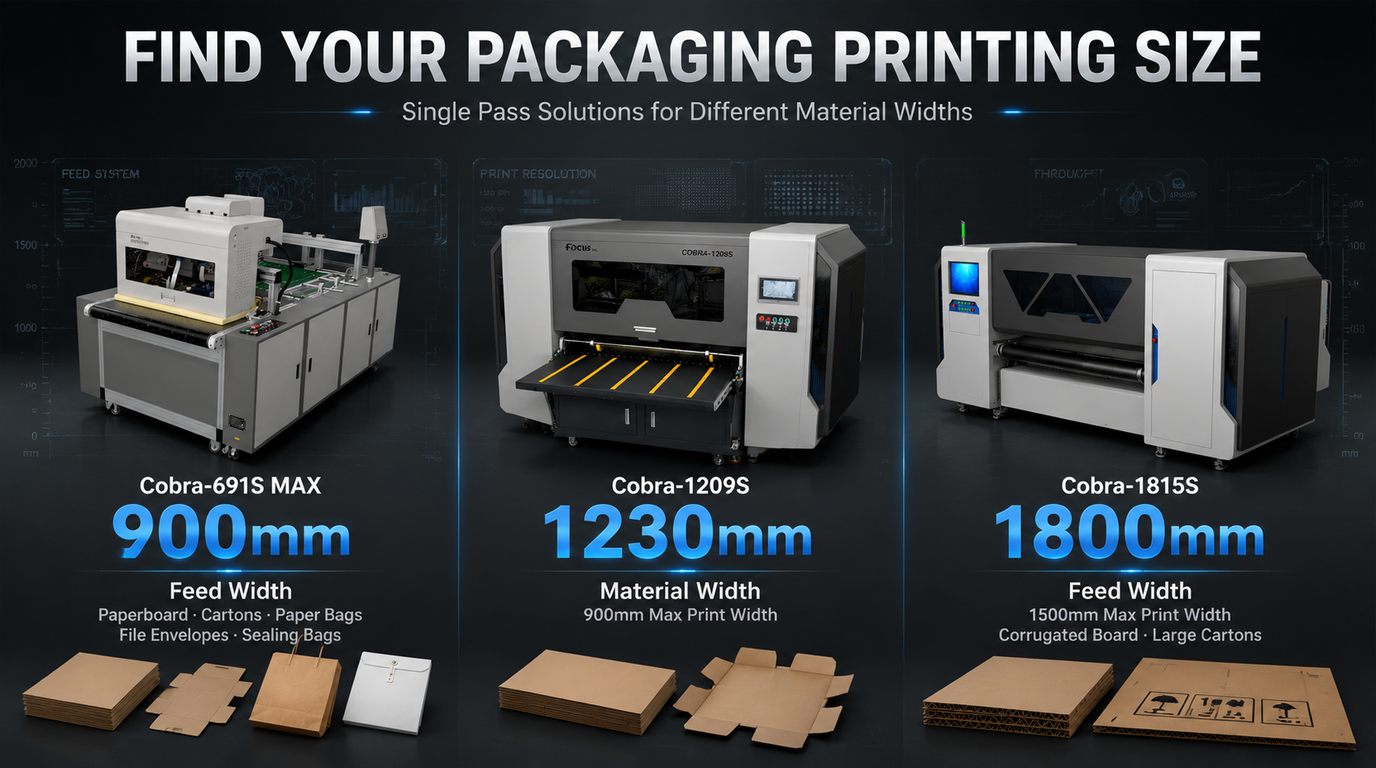
The same single-pass corrugated series can be specified with different printing widths to match converter capacity and business scale.
Where configured single-pass systems are in production
FocusInc case data provides concrete patterns, not just specifications. Across the documented cases, the recurring buyer goal is not merely printing. It is moving from manual or plate-based processes to a line that can accept an order, switch design, print, and deliver without large inventory.
Corrugated boxes and carton packaging
A multi-country case covering manufacturers of corrugated boxes, honeycomb board shipping boxes, and carton packaging reports 18 units installed over four years. The system is used for color-printed corrugated packaging, QR-code variable data on turnover boxes, gift boxes, shoe boxes, and pizza boxes. The reported outcome includes faster multi-batch personalized packaging orders, shorter lead time, flexible job switching, waste-free digital printing, and expansion into higher-margin custom packaging work.
Non-woven and takeout bags
A Brazil case documents three UV single-pass printer units operating for three years for on-demand customization of non-woven bags, takeout bags, and plastic bags. The process supports no minimum order quantity, plate-free printing, immediate order acceptance, and instant delivery. For converters, this shifts the sales conversation from holding large inventory of pre-printed bags to accepting smaller custom orders with quicker turnaround.
IML labels
In the United Arab Emirates, an S350 Jetpress is used on an IML-label fast printing line. The reported outcome includes full-automatic continuous IML label batch printing, manual labeling cost reduction of 40%, consistent color in injection-molded in-mold labels, and zero ink peeling during high-temperature injection molding. The technical support includes synchronous white and color ink one-pass printing and stable tension control for thin IML film. This case is relevant for plastic injection molding factories, daily chemical container manufacturers, and household appliance parts producers.
PVC decorative panels and building materials
A case covering Portugal, Spain, Mexico, and Poland reports three UV single-pass printers used for PVC sheet panel custom printing and decorative board printing. The documented benefits include on-demand order fulfillment, elimination of inventory backlog from multiple decorative specifications, shorter delivery times, improved inventory turnover, and reduced financial pressure. The sample-stage workflow is also notable: the supplier reports a 2-second sample printing turnaround from idea to physical sample checking. For building-material processors, that supports rapid market testing of new textures such as wood grain or marble patterns.
Labels and variable-data rolls
A Vietnam case involving a label manufacturer and daily chemical container supplier uses roll-to-roll label printing for general packaging labels and cold-chain logistics labels. The reported result includes no minimum order quantity, variable-data QR-code printing without plate making, on-demand digital production, and support for both short-run personalized orders and mass label runs. This pattern is especially important when labels must change frequently by SKU or by region.
Market trend analysis
The verified market data points in one direction: packaging print is becoming more digital, versioned, and regional, while corrugated and packaging substrates remain the dominant physical volume. Zion Market Research projects the global digital printing for packaging market to more than double from USD 31.64 billion in 2023 to USD 75.55 billion by 2032. The corrugated supply chain remains large enough to anchor industrial installations; China alone produced more than 88 billion square meters of corrugated board in 2024. Industry trend reporting also places single-pass production for applications such as paper bag printing in a 30 to 80 meters per minute range, higher than typical multi-pass scanning systems.
That combination—high digital growth and high corrugated volume—helps explain why the more advanced buying conversations in this category have moved beyond printhead count. They now include production-line configuration, feedstock compatibility, inline pre- and post-processing, data handling, and service reach. Markets subject to EU compliance also require documentation such as the Low Voltage Directive 2014/35/EU and the EMC Directive for CE marking. FocusInc lists a CE LVD certificate reference for its multi-functional digital inkjet printer range, with standards including EN 1010-2:2006+A1:2010, EN 1010-1:2004+A1:2010, EN ISO 12100:2010, and EN 60204-1:2018+A1:2025.
Where single-pass digital makes sense—and where it does not
A fair comparison with traditional solutions starts with run economics and substrate boundaries. Single-pass digital inkjet is strong when the workflow benefits from no plates, variable data, fast changeover, and short-run or versioned production. However, it is not automatically the lowest-cost technology for every job.
At very long, unchanged runs, conventional flexographic or offset packaging may still offer lower unit cost once plates and setup are amortized. The advantage of digital is often flexibility and lead-time reduction, not absolute cost per print in every volume band. This is a real limitation that should be part of the buyer calculation.
Substrate compatibility is a second boundary. Aqueous HP Pagewide packaging models are specified for corrugated paper, paperboard, paper bags, paper cups, and similar cellulose-based or coated materials. They are not a universal plastic-film solution. UV single-pass systems extend coverage to non-woven bags, PVC, decorative panels, and certain containers, but low-surface-energy plastics may require corona, plasma, flame, or primer pre-treatment. FocusInc’s capability notes specifically reference the possible need for a surface treatment module on difficult substrates such as Teflon-coated surfaces, in order to reach industrial scratch-resistance standards.
A third limitation is process realism. Single-pass printing does not eliminate registration, tension, drying or curing, material feeding, or operator training. It changes where those functions must be controlled. A buyer that evaluates only printhead specifications may underestimate the importance of vacuum control, edge alignment, feeder design, and after-sales support. The correct comparison is therefore not printer versus printer alone, but configured line versus configured line.
What to evaluate as single-pass lines mature
The next phase of single-pass adoption will likely place more weight on procurement criteria than on raw print speed. Buyers should prepare to evaluate:
- Maximum print width and load width, not only nominal printhead width;
- Material thickness range and whether the feeder can handle the exact sheet, board, bag, film, or label stock;
- Ink and curing match for the target substrate, including any pre-treatment requirement;
- RIP, color management, and variable-data workflow stability;
- Whether pre-print and post-print modules can be configured as one accountable system;
- Regional service, on-site installation, training, warranty, and spare-parts availability;
- Compliance documentation for CE, LVD, EMC, and any market-specific WEEE obligations.
For FocusInc, the documented service model includes global online remote technical support, overseas on-site installation and training, OEM 13-month warranty, ODM 3-year machine warranty, and lifelong technical consultation and spare-parts supply. Third-party factory audit and SGS/CE inspection availability depends on the production mode and client request. These terms are procurement details, not marketing features; they should be verified during evaluation.
Frequently Asked Questions
For additional technical reference, a manufacturer factory introduction brochure is available: FocusInc Factory Introduction PDF.